Free Preschool and Kindergarten Curriculum: A 36-Week Printable Plan for Ages 3–6
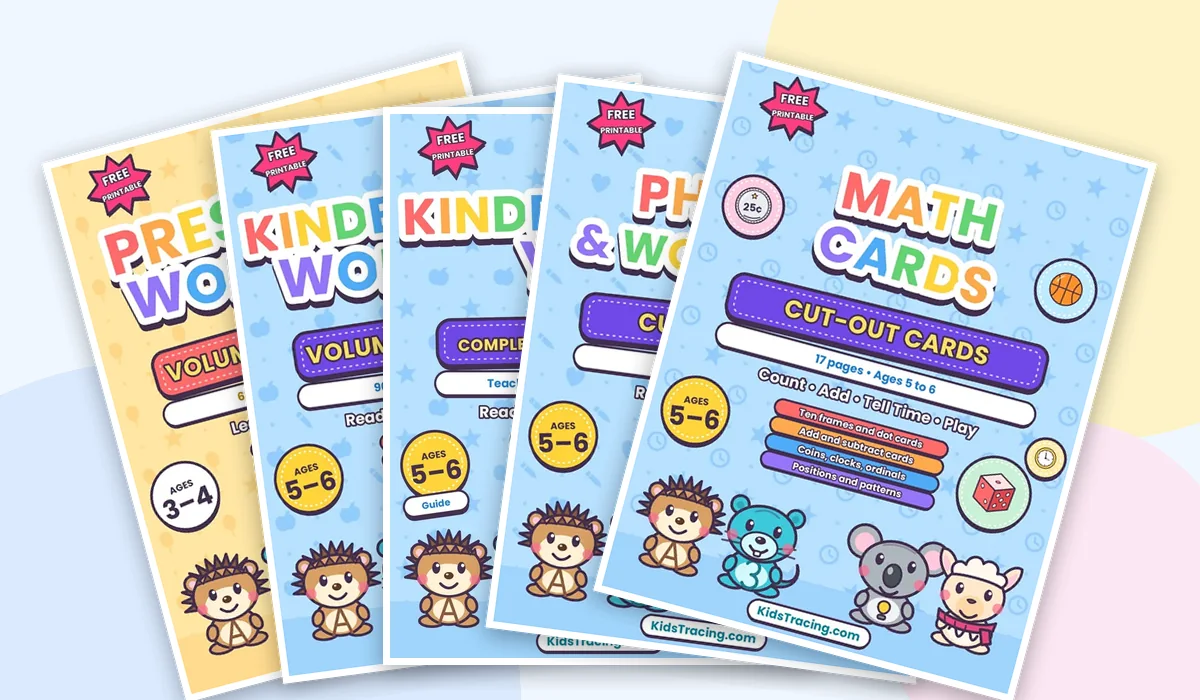
This is a complete school year in printable form, free for families and classrooms. Preschool (ages 3 to 4) and Kindergarten (ages 5 to 6) each have their own 36-week plan, with a workbook for every week, mini readers, cut-out cards, calendar and circle-time pages, extra practice books and a year guide for the grown-up. Everything is a PDF in US Letter size, and there is nothing to sign up for.
- 936 printable pages in two 36-week plans: Preschool (ages 3–4) and Kindergarten (ages 5–6)
- Workbooks, 12 mini readers, cut-out cards, calendar and circle-time pages, 4 practice books and a guide for each year
- Free for personal, home and classroom use, with no sign-up or email address
- US Letter (8.5 × 11 in) PDFs only, American spelling. Printing on A4? Read this first
- Every picture was drawn for KidsTracing
What the curriculum is
A set of PDFs you print as you go. Each year runs 36 weeks, and the year guide says which pages to use in which week. Preschool has five workbook pages a week, one for each school day. Kindergarten has eight: three for reading, one for writing, three for math and one "Discover" page for science or social studies.
The extras make a kitchen table feel like a classroom: twelve small decodable readers, picture, word and math cards, a calendar and circle-time pack, wall charts and four booster books. Four friends guide the pages: Hazel Hedgehog for reading, Otto Otter for math, Kiki Koala for discovery and Lenny Llama for writing and drawing.
It follows the skills most US programs and state early-learning standards describe. It is not an official curriculum of any school, agency or brand, and it does not match one state's standards line by line. The week-by-week skill lists in the guides make a comparison easy.
Download the printable curriculum
Pick the year, download the guide first and then the workbooks. Each file is separate, so you only download what you need. Total download size is about 88 MB if you take it all.
US Letter is the standard paper in the United States and Canada. If you print on A4, which most other countries use, everything still prints well, but the two sizes are not the same. In your printer window choose Fit to page (some programs call it Fit to printable area or Scale to fit) instead of Actual size. The page prints about 3% smaller, with a little more white space at the top and bottom, and nothing is cut off.
Please print one page first as a test, especially before you print cut-out cards or a class set. We do not have A4 versions of this curriculum yet.
Start here: the year guides
A welcome letter, a daily rhythm, the skills checklist, a materials list and a lesson plan for each of the 36 weeks. The Kindergarten guide also has the phonics path, the sight words by week and a table of which cards to use when.
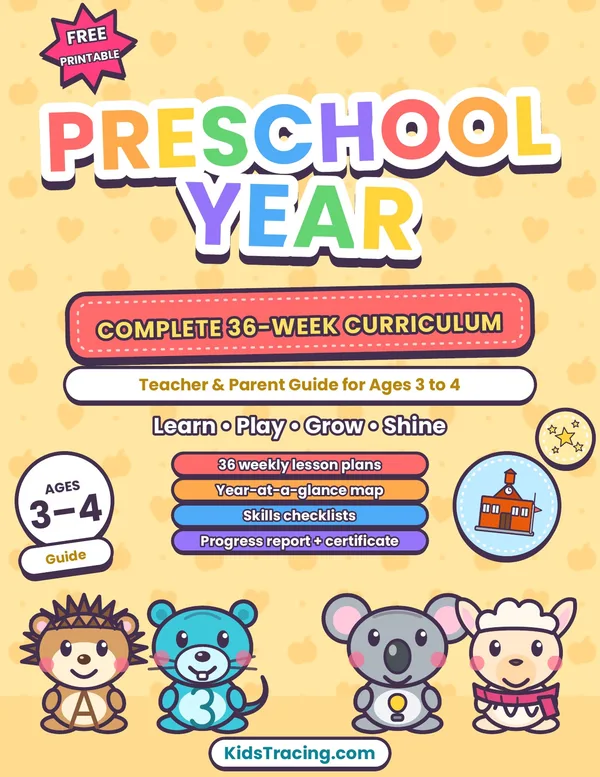 Ages 3–4 · for adults · 52 pages
Preschool Year Guide
36 weekly lesson plans, a year-at-a-glance map, stroke-order pages, a progress report, a family letter and a certificate.
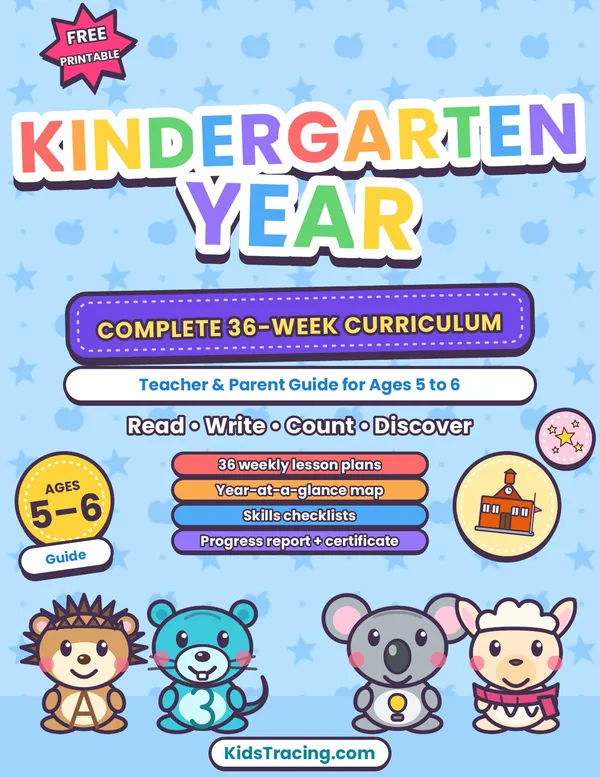 Ages 5–6 · for adults · 58 pages
Kindergarten Year Guide
The same plus the phonics path, sight words by week, the readers list and a "which cards to use when" table.
Preschool year (ages 3–4)
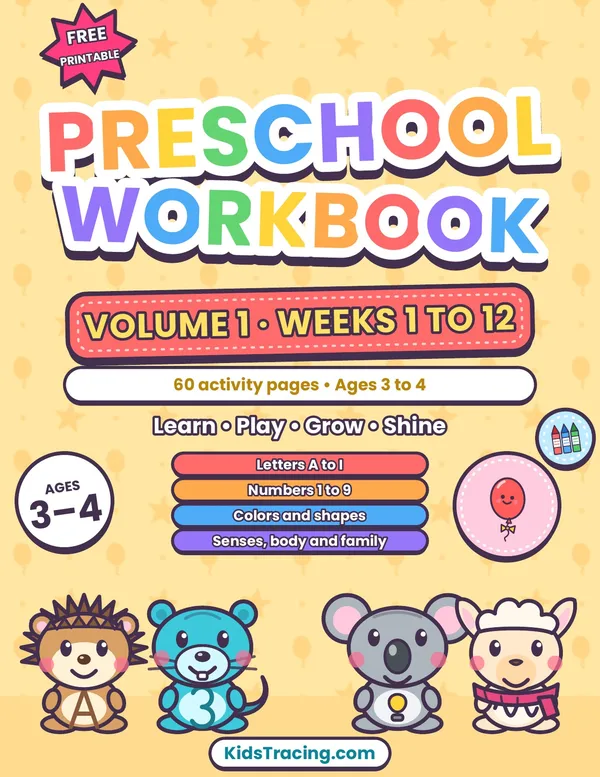 Ages 3–4 · 63 pages
Preschool Workbook 1 (weeks 1–12)
Hello friends, letters A to I, numbers 1 to 9, colors and shapes, the senses, my body, family and home.
 Ages 3–4 · 63 pages
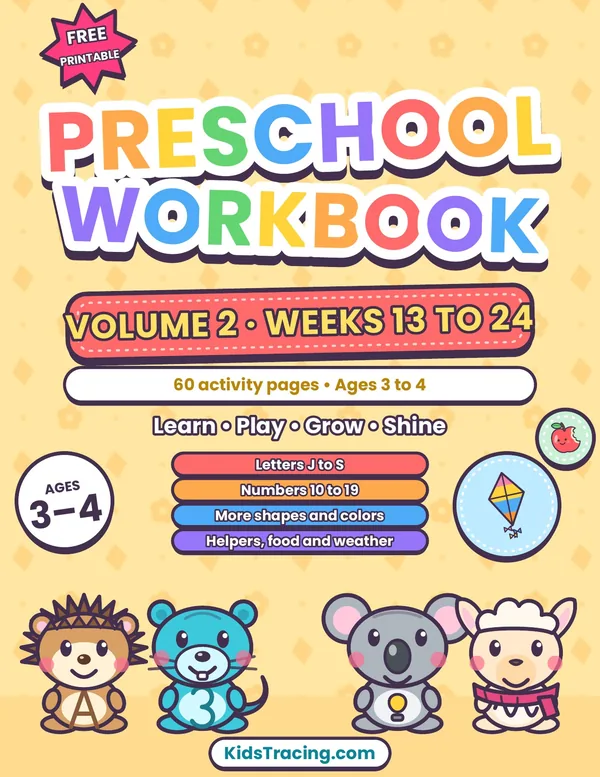
Preschool Workbook 2 (weeks 13–24)
Letters J to S, numbers 10 to 19, more shapes and colors, community helpers, healthy food and weather.
 Ages 3–4 · 62 pages
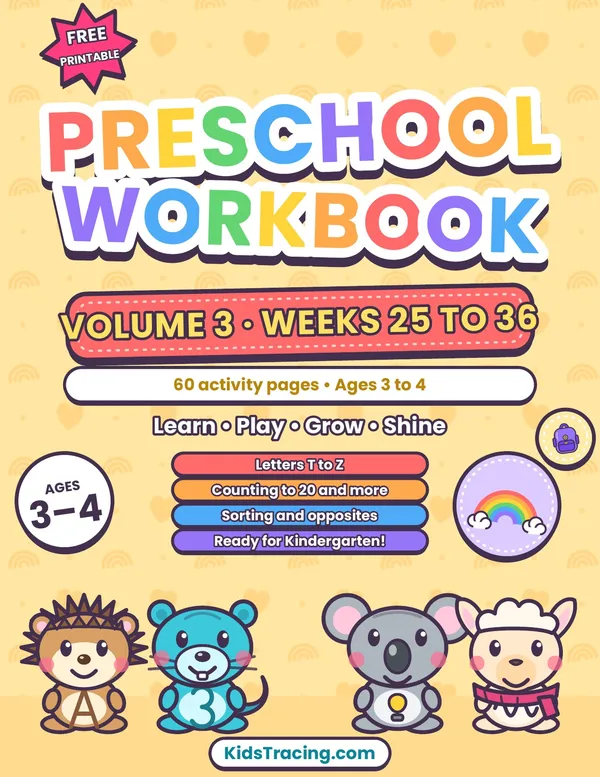
Preschool Workbook 3 (weeks 25–36)
Letters T to Z, number 20 and counting, sorting, opposites, writing my name and a graduation page.
Kindergarten year (ages 5–6)
Each workbook has a progress tracker and ends with a completion page and answer-key pages. Use them in order.
 Ages 5–6 · 102 pages
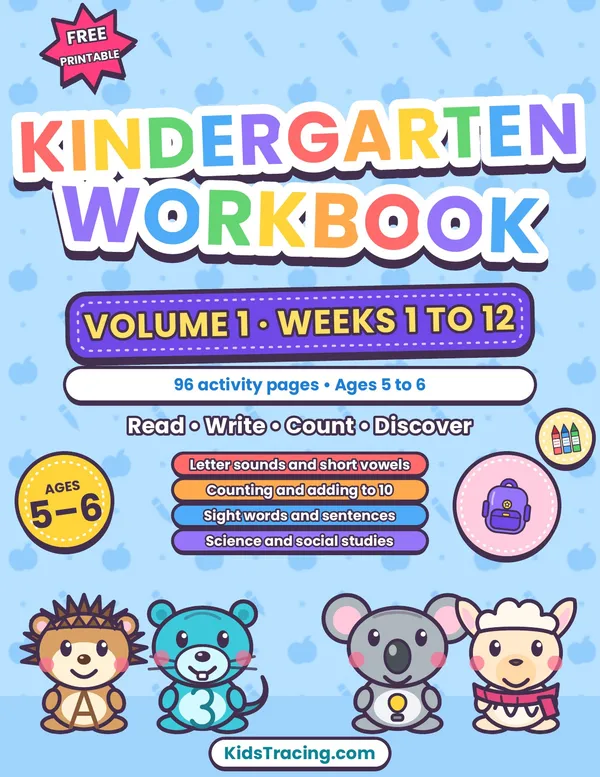
Kindergarten Workbook 1 (weeks 1–12)
All 26 letters and sounds, short a, i and o word families, 36 sight words, counting to 100, ten frames and first discoveries.
 Ages 5–6 · 102 pages
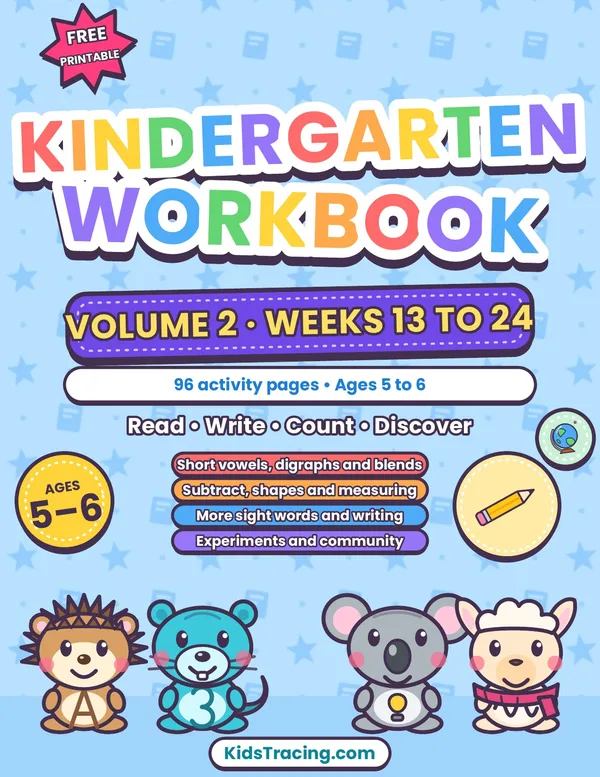
Kindergarten Workbook 2 (weeks 13–24)
Short o, e and u families, digraphs, l- and r-blends, 36 more sight words, subtraction, shapes, community and rules.
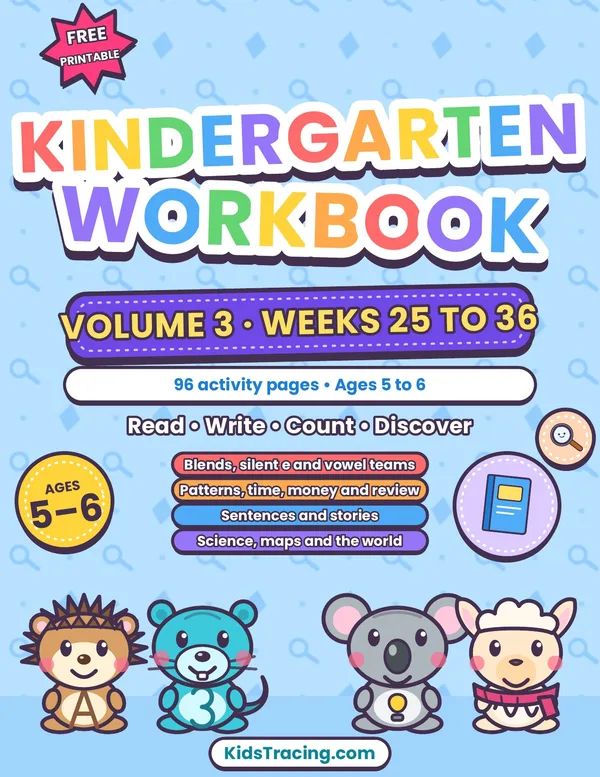 Ages 5–6 · 103 pages
Kindergarten Workbook 3 (weeks 25–36)
S-blends, magic e, vowel teams, short stories, time, money, patterns, life cycles and a year-end certificate.
My First Readers: 12 mini books (ages 5–6)
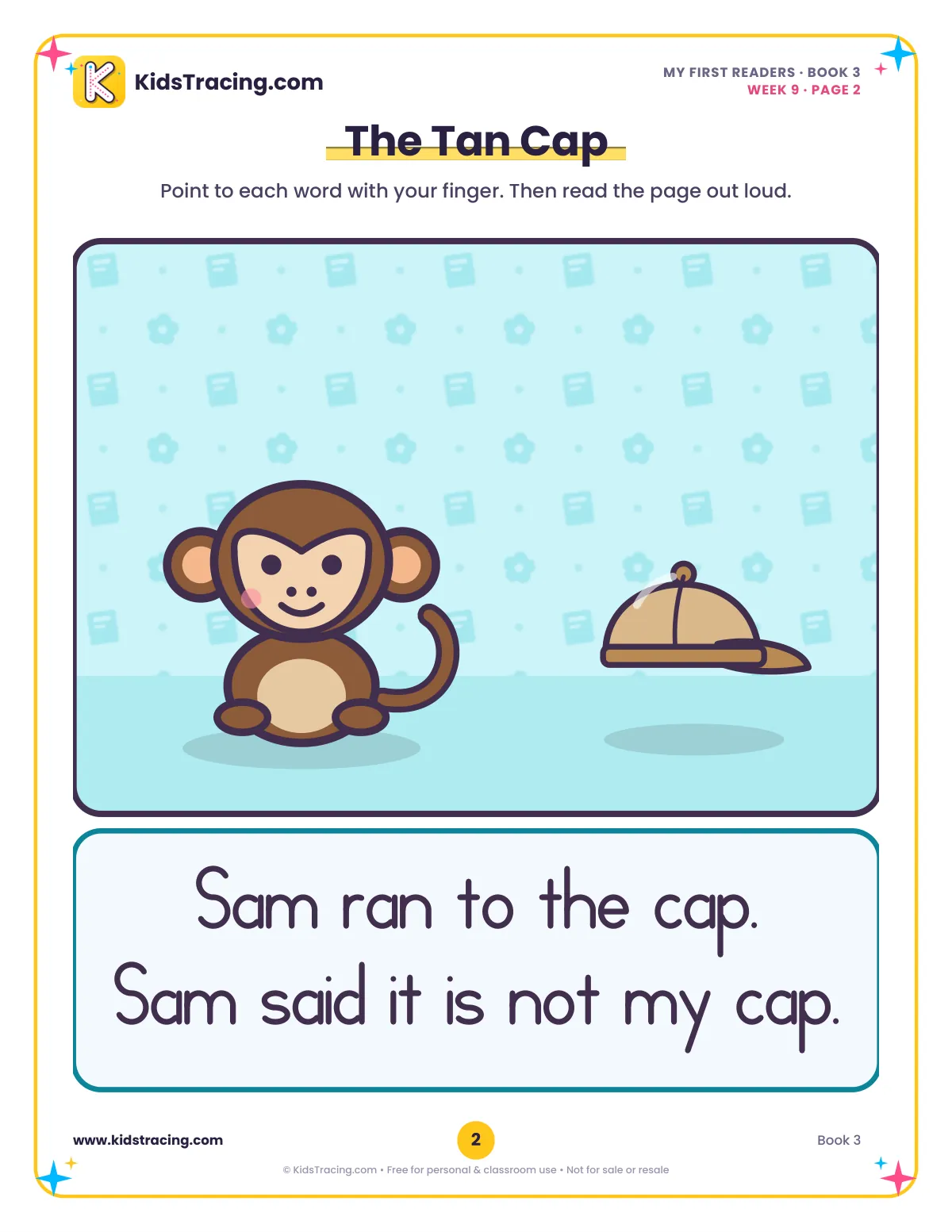
Each book has 8 pages: a cover, six story pages with a picture and one or two short sentences, and a "Think About It!" page. Every word is a sight word already taught, a character name, or a word your child can sound out with the phonics taught by that week. Use each book in the week shown.
 1. Sam and PatWeek 3 · 811 KB
 2. A Big NapWeek 6 · 826 KB
 3. The Tan CapWeek 9 · 769 KB
 4. Kit and the PigWeek 11 · 809 KB
 5. Hot PotsWeek 13 · 820 KB
 6. The Red HenWeek 15 · 824 KB
 7. Fun in the SunWeek 17 · 839 KB
 8. Chip and the ShipWeek 21 · 776 KB
 9. The Frog TripWeek 24 · 841 KB
 10. Camp FunWeek 26 · 828 KB
 11. The KiteWeek 30 · 782 KB
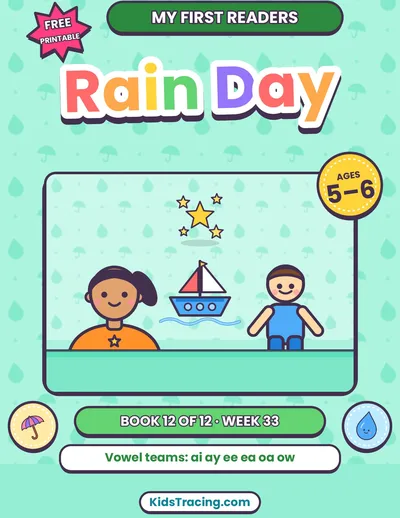 12. Rain DayWeek 33 · 803 KB
Cards, calendar and charts
Print these on white cardstock and laminate them if you can. They are cut-out packs for games, not worksheets.
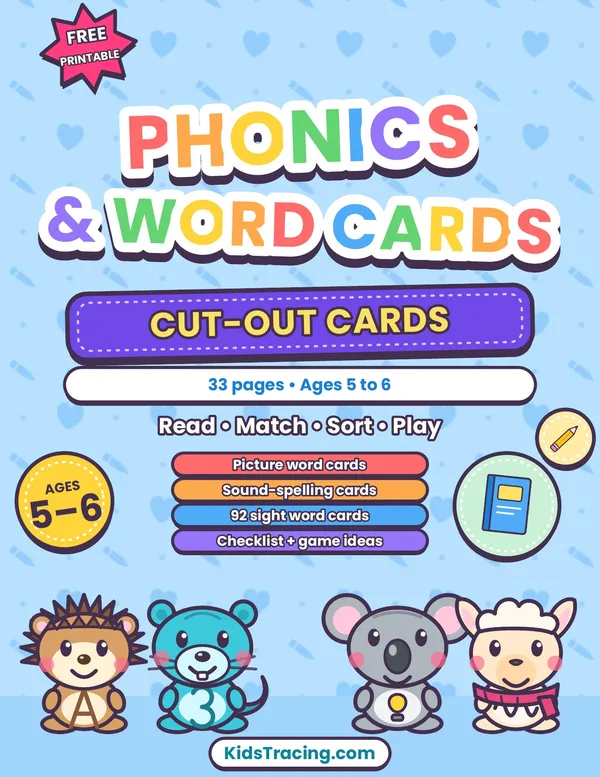 Ages 5–6 · 33 pages
Phonics and Sight Word Cards
144 picture cards, 144 word cards, 45 sound-spelling cards for a sound wall, 92 sight word cards and a checklist, with 8 game ideas.
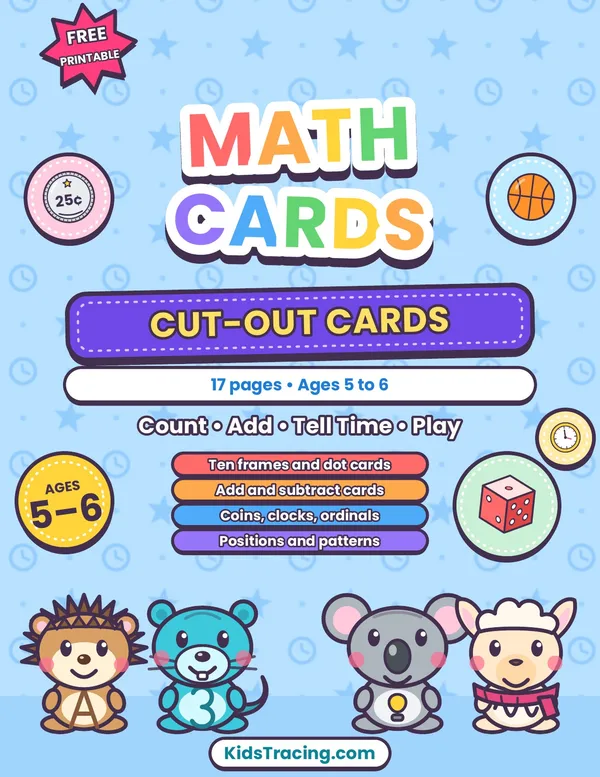 Ages 5–6 · 17 pages
Math Cards
Ten frames, dot cards, make-10 cards, 45 addition and 45 subtraction cards, coins, clocks, ordinals, position words and patterns.
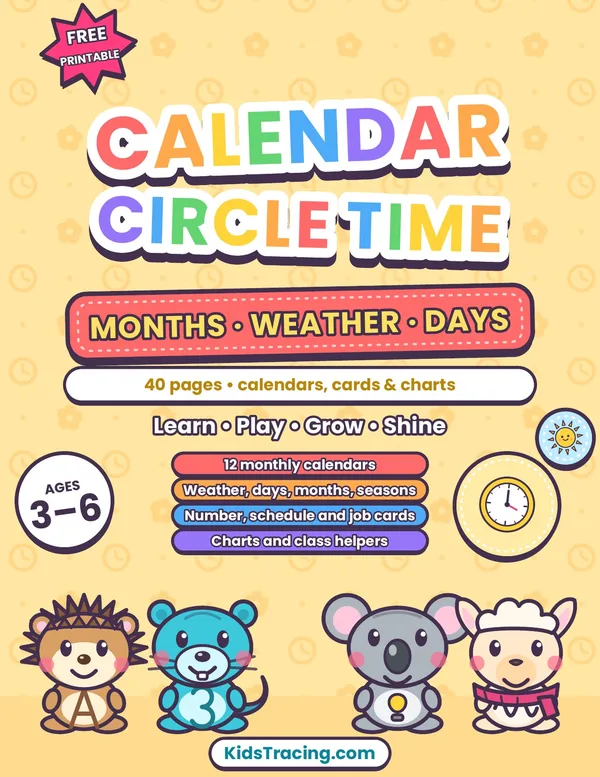 Ages 3–6 · 40 pages
Calendar and Circle Time Pack
12 undated monthly calendars, weather graph, days, months and seasons, a "Today is" board, class jobs, schedule cards and a 180-days chart.
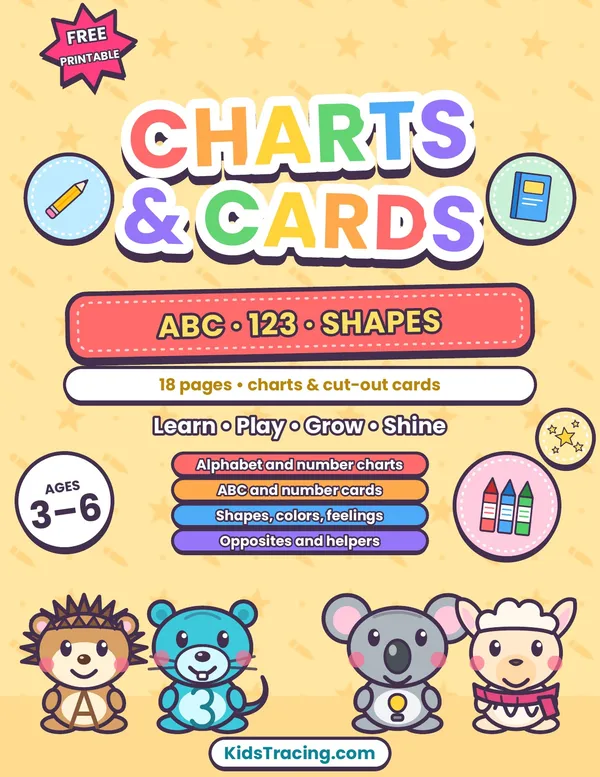 Ages 3–6 · 18 pages
Charts and Cards Pack
Alphabet wall chart, ABC and number cards, 1 to 100 charts, shape, color, feelings, opposites and community helper cards.
Skill booster books (extra practice)
The three Kindergarten Workbooks already cover the whole year. Use a booster when your child needs more practice or wants a challenge. Each one has a certificate and an answer key.
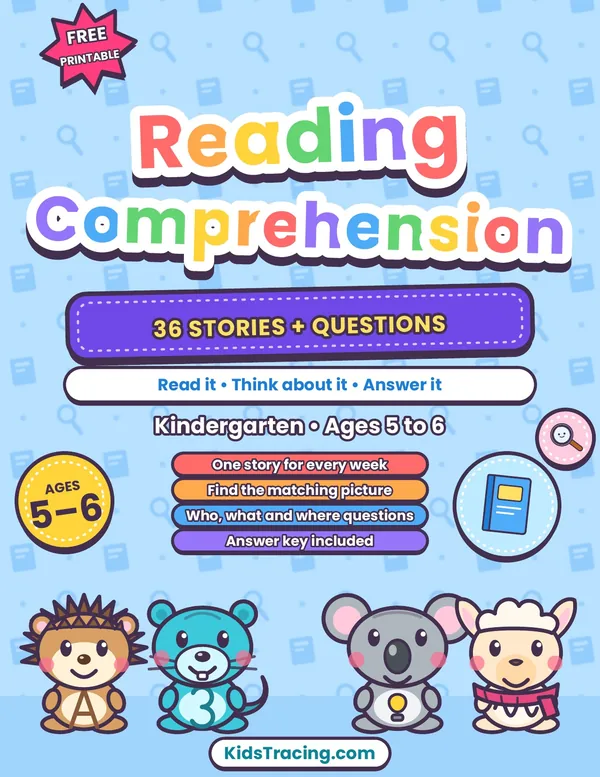 Ages 5–6 · 42 pages
Reading Comprehension
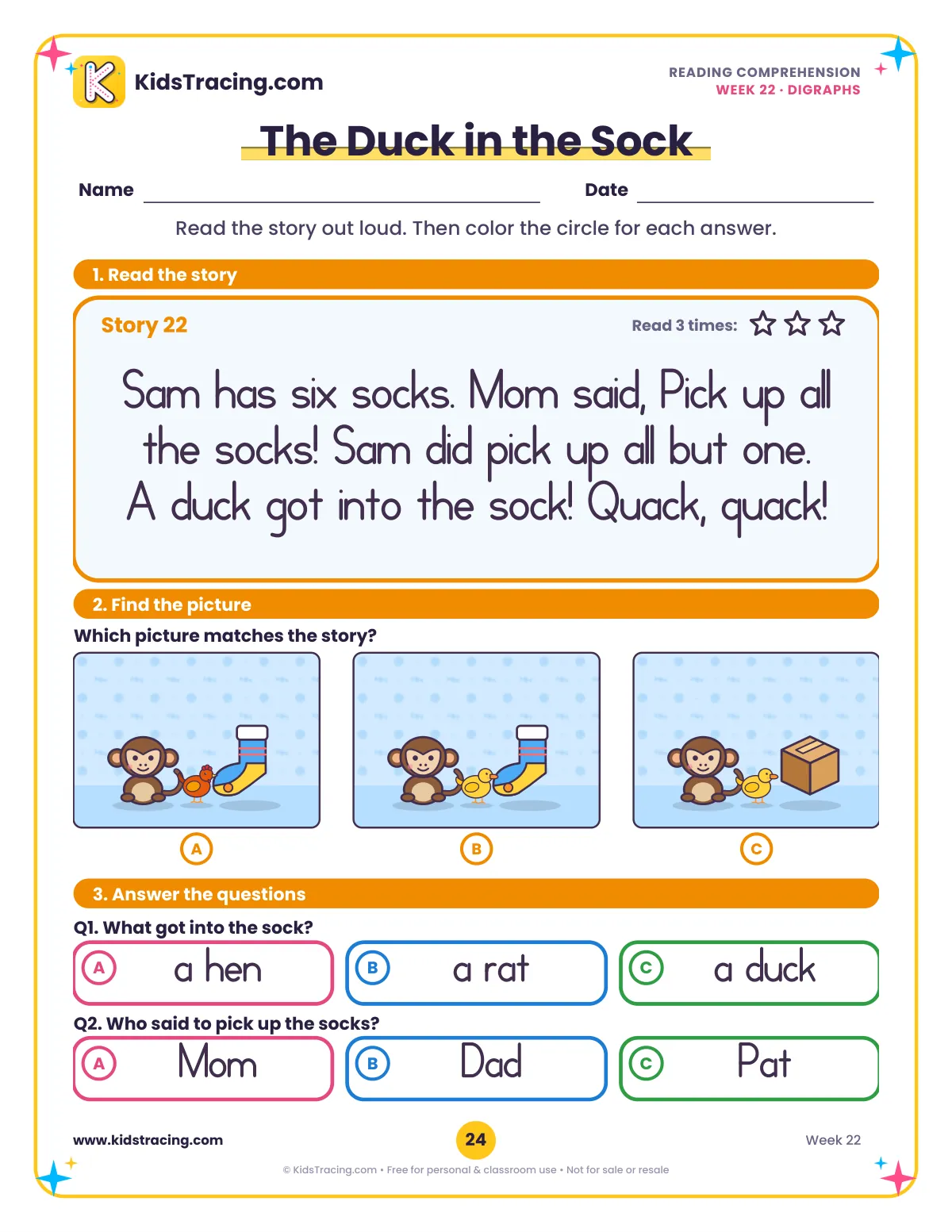
36 short stories, one for every week. Read, find the matching picture and answer two questions. Each story uses only sounds and sight words taught by that week.
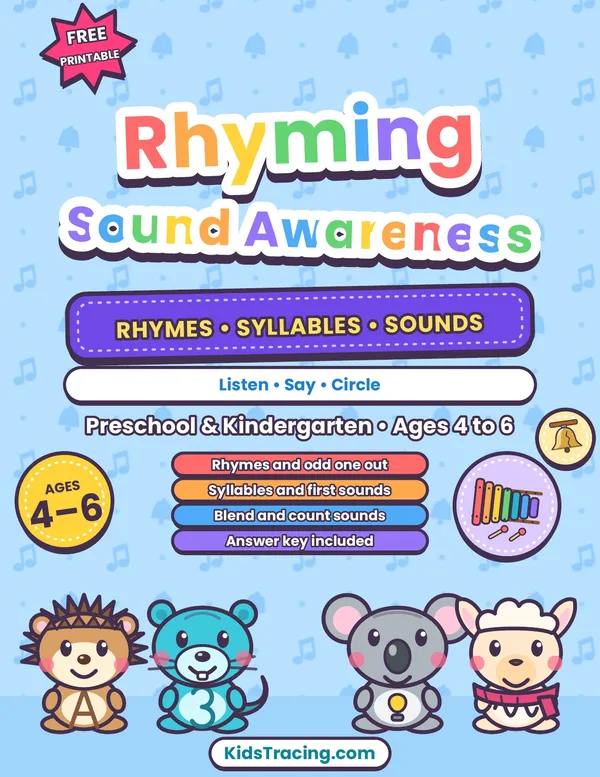 Ages 4–6 · 31 pages
Rhyming and Sound Awareness
Rhymes, syllables, beginning, middle and ending sounds, blending and segmenting. Mostly pictures, so children can work before they can read.
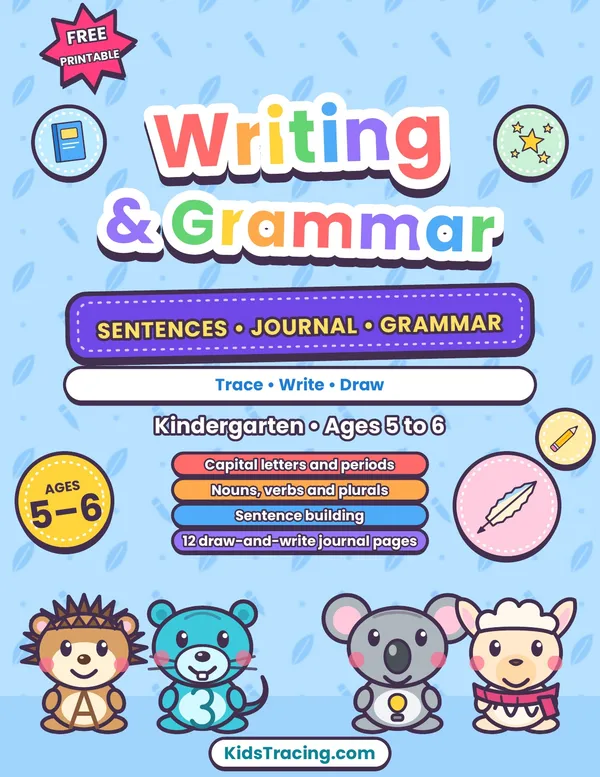 Ages 5–6 · 32 pages
Writing and Grammar Journal
Capital letters and end marks, nouns, verbs, plurals, sentence scrambles and 12 draw-and-write journal pages.
 Ages 5–6 · 22 pages
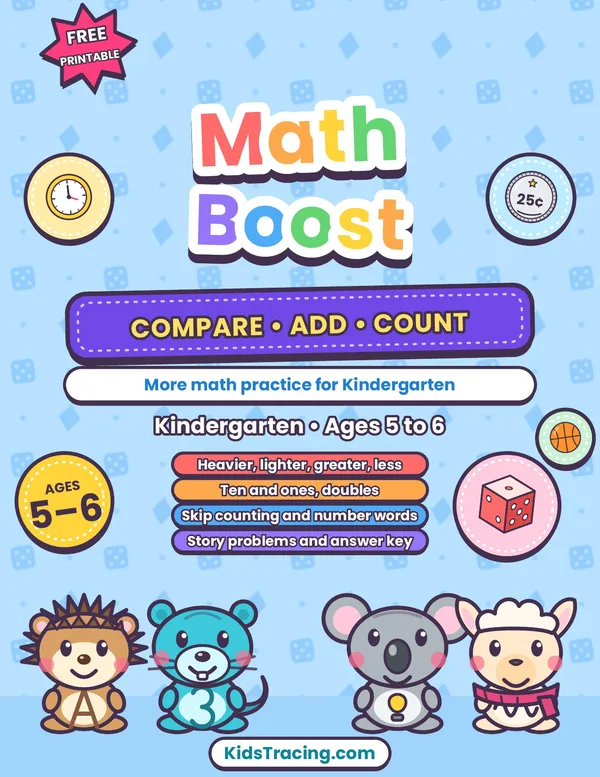
Math Boost
Heavier and lighter, greater and less, ten and ones, doubles, skip counting, number words and story problems.
Bonus book: Ocean Animals Activity Book (ages 3–5)
Free for personal, home and classroom use. Not for sale or resale. Please do not share the files on another website. If you want to point someone to the curriculum, link to this page.
Who it is for and what a day looks like
Preschool, ages 3 to 4
Letters A to Z, numbers up to 20, shapes, colors, the five senses, family and community helpers, and a lot of pencil play. Plan on 20 to 30 minutes a day, and stop while your child still wants more.
A typical preschool day
Five short blocks:
- Circle time: say hello, look at the calendar, count, sing (5 to 10 minutes)
- The workbook page for the day, read aloud together (10 minutes)
- One hands-on idea from the week's plan, such as sorting, building or pretend play (10 minutes)
- A picture book about the week's letter or theme (5 to 10 minutes)
- A short wrap-up with a game or a song (5 minutes)
Kindergarten, ages 5 to 6
Letter sounds, short-vowel words, blends, magic e and vowel teams, sight words, sentences, counting to 100, adding and subtracting within 10, and a weekly science or social studies page. Plan on 30 to 45 minutes a day.
A typical kindergarten day
Five blocks, about two workbook pages a day:
- Circle time with the calendar and the week's sounds (5 to 10 minutes)
- Reading pages 1 to 3: letters or words, practice, sentences (15 minutes)
- The writing page (5 to 10 minutes)
- Math pages 1 to 3 with counters or ten frames (10 to 15 minutes)
- The Discover page and a reader or picture book (10 minutes)
Parents and teachers: homeschool families can use it as the spine of the year, and teachers can print copies for their own students. Every week is planned, so you can also use just one week, one book or one card pack.
Not sure where to start? If your child already knows most letter sounds and is ready to blend short words, begin with Kindergarten Workbook 1. If letters are still new, Preschool Workbook 1 is a gentle start, whatever their age.
Short on time? One reading page, one math page and a reader is still a good day. Do reading and writing first, while children are fresh, and math after a movement break.
The 36 weeks at a glance
Both years run Monday to Friday for 36 weeks. The guides list every single week; here is the shape of each year.
Preschool year
Weeks 1 and 2 are settling-in weeks: hello friends, all about me, rules and routines. From week 3 to week 33 there is one letter a week, from A to Z, with a review week after every fifth letter. Numbers climb from 1 to 20 across the same weeks, and each week adds one shape or color and one discovery topic, such as my senses, community helpers, weather, plants, farm animals and being kind. Weeks 34 to 36 are for writing your name, counting, shapes and patterns, and a graduation page.
A sample week: in week 3 the letter is A, the number is 1, the color is red and the discovery topic is my body.
Kindergarten year: the phonics path
| Weeks | Focus | What is taught |
|---|---|---|
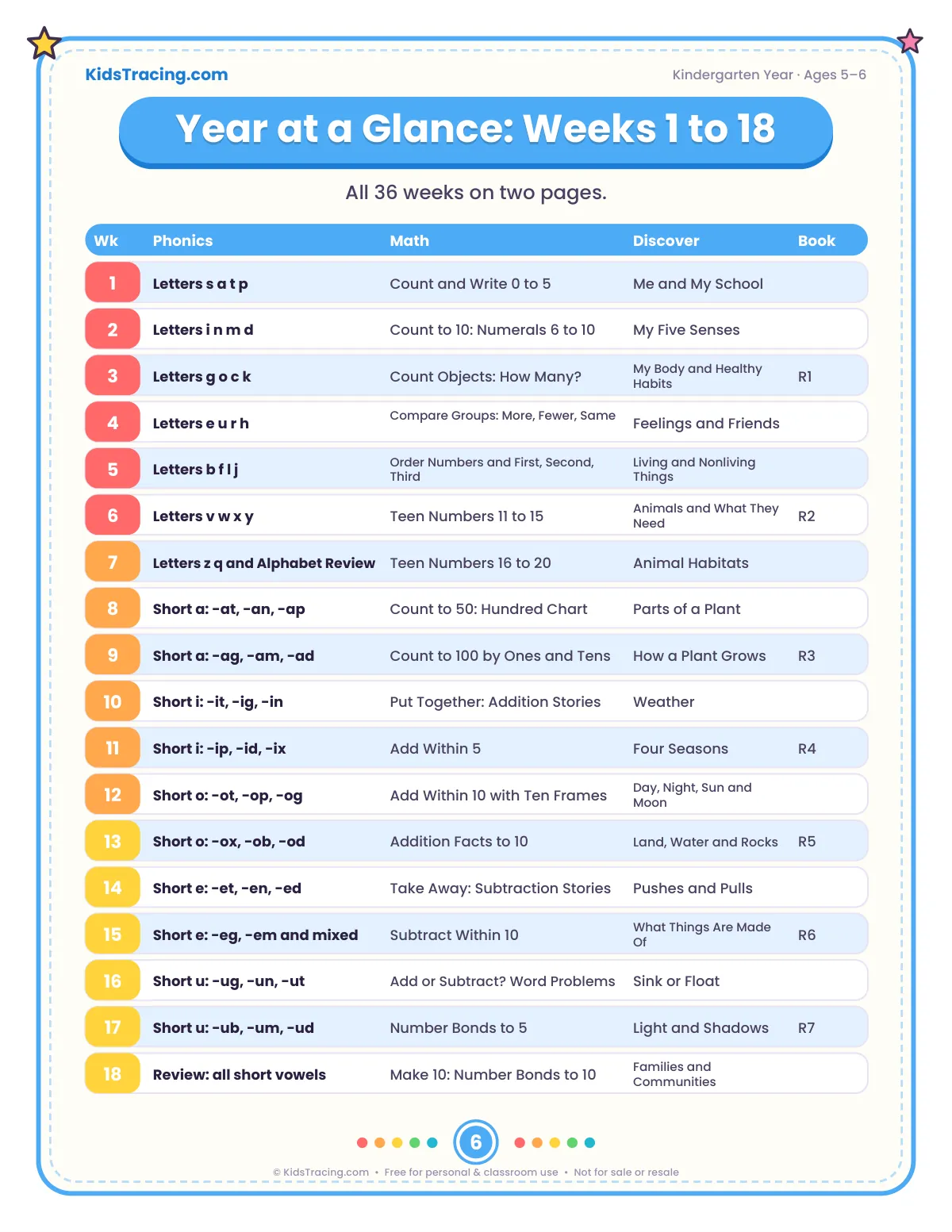
| 1–7 | Letters and sounds | s a t p, i n m d, g o c k, e u r h, b f l j, v w x y, then z q and an alphabet review |
| 8–18 | Short vowels and word families | a (weeks 8–9), i (10–11), o (12–13), e (14–15), u (16–17), then a mixed review in week 18 |
| 19–22 | Digraphs | sh, ch, th, wh and the ending ck |
| 23–27 | Blends | l-blends, r-blends, s-blends, ending blends and a review |
| 28–30 | Magic e | a_e, i_e, o_e and u_e |
| 31–33 | Vowel teams | ai and ay, ee and ea, oa and ow |
| 34–36 | Fluency and writing | short stories with questions, reading and writing sentences, year-end review |
Math runs alongside: counting and writing numbers to 10, then teen numbers, ten frames and counting to 100, then adding and subtracting within 10, shapes, measuring, patterns, time to the hour, coins and a year-end check. The Discover page moves from my five senses and living things to plants, weather, community, maps, life cycles, the water cycle and magnets.
A sample week: in week 3 the letters are g, o, c and k, the math topic is counting objects, the Discover topic is my body and healthy habits, and it is time for the first reader, "Sam and Pat". Sight words come three new words a week in weeks 1 to 30 and two in week 31 (92 sight words in all, the common Dolch pre-primer and primer list), and weeks 32 to 36 review them.
Look inside
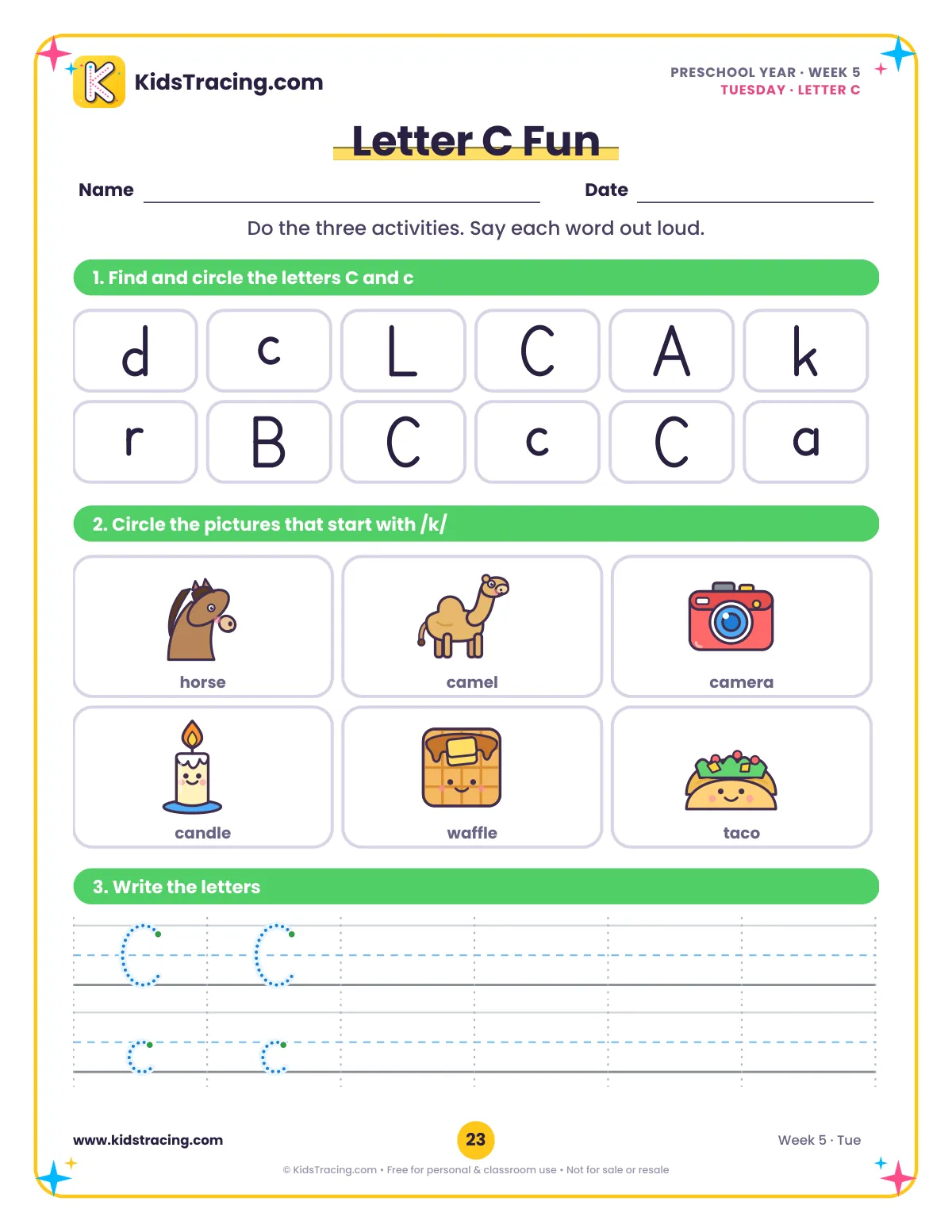
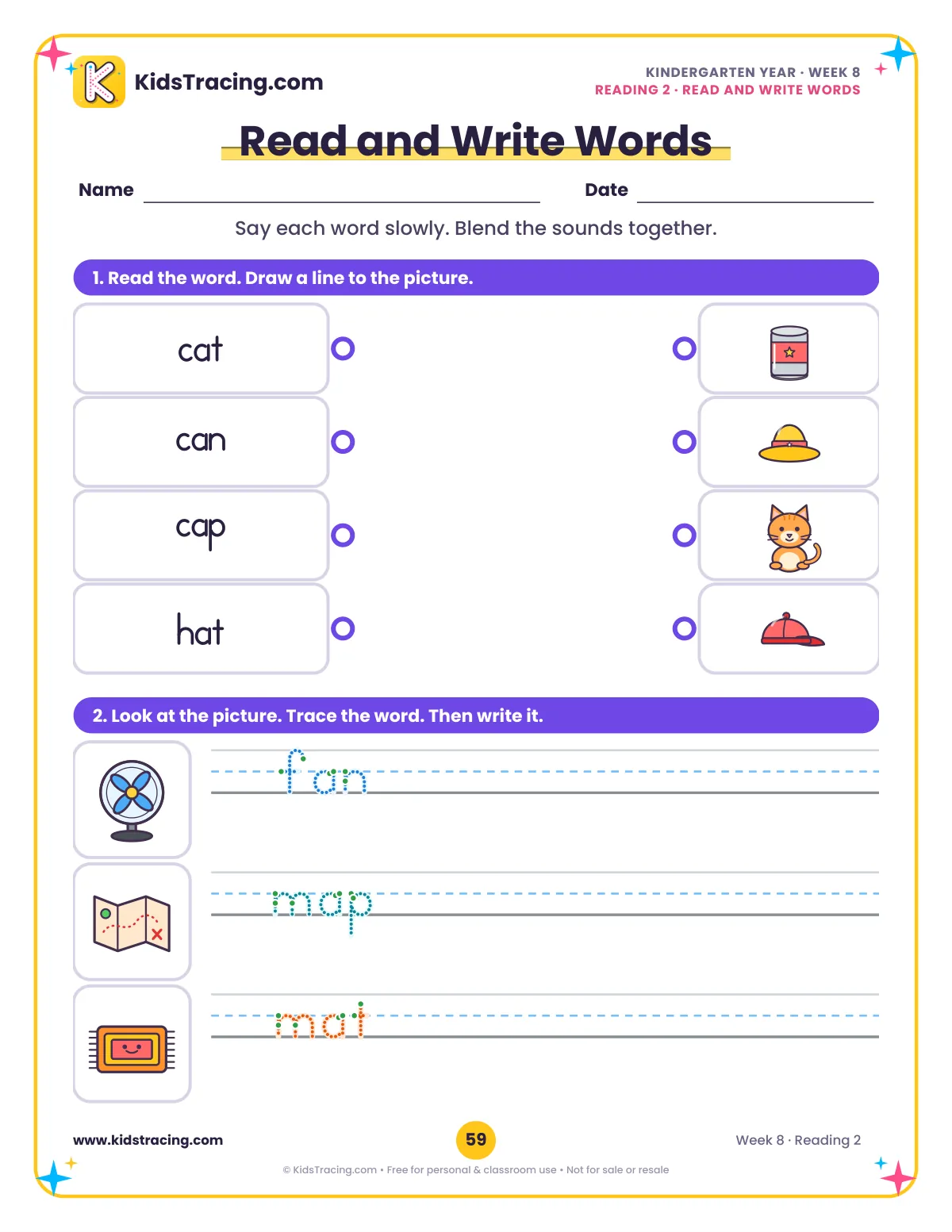
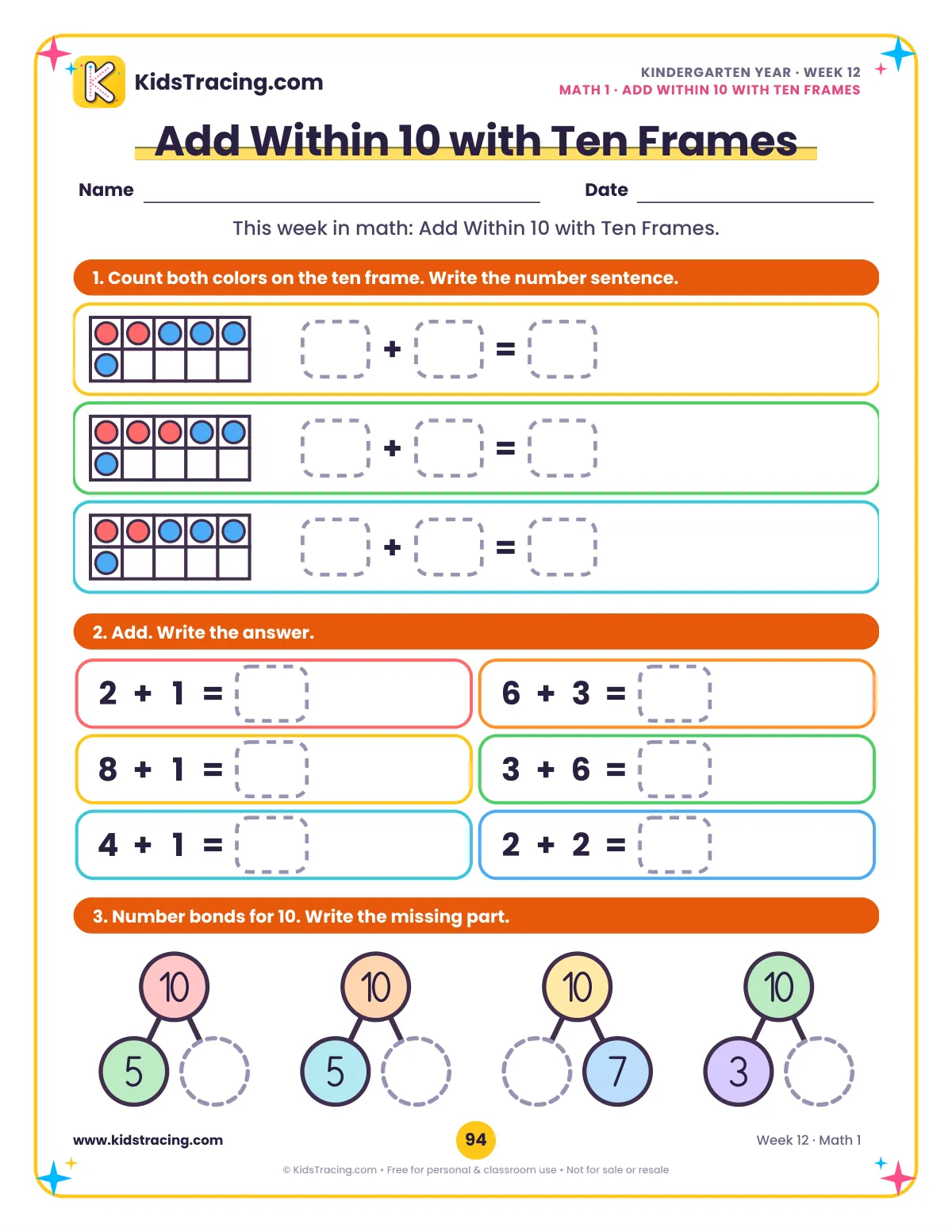
Six pages from the finished curriculum. Every PDF is sharp enough to print at full size.
Which book to use when
The three workbooks are the spine. Everything else plugs in at a suggested week, and every extra page also works at any time once the skill has been taught.
| Part | Ages | Pages | When to use it |
|---|---|---|---|
| Year guides (Preschool and Kindergarten) | adults | 52 and 58 | Read first, then use every week |
| Preschool Workbooks 1, 2, 3 | 3–4 | 63, 63, 62 | Weeks 1–12, 13–24, 25–36 |
| Kindergarten Workbooks 1, 2, 3 | 5–6 | 102, 102, 103 | Weeks 1–12, 13–24, 25–36 |
| My First Readers 1 to 12 | 5–6 | 8 each | One every few weeks, from week 3 to week 33 |
| Phonics and Sight Word Cards | 5–6 | 33 | Weeks 1–33, matched to the phonics path |
| Math Cards | 5–6 | 17 | Weeks 1–32 |
| Calendar and Circle Time Pack | 3–6 | 40 | Every day |
| Charts and Cards Pack | 3–6 | 18 | Any week |
| Reading Comprehension | 5–6 | 42 | One story a week, after that week's sounds |
| Rhyming and Sound Awareness | 4–6 | 31 | Kindergarten weeks 1–16, or as a bonus for older 4-year-olds |
| Writing and Grammar Journal | 5–6 | 32 | Sentence pages from about week 10, journal pages from about week 20 |
| Math Boost | 5–6 | 22 | Whenever extra math practice is needed |
| Ocean Animals Activity Book (bonus) | 3–5 | 40 plus a 5-page key | Any time, as a stand-alone book |
What children build over the year
Preschool (ages 3–4)
See the skills
- Names many capital and small letters and says the sounds
- Recognizes rhymes and listens to a story and answers questions
- Counts objects, then counts to 10 and on to 20
- Names circle, square, triangle and rectangle, and makes simple patterns
- Names body parts and the five senses, and talks about weather and seasons
- Holds a pencil with a good grip, traces, draws lines and circles, and cuts on a line
- Takes turns, uses kind words and follows classroom routines
Kindergarten (ages 5–6)
See the skills
- Says one sound for each letter and blends and reads short words
- Reads words with sh, ch, th, wh, common blends and silent e
- Reads the 92 sight words and a simple story aloud
- Writes a first and last name, all the letters, short words and a sentence with a capital and a period
- Counts to 100, writes numbers to 20, adds and subtracts within 10 and knows the pairs that make 10
- Tells time to the hour, names coins and measures length
- Reads a simple map and talks about families, communities and rules
These lists come from the skills pages of the two year guides. They describe what to watch for, not a test.
Print it and get started
Five steps
- Print the guide for your child's year and read the welcome pages and the year-at-a-glance map.
- Print the first workbook. Do the week's pages in order, one day at a time.
- Use the readers and card packs in the weeks the guide suggests. They are quick, hands-on breaks from the workbook.
- Check the skills lists at the three checkpoints in each guide, and repeat any week that felt hard. There is no prize for finishing early.
- At the end of the year, fill in the progress report and the certificate.
Printing and setup tips
- Print on US Letter at Actual size (100%). On A4, choose Fit to page; the printing note above the downloads explains why. Color is best, black and white works too, and draft mode saves ink.
- Print one workbook at a time, or only the pages for this week. Keep finished pages in a folder: it makes a good record of the year.
- Print the card packs on white cardstock and laminate them if you can. Small green numbers and words on the math cards are the answers, so cover them with a sticky note for flash-card games.
- Print each reader single-sided and fold or staple it. Read it for three short sessions: a picture walk, then pointing and reading, then reading again smoothly and talking about it.
- For materials you need pencils, crayons, child-safe scissors, a glue stick, a folder and a few counters such as buttons or blocks. The guides list a few more for the science pages, all household or low-cost items.
What is not in the curriculum
It is a paper-based curriculum for reading, writing, math, science and social studies. There are no art, music or physical education lessons beyond the hands-on ideas in the weekly plans. Cursive is not included, because it is a later skill. Rhyming is not part of the Preschool workbooks; it lives in the Rhyming and Sound Awareness book. A few word-family words in Kindergarten Workbook 2, such as glum and blot, are uncommon, and they are there for sounding out, not memorizing.
All the artwork was drawn for KidsTracing, with no stock pictures and no characters from other brands. The pages were checked on screen and have not yet been classroom-tested, so please print one copy of each book and check the margins before you print more.
More free practice on KidsTracing
Want to make your own single pages instead of a whole book? These generators pair well with the curriculum.
CVC Words Worksheets
Make short-vowel word pages for the reading weeks.
Sight Words Worksheets
Extra practice for the three new words a week.
Number Tracing
Trace numbers to 20 or to 100.
Rhyming Words
Rhyme matching pages to go with the sound awareness book.
Preschool Worksheets
Single pages for ages 3 to 4.
Kindergarten Worksheets
Single pages for ages 5 to 6.
To celebrate a finished week, the free sticker sheets, reward charts and 30-day challenges are ready to print. The memory match games, picture scavenger hunts and paper crafts make good circle-time or Friday-fun extras. After the readers, Pyramid Reading: Short Vowels gives 50 short sentences to read one word at a time.
Browse everything: all free worksheets, free workbooks and free printables.
Guides for parents and teachers
Preschool and KG Worksheets: English and Math for Ages 3 to 6
Choose preschool and kindergarten English and math worksheets by skill, with worked lessons, practical adaptations and free printable activities.
How Long Should a Child Study at Home?
How long should a child study at home? Ages 4 to 9: daily minutes, session length, breaks, sample timetables, and signs it is too much.
Dolch Sight Words List: Pre-Primer to Grade 3 (Free Printable)
The full Dolch sight words list for pre-primer, primer and grades 1 to 3: 220 words, how to teach them, easy games and free printable practice.
CVC Words List: Short A, E, I, O and U
Explore short-vowel CVC word lists with sound-box examples, blending and spelling lessons, common exceptions and free printable practice.
Frequently asked questions
Is the curriculum really free?
Yes. It is free for personal, home and classroom use, with no sign-up and no email address. It is not for sale or resale, so please do not post the files on another website or put them in a paid bundle.
Which ages is it for?
The Preschool Year is written for ages 3 to 4 and the Kindergarten Year for ages 5 to 6. The Calendar and Circle Time Pack and the Charts and Cards Pack suit ages 3 to 6, and the Rhyming and Sound Awareness book is aimed at ages 4 to 6.
Can I use it as my homeschool curriculum?
It can be the backbone of a reading, writing, math, science and social studies year. It does not have art, music or physical education lessons, although the weekly plans suggest hands-on ideas, so you will want to add those. Check your state's homeschool rules, because they differ from place to place.
Do I have to print everything?
No. Print one workbook at a time, or even just the pages for the week you are on. The card packs are the exception: print those on cardstock when you reach them. Every file is separate, so you only download what you need.
How long does a day take?
The Preschool Year guide suggests 20 to 30 minutes a day, five days a week. The Kindergarten Year guide suggests 30 to 45 minutes. Both say to slow down or repeat a week when your child needs it.
Is there an answer key?
Where answers exist, yes. The three Kindergarten Workbooks end with answer-key pages, and the Reading Comprehension, Rhyming and Sound Awareness, Writing and Grammar Journal and Math Boost books each have their own. Writing, drawing and copying pages are your child's own work, so they have no key. The Preschool Workbooks have no separate answer keys.
Does it follow Common Core or my state's standards?
It follows the skills most US programs and state early-learning standards describe, but it is not an official curriculum of any school or agency, and it was not matched line by line to one state's standards. The skill lists in the year guides make it easy to compare with your own.
Can I print on A4 paper?
Yes, but there are no A4 files for the curriculum yet (only the bonus Ocean book comes in both sizes). Every curriculum PDF is made for US Letter paper (8.5 by 11 inches). A4 is a little narrower and a little taller, so choose "Fit to page" (or "Fit to printable area" or "Scale to fit") in the print window instead of "Actual size". The page then prints about 3% smaller with a bit more white space at the top and bottom, and the thin colored frame stays inside the paper. Print one page first as a test, and do that before you copy a class set or cut out cards.
Has it been tested in a classroom?
Not yet. Every page was checked on screen, and the sums on the cards and the dates on the calendar pages were checked by a program, but the curriculum has not been printed and tried with a group of children. Print one copy of a book first and check the margins before you print more. If you find a mistake, please tell us through the contact page.
What if my child is ahead or behind?
Start where your child is, not where their age says. A 5-year-old who does not yet know letters can begin with Preschool Workbook 1, and a 4-year-old who reads simple words can try Kindergarten Workbook 1. Repeat or skip weeks as you like. The Rhyming and Sound Awareness book is a good bridge between the two years.