Counting Activity Book: Numbers 1 to 20 with Ten Frames and Answer Key (Free PDF)
A free printable counting book with 35 activity pages for ages 3 to 6. Your child counts bright pictures, writes and matches numbers, fills ten frames, compares groups, skip counts by 2s, 5s and 10s and adds and takes away with pictures. The numbers grow part by part from 1 to 5 up to 20, and an answer key and a certificate are at the back. Download the 44-page PDF in US Letter or A4 and print it at home or in class.
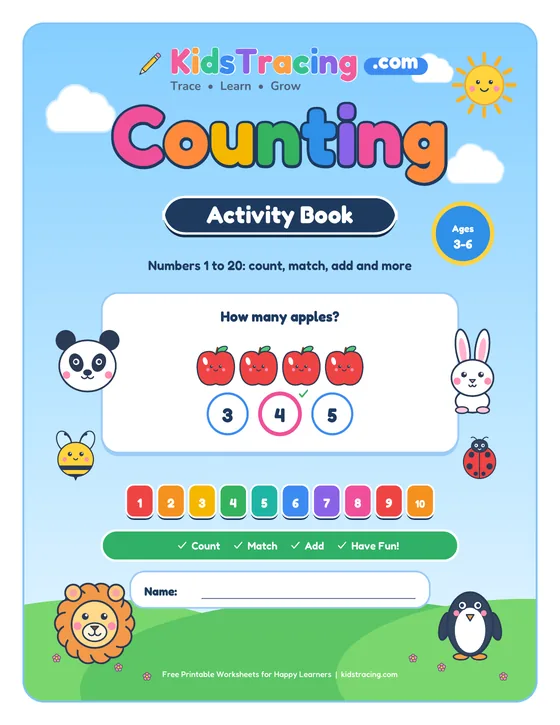
Download Counting Activity Book
- 44 pages with 35 counting activities for ages 3–6
- Numbers 1 to 20, ten frames, tally marks, dice, skip counting, adding and taking away
- Answer key, games page and certificate
- Free for home and classroom use, with no sign-up or email address
- Two PDF files: US Letter (8.5 × 11 in) and A4
Print at 100% (Actual size). Choose US Letter in the United States and Canada, and A4 almost everywhere else. How to print a workbook
Who this book is for
This is a counting book for children from about age 3 to 6, from the first time a child counts three apples to counting a group of twenty. Counting looks simple, but a child has to learn several things at once: the number words in order, to touch one picture for each number word, and that the last number said tells how many there are. This book gives all of that practice in small steps, on pages that are friendly and not crowded.
The book is in order. The first six pages use only the numbers 1 to 5, and several of them need no writing at all: your child circles a number, colors pictures, joins a group to its number by drawing a line or draws counters in a ten frame. Numbers 6 to 10 come next, then pages on more and fewer and on the order of the numbers, then the numbers 11 to 20. After that come skip counting, adding and taking away with pictures, and three big scenes where your child has to find and count five kinds of pictures. Because each part is a little harder than the one before it, a child can finish a part, feel proud and move on when ready.
Every page has bright pictures to count, 22 different ones in all, such as apples, ducks, balloons, cupcakes, ladybugs, kites and sailboats. The pictures are the same on US Letter and A4. There is an answer key at the back, so a parent or teacher can check a page in a minute, and a certificate for when the book is finished. This is a counting book, not a number tracing book: if your child also needs to practice forming the digits, use it together with our Number Tracing and Counting Book.
What is inside the Counting Activity Book
The book has 44 pages, and every page is numbered in the bottom corner, so you can print one part at a time. Each activity page has a colored tab in the top corner with the name of the part, so a child can see where they are in the book.
| Pages | Section | Number of pages |
|---|---|---|
| 1–3 | Cover, welcome page for adults, and contents | 3 |
| 4–9 | Numbers 1 to 5 | 6 |
| 10–17 | Numbers 6 to 10 | 8 |
| 18–22 | Compare and Order | 5 |
| 23–26 | Numbers 11 to 20 | 4 |
| 27–29 | Skip Counting | 3 |
| 30–34 | Add and Take Away | 5 |
| 35–38 | Count Everything | 4 |
| 39 | Games to play at home: six quick counting games with everyday things | 1 |
| 40–42 | Answer key for every page | 3 |
| 43 | Certificate of achievement | 1 |
| 44 | Back cover | 1 |
Start here (pages 1–3)
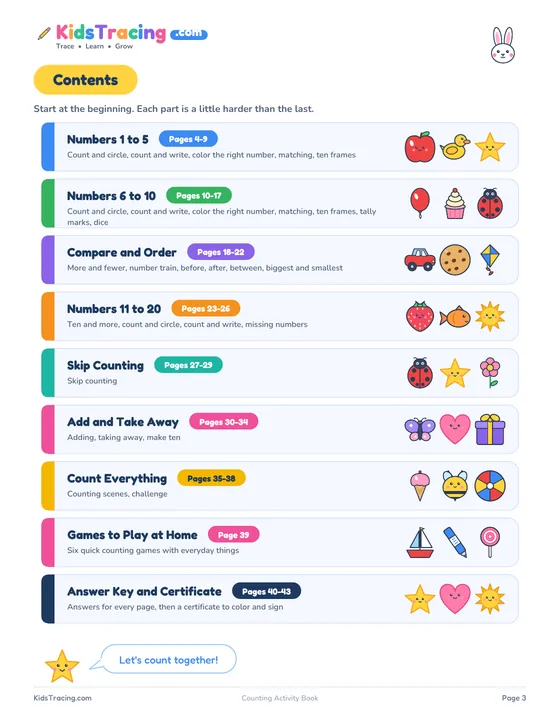
The cover shows a sample question: four apples, and the numbers 3, 4 and 5 to choose from. Page 2 is a welcome page for parents and teachers. It gives six short steps for using the book, lists what your child practices and has a box for your child’s name. Page 3 is the contents, with the seven parts, the games page, the answer key and the certificate, and the pages they are on.
Numbers 1 to 5 (pages 4–9)
Six pages built around the numbers 1 to 5. Your child counts and circles, counts and writes, colors the right number of pictures, matches groups to numbers and meets the ten frame for the first time. A ten frame is a box with two rows of five squares, and it helps children see numbers as a group of five and some more.
| Page | Activity | What your child does |
|---|---|---|
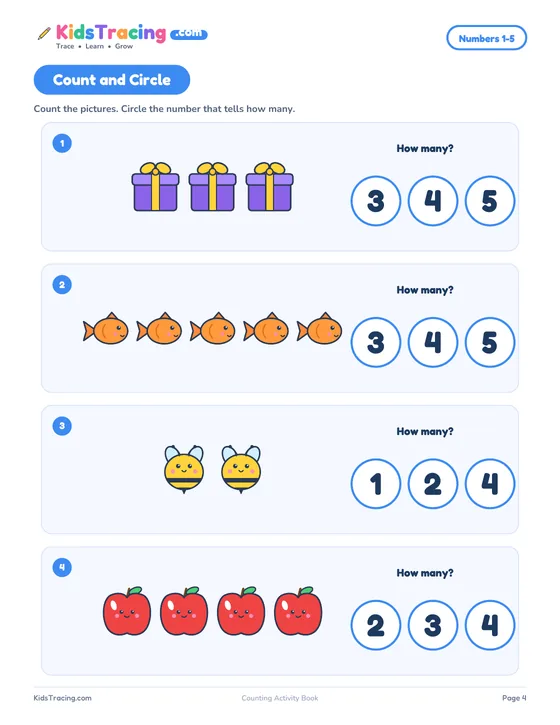
| 4 | Count and Circle | Count the pictures in each group and circle the right number out of three. |
| 5 | Count and Write | Count the pictures in each box and write how many. |
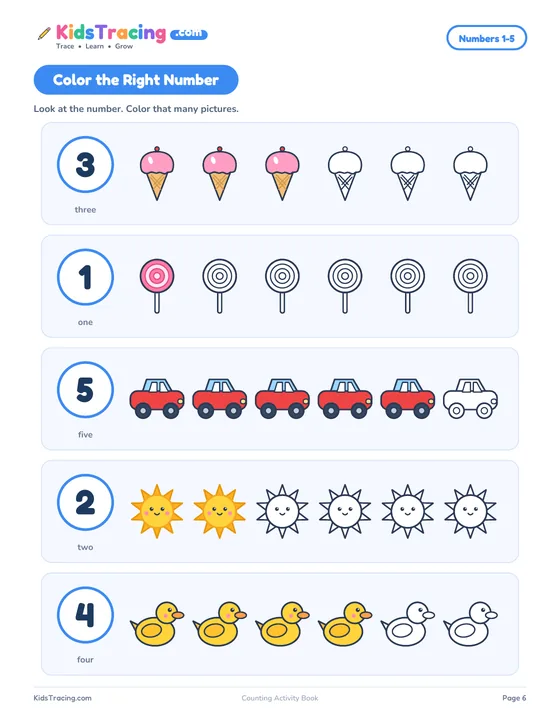
| 6 | Color the Right Number | Read a number and color that many pictures in a row. |
| 7 | Match the Groups | Count each group and draw a line to the number that matches. |
| 8 | Ten Frames: Count the Counters | Count the counters in each ten frame and write the number. |
| 9 | Ten Frames: Draw the Counters | Read a number and draw that many counters in an empty ten frame. |
Numbers 6 to 10 (pages 10–17)
The same kinds of pages with groups of six to ten, and two new ones. On the tally page your child counts tally marks, where every fifth mark crosses the other four, and draws tally marks for a number. On the dice page your child counts the dots on a die, from one to six, and draws dots for a number.
| Page | Activity | What your child does |
|---|---|---|
| 10 | Count and Circle | Count the pictures in each group and circle the right number out of three. |
| 11 | Count and Write | Count the pictures in each box and write how many. |
| 12 | Color the Right Number | Read a number and color that many pictures in a row. |
| 13 | Match the Groups | Count each group and draw a line to the number that matches. |
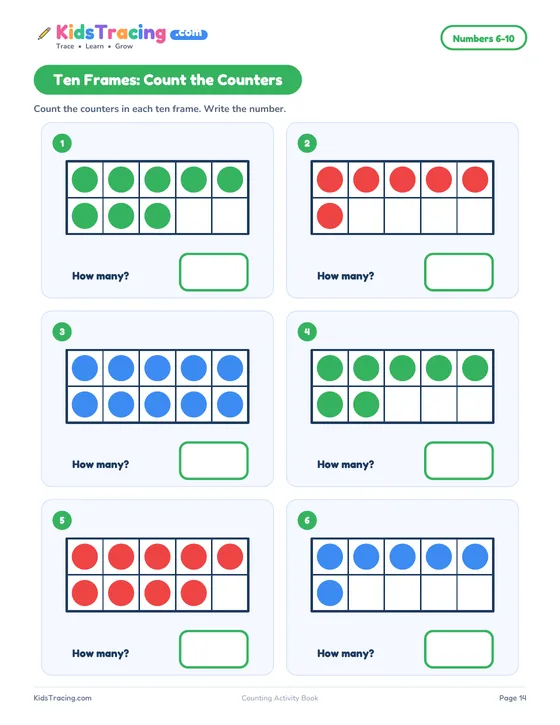
| 14 | Ten Frames: Count the Counters | Count the counters in each ten frame and write the number. |
| 15 | Ten Frames: Draw the Counters | Read a number and draw that many counters in an empty ten frame. |
| 16 | Tally Marks | Count tally marks and write the number, then draw tally marks for a number. |
| 17 | Dots on a Die | Count the dots on six dice, then draw dots to match six numbers. |
Compare and Order (pages 18–22)
Two pages compare groups, one for MORE and one for FEWER. In each pair the pictures are the same size, so your child has to count, not guess by looking at which group seems bigger. The number train, the before, after and between page and the biggest and smallest page teach the order of the numbers.
| Page | Activity | What your child does |
|---|---|---|
| 18 | Which Group Has More? | Count two groups and circle the group that has MORE. |
| 19 | Which Group Has Fewer? | Count two groups and circle the group that has FEWER. |
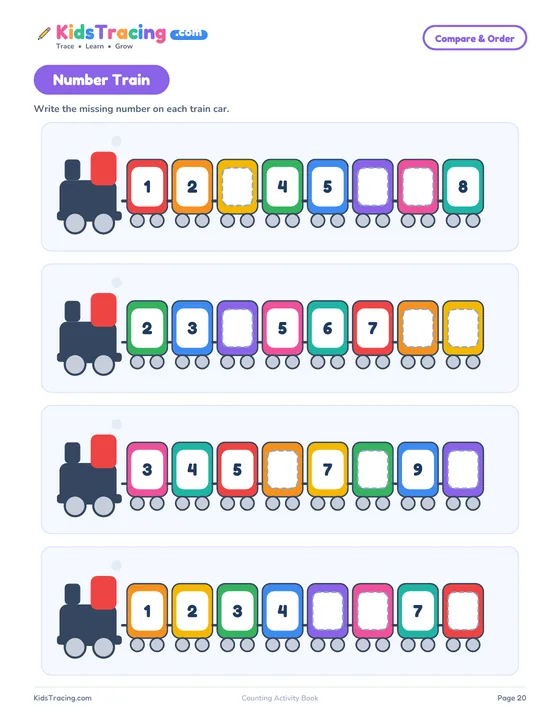
| 20 | Number Train | Write the missing numbers on four trains with eight cars each. |
| 21 | Before, After, Between | Write the number that comes before, after or between, on twelve small cards. |
| 22 | Biggest and Smallest | Circle the biggest number in three rows and the smallest number in three rows. |
Numbers 11 to 20 (pages 23–26)
This is where the counting grows. The first page shows a full ten frame next to a second frame, so a child can see that 10 and 3 more make 13 without counting the first ten again. Then come groups of 11 to 20 pictures in rows of ten, and number paths with missing numbers.
| Page | Activity | What your child does |
|---|---|---|
| 23 | Ten and More | Count a full ten frame and a second frame together to find a number from 11 to 20. |
| 24 | Count and Circle | Count the pictures in each group and circle the right number out of three. |
| 25 | Count and Write | Count the pictures in each box and write how many. |
| 26 | Missing Numbers to 20 | Write the missing numbers on six number paths that run up to 20. |
Skip Counting (pages 27–29)
Three pages, one for each way to skip count. Each page has five groups with their running totals, with some totals left blank, and two number rows to complete. Counting by 2s goes up to 20, counting by 5s up to 50 and counting by 10s up to 100.
| Page | Activity | What your child does |
|---|---|---|
| 27 | Count by 2s | Count the pairs, say the numbers out loud and write the missing totals, up to 20. |
| 28 | Count by 5s | Count the groups of five, say the numbers out loud and write the missing totals, up to 50. |
| 29 | Count by 10s | Count the full ten frames, say the numbers out loud and write the missing totals, up to 100. |
Add and Take Away (pages 30–34)
Adding and taking away begin with pictures that can be counted, not with sums on their own. On the adding pages your child counts two groups together. On the taking away pages your child crosses out the pictures that go away and counts what is left. The sums on these pages stay within 10.
| Page | Activity | What your child does |
|---|---|---|
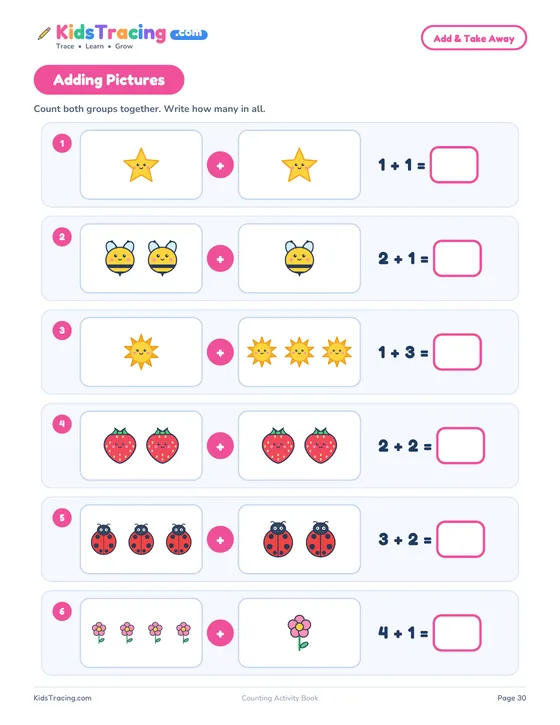
| 30 | Adding Pictures | Count two groups of pictures together and write how many in all. |
| 31 | Adding to 10 | Count two groups of pictures together and write how many in all. |
| 32 | Taking Away Pictures | Cross out the pictures that are taken away and write how many are left. |
| 33 | Taking Away to 10 | Cross out the pictures that are taken away and write how many are left. |
| 34 | Make Ten | Draw counters to fill a ten frame and write how many were added to make 10. |
Count Everything (pages 35–38)
Three big scenes, a birthday party, a sunny garden and a toy box, each with five kinds of pictures scattered around. Your child counts each kind and writes the five numbers in the boxes below. The last page is a challenge with six short activities that mix the main skills of the book.
| Page | Activity | What your child does |
|---|---|---|
| 35 | Birthday Party | Find and count five kinds of pictures in one big scene and write five numbers. |
| 36 | Sunny Garden | Find and count five kinds of pictures in one big scene and write five numbers. |
| 37 | Toy Box | Find and count five kinds of pictures in one big scene and write five numbers. |
| 38 | Counting Challenge | Six short activities on one page: count and circle, count and write, bigger number, missing numbers, add and count counters. |
Games, answer key and certificate (pages 39–44)
Page 39 has six quick counting games to play with everyday things: Snack Count, Stair Steps, Dice Race, Number Hunt, Sock Pairs and Bean Bag Tally. Pages 40 to 42 give the answers for every activity page, page 43 is a certificate for counting all the way to 20 and page 44 is the back cover.
Sample pages
A few pages from the finished workbook. The PDF is sharp enough to print at full size.
Skills your child practices
- Counting pictures one by one, with one number for each picture
- Knowing that the last number said tells how many
- Reading and writing the numbers 1 to 20
- Seeing numbers as patterns on ten frames and dice
- Comparing groups: more, fewer, biggest and smallest
- Number order: before, after and between
- Skip counting by 2s, 5s and 10s
- Adding and taking away with pictures
How to use this workbook
Print the book
Pick the file that fits your paper, US Letter or A4, and print it at 100% (Actual size), one side only. Skip the answer key (pages 40–42) if you would rather your child did not see it.
Start at the beginning
Begin with Numbers 1 to 5 on pages 4 to 9. Move on to the next part when your child counts small groups with confidence.
Read the instruction together
Each page has one short instruction at the top, such as “Count the pictures. Circle the number that tells how many.” Read it aloud, then let your child try.
Count with a touch
Let your child touch each picture while saying one number for each. Cross out the pictures that are counted. Use buttons or coins on the ten frame pages.
Check and celebrate
Check the page with the answer key, count again together where an answer is different and give the certificate on page 43 when the book is finished.
How the numbers grow
The table shows what each part adds. Numbers 1 to 5 and 6 to 10 come first, because counting a group of three and counting a group of nine are different jobs for a young child. Only the three big scenes at the end ask your child to look at twenty or twenty-five pictures at once, and there the pictures are split into five kinds, so no single group has more than eight.
| Part | Pages | Numbers | New in this part |
|---|---|---|---|
| Numbers 1 to 5 | 4–9 | 1 to 5 | Counting small groups, writing the numbers and filling the first ten frames |
| Numbers 6 to 10 | 10–17 | 6 to 10 | Bigger groups, full ten frames, tally marks and dice |
| Compare and Order | 18–22 | 1 to 10 | More and fewer, the order of the numbers, before, after and between, biggest and smallest |
| Numbers 11 to 20 | 23–26 | 11 to 20 | Ten and more, counting groups of up to 20, number paths |
| Skip Counting | 27–29 | up to 100 | Skip counting by 2s, 5s and 10s |
| Add and Take Away | 30–34 | up to 10 | Adding, taking away and making ten with pictures |
| Count Everything | 35–38 | up to 25 in a scene | Counting five kinds of pictures in a big scene, then a six-part challenge |
Every answer has been checked twice
A counting book is only useful if the answers are right, so we checked this one in two ways. First, every question, every picture and every answer in the book comes from one list, so the answer key cannot disagree with the pages. Second, we counted the pictures again on the finished pages. A program looked at the picture of every page, in both paper sizes, counted every group of pictures, counters, dots and tally marks, and compared the result with the answer key. All the counts matched. We also made sure that no pictures touch or overlap, so every picture can be counted on its own.
What children practice with this book
One number for each picture. The most important idea in early counting is that each picture gets exactly one number word, and no picture is skipped or counted twice. Many groups in this book are spread out and not in a line, so a child has to find a way to keep track, such as touching each picture or crossing it out. Our tip list below shows how to help.
The last number tells how many. Children often count correctly, then answer a different number when you ask “How many?”. The “How many?” boxes and the circle-the-number questions give your child practice at saying and showing that the last number counted is the answer.
Seeing numbers in groups. Ten frames and dice show a number as a pattern. After a while a child stops counting every counter and sees that a row of five and three more is eight. This is one of the most useful ways to get ready for adding.
Reading and writing numbers. Your child sees every number from 1 to 20 many times, in big, clear digits, and writes them in boxes. The pages that need no writing make the early part of the book easier for a child who is still learning to hold a pencil.
Comparing and ordering. More, fewer, biggest, smallest, before, after and between are the words of number sense. The pages that use them let your child practice the words with pictures in front of them.
Skip counting. Counting by 2s, 5s and 10s is a first step toward multiplication. It also helps with counting socks, shoes and mittens in pairs, as in the Sock Pairs game on page 39.
Adding and taking away. Putting groups together and taking pictures away shows what adding and subtracting mean before a child meets the sums on their own. The make-ten page prepares for number bonds, the pairs of numbers that make 10.
What it is not. This book is not a full math course, and it does not teach number writing step by step. For the stroke order of each digit, see our guide to teaching number writing and the Number Tracing and Counting Book.
Tips for counting well
- Touch each picture once. Let your child touch every picture while saying one number for each. Pointing with a pencil tip works well, and so does moving a finger along.
- Cross out as you count. On the pages where the pictures are scattered, a small line through each counted picture shows which ones are left. A different color for the second try keeps the page tidy.
- Use real counters. Buttons, coins, dry beans or small blocks make the ten frame pages much easier. Put a counter on each square and then draw it.
- Always ask “How many?”. After your child has counted, ask for the answer in a sentence, such as “There are seven apples.” It connects the last number said with the size of the group.
- Count again to check. If your child gets a different number the second time, do not say the first number is wrong. Count together and let your child see where the mix-up happened.
- Stay with one part for a while. If numbers 6 to 10 feel hard, repeat a page with a different color or play one of the games on page 39 before moving on.
- Short sessions. One or two pages a day, about ten minutes, is enough. Stop when the fun is gone.
Printing and using the pages
Set your printer to 100% (Actual size) and print on one side of each sheet. “Fit to page” can shrink the ten frames and the numbers. Both PDFs hold the same pages, pictures and answers, and only the shape of the sheet differs. Ordinary copy paper is fine for pencils, crayons and washable markers.
The pictures are in full color, and they print in clear shades of gray on a black-and-white printer, so a color printer is nice but not necessary. The two “Color the Right Number” pages (pages 6 and 12) use line drawings, so they print well in black and white and children can color them. To save ink, print the book in grayscale.
You can print only the pages you need. For example, pages 4–9 are the numbers 1 to 5, pages 10–17 are 6 to 10 and pages 23–26 are 11 to 20. If you print the answer key (pages 40–42) keep it for the adult in the room. Page 39 is a good page to put on the fridge.
Free worksheet generators to go with this workbook
Make extra counting pages and number practice with free printable generators.
Counting
Count pictures, then write or circle the number. Compare groups too.
Numbers
Number tracing, number words and skip counting worksheets.
Number Tracing
Any range from 0 to 1000, with number words.
Patterns
AB, AAB, ABB and ABC patterns: what comes next, what is missing.
Preschool Worksheets
Lines, names, shapes, cutting, counting, patterns and first sounds.
Kindergarten Worksheets
Letters, numbers to 20, sounds, CVC words and early writing.
Guides for parents and teachers
How to Teach a Child to Write Numbers 1 to 10
How to teach a child to write numbers 1 to 10: how to form each digit, a simple practice plan and tips for numbers written backwards.
Handwriting Readiness Checklist: Is Your Child Ready to Write?
A simple handwriting readiness checklist for ages 3 to 6: ten signs your child is ready to start writing, and what to do if they are not there yet.
Pre-Writing Activities for Preschoolers: 15 Fun Ideas
Fifteen fun pre-writing activities for preschoolers that build the strokes, strength and control children need before they start writing letters and names.
More free printable workbooks
Number Tracing and Counting Book
Trace, count and color every number from 1 to 20, then practice number words and skip counting.
Dot Marker Alphabet and Numbers Book
Dab capital and small letters A to Z, count and dab numbers 1 to 10, then shapes and 15 pictures.
Animal Mazes Activity Book
Thirty animal mazes in three levels, from a bee and a flower to a flamingo and a shrimp, with fun facts and an answer key.
Frequently asked questions
Is the Counting Activity Book really free?
Yes. It costs nothing, and you do not need an account or an email address to download it. Print a fresh copy for every child in your family or class. If a friend or colleague would like the book, please send them the link to this page instead of attaching the PDF, and please do not sell it or post it on another site.
What age is it for?
The cover says ages 3 to 6. Many three-year-olds can enjoy the first part with an adult, because several pages need only circling, coloring or drawing a line. Four- and five-year-olds can work through the numbers up to 10 and the compare pages, and many five- and six-year-olds will enjoy numbers 11 to 20, skip counting and the adding and taking away pages.
Which numbers does it cover?
The main counting pages cover the numbers 1 to 20: 1 to 5 in the first part, 6 to 10 in the second and 11 to 20 in the fourth part. The skip counting pages go up to 20, 50 and 100, and the adding and taking away pages use numbers up to 10.
Does my child need to know how to write numbers first?
No. Writing starts on page 5, and even there the numbers are single digits in a large box. Pages 4, 6, 7 and 9 need no writing at all, because a child circles a number, colors pictures, draws a line or draws counters. If forming the digits is hard, use our Number Tracing and Counting Book alongside this book.
How is this book different from the Number Tracing and Counting Book?
The Number Tracing and Counting Book is about writing numbers: tracing digits, number words and skip counting. The Counting Activity Book is about what numbers mean: counting groups, ten frames, comparing, number order, skip counting and adding and taking away with pictures, with an answer key. Many families use the two books one after the other.
Where are the answers?
The answer key is on pages 40 to 42. It lists the answers for every activity page in small cards, in page order, so you can check a page in a minute. Pictures can be colored, crossed out or circled in any way that fits, so the key shows only the numbers. You can leave those pages out when you print.
Are the A4 and the US Letter books the same?
Yes. Both files have the same 44 pages, the same pictures and the same answers. Only the paper shape differs. Use US Letter if your printer takes 8.5 × 11 inch paper, and A4 if it takes the longer, narrower A4 sheets common outside North America.
Do we need counters or other things?
You do not need anything except a pencil and crayons, but real counters make the ten frame pages easier. Buttons, coins, dry beans and small blocks all work. The games on page 39 use snacks, steps, a die, socks and bean bags, all things that you can find at home.
How can I make the book easier or harder?
To make it easier, let your child touch or cross out each picture while counting and use real counters on the ten frame pages. To make it harder, ask your child to count again without touching, to say how many are left before crossing out and to explain how they found each answer. You can also skip ahead to a part that suits your child, because every part can be used on its own.
Can I print only some of the pages?
Yes. In the print window, type a page range instead of printing everything. Typing 4–9 prints the numbers 1 to 5, and typing 23–26 prints the numbers 11 to 20. The contents table above lists where every part starts.
How is this book different from the counting worksheet generator?
The counting worksheet generator makes a new counting worksheet every time you click, with the numbers, the pictures and the arrangement that you choose. This book is a finished, ordered set of 35 pages with ten frames, tally marks, dice, comparing, skip counting, adding, taking away and counting scenes, plus games, an answer key and a certificate, so it is ready to print and hand to a child.
Do I need a color printer?
No. The pictures print clearly in shades of gray on a black-and-white printer, and the pages still work well. Color is nicer, especially for the cover, the scenes and the certificate.