How to Teach a Child to Write Numbers 1 to 10
Published by Hasnat N, Founder · October 6, 2026 · Updated October 25, 2026 · 9 min read
Quick answer: Teach number writing in three steps: count real objects first, trace each digit with arrows showing where to start, then write it alone. Group the digits by their shape (1 and 7 are straight lines, 0, 6 and 9 are circles, 2, 3 and 5 are curves) and practice two or three at a time. Backward numbers are very common before age 7, and gentle practice fixes most of them.
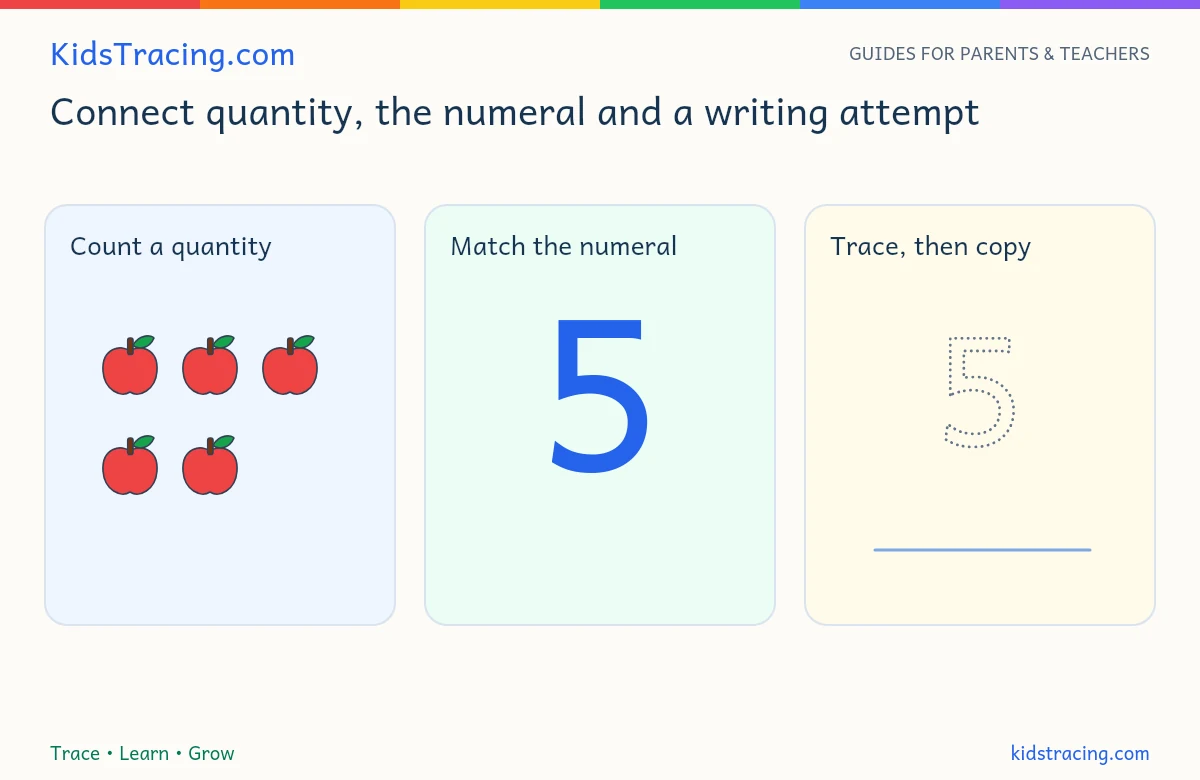
Most children can say numbers long before they can write them. Writing a digit is a different skill. It needs the same pre-writing strokes as letters, and it asks your child to link a written shape to a quantity they can already count. This guide shows how to form each digit from 0 to 10, a simple practice plan, and what to do when numbers come out backward.
Before you start: quantity first
Children understand a number better when they can see how many it is. Before tracing a digit, count real things together: five blocks, three apples, two socks. Then show the digit that stands for that amount. When children connect the symbol to the quantity, the digit has meaning, and meaning helps memory.
Your child will also find it easier to write numbers if they can already copy a vertical line, a circle and a curve. If you are not sure, read about the pre-writing shapes by age first.
How to write each number
These are the usual ways to form the digits in US schools. Many programs have small differences, so follow your child’s school if it teaches a different way. Always start at the top.
| Digit | How to write it |
|---|---|
| 1 | Start at the top and draw a straight line down. (Some programs add a small flag at the top.) |
| 2 | Start at the top left, curve around to the right, slide down on a slant to the bottom left, then draw a straight line across the bottom to the right. |
| 3 | Start at the top left and curve around to the middle. Then curve around again to finish at the bottom. Two bumps. |
| 4 | Start at the top and slant down to the left, then go across to the right. Lift the pencil, then draw a straight line down on the right side, from the top through the crossbar. |
| 5 | Start at the top right and draw a line left, then down a short way. Curve around the bump to finish at the bottom left. Or write the straight part first and add the top flag last. |
| 6 | Start at the top and curve down and to the left like a big C, then loop around at the bottom to make a circle. |
| 7 | Start at the top left and draw a line across to the right. Then slide down on a slant to the bottom left. |
| 8 | Make an S shape from the top right, then go back up to close the shape. Or draw two circles, one on top of the other. |
| 9 | Draw a circle at the top, starting near the top right and going counter-clockwise. Then draw a line straight down from the right side. |
| 0 | Start at the top and go counter-clockwise around the oval, back to the start. |
| 10 | Write 1, leave a small space, then write 0. |
Group the digits by shape
- Straight-line digits: 1, 4, 7. Start here, because lines are the easiest strokes.
- Circle digits: 0, 6, 9 (and 8 as two circles). Use the same counter-clockwise start as the letter o.
- Curve digits: 2, 3, 5. These need a smooth curve and a change of direction, so they take longest.
A simple practice plan
- Trace with a finger. Trace the digit on a printed page, saying the movement aloud. Follow the numbers and arrows if the sheet has them.
- Trace with a pencil. Use dotted digits. Try our number tracing 1-10 sheets, or number tracing for preschool with large digits, from 1 to 5 on each row.
- Copy. Write the digit next to a model.
- Write from memory. Ask your child to write a digit with nothing to copy, such as on blank handwriting paper.
- Use it. Count objects and write the answer, number the pages of a drawing, or write the date.
Practice two or three digits a week, five minutes at a time. When your child is ready for more, move to number tracing for kindergarten, or the full range on the number tracing worksheets page. See handwriting practice at home for a short routine.
Why do kids write numbers backward?
Reversed numbers and letters are very common in young children. A child may write a 3 as an E, or a 2 or a 5 backward. For most of the objects in a child’s world, such as a cup or a chair, turning the object around does not change what it is. Learning that direction matters for written symbols takes time. It does not mean a child is bad at math.
Reversals are considered typical in children under about 7. If they continue much past that age, it is worth mentioning to your child’s teacher, who may suggest extra help. Reversing numbers is not a sure sign of any particular learning difficulty.
How to help
- Point out the fix gently. “Look, the 3 bumps this way,” and show the right way. Do not make a big deal of each mistake.
- Add a start dot. Put a green dot where the digit begins. Tracing sheets with arrows do this for you.
- Use touch. Trace digits in sand, shaving foam or on sandpaper, or form them with play dough.
- Practice only the tricky ones. 2, 3, 5, 7 and 9 are the usual culprits. A short daily practice of one digit is better than a long weekly one.
- Praise effort, not perfection.
Hands-on practice: match quantities to numerals
- 1 and 2: Place one button beside 1 and two buttons beside 2 before tracing each numeral.
- 3 and 4: Make groups of three and four blocks, count aloud, then write the matching digit.
- 5 and 6: Show five fingers, add one counter for six, then copy the two digits.
- 7 and 8: Build groups of seven and eight with small toys and compare their counts.
- 9 and 10: Arrange nine dots and ten dots in two rows; write 9 and 10 underneath.
Check that the child connects each written number with its quantity; copying a shape alone is not the same as number understanding.
Sources
The age guide for reversals follows Understood’s overview of children who write numbers backward.
A worked lesson: connect five objects with the numeral 5
Place five large counters or blocks in a row. Touch each object once while counting, then say, "There are five altogether." Show a card with 5 and explain that this written symbol represents the quantity. Finally, demonstrate the numeral using the model taught at school.
Invite one trace and one copy, then return to the objects. Move the same five counters into a different arrangement and count again together if needed. The writing activity should support number meaning rather than replacing it.
Choose practice from the difficulty you observe
| Observation | Next activity |
|---|---|
| Can count, cannot select the numeral | Match small quantities to a choice of two numeral cards. |
| Recognizes the numeral, cannot form it | Keep a large model visible and practice one movement. |
| Writes the numeral, miscounts objects | Touch or move each object once while counting a manageable set. |
Keep practice within a useful number range
Choose preschool number tracing for a small starting set or numbers 1-10 when those quantities are familiar. Moving to 1-20 introduces two-digit numerals, so keep enough space for both digits. A child does not need 1-100 handwriting practice simply because they can recite a long count.
When writing 12, read it as twelve and notice the order of the two digits. Keep a model next to the attempt; do not turn it into a place-value lesson before the child is ready for that separate concept. Number words can be added later with the number words generator.
If a numeral is reversed, show it beside the model and compare its starting point and direction calmly. Reversals alone do not establish a diagnosis. Describe persistent concerns to the teacher, especially when the difficulty affects other activities too.
For counting to 100, the 100th Day of School Workbook adds a hundred chart and skip counting, and the kindergarten math printables page collects more kindergarten math tools.
Free printables to go with this guide
Put this guide into practice with our free generators: number tracing worksheets, number tracing 1-10, number tracing for preschool, number tracing for kindergarten, blank handwriting paper.
Free workbooks to go with this guide
- Number Tracing and Counting Book – Trace, count and color every number from 1 to 20, then practice number words and skip counting.
Keep reading
- Handwriting Practice at Home: How Long and How Often – Handwriting practice at home: how long and how often for ages 3 to 6, a 10-minute routine, setup tips and the signs that it is time to stop.
- Pre-Writing Shapes by Age: When Can Kids Draw Each Shape? – The pre-writing shapes in order, with the usual age children can copy each one: line, circle, cross, square, diagonals and triangle, and how to practice.
- Handwriting Readiness Checklist: Is Your Child Ready to Write? – A simple handwriting readiness checklist for ages 3 to 6: ten signs your child is ready to start writing, and what to do if they are not there yet.
- Preschool and KG Worksheets: English and Math for Ages 3 to 6 – What to practice in English and math at ages 3 to 6, with free printables and a weekly plan.
Frequently asked questions
At what age should a child be able to write numbers 1 to 10?
Many children can write most of the numbers from 1 to 10 by the end of kindergarten, around age 6, and kindergarten standards in the US ask children to write the numbers 0 to 20. Some manage earlier, some later.
Why does my child write 2, 3 or 5 backward?
Reversals are common and typical for children under about 7. They happen because children are still learning that direction matters for written symbols. Short, gentle practice with a clear starting point usually fixes it.
Should I teach numbers or letters first?
Either order works. Many children enjoy numbers because they have plenty of everyday practice counting. The strokes in both are the same, so progress in one helps the other.
How can I teach my child to write double-digit numbers?
Write the tens digit first, leave a small space, then write the ones digit. Practice 10 first, then 11 to 20, and use a place-value chart on blank paper if your child needs a guide.