Is My Child Behind in Writing? What to Expect at Ages 3 to 6
Published by Hasnat N, Founder · November 3, 2026 · Updated November 3, 2026 · 10 min read
Quick answer: Writing skills develop in a wide range. Most children go from scribbling to drawing lines and circles, then crosses and squares, and then to writing their name and some letters between about ages 3 and 6. Ages below are typical ranges, not deadlines. If you see pain, no progress over several months or struggles in many areas, talk to a teacher or pediatrician.
The short answer: there is a wide range
Two healthy children of the same age can write very differently. One may write their whole name at 4 and another may only scribble, and both can be on track. What matters most is steady progress, comfort and interest, not a fixed age.
School expectations also vary. In the United States, kindergarten starts at different ages in different states, and classrooms differ in how much writing they expect. Our guide to kindergarten age requirements explains the birthday cutoffs.
What writing and drawing usually look like by age
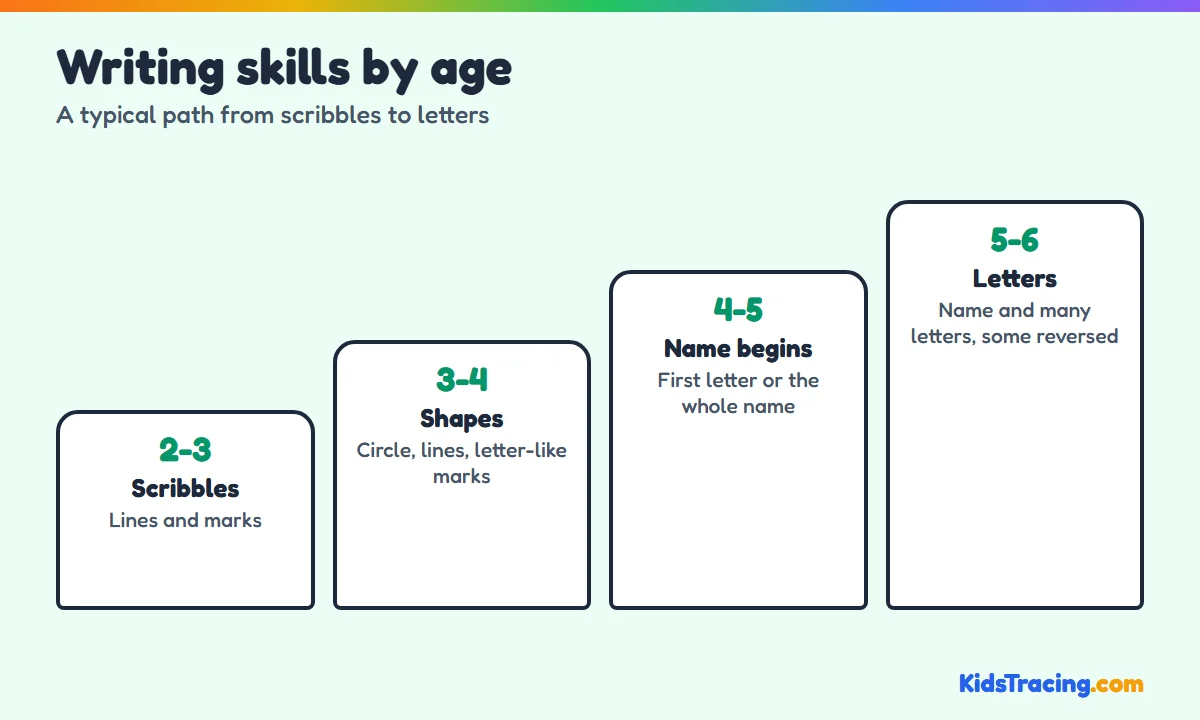
This table shows a typical order of skills. The ages are approximate: use them to see the direction, not to score your child.
| Age | What you may see |
|---|---|
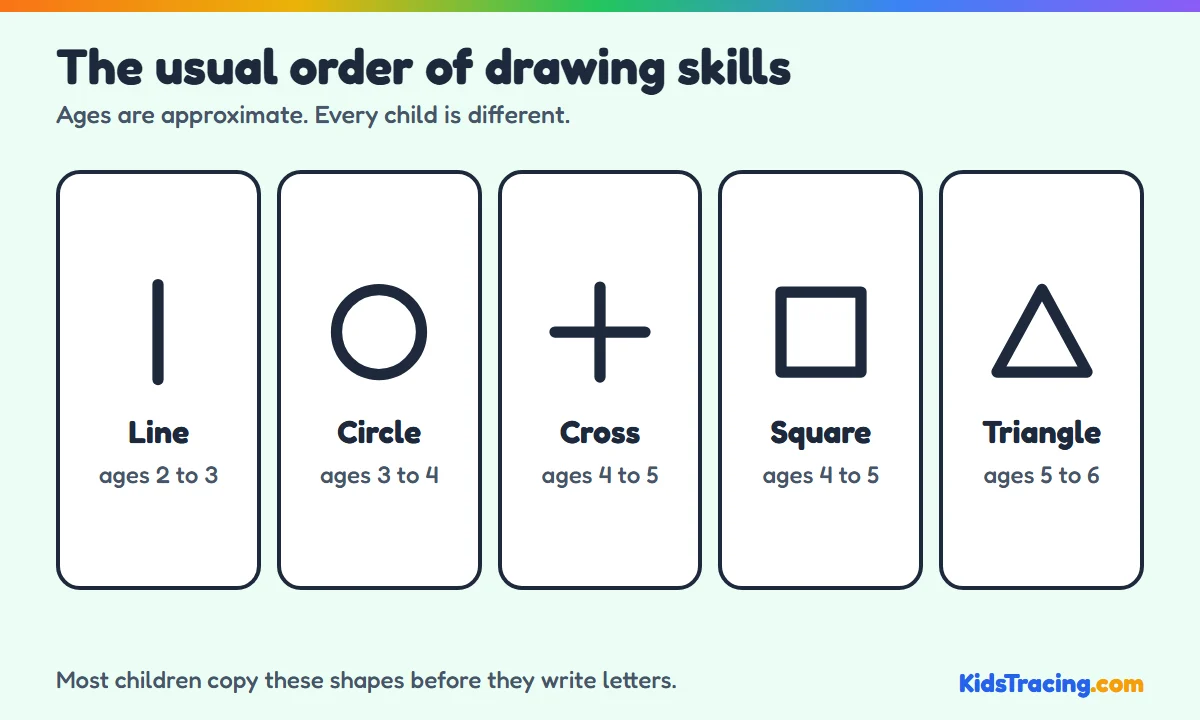
| 2 to 3 | Scribbles, then up-and-down and side-to-side lines. Holds a crayon in a fist or with the fingers. |
| 3 to 4 | Copies a vertical line, a horizontal line and a circle. May make letter-like shapes and “write” pretend words. |
| 4 to 5 | Copies a cross and a square. Begins to write the first letter or all of their name, often in capitals and sometimes backwards. |
| 5 to 6 | Copies a triangle. Writes their name and many letters and numbers. Letters vary in size and may still be reversed. |
| 6 to 7 | Writes more letters and short words with growing control. Spacing and size become more consistent. |
Reversed letters are common
Many children write letters such as b, d, p and q backwards while they are learning. This is very common in the early school years and usually fades with practice and time. Practice them on separate days, say the starting point out loud, and trace the correct form. If reversals continue well past the early school years, or your child also struggles with reading, mention it to the teacher.
Signs worth watching
- Your child says writing or drawing hurts, or avoids using the hand.
- There is little or no progress over several months, even with regular, gentle practice.
- Your child finds many small-hand tasks hard, such as cutting, buttoning, using utensils or stacking small blocks.
- Your child gets very upset or shuts down when asked to draw or write.
- You have concerns about vision, hearing, attention or speech as well.
One sign alone does not mean there is a problem. A pattern that lasts is a reason to ask for advice.
What to do if you are worried
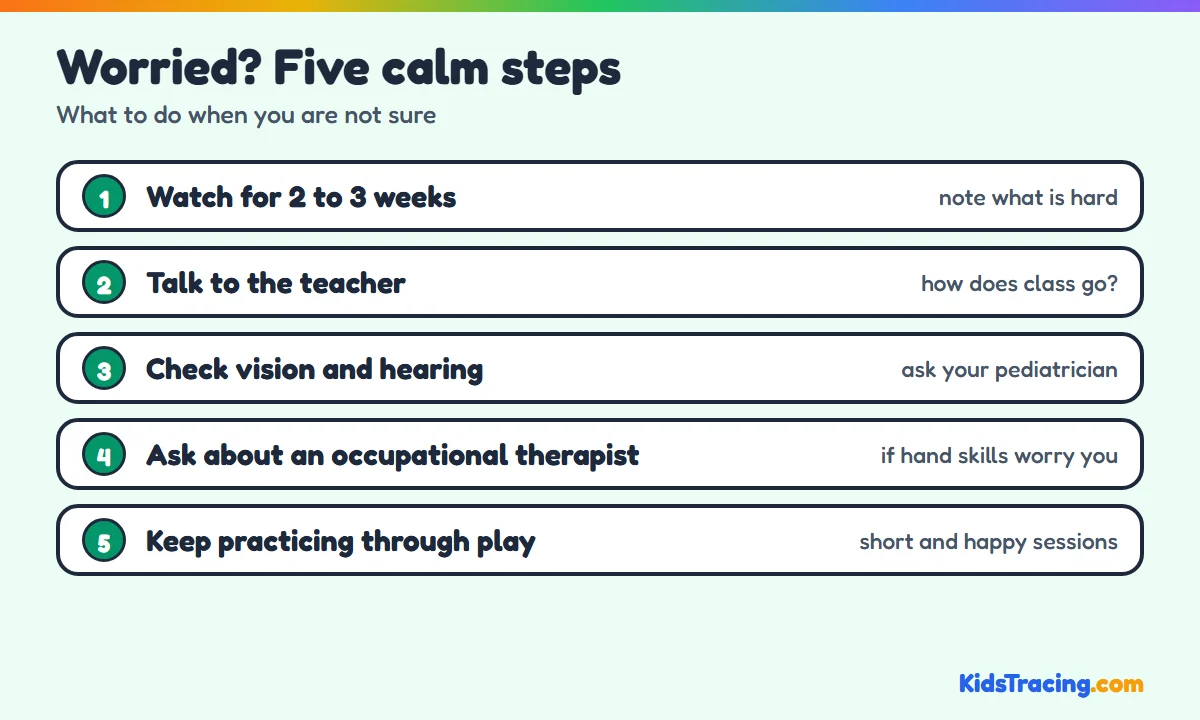
- Watch for two to three weeks. Note when your child draws, how long they stay with it and which tasks are hard.
- Talk to the teacher. Ask how your child manages writing, cutting and drawing in class compared with the group.
- Check the basics. Ask your pediatrician about vision and hearing, and about any concern with movement or coordination.
- Ask about an occupational therapist. If hand skills are a worry, a pediatrician or school can advise whether an evaluation would help.
- Keep practicing through play. Short, enjoyable activities support progress while you wait for answers.
This guide is general information and not a diagnosis.
How to help at home
- Build hand strength through play. Play dough, clothespins, tweezers, tearing paper and scissor skills practice all help.
- Practice the early strokes. Lines, curves and shapes in our pre-writing worksheets come before letters.
- Start with the name. A name tracing sheet gives a meaningful first goal.
- Keep it short. Five minutes of good practice beats twenty minutes of struggle.
- Make sure the setup is comfortable. Feet supported, paper steady, chunky crayons for small hands.
For a gentle way to look at readiness without a score, see our handwriting readiness checklist.
Free printables to go with this guide
Practice that builds from the first strokes: pre-writing worksheets, shape tracing worksheets, name tracing worksheets and letter formation worksheets.
Free workbooks to go with this guide
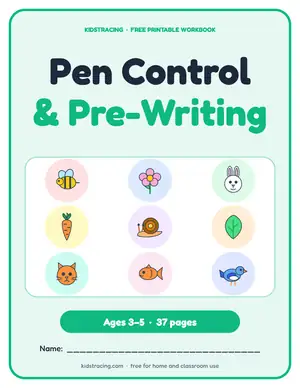
Pen Control and Pre-Writing Book
Lines, curves, zigzags, loops and spirals, plus paths from a bee to a flower, to build pencil control.
Free PDF Download US Letter · PDF of the Pen Control and Pre-Writing Book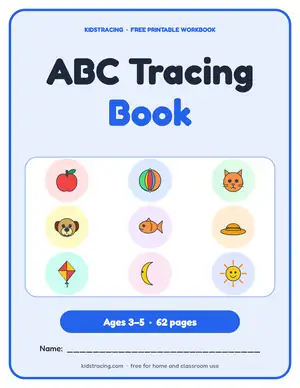
ABC Tracing Book
Every letter A to Z with numbered stroke arrows, a picture to color and a word to trace.
Free PDF Download US Letter · PDF of the ABC Tracing Book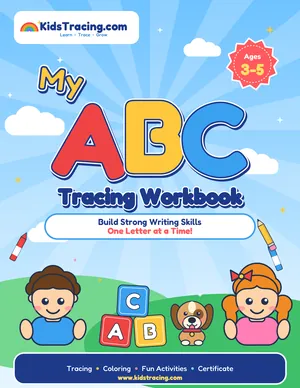
My ABC Tracing Workbook
A picture for every letter A to Z to trace, color and circle, plus four review tests and a certificate.
Free PDF Download US Letter · PDF of the My ABC Tracing WorkbookSources
The typical ages in this guide fit these public sources. Open them for the full lists.
- CDC: Milestones by 3 years includes drawing a circle after someone shows how.
- CDC: Milestones by 4 years includes holding a crayon or pencil between the fingers and thumb, and advises talking with your child’s doctor if you have concerns.
- CDC: Milestones by 5 years includes writing some letters in the name.
- HealthyChildren.org (American Academy of Pediatrics): Developmental milestones, 3 to 4 year olds includes copying squares and beginning to copy some capital letters.
- Understood: When do kids stop writing letters backwards? says most children write letters correctly by third grade.
These pages do not list ages for copying a cross or a triangle, so treat those ages in the table as rough.
Keep reading
- Handwriting Readiness Checklist: Is Your Child Ready to Write? – Use practical handwriting readiness observations to notice comfort, control and interest, choose activities and support early writing without a pass/fail score.
- My Child Refuses to Write: What to Do (Ages 3 to 6) – Child refuses to write? Learn why preschoolers avoid writing and 9 gentle, practical ways to help, from play to short sessions and free printables.
- How Long Should Preschoolers Practice Tracing? – How long should a preschooler trace each day? Get simple time guides by age, a 10-minute tracing routine, and signs it is time to stop or move on.
- Letter Formation Order: Which Letters to Teach First – Choose a practical letter formation order using movement families, name letters and school models, with worked lessons and targeted follow-up practice.
- How to Teach a Child to Write Their Name – Teach name writing through recognition, letter formation, tracing, copying and independent attempts, with practical activities and free worksheets.
Frequently asked questions
At what age should a child be able to write their name?
Many children can write their name between ages 4 and 5, but there is a wide range. Some write the first letter at 3, and others do not write the whole name until kindergarten or later. Tracing a name and writing it for real reasons helps.
Is it a problem if my 5-year-old cannot write yet?
Not by itself. Many 5-year-olds are still learning letter shapes, and kindergarten expects some children to learn to write during the school year. If your child has made little progress over several months or also struggles with other small-hand tasks, talk to the teacher.
Does left-handedness mean my child is behind?
No. Left-handed children can write just as well. They sometimes need small adjustments, such as tilting the paper and holding the pencil a little higher so they can see what they write.
Should I be worried if my child writes letters backwards?
Reversed letters are common in the early school years and usually settle with practice. Mention them to the teacher if they continue to be frequent as your child gets older, or if reading is also hard.
How can I tell if my child needs an occupational therapist?
You cannot tell from home alone. If your child avoids hand tasks, has pain, or shows no progress over months, ask the teacher and pediatrician. They can advise whether an evaluation by an occupational therapist would help.