Blank Handwriting Paper
Download free blank handwriting paper with 3-line guides. Choose 1–10 lines, US Letter or A4, and print a PDF.
Customize
More options
The preview updates as you change the settings.
Choose a line size that fits the learner
Use wider guidelines when a child is learning to control pencil movements; move to narrower lines only after letters stay comfortably between the guides. Print one test sheet at actual size before making multiple copies, and keep practice short enough to maintain neat writing.
Free Printable Lined Paper for Handwriting Practice
These blank sheets have a red top line, a dashed middle line and a blue base line, the same kind of guides used in many primary classrooms. Choose how many lines you need, from 1 to 10 per page. If your child's school uses names such as sky line, plane line, grass line and worm line for the lines, this guide explains what each name means and which letters sit where.
Switch off the guides for plain lines, pick US Letter or A4, and print up to five pages at once. Nothing is uploaded and no account is needed.
Want words to trace? Type them in the box and they appear on every line, or press Enter to put a different word on each line. Leave the box empty for plain blank paper.
Ways to Use Handwriting Paper
Use it for spelling words, copywork, journalling, letter formation or homework. Younger children do better with fewer, bigger lines; older children can use all 10.
Choosing the Number of Lines
Four or five lines per page give young children big, comfortable writing space. Older children can manage eight to ten. If your child gets tired quickly, print fewer lines and use more pages instead of squeezing everything onto one.
Three-Line Guides or Plain Lines?
The red, dashed and blue guides help beginners keep letters the right height. Once your child writes steadily you can switch the guides off to get plain lines, which feel more like ordinary notebook paper.
Printing Tips
Choose Actual size or 100% in the print dialog, because Fit to page can shrink the lines slightly. Pick US Letter or A4 to match your paper. A soft pencil gives clearer lines and rubs out easily, which keeps young writers relaxed.
Frequently asked questions
What are the three lines for?
The top line marks the height of tall letters, the dashed middle line marks small letters, and the bottom line is where letters sit.
Can I print more than one page?
Yes. Choose up to 5 pages before you download the PDF.
Does it work on US Letter paper?
Yes. Pick US Letter or A4 under Paper Size.
Is there ready-made blank handwriting paper to download?
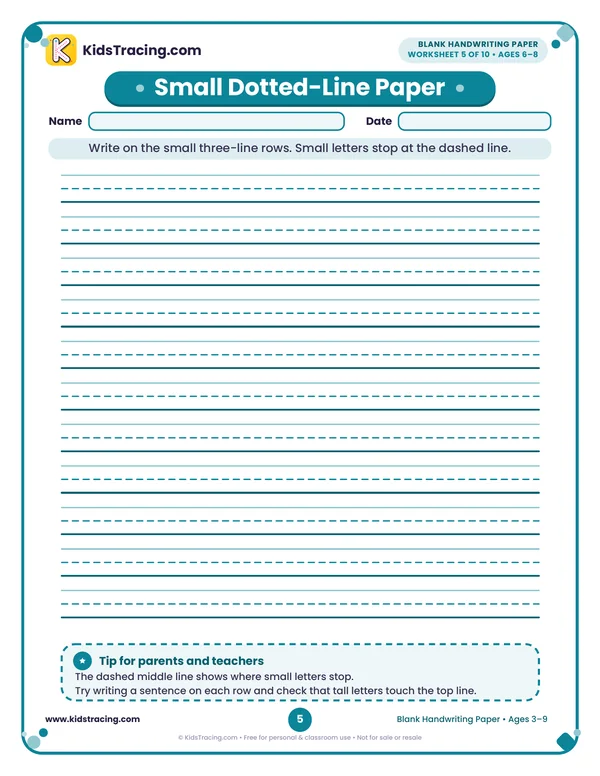
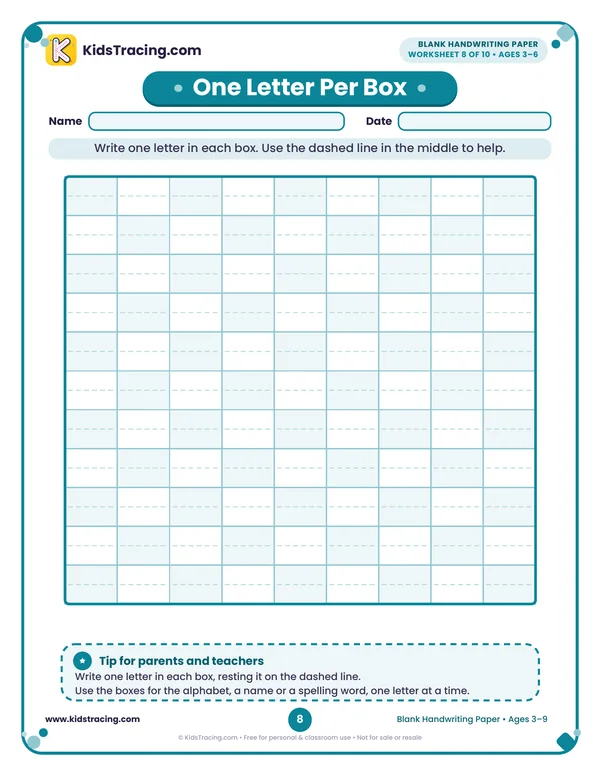
Yes. The ready-made section on this page has 10 printable handwriting paper pages in US Letter and A4: large, medium, wide-ruled, narrow-ruled and dotted-line paper, sky, grass and dirt lines, a draw and write page, one letter per box, cursive slant lines and square grid paper, for ages 3 to 9. They are blank, so there is no answer key.
What size lined paper should a kindergartner use?
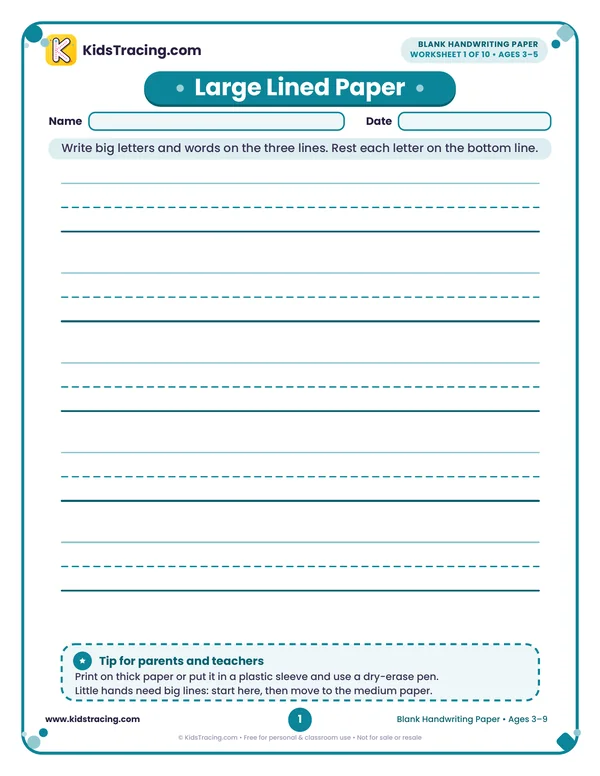
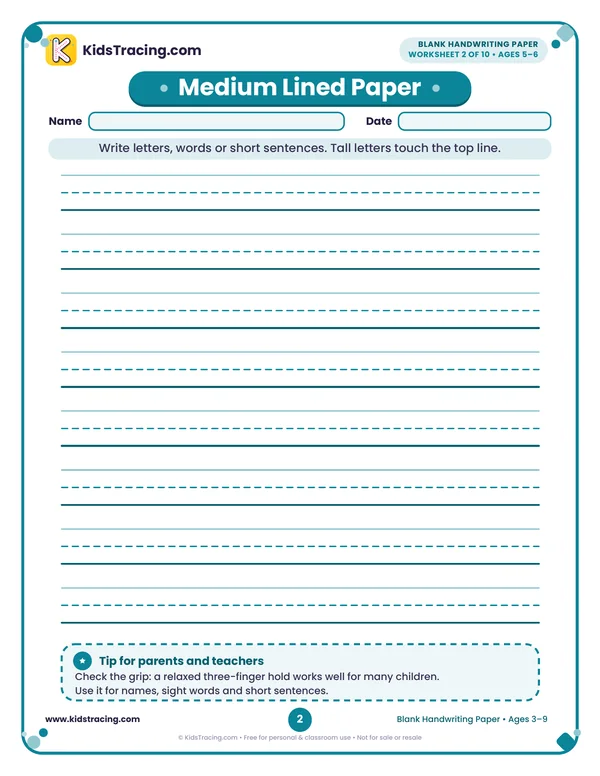
Medium Lined Paper has eight three-line rows and is made for kindergarten and first grade. If your child's letters keep spilling over the lines, try Large Lined Paper, which has five taller rows. Once letters sit neatly, Wide-Ruled Paper is the next step.
What is the difference between wide-ruled and narrow-ruled paper?
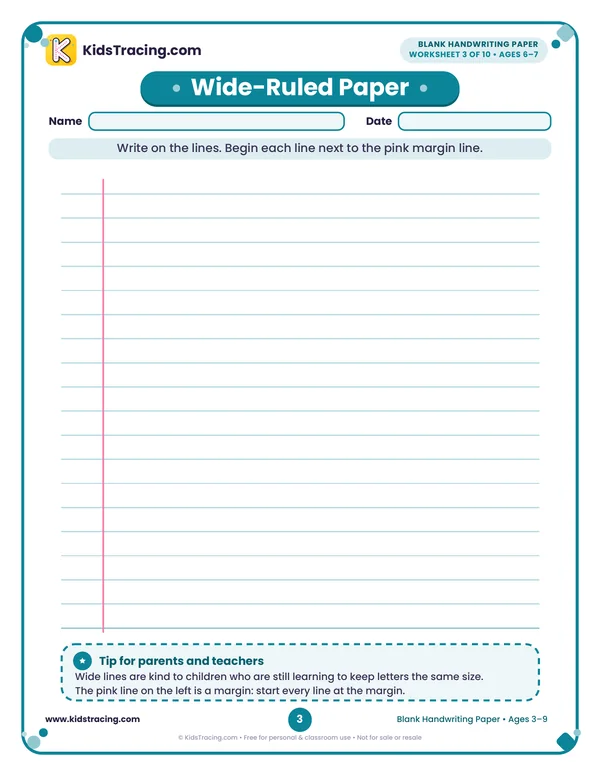
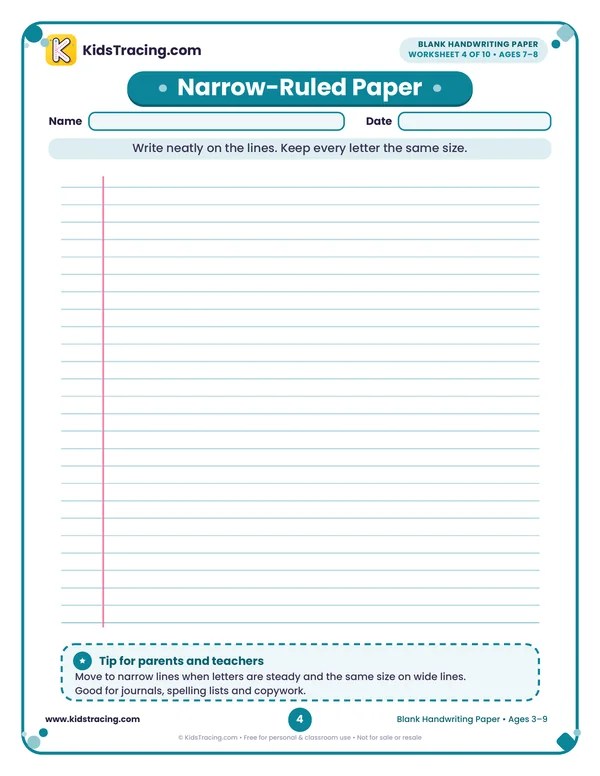
On our pages, Wide-Ruled Paper has 19 lines and a left margin and suits ages 6 to 7. Narrow-Ruled Paper has 26 lines, so the lines sit closer together, and it is labeled for ages 7 to 8. Move to narrow lines when your child's writing stays small and even on wide ones.
Do you have printable cursive writing paper?
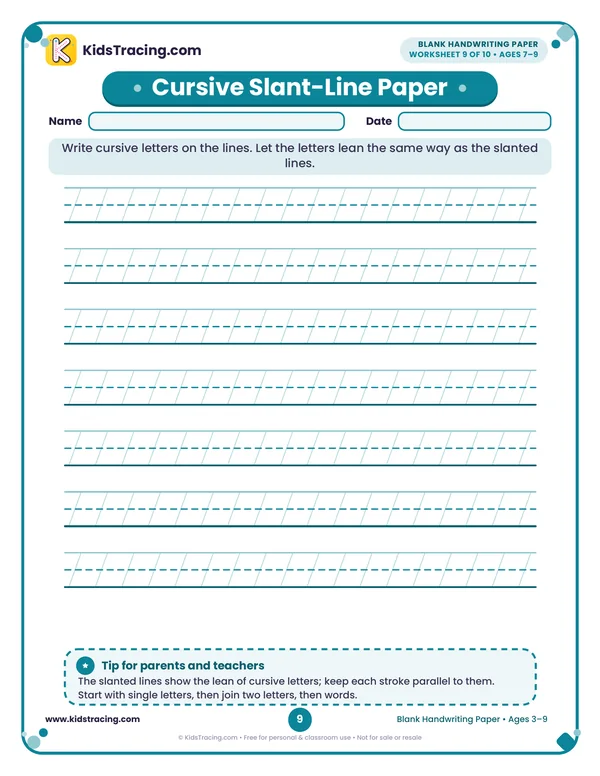
Yes. Cursive Slant-Line Paper has seven three-line rows with slanted guide lines to help keep a steady slant, and it is aimed at ages 7 to 9. It prints in US Letter and A4 like the other sheets. For letter models to copy, see our cursive writing practice pages.
Free Printable Blank Handwriting Paper (Ready-Made PDFs)
Some children need big letters and tall lines, and others need narrow rules and a slant. These ten blank papers cover both, from large three-line paper for ages 3 to 5 to cursive slant-line paper for ages 7 to 9, plus sky, grass and dirt lines, draw-and-write paper, letter boxes and square grid paper. They print in US Letter or A4, and blank paper has no answer keys.
Download all, US Letter PDF (all 10 blank handwriting paper worksheets)Download all, A4 PDF (all 10 blank handwriting paper worksheets)
Show 6 more worksheetsShow fewer worksheets
How to use these writing papers
Pick the line size by how big your child writes, not only by grade. A child who grips the pencil in a fist is usually more comfortable on Large Lined Paper, where five tall rows leave room for big letters. Move to Medium Lined Paper when letters mostly stay between the lines, and to Wide-Ruled Paper when your child writes a short sentence without help.
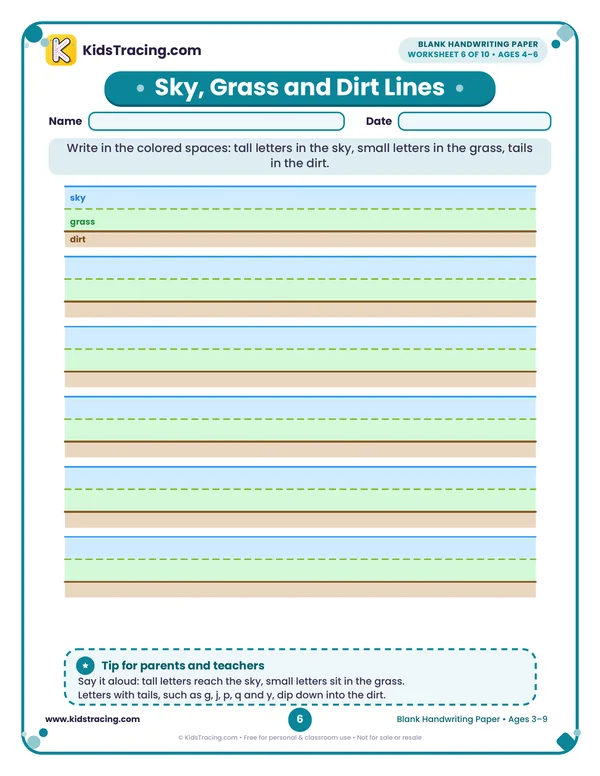
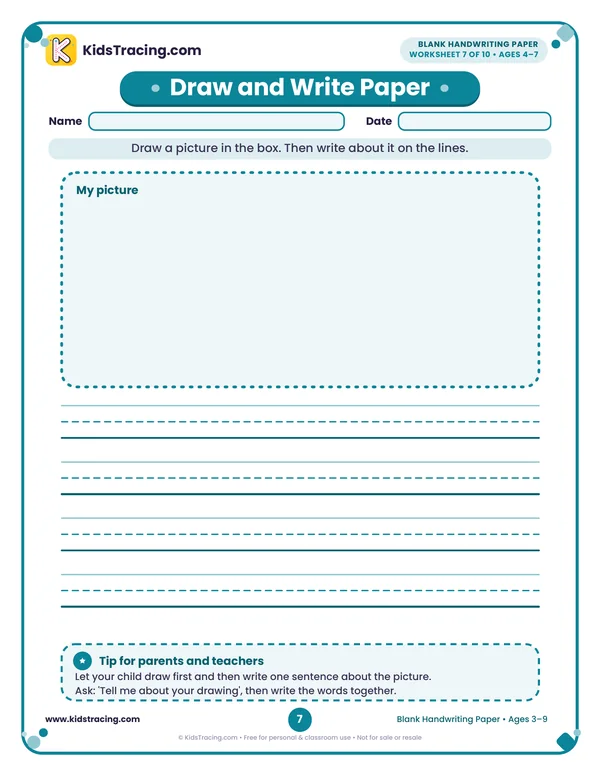
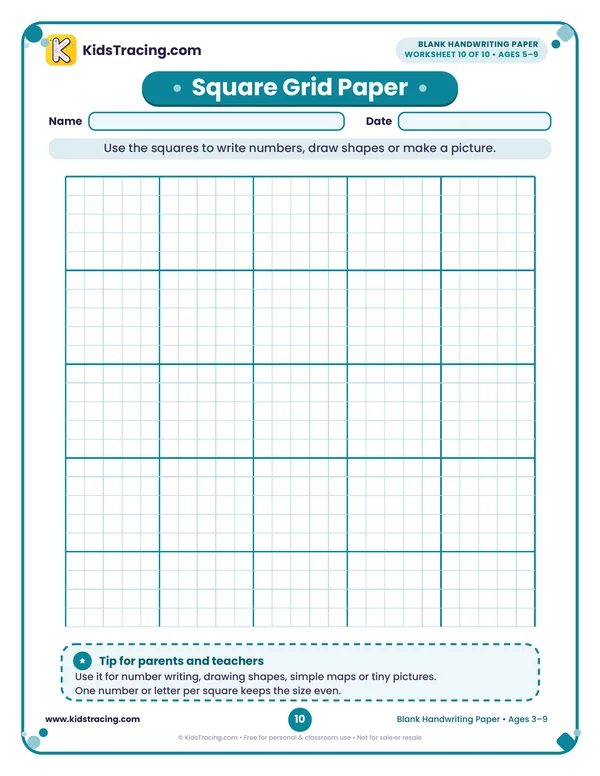
Sky, Grass and Dirt Lines gives each space its own color, so you can say that tall letters touch the sky and tail letters drop into the dirt. If your child would rather draw first, Draw and Write Paper has a big picture box and four lines for one sentence about it. Square Grid Paper is for numbers and drawing. Print at 100%, not Fit to page, so the lines keep their size. Our guide to the sky line, grass line and worm line explains the idea in more detail.
Which worksheet should I start with?
Ages 3 to 5: Large Lined Paper or One Letter Per Box. Kindergarten, ages 5 to 6: Medium Lined Paper or Sky, Grass and Dirt Lines. Ages 6 to 7: Wide-Ruled Paper. Ages 7 and up: Narrow-Ruled Paper, and Cursive Slant-Line Paper once your child starts cursive. Draw and Write Paper fits almost any age from 4 to 7.
More practice: name tracing and cursive writing. More pages are on kindergarten worksheets.
Free for personal, home and classroom use. Not for sale or resale.
Related worksheet tools
Explore more: Handwriting and Tracing Worksheets for Kids · Kindergarten Worksheets · All free worksheet tools
Guides for parents and teachers: How to Teach a Child to Write Their Name · How to Teach Cursive Handwriting to Kids · Cursive Letters A to Z: A Simple Guide for Kids · Cursive Practice Sentences for Kids: Easy to Hard List