7 Finger Spacing Activities for Kindergarten (Easy Word Spacing Practice)
Published by Hasnat N, Founder · November 8, 2026 · Updated November 8, 2026 · 7 min read
Quick answer: To teach spaces between words, say a short sentence aloud and tap once for each word, then write it with a finger or a craft stick as a spacer. A clear gap between words matters more than an exact width. Practice one short sentence at a time for about five minutes.
When a kindergartener writes Ilikemycat, the letters may be fine, but the words run together. Learning to leave spaces between words takes practice. The good news is that you do not need a special handwriting kit. A finger, a craft stick and a few short sentences are enough to get started.
Why do spaces between words matter?
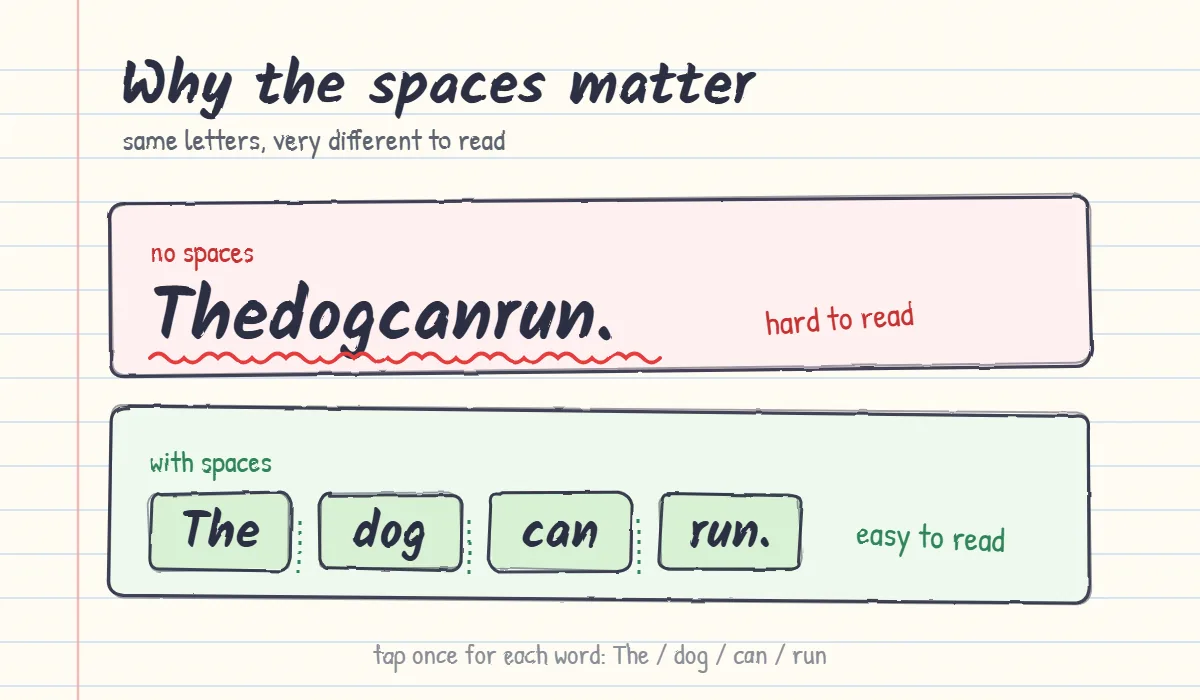
Compare these two lines:
Without spaces: Thedogcanrun.
With spaces: The dog can run.
The second is easier to read because we can see where each word begins and ends. Understanding that words are separated by spaces in print is one of the kindergarten foundational reading skills: standard RF.K.1.c of the Common Core kindergarten standards says children should “understand that words are separated by spaces in print.”
Before asking a child to write a sentence, say it aloud together. Tap once for each word: The / dog / can / run. If the child cannot yet tell where one spoken word ends and another begins, start with word cards and reading activities rather than more pencil work.
7 simple finger spacing activities
Pick one activity and try it for a few days before adding another. Occupational therapy guidance from the NHS also describes finger spacing, dots and simple spacers such as a lollipop stick (NHS Betsi Cadwaladr University Health Board: handwriting).
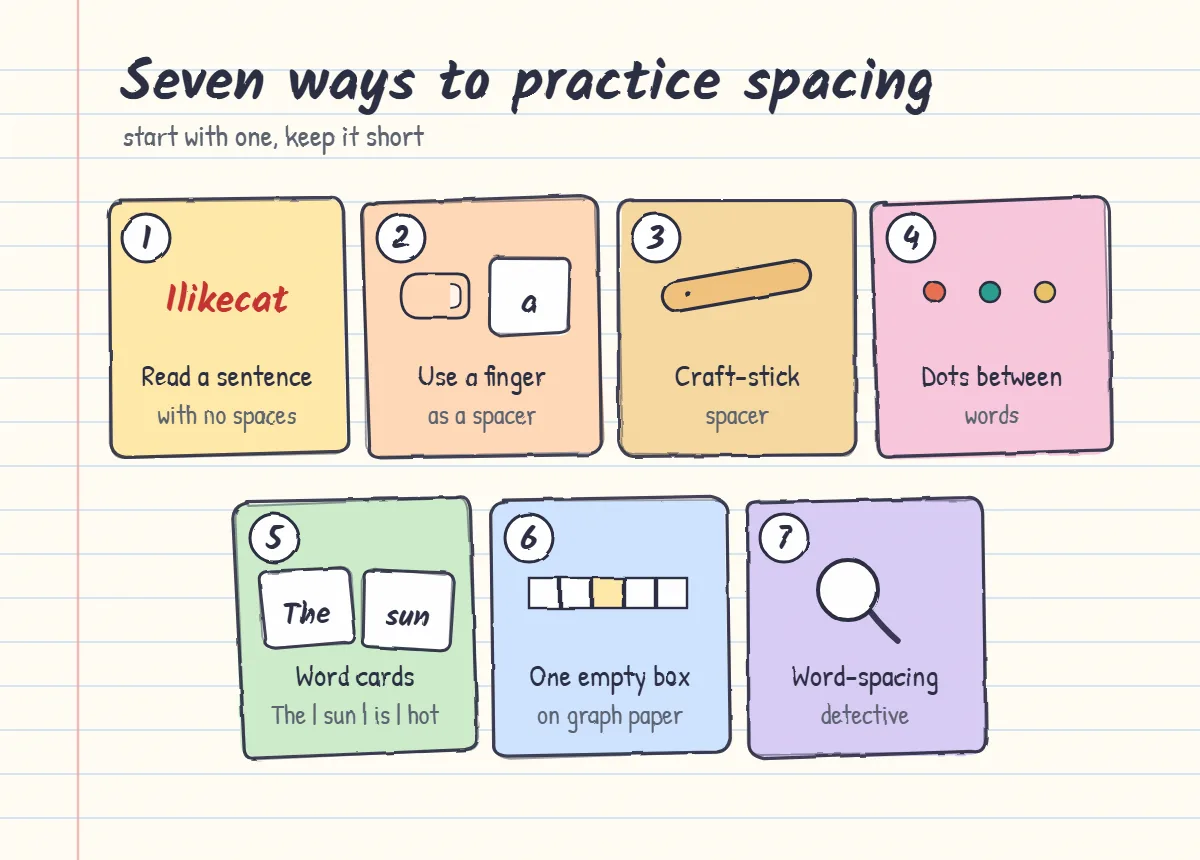
1. Read a sentence with no spaces
Write Ilikeapples on a board. Ask, “Is this easy to read?” Then rewrite it as I like apples. Read both aloud and count the words. Let your child draw short marks where the missing spaces should go in another simple sentence, such as Thecatisbig.
Try it with: I can hop. · We see a dog.
2. Use a finger as a spacer
Model a short sentence slowly. After writing I, put one finger from the helping hand beside it. Write see after the finger, then move the finger and write a cat with spaces. Ask your child to copy the sentence using the same method.
The finger is a temporary reminder, not a rule for exactly how wide every space must be. Aim for a visible gap between words and smaller gaps between letters.
3. Make a craft-stick spacer
If using a finger feels awkward, let the child decorate a clean craft stick. Place the stick after each completed word, write the next word, and lift it away. A narrow card strip can work too. Some children find a stick easier than moving a finger across the page.
4. Put a dot between words
Write We like cats. and have your child place a tiny colored dot in each space. Next, they copy the sentence, adding a pencil dot after each word. When the sentence is finished, erase the dots. This helps children see the gaps without stopping to measure them.
5. Build sentences with word cards
Cut three or four small paper cards and write one word on each: The | sun | is | hot. Arrange them in order with a little space between the cards. Read the sentence, push the cards together, then spread them apart again. Finally, copy the sentence onto paper, keeping the same visible gaps.
This is especially helpful for children who understand spoken sentences but are not ready to write every word independently.
6. Try one empty box on graph paper
Use large-square graph paper. Write a short word across several boxes, leave one box empty, and start the next word. For example, write My in two boxes, skip a box, then write dog. Once the child sees how the separation works, switch back to regular handwriting lines.
Do not worry about fitting every letter neatly into a tiny square; use larger boxes if needed.
7. Be a word-spacing detective
Give your child three short sentences. Two have clear spaces; one has missing spaces. Ask them to circle the places that need fixing. Then have them check one of their own sentences with this question: “Can I see where each word starts?”
Start with one correction, not a full page of red marks. The goal is to notice spacing independently.
Free handwriting paper for spacing practice
You can turn any of the activities above into a simple printable exercise:
- Open the free blank handwriting paper on KidsTracing.com and print a sheet with wide lines.
- Write one model sentence at the top: I see a dog.
- Ask the child to copy it once with a finger or craft-stick spacer, then once without it.
- Circle a space they remembered on their own.
For children still learning individual words, use the word tracing worksheet generator before moving to full sentences, or the sight words worksheets for short, common words. If handwriting feels tiring, the handwriting practice at home guide has ideas for shorter sessions.
Three sentences to practice today
- I like my dog. (4 words)
- The sun is hot. (4 words)
- We can run fast. (4 words)
Read each sentence aloud, count its words and have your child copy just one sentence at a time.
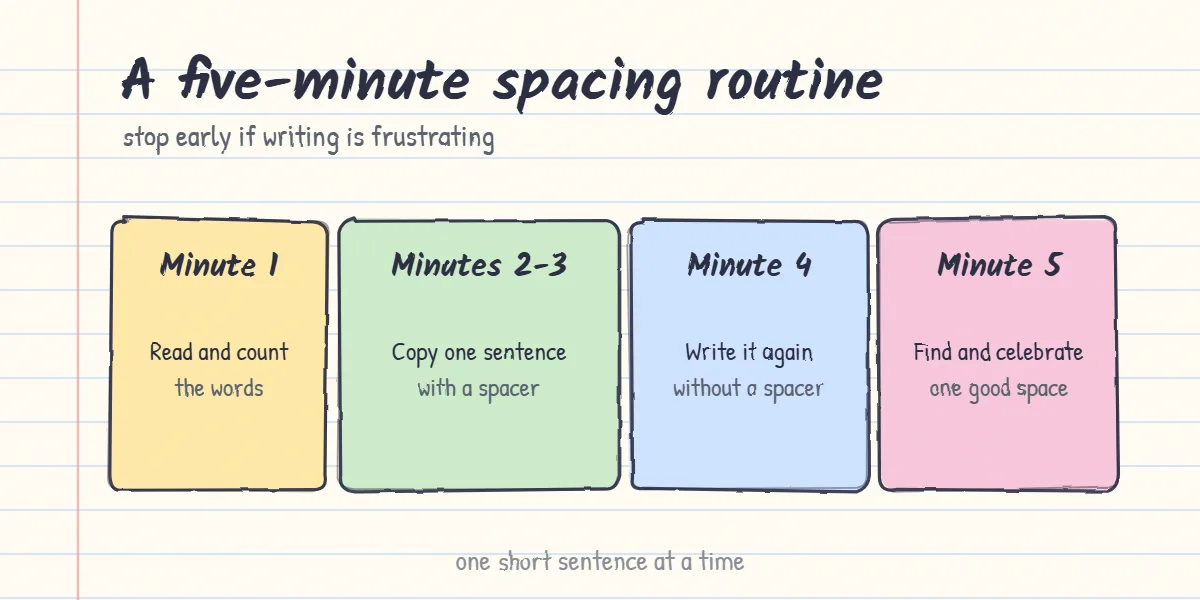
A five-minute spacing routine
Minute 1: Read a sentence together and count the words.
Minutes 2–3: Copy one sentence using a finger or craft-stick spacer.
Minute 4: Write the same sentence without a spacer, if ready.
Minute 5: Find and celebrate one correctly placed space.
If writing is frustrating, stop after the first activity. Understanding that spaces separate words is useful even before independent sentence writing is comfortable.
Is your child not yet writing words? See the handwriting readiness checklist. For learning to write a name, try how to teach a child to write their name. If the trouble is mostly refusing to write, read what to do when a child refuses to write.
Free printables to go with this guide
Short pages for short blocks: blank handwriting paper, word tracing, name tracing, sight words, kindergarten worksheets and all free worksheet generators.
Free workbooks to go with this guide
Sight Words Tracing Book
Trace, write and read common sight words, with sentences to read and write.
Free PDF Download US Letter · PDF of the Sight Words Tracing Book
CVC Words Workbook
Read, build, trace and write short a, e, i, o and u words with pictures, sound boxes and sentences.
Free PDF Download US Letter · PDF of the CVC Words Workbook
Alphabet Activity Book
70 picture pages to trace, match, color and solve: letter puzzles, beginning sounds, a letter hunt and a certificate.
Free PDF Download US Letter · PDF of the Alphabet Activity BookSources
Where we give outside information, it is listed here. The activities, the sample sentences and the five-minute routine are our own suggestions.
- Common Core: Kindergarten Reading, Foundational Skills (RF.K.1.c): “Understand that words are separated by spaces in print.”
- Betsi Cadwaladr University Health Board (NHS): Handwriting: spacing techniques such as a helper-hand finger, dots after each word and other spacers.
Keep reading
- Handwriting Practice at Home: How Long and How Often – Plan manageable handwriting practice at home with sample sessions, specific feedback, useful observations and ways to adjust difficulty.
- How to Teach a Child to Write Their Name – Teach name writing through recognition, letter formation, tracing, copying and independent attempts, with practical activities and free worksheets.
- Handwriting Readiness Checklist: Is Your Child Ready to Write? – Use practical handwriting readiness observations to notice comfort, control and interest, choose activities and support early writing without a pass/fail score.
- My Child Refuses to Write: What to Do (Ages 3 to 6) – Child refuses to write? Learn why preschoolers avoid writing and 9 gentle, practical ways to help, from play to short sessions and free printables.
- Is My Child Behind in Writing? What to Expect at Ages 3 to 6 – Worried your child is behind in writing? See what is typical from scribbling to writing a name at ages 3 to 6, signs to watch, and how to help.
Frequently asked questions
How much space should a kindergartener leave between words?
Enough that the words are clearly separated. A finger is a useful starting cue, but the right gap depends on the child’s writing size. A visible, consistent gap matters more than an exact measurement.
What if my child puts spaces between every letter?
Show the difference using word cards: the letters stay together to make dog, and a space separates dog from the next word. Practice finding complete words before copying longer sentences.
What if finger spacing does not work for a left-handed child?
Try a craft stick, a narrow card strip or small removable dots. Let the child place the paper and the helping hand comfortably instead of forcing one method.
Should I correct every missing space?
No. Choose one short sentence, point out one missing gap and show how to fix it. Children are more likely to pay attention when feedback is specific and manageable.
At what age should children leave spaces between words?
Many children begin to do this in kindergarten, and the Common Core kindergarten standards include understanding that words are separated by spaces in print. Children develop at different speeds, so keep practice short and positive.