How Long Should Preschoolers Practice Tracing?
Published by Hasnat N, Founder · November 3, 2026 · Updated November 3, 2026 · 8 min read
Quick answer: For most preschoolers, 3 to 5 minutes of tracing is plenty at age 3, 5 to 10 minutes at age 4 and 10 to 15 minutes at age 5, a few times a week. Stop when the hand tires, the lines get messy or your child loses interest. Tracing is a stepping stone: move on to copying and independent writing when tracing becomes easy.

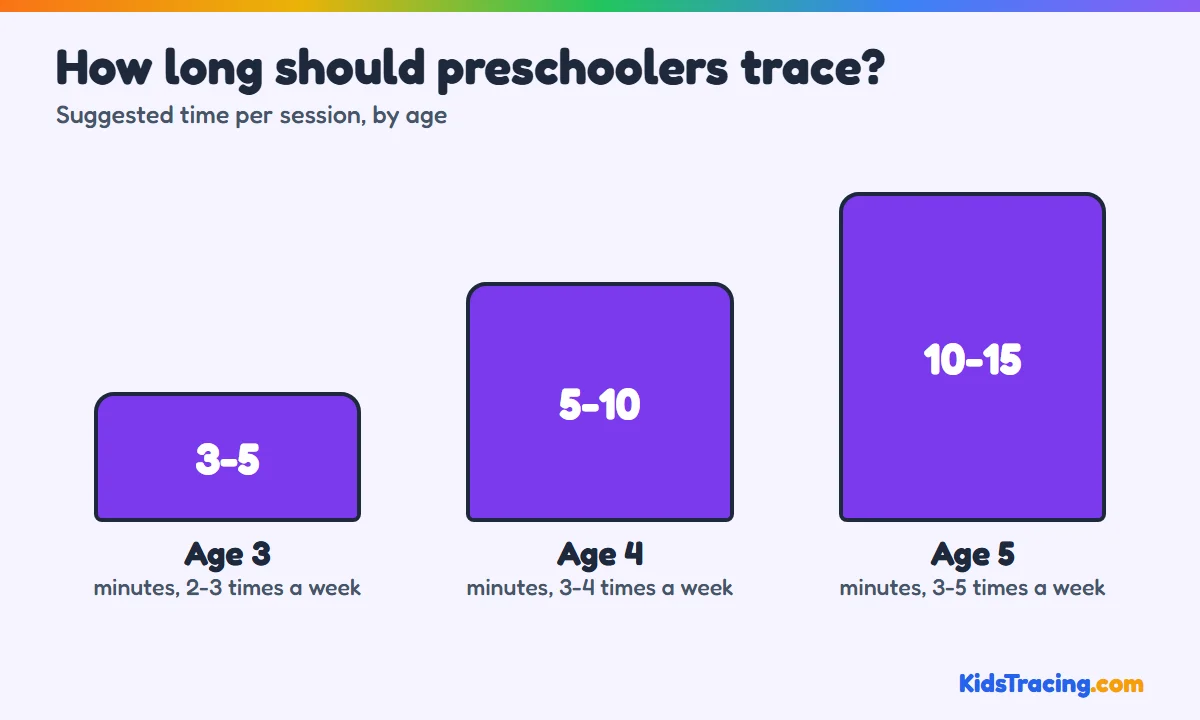
How long to trace by age
These are gentle guides, not rules. Your child’s mood and energy matter more than the clock.
| Age | Time per session | How often |
|---|---|---|
| 3 | 3 to 5 minutes | 2 to 3 times a week |
| 4 | 5 to 10 minutes | 3 to 4 times a week |
| 5 | 10 to 15 minutes | 3 to 5 times a week |
There is no official standard for tracing time. Teaching blogs give different ranges (for ages 4 to 5, one suggests about 5 to 10 minutes and another 10 to 15), so the times above are our practical suggestions, not medical rules. Your child’s mood matters more than the clock.
For a wider routine that includes drawing, copying and writing, see handwriting practice at home: how long and how often. This guide focuses only on tracing.
Why short sessions work better
Tracing uses small hand muscles and close eye-hand coordination, and both tire quickly in young children. When the hand is tired, lines wobble and children often rush or give up. A short session ends while your child still feels successful, and that feeling is what brings them back tomorrow.
What to trace, in a sensible order
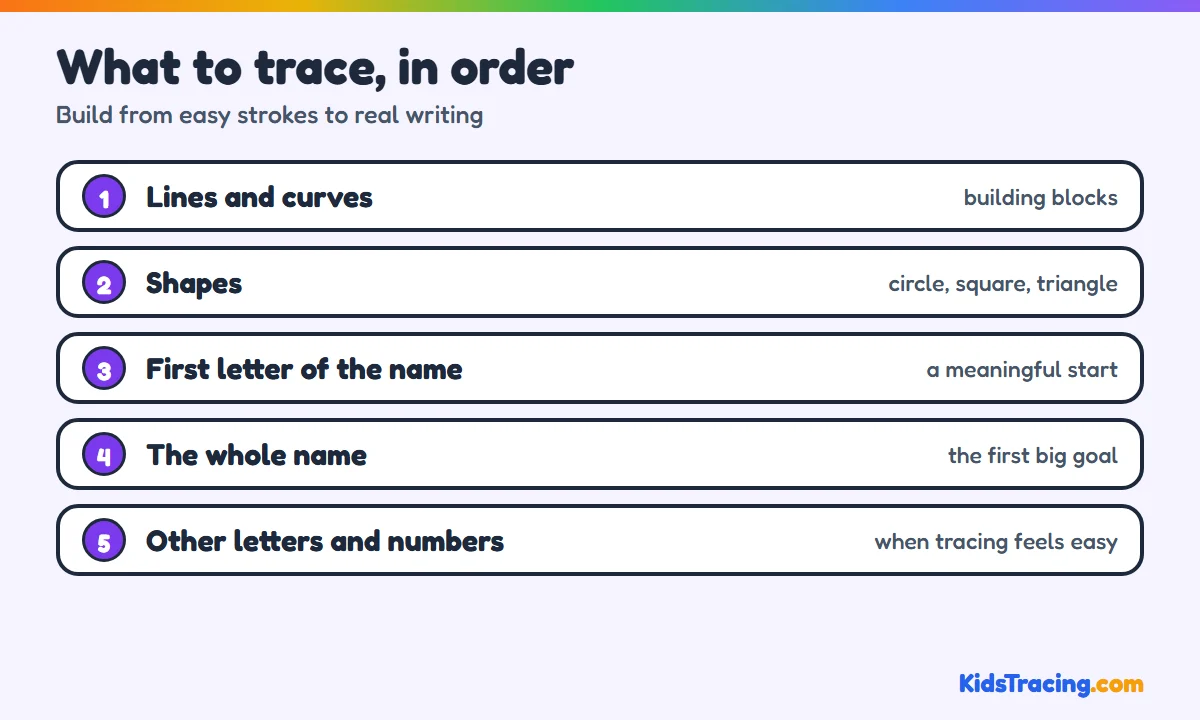
- Lines and curves. Straight, wavy and zigzag lines are the building blocks of letters. Start with pre-writing lines.
- Shapes. Circles, squares and triangles build control. Try shape tracing worksheets.
- The first letter of the name. A meaningful letter motivates more than a random one.
- The whole name. Use a name tracing sheet.
- Other letters and numbers. Move on to letter formation worksheets and number tracing.
You do not need to finish one step before touching the next, but this order keeps the hardest strokes for later.
A simple 10-minute tracing routine (age 4 to 5)
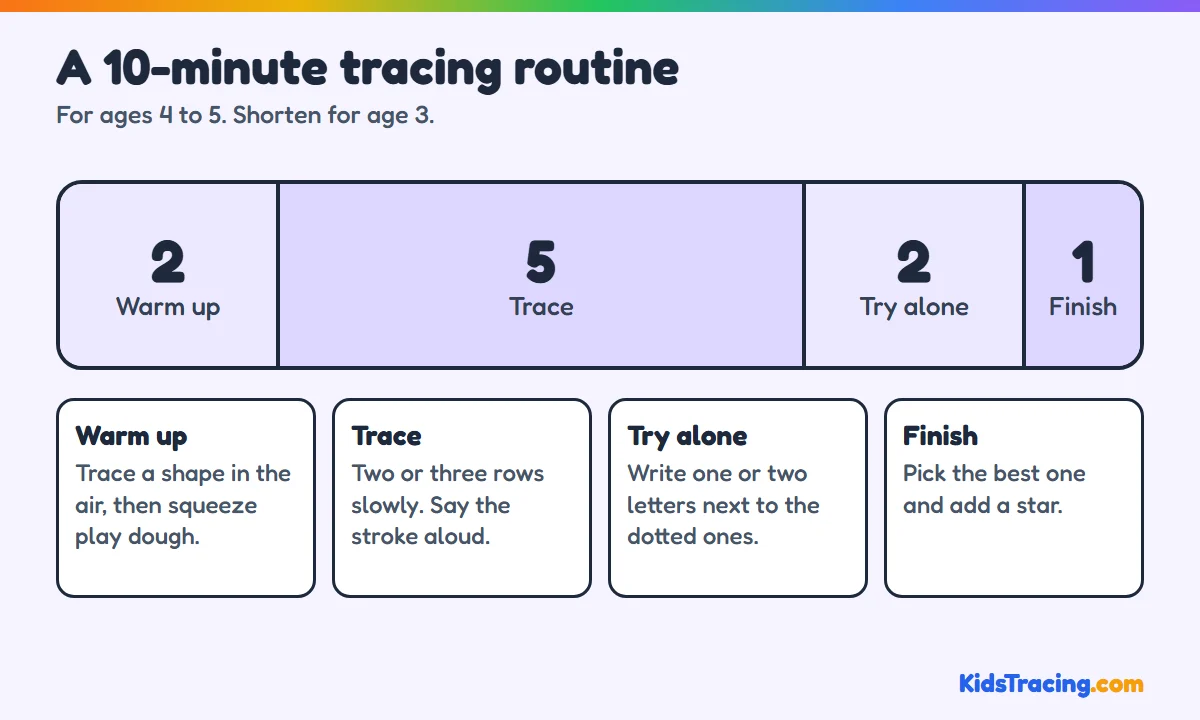
- Warm-up (2 minutes). Trace a shape in the air or on a tray of sand with a finger, then squeeze play dough.
- Trace (5 minutes). Choose one worksheet and trace two or three rows slowly. Say the stroke out loud, for example “down, then across.”
- Try one on your own (2 minutes). Write one or two letters next to the dotted ones, with no pressure to make them neat.
- Finish (1 minute). Pick the best one together and add a star.
For age 3, do only the warm-up and one short trace. For age 4, cut the middle step to three minutes.
Signs it is time to stop
- The lines get much messier than they were at the start.
- Your child rubs the hand, shakes it or presses too hard.
- Your child rushes, scribbles over the dotted line or says “I am done.”
- There is frustration or tears.
Stopping at this point is not giving up. It is the right call, and it protects your child’s interest for the next session.
When to move from tracing to writing on their own
Move forward when tracing is easy, your child stays on the line most of the time and shows interest in writing without a model. A good next step is to write a letter or two next to a model, then try writing the name alone. Our guide to dotted, outline and solid tracing explains how to make tracing gradually harder.
Tracing does not harm creativity when it is only part of the day. Keep free drawing and play alongside it.
Ways to make tracing more fun
- Trace with a finger, a chunky crayon or a dot marker instead of a pencil.
- Use colored pencils, markers or gel crayons so each line is a different color.
- Trace in a tray of salt, sand or shaving cream first, then on paper.
- Put a worksheet in a plastic sleeve and trace with a dry-erase marker so mistakes wipe away.
- Try a picture to color by number afterwards as a reward.
When should I talk to a teacher or doctor?
Many children dislike tracing now and then, and that is normal. Talk to your child’s teacher or pediatrician if your child avoids all drawing and tracing for several weeks, says the hand hurts, or still holds the pencil in a fist at age 4 or 5. The CDC 4-year checklist lists holding a crayon or pencil between the fingers and thumb, not in a fist, as a typical skill. It also says to ask about developmental screening if you are worried. This guide is general information and not medical advice.
Free printables to go with this guide
Short tracing sheets for short sessions: pre-writing worksheets, shape tracing worksheets, name tracing worksheets and word tracing worksheets.
Free workbooks to go with this guide
Pen Control and Pre-Writing Book
Lines, curves, zigzags, loops and spirals, plus paths from a bee to a flower, to build pencil control.
Free PDF Download US Letter · PDF of the Pen Control and Pre-Writing Book
ABC Tracing Book
Every letter A to Z with numbered stroke arrows, a picture to color and a word to trace.
Free PDF Download US Letter · PDF of the ABC Tracing Book
Dot Marker Activity Book
Big letters, numbers, shapes and pictures filled with circles for dot markers, stickers or fingertips.
Free PDF Download US Letter · PDF of the Dot Marker Activity BookSources
For the milestone and when to ask for advice, and for the tracing times other teaching blogs suggest, see:
- CDC: Milestones by 4 years includes holding a crayon or pencil between the fingers and thumb, and says to ask about developmental screening.
- Class Weekly: Teaching handwriting to preschoolers suggests 5 to 10 minutes for ages 4 to 5.
- Lil Legends: How long should a child practice tracing every day? suggests 10 to 15 minutes for ages 4 to 5.
Keep reading
- Handwriting Practice at Home: How Long and How Often – Plan manageable handwriting practice at home with sample sessions, specific feedback, useful observations and ways to adjust difficulty.
- Dotted vs Outline vs Solid Gray Tracing: Which Style Comes First? – Compare dotted, outline and solid gray tracing, choose support from the child's response, and bridge tracing with copying and independent writing.
- Handwriting Readiness Checklist: Is Your Child Ready to Write? – Use practical handwriting readiness observations to notice comfort, control and interest, choose activities and support early writing without a pass/fail score.
- My Child Refuses to Write: What to Do (Ages 3 to 6) – Child refuses to write? Learn why preschoolers avoid writing and 9 gentle, practical ways to help, from play to short sessions and free printables.
- Is My Child Behind in Writing? What to Expect at Ages 3 to 6 – Worried your child is behind in writing? See what is typical from scribbling to writing a name at ages 3 to 6, signs to watch, and how to help.
Frequently asked questions
How many tracing pages a day is enough for a preschooler?
One page, or part of a page, is enough for most preschoolers. Quality matters more than quantity. Stop when the lines start to get messy or your child gets tired.
Should preschoolers trace every day?
Not necessarily. Two to four short sessions a week are enough for most children, with play, drawing and coloring on the other days. Daily tracing is fine if your child enjoys it and the sessions stay short.
Is tracing bad for creativity?
No. Tracing builds hand control, and creativity comes from drawing, building and play, which should continue alongside it. Use tracing for a few minutes and leave plenty of time for free drawing.
When should my child stop tracing?
When tracing feels easy, your child can copy simple shapes and letters from a model and shows interest in writing without help. Many children are ready somewhere between ages 4 and 6, but there is a wide range.
What if my child hates tracing?
Try big movements first, such as tracing in the air or in sand, make the sessions shorter and let your child choose the color or the letter. If the dislike continues, read our guide to a child who refuses to write.