Shadow Matching Activity Book: Free Printable Shadow Puzzles for Ages 3 to 6
A free printable shadow matching book with 33 activity pages for ages 3 to 6. Your child matches a picture to its dark outline by drawing lines, circling the right shadow, finding twins and the odd one out, and cutting and gluing. The puzzles begin with three big pairs on a page and end with shadows that face the wrong way. An answer key and a certificate are at the back. Download the 42-page PDF in US Letter or A4 and print it at home or in class.
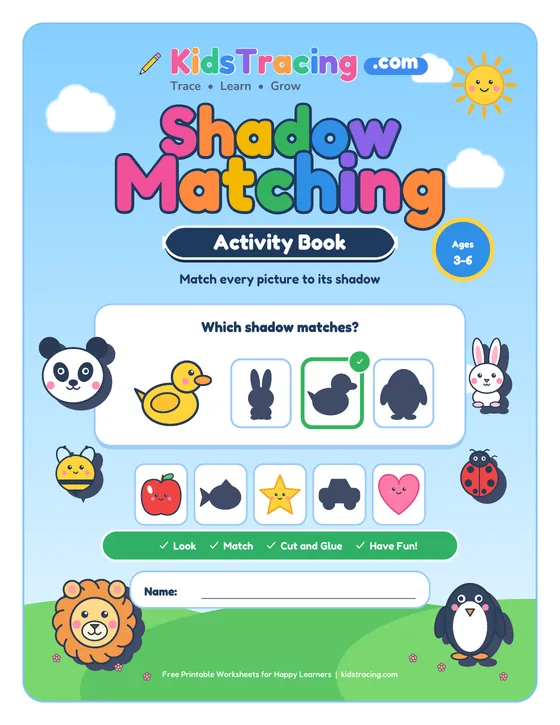
Download Shadow Matching Activity Book
- 42 pages with 33 shadow puzzles for ages 3–6
- 52 different pictures, each matched with its exact shadow
- Draw lines, circle, find twins, color and match, cut and glue
- Answer key, a page of shadow games for home and a certificate
- Free for home and classroom use, with no sign-up or email address
- Two PDF files: US Letter (8.5 × 11 in) and A4
Print at 100% (Actual size). Choose US Letter in the United States and Canada, and A4 almost everywhere else. How to print a workbook
Who the Shadow Matching Activity Book is for
Shadow matching is often treated as a toddler puzzle, yet the idea stretches a long way. A three-year-old can start by seeing that a duck and a duck-shaped dark patch belong together. A six-year-old can be asked which of three duck shadows faces the same way as the picture, and that is a much harder question than it sounds. This book covers the whole range in eight parts, so it stays useful as your child grows.
The first part is for the youngest children. There are three pairs on a page, each one drawn big enough to fill its box, and no shadow ever sits in the same row as its own picture, so the first line a child draws always slants across the page. Nothing in the book has to be written. Your child draws lines, circles shadows, colors a few pictures and, on four pages, cuts with scissors and glues. A thick crayon is plenty for the first pages.
This is a finished book with a fixed order, not a generator. If you only need a single page of shadow matching worksheets, or one built from pictures your child loves, our shadow matching worksheet generator makes one in seconds. It is also handy after the book, when you want extra practice at one level.
What is inside the Shadow Matching Activity Book
There are 42 pages in all. Each page has its number in the bottom corner, and each activity page carries a colored label in the top corner with the name of its part, so it is easy to print one part at a time and to find your place again. In total your child will meet 52 different pictures, 55 picture and shadow pairs and 48 circle-the-answer questions.
| Pages | Part | Number of pages |
|---|---|---|
| 1–3 | Cover, welcome page for adults, and contents | 3 |
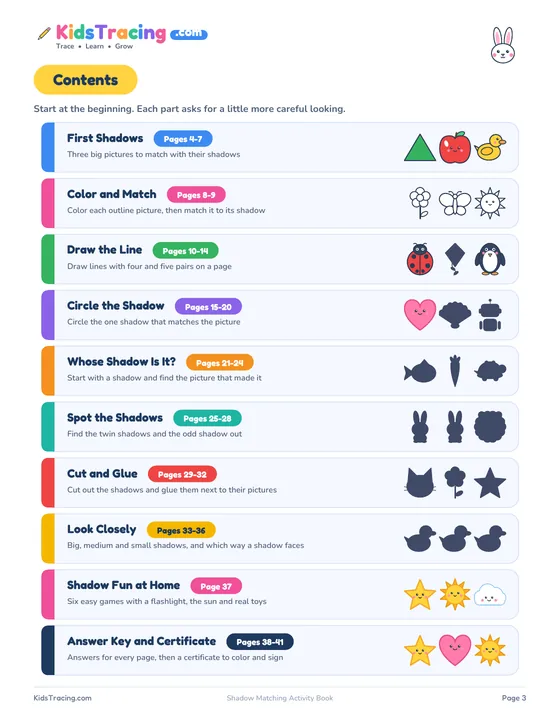
| 4–7 | First Shadows | 4 |
| 8–9 | Color and Match | 2 |
| 10–14 | Draw the Line | 5 |
| 15–20 | Circle the Shadow | 6 |
| 21–24 | Whose Shadow Is It? | 4 |
| 25–28 | Spot the Shadows | 4 |
| 29–32 | Cut and Glue | 4 |
| 33–36 | Look Closely | 4 |
| 37 | Shadow fun at home: six easy games with a flashlight, the sun and real toys | 1 |
| 38–40 | Answer key for every page | 3 |
| 41 | Certificate of achievement | 1 |
| 42 | Back cover | 1 |
Start here (pages 1–3)
The cover shows a sample puzzle: a yellow duck and three shadows, with a green check on the one that fits. Page 2 greets parents and teachers with six quick steps and a line for the child’s name. Page 3 lists the parts of the book, each with a few small pictures that show what to expect.
First Shadows (pages 4–7)
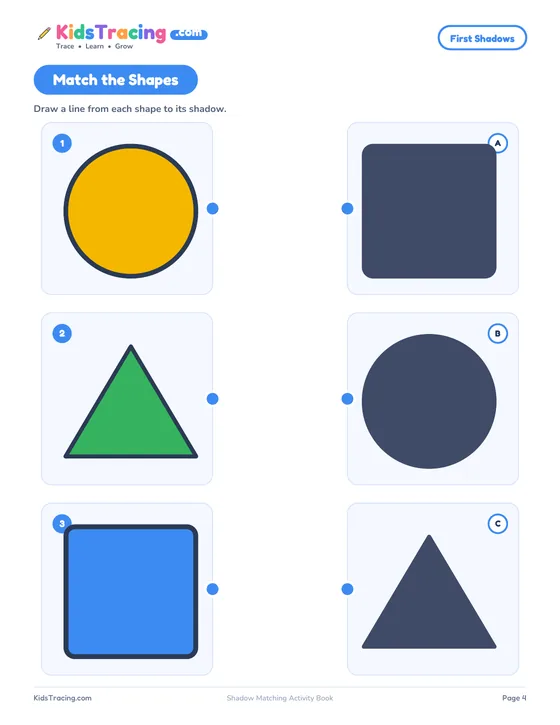
Four pages with three big pairs each: shapes, treats, animals and toys. The shapes page comes first on purpose, because a circle, a square and a triangle are about the easiest outlines there are to tell apart. After that the pictures get more detailed, but the three shadows on a page still look very different from one another. A dot sits beside every picture and every shadow, so a child knows where to start a line and where to finish it.
| Page | Activity | What your child does |
|---|---|---|
| 4 | Match the Shapes | Draw a line from a circle, a triangle and a square to their shadows. |
| 5 | Match the Treats | Draw a line from an apple, a banana and an ice cream to their shadows. |
| 6 | Match the Animals | Draw a line from a duck, an elephant and a bunny to their shadows. |
| 7 | Match the Toys | Draw a line from a car, a kite and a robot to their shadows. |
Color and Match (pages 8–9)
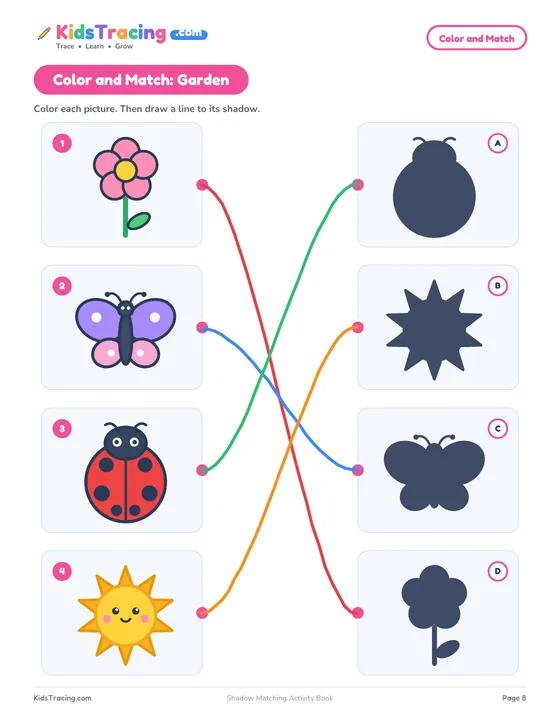
On these two pages the pictures are line drawings. Your child colors each one in first and then draws a line to its shadow. Coloring makes a child look at a picture for a while before matching it, and that helps the outline stick in memory. Because the pictures are line drawings, these pages print well in black and white.
| Page | Activity | What your child does |
|---|---|---|
| 8 | Color and Match: Garden | Color a flower, a butterfly, a ladybug and a sun, then draw a line from each one to its shadow. |
| 9 | Color and Match: Fun | Color a sailboat, a cupcake, a bee and a gift, then draw a line from each one to its shadow. |
Draw the Line (pages 10–14)
Five pages with four or five pairs on each. More pairs mean more lines crossing the page and more shadows to rule out, so a child has to think “not that one” as well as “that one”. Every page has a theme, such as garden friends or a sunny day, but within a page no two shadows look alike.
| Page | Activity | What your child does |
|---|---|---|
| 10 | Garden Friends | Draw a line from a ladybug, a mushroom, a tulip and a butterfly to their shadows. |
| 11 | Animal Friends | Draw a line from a cat, a turtle, a fish and a penguin to their shadows. |
| 12 | Sunny Day | Draw a line from a sun, a cloud, a kite, a sailboat and a balloon to their shadows. |
| 13 | Yummy Things | Draw a line from a cupcake, a carrot, a strawberry, a lollipop and a banana to their shadows. |
| 14 | Wild and Wonderful | Draw a line from a lion, an elephant, a bird, a worm and a bunny to their shadows. |
Circle the Shadow (pages 15–20)
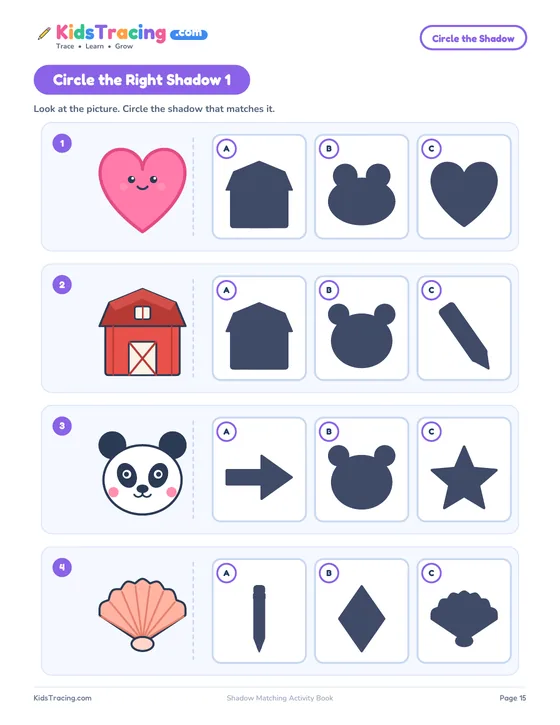
Here the lines stop and the circling starts. A picture sits on the left and three shadows sit on the right, and your child circles the one that fits. On the first two pages the wrong shadows are easy to dismiss, because a heart is shown beside a barn and a frog. On the next two the wrong shadows come from the same group, so an animal has to be told from other animals. The last two pages use the closest look-alikes that the book allows, and that is where ears, tails and corners start to matter.
| Page | Activity | What your child does |
|---|---|---|
| 15 | Circle the Right Shadow 1 | The pictures are a heart, a barn, a panda and a shell. Circle the matching shadow out of three. The two wrong shadows come from other groups, so they look nothing like the picture. |
| 16 | Circle the Right Shadow 2 | The pictures are a hexagon, a leaf, a fox and a gift. Circle the matching shadow out of three. The two wrong shadows come from other groups, so they look nothing like the picture. |
| 17 | Circle the Right Shadow 3 | The pictures are a rectangle, a strawberry, a robot and a turtle. Circle the matching shadow out of three. The wrong shadows come from the same group, such as animals with animals, so the outline has to decide. |
| 18 | Circle the Right Shadow 4 | The pictures are an arrow, a bee, a lollipop and a flower. Circle the matching shadow out of three. The wrong shadows come from the same group, such as animals with animals, so the outline has to decide. |
| 19 | Circle the Right Shadow 5 | The pictures are a duck, a hexagon, a pencil and a star. Circle the matching shadow out of three. The wrong shadows are the closest look-alikes that the book allows. |
| 20 | Circle the Right Shadow 6 | The pictures are a lion, a cross, a crayon and a cupcake. Circle the matching shadow out of three. The wrong shadows are the closest look-alikes that the book allows. |
Whose Shadow Is It? (pages 21–24)
This part turns the question around. A big dark shadow sits on the left, three colored pictures are on the right, and your child decides which picture could have made it. That is a harder job than matching two things that are both in front of you, because the child has to imagine the shadow of each choice. Color gives no clue, because the shadow has none, so the outline has to decide.
| Page | Activity | What your child does |
|---|---|---|
| 21 | Whose Shadow Is It? 1 | The shadows belong to a fish, a diamond, a flower and a carrot. Circle the picture that made each one, out of three. The wrong pictures are from other groups. |
| 22 | Whose Shadow Is It? 2 | The shadows belong to an elephant, a cloud, a shell and a heart. Circle the picture that made each one, out of three. The wrong pictures are from other groups. |
| 23 | Whose Shadow Is It? 3 | The shadows belong to an arrow, a fish, a banana and a tulip. Circle the picture that made each one, out of three. The wrong pictures are from the same group, so color gives no help. |
| 24 | Whose Shadow Is It? 4 | The shadows belong to a bird, a pencil, a diamond and a star. Circle the picture that made each one, out of three. The wrong pictures are from the same group, so color gives no help. |
Spot the Shadows (pages 25–28)
Four pages with no pictures at all, only shadows. The twin pages ask your child to scan a row of six and find the two that are exactly the same. The odd one out pages turn the job around: three shadows match and one does not. By page 28 the odd shadow is the same picture facing the other way, which makes the difference very small.
| Page | Activity | What your child does |
|---|---|---|
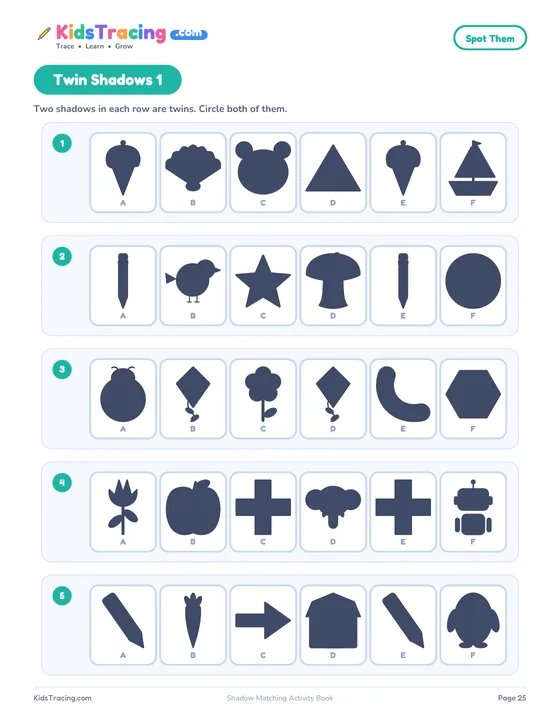
| 25 | Twin Shadows 1 | Five rows of six shadows, and exactly two in each row are the same. In row 1, for example, the twins are the two ice cream shadows hiding among a shell, a panda, a triangle and a sailboat. The shadows in a row come from unrelated things, so the twins stand out. |
| 26 | Twin Shadows 2 | Five rows of six shadows, and exactly two in each row are the same. In row 1, for example, the twins are the two bunny shadows hiding among a lion, a fish, a bee and a worm. Each row is one kind of thing, such as animals or shapes, so the shadows look more alike. |
| 27 | Odd Shadow Out 1 | Five rows of four shadows. In row 1, for example, three are gift shadows and one is a pentagon. Circle the odd one in every row. |
| 28 | Odd Shadow Out 2 | Five rows of four shadows of one picture, such as the crayon in row 1. In every row one shadow faces the other way. Circle it. |
Cut and Glue (pages 29–32)
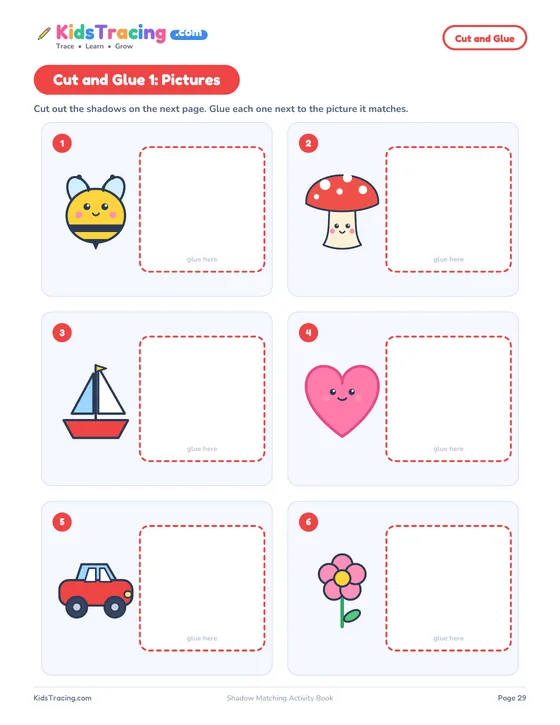
Two sets of six. In each set, one page shows six pictures with an empty dashed box beside each, and the next page holds six shadows to cut out. The boxes are exactly the size of the cut-out squares, so every piece fits. Each shadow sits in its own square with softly rounded corners, so the cutting follows easy, nearly straight lines. For practice at cutting around curved shapes, see the Scissor Skills Cutting Practice Book.
| Page | Activity | What your child does |
|---|---|---|
| 29 | Cut and Glue 1: Pictures | The pictures are a bee, a mushroom, a sailboat, a heart, a car and a flower, each with an empty dashed box. Cut the shadows out of page 30 and glue each one in its box. |
| 30 | Cut and Glue 1: Shadows | Six shadows to cut out along the dashed lines. Each one goes in the box beside the picture that made it, on page 29. |
| 31 | Cut and Glue 2: Pictures | The pictures are a fish, a shell, a robot, a pencil, a turtle and a star, each with an empty dashed box. Cut the shadows out of page 32 and glue each one in its box. |
| 32 | Cut and Glue 2: Shadows | Six shadows to cut out along the dashed lines. Each one goes in the box beside the picture that made it, on page 31. |
Look Closely (pages 33–36)
The last part asks for the most careful looking. On the first two pages the same picture is shown big, medium and small, and the shadows come in the same three sizes, so a child has to compare size as well as shape. On the last two pages each question shows one picture and three shadows with the same outline, but only one of them faces the same way as the picture. The other two are a mirror image and an upside-down copy.
| Page | Activity | What your child does |
|---|---|---|
| 33 | Big, Medium and Small 1 | Two sets, a duck and a heart. In each set the same picture appears big, medium and small. Match every size to the shadow of the same size. |
| 34 | Big, Medium and Small 2 | Two sets, a car and a tulip. In each set the same picture appears big, medium and small. Match every size to the shadow of the same size. |
| 35 | Which Way Does It Face? 1 | The pictures are a duck, a fish, a bird and a banana. Each one comes with three shadows of the same outline: one facing the same way, one facing the other way and one upside down. Circle the one that matches. |
| 36 | Which Way Does It Face? 2 | The pictures are a worm, a tulip, a crescent and an arrow. Each one comes with three shadows of the same outline: one facing the same way, one facing the other way and one upside down. Circle the one that matches. |
Games, answer key and certificate (pages 37–42)
Page 37 has six games to play away from the page: Flashlight Show, Trace a Shadow, Shadow Hunt, Bigger and Smaller, Shadow Chase and Morning to Afternoon. They use a flashlight, the sun and toys you already own. Pages 38 to 40 give the answers for every activity page, page 41 is a certificate to color and sign and page 42 is the back cover.
Sample pages
A few pages from the finished workbook. The PDF is sharp enough to print at full size.
Skills your child practices
- Telling shapes apart by their outline
- Looking at the whole shape and ignoring color and inner details
- Noticing small differences, such as which way a shadow faces
- Picturing the shadow of a picture before seeing it
- Comparing big, medium and small
- Drawing lines, circling and coloring with control
- Cutting along straight lines and gluing neatly
- Describing shapes in words, such as long, round and pointed
How to use this workbook
Print the book
Pick the file that fits your paper, US Letter or A4, and print it at 100% (Actual size). Print the cut and glue pages (pages 29–32) on one side only, and keep the answer key (pages 38–40) for yourself.
Begin with First Shadows
Start on pages 4 to 7, where there are only three big pairs. Move on when matches feel easy, even if your child is older than the cover age.
Say what you see
Before your child draws a line, talk about the picture: “It has long ears and a round tail.” Then ask which shadow has those parts.
Draw, circle and cut
Let your child choose a crayon and draw from dot to dot. Lines may cross. On the circle pages, circle the shadow. For cut and glue, help with the first cut and let your child decide where each shadow goes.
Check and celebrate
Go through each page together with the answer key. If a match is off, put the two shapes side by side and look again before you correct it. The certificate on page 41 is for the end of the book.
How the puzzles get harder
Shadow matching can be easy or hard, and the difference comes from only a few things: how many shadows there are, how much they look alike, and whether the child has to draw, circle, imagine or turn the shape around in their head. The table shows how those things change from part to part.
| Part | Pages | On each page | What changes |
|---|---|---|---|
| First Shadows | 4–7 | 3 pairs, drawn big | Very different outlines: shapes, treats, animals and toys |
| Color and Match | 8–9 | 4 pairs | Line drawings to color first, then a line to the shadow |
| Draw the Line | 10–14 | 4 or 5 pairs | More lines to draw, and more shadows to rule out |
| Circle the Shadow | 15–20 | 4 questions, 3 shadows each | The wrong shadows go from unlike, to the same group, to look-alikes |
| Whose Shadow Is It? | 21–24 | 4 questions, 3 pictures each | Start from the shadow and picture the thing that made it |
| Spot the Shadows | 25–28 | 5 rows | Find the twin pair, find the odd one, spot the one that faces the other way |
| Cut and Glue | 29–32 | 6 pairs per set | Cut out six shadows and glue each next to its picture |
| Look Closely | 33–36 | 3 sizes or 3 directions | Same picture in three sizes, and shadows that are flipped or upside down |
How the shadows were made
In this book a shadow is the picture itself, drawn again with every color switched to the same dark ink. The faces, stripes and spots inside the picture disappear, and only the outline, or silhouette, is left. That makes the shadow an exact copy of the picture’s shape, so the right shadow always fits its picture perfectly. The mirror, upside-down and odd shadows on pages 28, 35 and 36 are the same drawing, flipped or turned.
Some outlines are hard to tell apart even for adults. A ball, a cookie and a circle all have the same round shadow, and a fox and a cat both have two pointed ears. So we measured how much each pair of shadows overlaps when one is laid on the other, and made a rule that two shadows which overlap too much are never put in the same puzzle. The ball and the cookie are not in the book at all, since their shadows are only circles. That rule matters most on the Circle the Shadow pages, where there must be one right answer for a child who looks carefully.
Every answer was checked from the printed page
A matching book is only fair if the answer key is right. The pictures, shadows and answers are all generated from a single data file, so the key cannot drift away from the pages. We then checked the finished pages as well. A program looked at the printed pages of both paper sizes and found every shadow on them (279 in each edition). For each one it worked out which picture it came from and which way it faced, and from that it worked out all 135 answers by itself. Every one agreed with the answer key.
What shadow matching teaches a young child
Looking at the outline, not the details. Young children often match things by color or by one small detail, such as a spot. In shadow matching, the color is gone and the details are gone, so the only thing left to compare is the whole shape. That is the heart of visual discrimination, the habit of seeing how two things are the same and how they are different.
Direction. The pages with flipped shadows (28, 35 and 36) ask a child to notice which way something faces. It is a small version of the job a child does later when telling a b from a d, or a p from a q, because those letters have the same outline and differ only in direction.
Picturing something that is not there. When the page asks whose shadow it is, the child has to imagine the shadow of each picture before choosing. Doing that in the mind is a step up from comparing two things on the page, and it is a good early taste of mental imagery.
Size. The two Big, Medium and Small pages put size next to shape. A child sees that a small duck and a big duck have the same shape but not the same size, and that a shadow can match a picture in one way and not in the other.
Words for shapes. “Long ears”, “round body”, “pointy top”, “curly tail”. Saying what you see out loud gives a child something to check each shadow against, and the pictures in this book have plenty to describe.
Hands. Drawing a line from one side of the page to the other is real pencil practice, and it keeps the eyes moving across the page, as they will in reading. Circling needs a controlled loop, and the cut and glue pages train scissors, glue and careful placing.
What it is not. This book is a set of friendly puzzles, not a vision test. If your child finds even the first part very hard, put it away for a few weeks and try again. If you are worried about how your child sees, ask your child’s doctor or an eye specialist.
Helping without giving the answer
- Ask what the shadow has. “Does it have ears? A tail? Is it tall or wide?” Questions about parts help more than saying “look again”.
- Hide the other shadows. On the circle pages, lay a small card over two of the shadows so your child sees one shadow at a time and compares it with the picture. Then slide the card to the next one.
- Bring the real thing. If the page shows a toy duck and you own one, put it next to the page. Holding the real toy in front of a lamp so that it casts a shadow often makes the idea click.
- Trace with a finger. On the pages where a shadow faces a different way, have your child start at the same place on the picture and on each shadow, such as the tip of the beak, and follow the edge with a finger.
- Let a wrong answer be useful. If a child circles the wrong shadow, do not say it is wrong. Ask “What is different between your shadow and the picture?” The answer usually points to the right one.
- Take the puzzles outside the book. The games on page 37 use a flashlight and the sun, and children often match shadows on the page better after they have made a few real ones.
- Keep sessions short. Two or three pages is plenty at one time. When a child starts guessing quickly, put the book down.
Printing notes
Choose Actual size (100%) in the print window, because “Fit to page” shrinks the pictures and the cut-out squares. The US Letter and A4 files carry identical puzzles and answers. Plain copy paper takes pencils, crayons and washable markers well.
Print the cut and glue pages on one side only. On pages 29–32, a shadow page and a picture page printed on the two sides of one sheet would cut each other up, because cutting out the shadows also removes the pictures behind them. Use single-sided printing for those pages. If you have cardstock, print the shadow pages on it, since thicker paper is easier to cut and does not wrinkle under the glue.
Mind the ink. Shadows are solid dark shapes, so the shadow pages use more ink than a page of outlines. If you print many copies, choose draft or economy mode in the print window. The shadows stay dark enough to see clearly even then.
You do not have to print the whole book at once. Pages 4–7 are the gentlest start, and pages 15–20 hold the circle puzzles. Keep the answer key (38–40) out of sight, and pin page 37 where the whole family can see it.
Free worksheet generators to go with this workbook
Make extra shadow matching, picture matching and visual discrimination practice with free printable generators.
Shadow Matching
Join each picture to its shadow: 4 to 10 pairs.
Picture Matching
Match identical pictures or things that go together.
Visual Discrimination
Spot the odd one out, find the match, same or different.
Matching & Thinking
Shadow matching, picture matching and visual discrimination.
Scissor Skills
Cutting practice: lines, zigzags, curves, shapes and pictures.
Preschool Worksheets
Lines, names, shapes, cutting, counting, patterns and first sounds.
Guides for parents and teachers
Shadow Matching Activities for Preschoolers
What shadow matching is, the skills it builds and eight easy shadow matching activities for preschoolers, from printable sheets to flashlight play.
How to Teach a Child to Use Scissors: Step-by-Step
How to teach a child to use scissors: the right grip, the best first scissors and a step-by-step cutting plan from snipping to cutting out shapes.
Pre-Writing Activities for Preschoolers: 15 Fun Ideas
Fifteen fun pre-writing activities for preschoolers that build the strokes, strength and control children need before they start writing letters and names.
More free printable workbooks
Animal Mazes Activity Book
Thirty animal mazes in three levels, from a bee and a flower to a flamingo and a shrimp, with fun facts and an answer key.
Scissor Skills Cutting Practice Book
Cutting practice from first snips to zigzags, shapes and pictures to cut out and color.
Shapes Tracing and Coloring Book
Ten shapes to trace, hunt for and color, plus tracing practice and matching games.
Frequently asked questions
What is shadow matching?
Shadow matching is a visual discrimination activity. A child looks at a picture and finds the dark silhouette with exactly the same shape, so color and small details cannot be used as clues. It trains the eyes to compare outlines, which helps with shapes, with telling similar letters apart later on and with many early puzzles. In this book your child does it by drawing lines, circling, spotting twins and cutting and gluing.
Is the Shadow Matching Activity Book really free?
Yes, it costs nothing, and there is no account to create and no email address to give. Print as many copies as you need for your own children or your class. To share it, send people to this page instead of attaching the PDF, and please do not sell it or post it on another site.
What age is it for?
The cover says ages 3 to 6, so it suits preschool and kindergarten at home or in class. Many three-year-olds can manage the first part with an adult beside them, because it needs only a line from one dot to another. Four- and five-year-olds usually enjoy the line pages, the circle pages and cut and glue. The parts on twins, odd shadows, size and direction are meant for older fives and sixes, and they are a good challenge for an even older child who likes puzzles.
How is the book different from your shadow matching worksheet generator?
The shadow matching worksheet generator makes a new sheet each time, joining each picture to its shadow with 4 to 10 pairs on a page. This book is a finished, ordered set of 33 pages that also has circle puzzles, twins, odd one out, cut and glue, size and direction, plus games, an answer key and a certificate. Use the book to teach, and the generator when you want a fresh page.
Do any of the shadows look alike?
Some outlines are close, such as a cat and a fox, which both have two pointed ears. When we laid one shadow over another and measured how much they overlap, any pair that overlapped too much was never allowed into the same puzzle. The closest choices are saved for pages 19 and 20, the second twin page and the two pages on direction, which are meant to be hard. Every question has one right answer.
Where are the answers?
On pages 38 to 40. For the line pages and the circle pages, a number stands for a picture or a question and a letter stands for a shadow, so “2 C” means that picture 2 matches shadow C. For the twin and odd shadow pages, each row lists the letters of the shadows to circle. The key for Cut and Glue shows which shadow goes next to each picture. The small letters on the shadows are only there for the key, and your child does not need to read them.
How do the cut and glue pages work?
Print pages 29 and 30 on separate sheets, not back to back. Your child cuts the six shadows out along the dashed lines and glues each one in the box next to its picture. Pages 31 and 32 are a second set. The cutting lines are nearly straight, so it suits a child who is just learning to use scissors.
Can my child do the book without a pencil?
Yes. A finger works for matching, a dot marker or a sticker can be used for circling, and a crayon for lines. For a page you want to use again, slide it into a clear plastic sleeve and use a dry-erase marker, then wipe it clean. Do not use the sleeve for the cut and glue pages.
What pictures are in the book?
There are 52 different pictures. They include animals such as a duck, a fish, a bunny, an elephant, a penguin, a turtle and a lion, food such as an apple, a banana, a carrot and an ice cream, and things such as a car, a kite, a robot and a sailboat. Others come from the garden, such as a flower, a tulip and a mushroom, and there are plain shapes from a circle to a hexagon. Every picture was drawn for this site, and none of them is a licensed cartoon character.
Which part should we start with?
Start with First Shadows on pages 4–7, even for an older child, and see how it goes. If every match is easy, jump ahead to the Circle the Shadow pages, 15–20. If it is hard, repeat a page on another day and let your child talk about the shapes before choosing. Each part works on its own, so there is no need to do them all in order.
Which file should I download, US Letter or A4?
Pick the one that matches your paper: US Letter (8.5 × 11 in) in the United States and Canada, and A4 in most other countries. The 42 pages, the pictures and the answers are identical in both, and only the proportions of the page change.
Do I need a color printer?
Not really. On a black-and-white printer the pictures turn into clear grays and the shadows stay solid dark, so every puzzle can still be solved. Color simply makes the cover and the pictures nicer to look at. To save ink, use draft mode, because the shadow pages use a lot of dark ink.