Shadow Matching Activities for Preschoolers
Published by Hasnat N, Founder · October 8, 2026 · 8 min read · Updated November 14, 2026
Quick answer: In shadow matching, a child matches a colorful picture to its dark outline, or shadow. It builds visual discrimination: looking carefully at shapes while ignoring color and detail. It suits ages 2½ to 5. Start with four pairs of very different shapes, and make it harder by adding more pairs and similar shadows.
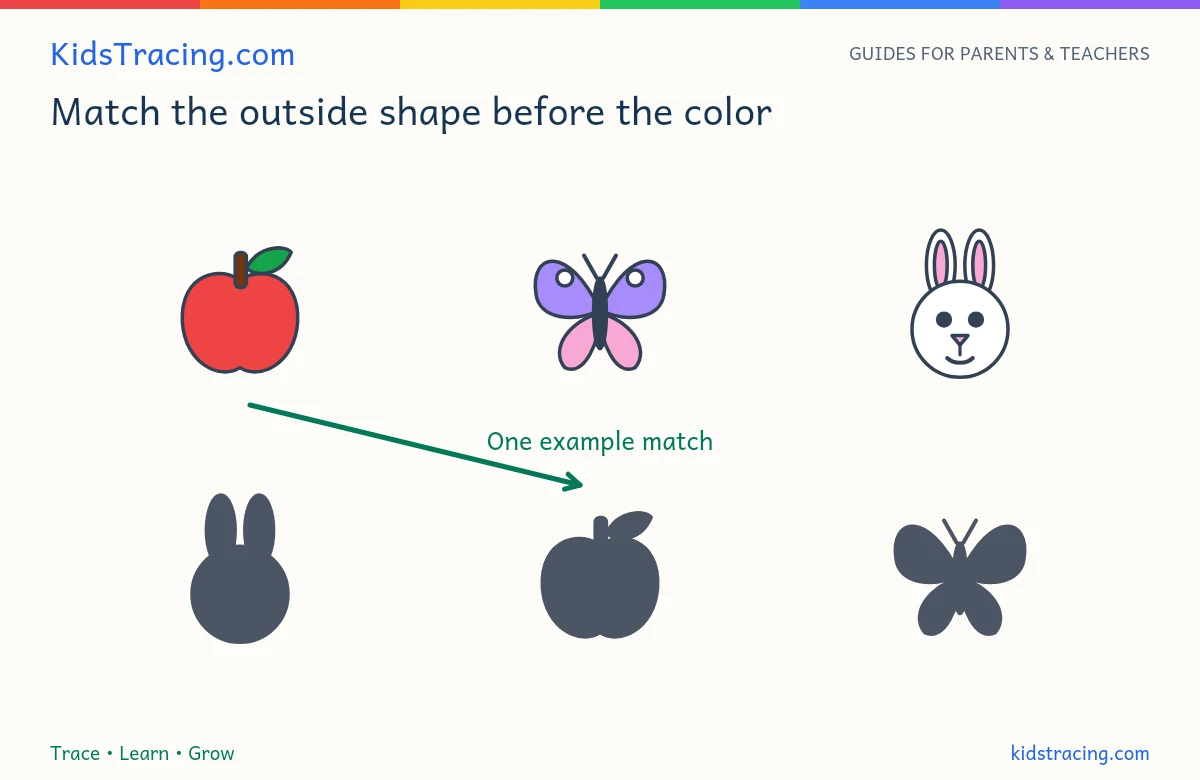
Shadow matching is one of the simplest, most popular early learning puzzles, and for good reason. It needs no reading, it looks like a game, and it quietly practices a skill that children use every day when they learn letters, numbers and words.
What is shadow matching?
A shadow matching activity shows a set of colorful pictures on one side and a set of black or gray silhouettes on the other. The child decides which shadow belongs to which picture, then draws a line to connect them, or points, or moves a card. A fox goes with the fox-shaped shadow, and a frog goes with the frog-shaped shadow.
What skills does shadow matching practice?
- Visual discrimination. Your child compares shapes and decides which ones are the same and which are different. This careful looking is the same skill used later to tell apart letters that look alike, such as b and d.
- Shape awareness. The color and the details are gone, so children have to focus on the outline: round, tall, spiky, long.
- Reasoning. “This one has long ears, so it must be the rabbit.” Children learn to give reasons.
- Pencil control. Drawing a line from one side to the other is real pre-writing practice, especially when the line crosses the page.
- Vocabulary and attention. Naming the pictures, and staying with a puzzle until it is finished.
Which level should you start with?
- Easy: four pairs. Use pictures with very different shapes, such as a fish, an apple and a car.
- Medium: six pairs, with some shapes that are closer together.
- Hard: eight to ten pairs, including shadows that look alike. Children have to look at the details of the outline, such as the ears, the tail or the legs.
Our shadow matching worksheets generator has all three levels, pairs from 4 to 10 per page, six picture groups (animals, fruits, vehicles, shapes, objects and toys) and an answer key page so you can check the work together.
Eight shadow matching activities to try
- Print a sheet. Choose a picture group your child loves and print a page. Let them choose a crayon for the lines.
- Flashlight shadows. In a dim room, shine a flashlight on a few toys so they cast shadows on the wall. Ask your child which toy made which shadow.
- Trace and match. Trace around toys or cookie cutters on black paper, cut out the shapes and have your child match each cut-out to the right toy.
- Puzzle boards. Wooden puzzles with outlines are shadow matching in 3D. Take the pieces out and put them back.
- Sunny day shadows. Draw around your child’s shadow with chalk and do it again later. Notice how the shadow changes size through the day.
- Memory game. Make pairs of cards, one with the picture and one with its shadow, and play a matching memory game.
- Wrong shadow detective. Show a picture and three similar shadows, only one of them correct. Ask your child to explain how they know.
- Make your own. Let your child draw a picture, and you draw its shadow in black. Trade, and swap roles.
Tips for adults
- Start with real objects. Matching a toy to its shadow is easier than a drawing, because it has real depth.
- Name each picture before matching. Children who know what an item is are better at recognizing its outline.
- Ask “how do you know?” This turns a quick guess into a thinking skill.
- Let them choose how to answer. If drawing lines is hard, let them point, use stickers or place cards.
- Reduce the pairs if they get frustrated, and add more when it feels easy.
What to do next
After shadow matching, try other matching and looking puzzles. Picture matching worksheets link a picture to a related one, such as a bee to a flower. Visual discrimination worksheets ask your child to find the odd one out, find the match, or decide whether two pictures are the same or different. When your child is ready to look closely at letters, find and color letters worksheets turn the same skill to the alphabet.
Shadow matching is also a good warm-up before pencil work. See 15 pre-writing activities for preschoolers for more.
A worked comparison: find the rabbit's shadow
Show a rabbit picture and two silhouettes with clearly different outlines. Ask the child to point to one detail on the picture, such as its long ears. Compare that detail with each silhouette before choosing. Avoid pointing to the answer while asking the question.
After the match, ask, "What helped you choose?" A spoken answer is optional; pointing to the ears also shows the useful observation. Then try a new picture with a different outline clue, such as wings or a leaf.
Change one visual demand at a time
- Number of choices: begin with a small selection before increasing the pairs.
- Similarity: compare clearly different outlines before using animals or objects with similar shapes.
- Direction: keep the picture and silhouette facing the same way before introducing turned or mirrored examples.
- Response: let the child point or place a card before asking for a pencil line.
Separate looking from drawing a connection
A child may find the correct shadow but draw a line to a neighboring one. Ask them to point to the intended answer before deciding that the match was misunderstood. Covering some choices temporarily or using a larger sheet can reduce the extra drawing demand.
Use the shadow matching worksheets with fewer pairs when starting. If comparing outlines is still confusing, return to identical picture matching, where color and internal detail remain available. If matching feels comfortable, visual discrimination puzzles introduce other ways to compare details.
Check the explanation, not only the line
Children may notice a small feature you did not expect. Listen to the reasoning and check whether the whole outline also fits. If it does not, compare one extra feature together: "The ears match, but where is the tail?" This models a second check without turning the activity into guessing until the adult says yes.
For a hands-on version, an adult can trace the outline of a safe familiar object on paper and invite a match to the real object. Keep the scale and orientation similar at first.
Shadow matching cards and worksheets
If you want something ready to print, our shadow matching worksheets let you choose the number of pairs, the level and the picture group, and they include an answer key. For a no-pencil version, print a sheet, cut the pictures and shadows apart and use them as shadow matching cards: the child places each picture on top of its shadow. Cards work well for younger children and for floor games, and the same pieces can be reused if you laminate them.
If you would rather design the page yourself, every picture in our clipart bundles comes with a matching one-color shadow cut to the same size, so you can build your own matching sheet in Word, Slides or Canva.
Free printables to go with this guide
Put this guide into practice with our free generators: shadow matching worksheets, visual discrimination worksheets, picture matching worksheets, find and color letters worksheets.
Free workbooks to go with this guide
- Shapes Tracing and Coloring Book – Ten shapes to trace, hunt for and color, plus tracing practice and matching games.
- Fruits and Vegetables Tracing and Coloring Book – Color 26 fruits and vegetables, trace each word and write it alone, then review with matching games.
- Animals Tracing and Coloring Book – Color 28 animals from the farm, the garden and the wild, trace each name and write it alone.
- My Little Zoo: Color and Trace Book – Color and trace 28 animals, then match animals with their shadows and their homes.
Keep reading
- Coloring Activities for Preschoolers - Six picture-based invitations, practical adjustments and free printable coloring resources.
- Pre-Writing Activities for Preschoolers: 15 Fun Ideas – Fifteen fun pre-writing activities for preschoolers that build the strokes, strength and control children need before they start writing letters and names.
- Handwriting Readiness Checklist: Is Your Child Ready to Write? – A simple handwriting readiness checklist for ages 3 to 6: ten signs your child is ready to start writing, and what to do if they are not there yet.
- Letter Formation Order: Which Letters to Teach First – A simple letter formation order: group letters by how they are written and teach straight-line letters first. Capital and small letter groups, with a week plan.
Make a shadow-match challenge
Draw three simple objects, such as a cup, star and tree. On another sheet, fill in their silhouettes using a dark pencil. Mix up the silhouettes and ask the child to match by outline, not color. Increase difficulty by adding objects with similar shapes, and let the child explain which detail helped.
An ocean shadow page
The free Ocean Animals Activity Book has a Match the Shadows page with five sea animals, if your child likes a sea theme. Dinosaur fans can try the Dinosaur Activity Book, which has a Match the Shadows page with five dinosaurs.
Frequently asked questions
What age is shadow matching for?
Most children enjoy it from about 2 and a half to 5 years old. Younger children can match real objects to their outlines, and older children enjoy harder levels with similar shadows.
What is shadow matching good for?
It practices visual discrimination, which is noticing the similarities and differences between shapes. It also gives practice in reasoning, attention and, when children draw the line, pencil control.
Why does my child find some shadows hard to match?
Some outlines are very close, such as two animals with four legs and a tail. Try fewer pairs, use real objects first or choose picture groups with very different shapes.
Do I have to use a pencil?
No. Pointing, using stickers or moving cut-out cards works just as well. Drawing lines is an extra pencil control practice for children who are ready for it.
What are shadow matching cards?
Shadow matching cards are separate picture cards and shadow cards. The child places each picture on its shadow instead of drawing a line. You can make them by printing a shadow matching worksheet and cutting it apart.