Coloring Activities for Preschoolers: A Practical Guide
Published by Hasnat N, Founder · · 10 min read
Quick answer: Start a preschool coloring activity with one large, simple picture, a few suitable crayons and a choice the child can make. Model an action only when it helps, allow colors and marks to vary, and finish by talking about the picture. The six ideas below use the butterfly, flower, fish, cat, smiling sun and rocket available in the free KidsTracing coloring page maker.
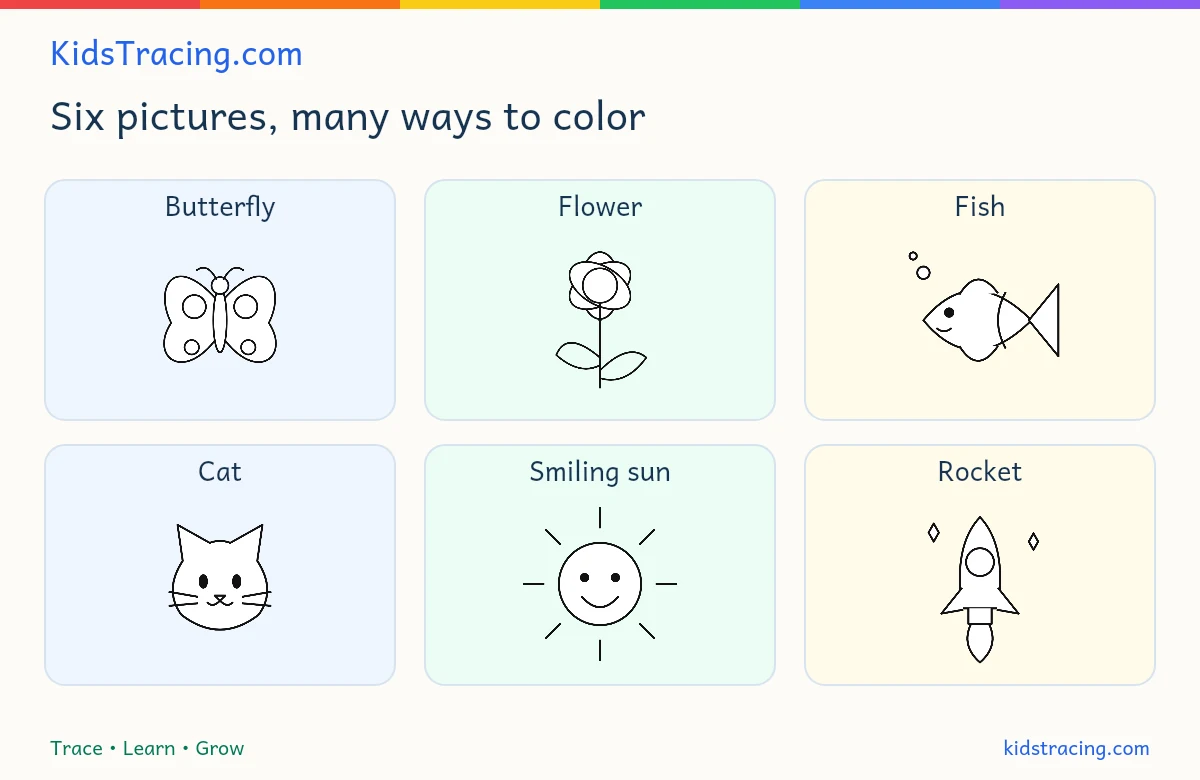
A coloring page can become a short invitation to explore a crayon, notice a shape, tell a story or make a pattern. It does not need to become a test of neatness. A purple cat, an unfinished flower and a picture with marks outside the outline can all be useful starting points for conversation.
This guide helps parents, teachers and homeschool families choose an activity, adjust its demands and connect it with drawing, early language or another printable. It is written for preschool and early kindergarten activities, broadly ages 3-6, but the child's interests and current control matter more than an age label.
Choose a coloring page with one clear purpose
Before printing, decide what you want to invite. If the aim is free color exploration, a large picture with open spaces is enough. If the aim is comparing a pattern, choose a picture with repeated features. If the child wants to tell a story, leave the picture open to imaginative additions rather than prescribing every color.
| Purpose | A useful starting point | An invitation |
|---|---|---|
| Explore marks | A large cat or sun with open spaces | "What marks would you like to try?" |
| Compare a pattern | A butterfly with repeated wing details | "Would you like these parts to match or be different?" |
| Describe a picture | A fish or rocket | "Tell me where it is going." |
Choose one main purpose for a short session. Counting petals, copying a label, following a color rule and filling every space are separate demands. You can return to the same picture another day with a different invitation.
Set out materials that are easy to use
Offer a small selection of age-appropriate, non-toxic drawing materials on a stable surface. Crayons, pencils and washable markers make different marks, so let the child try what is available rather than assuming one tool is best for everyone. Follow the product's age and supervision guidance, particularly for materials with small caps or detachable parts.
- Paper: use a sheet that sits flat, with room for the child's other hand to help keep it still.
- Color choices: offer a few colors first, with more available if requested. Too many choices are not necessary for an interesting picture.
- Work space: keep the picture easy to see and reach. Move clutter away from the drawing area.
- Time: begin with a manageable invitation and watch the child's response. Finishing the page is optional.
A comfortable tool that allows movement is more useful than repeatedly repositioning the child's fingers to copy a perfect-looking grip. If an activity causes discomfort, stop and consider the materials or setup. For persistent pain or difficulties across everyday hand activities, seek advice from a qualified professional.
Six coloring activities using the free page maker
1. Butterfly: matching or different wings
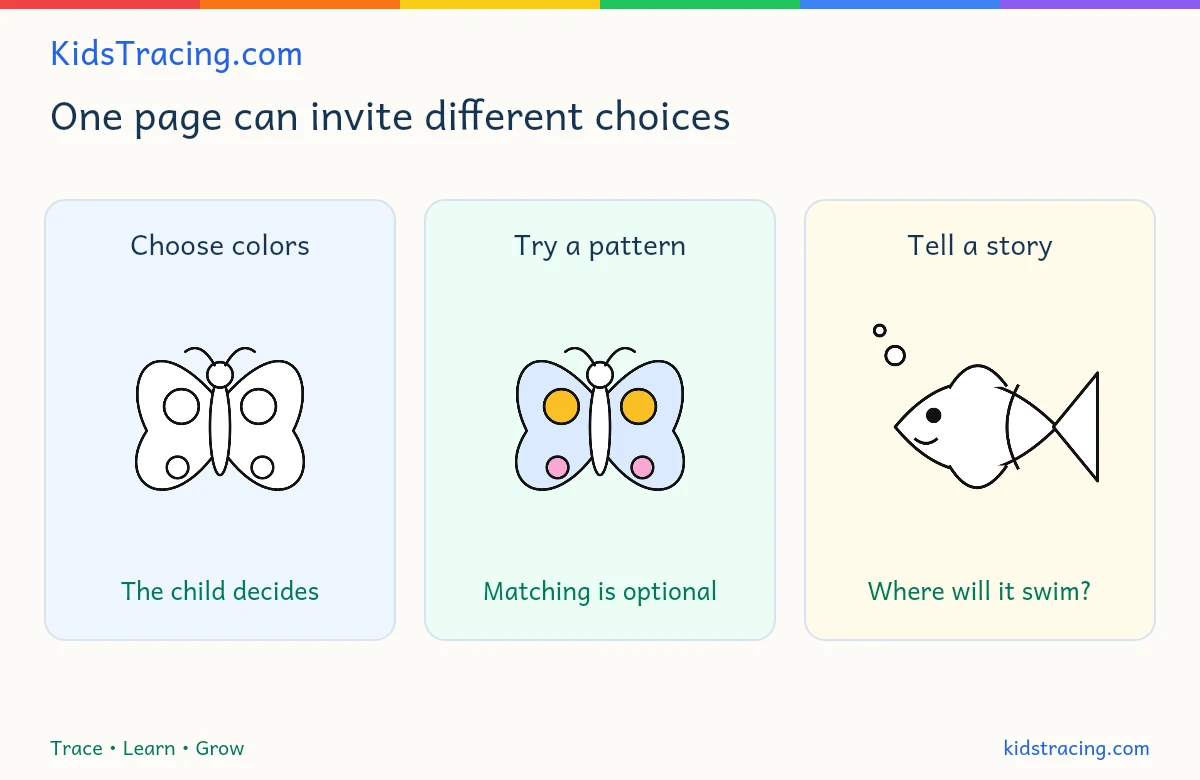
Choose the butterfly and ask whether the child wants similar or different colors on its wings. If they choose a matching pattern, point to one feature on each side and compare it together. Keep the challenge to that pair rather than correcting every mark. If they prefer different wings, invite them to describe their choices. Matching is an optional activity, not the only correct way to color a butterfly.
2. Flower: choose, count and describe
Ask the child to choose a color for the center and another for a petal. Count the visible petals together only if counting is part of the invitation, touching each once. The child can repeat a color or choose a new one; there is no requirement to find enough colors for every part. Finish by describing a feature: "You used small marks in the middle and long marks on the leaf."
3. Fish: create an underwater story
Color the fish, then invite an addition around it: water lines, bubbles, a rock or a friend. Ask what the fish can see. The child can tell the story aloud while an adult writes a short caption beneath or beside the page. This keeps language participation available even when writing a sentence would be an extra challenge.
4. Cat: invent a coat pattern
Offer the idea of spots, stripes or an entirely imaginary coat. Demonstrate a short line or a dot on scrap paper if the child asks how to make one. Let them decide how much of the picture to fill. Compare the types of marks rather than deciding that a cat must have realistic colors.
5. Smiling sun: talk about a day
After coloring, ask whether this sun belongs to a hot day, a cool bright morning or an imaginary place. Let the child add a cloud or a picture of something they would do outside. You can introduce words such as bright, warm and cloudy in conversation without turning the page into a weather quiz.
6. Rocket: design a journey
Invite the child to choose colors for the rocket and its window. They can add a planet, stars or the destination of their journey. A child who wants a small pattern challenge might repeat two colors in chosen details; another may simply enjoy making bold marks. Ask "Where will your rocket go?" and listen to the answer before suggesting additions.
A worked butterfly lesson for home or class
This is an original example of how to organize the activity, not a required timetable or a developmental assessment. Use fewer steps if that better suits the child.
- Offer a choice. Show the butterfly preview and a few crayons. Ask which part the child would like to begin with.
- Agree on the invitation. Say, "You can make the wings match, or you can make them different." Let the child choose.
- Support one action. If needed, demonstrate a short stroke on spare paper, then return control of the page to the child.
- Notice a detail. Comment on a visible choice: "I can see blue circles on both wings." Avoid comparing the picture with another child's work.
- Use the finished or unfinished picture. Invite a title, a story or a place to display it. A child may prefer to keep working later.
In a group, children can use the same outline with different responses. One might point to color choices, another might make a repeated pattern, and another might describe a butterfly garden. A shared worksheet does not require identical finished pictures.
Make coloring easier or add a small challenge
Change one demand at a time so you can notice what helps. A picture with more details is not automatically a better learning task, and reducing the amount to color is not a failure.
| What you notice | Try this |
|---|---|
| The child is unsure where to begin | Offer a choice of two parts or two colors, without completing the picture for them. |
| The page moves during coloring | Use a stable surface and demonstrate how the free hand can help hold the sheet. |
| The activity becomes tiring | Pause or choose just one part to color. Leave the rest for another day. |
| The child wants another idea | Offer a background, a two-color pattern or a spoken caption as an optional extension. |
| Small details are frustrating | Return to the larger open areas and a comfortable tool rather than insisting on completion. |
To explore different marks, try a patch of short strokes on scrap paper and compare it with a patch of circles. To explore a repeated pattern, choose one small area rather than adding a rule to the entire picture. Let the child return to free coloring when they wish.
Does coloring have to stay inside the lines?
Not for every purpose. If the activity is creative exploration, an outline is a starting point. If you are deliberately practicing a controlled movement, demonstrate that specific movement briefly and choose a manageable area. Do not judge all the child's coloring by a boundary-control goal that was never explained.
Printed coloring pictures also differ from open-ended drawing and process art. A ready-made outline offers a recognizable subject, while blank paper lets the child invent the subject and its form. Offer both over time. Coloring a printed page does not replace drawing, pretend writing, construction or other play.
Look for a choice, a useful movement or an explanation you can discuss. A completed page alone does not prove handwriting readiness or diagnose a difficulty. For broader observations, see the handwriting readiness guide.
How to make and print a KidsTracing coloring page
- Open the free coloring page maker and select butterfly, flower, fish, cat, smiling sun or rocket.
- Enter a short page title such as "My Butterfly" or "A Rocket Journey." Check that it fits in the live preview.
- Select A4 or US Letter to match your paper, and choose whether to show a name line.
- Use Print / Save PDF to open the browser's print dialog. Choose your printer, or a Save as PDF destination where your browser provides one.
- Inspect the print preview before saving or printing. Check the selected paper size and avoid a scale setting that crops the worksheet.
The separate Download SVG control saves the outline as an SVG file. It is not a direct PDF-download button. The maker creates one selected coloring page at a time; it does not automatically assemble all six pictures into a coloring book.
Free coloring worksheets and activity books
Choose a resource according to the activity you want to offer:
- Coloring page maker: one simple picture with a custom title, in A4 or US Letter.
- Find and Color Letters: a letter-search task where the selected letters are colored. This adds recognition and visual searching to the activity.
- Shape Tracing: guided paths for exploring shapes alongside coloring and drawing.
- Animals Tracing and Coloring Workbook: a multi-page option with animal pictures and name practice.
- Shapes Tracing and Coloring Book: a themed workbook to explore shapes, pictures and related activities.
- All free printable workbooks: browse other topics and select the page-size option available on the book's download page.
Book downloads and the one-page maker are different resources. Check a workbook's preview and contents before choosing a page for a child. Use the site's Terms and Conditions for personal, classroom and sharing permissions; do not assume a free download gives permission to redistribute the files elsewhere.
Frequently asked questions
What are good coloring activities for preschoolers?
Start with one large familiar picture and a choice of colors. Optional extensions include comparing butterfly wings, adding spots to a cat, describing an underwater fish scene or inventing a rocket journey.
What age should a child start coloring inside the lines?
There is no single deadline for staying within an outline. Choose tasks from the child's current control and interests. A printed coloring page can also be used for free exploration rather than boundary practice.
Are crayons or colored pencils better?
Try age-appropriate materials and choose what the child can use comfortably for the task. Crayons, pencils and markers make different marks; no one option suits every child or activity.
Are KidsTracing coloring pages free?
Yes. The coloring page maker lets you select one of six pictures, customize the title and print without an account. Use A4 or US Letter and check the preview before printing.
Can I save the coloring worksheet as a PDF?
Use Print / Save PDF to open your browser's print dialog, then choose Save as PDF where available. Download SVG is a separate option that saves an SVG outline file.
Does the generator make a complete coloring book?
No. It prepares one selected page at a time. For multi-page books, browse the separate free printable workbook collection and check each book's preview and download options.
Further reading
The activities in this guide are practical examples. For broader guidance, read Sheffield Children's NHS guidance on comfortable pencil use and NAEYC's discussion of process-focused art. A coloring worksheet is one possible activity alongside free drawing and other play, not a replacement for them.
Keep learning
- Pre-writing activities for preschoolers for playful lines, routes and marks.
- Shadow matching activities for comparing outlines and picture features.
- Choosing preschool and kindergarten worksheets for matching the task to a learning goal.