Preschool and KG Worksheets: English and Math Activities for Ages 3 to 6
Published by Hasnat N, Founder · October 14, 2026 · 11 min read
Quick answer: For ages 3 to 4, mix three short activities: dotted name tracing, big number tracing from 1 to 5, and a few picture-matching or beginning-sound questions. For ages 5 to 6 (kindergarten, or KG), add numbers to 20, skip counting, letter sounds and short a CVC words. Five to ten minutes a day is plenty. Below you will find what to start with at each age, a free printable for each skill and a simple weekly plan.
Search for preschool or kindergarten worksheets and you will find thousands of pages. Most children only need a handful of skills at a time. This guide sorts English and math worksheets by what a child is usually ready for: names and first letters at three, counting and early numbers at three and four, then letter sounds, short words and numbers to 20 in kindergarten.
A quick word on names. Preschool (or nursery) usually means ages 3 to 4, pre-K is ages 4 to 5, and kindergarten, often shortened to KG or K, is ages 5 to 6. These ages are only a guide. Start where your child feels confident, and move on when a sheet feels easy.
What children are usually ready for
The CDC’s milestone checklists describe skills children typically show by a given age, and the kindergarten standards describe what schools aim for. Some children get there earlier and some later, and that is normal.
| Age | Skills to expect | Good first worksheets |
|---|---|---|
| 3 | Draws a circle after being shown how | Dotted name tracing, line tracing |
| 4 | Holds a crayon or pencil between the fingers and thumb, not in a fist | Number tracing 1 to 5, beginning sounds |
| 5 | Counts to 10, names some numbers from 1 to 5, writes some letters of their name | Letter formation, number tracing 1 to 10 |
| 5 to 6 (KG) | Kindergarten standards aim for writing numbers to 20 and saying the sounds in three-letter words | Numbers 1 to 20, CVC words |
Dotted name tracing for a 3-year-old
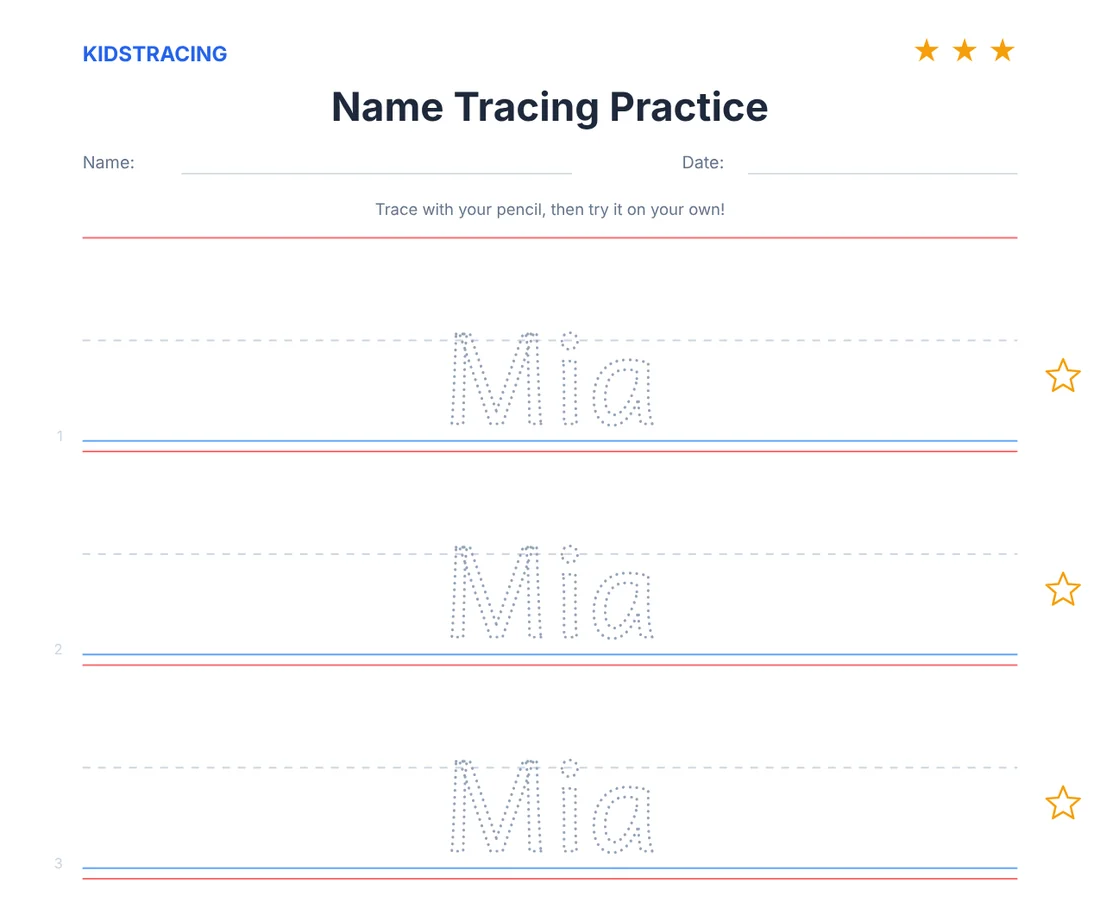
A child’s name is the most meaningful word they know, which makes it the best first thing to trace. At three, many children are still learning to hold a crayon and draw a circle, so the goal is not a neat name. It is to move a crayon along a path from left to right and to start recognizing the first letter.
- Type the name into the name tracing generator, choose Capital First Letter and the Dotted style.
- Use only a few rows so the letters stay big. For a long name, fewer rows keep each letter larger.
- Turn on the green start arrow so your child can see where the name begins.
- Let your child trace the first letter with a finger, then with a fat crayon. One row is a full session for most 3-year-olds.
- Say the letter names out loud as you go, and praise the effort, not the neatness.
When your child is comfortable, switch to outline letters, then solid gray, and finally a blank line for writing the name alone. Our guide on how to teach a child to write their name has the full step-by-step plan, and the handwriting readiness checklist will help you decide if now is the right time.
English nursery worksheets: lines, sounds and letters
For nursery and preschool English, listening comes first and paper comes second. Three jobs matter most at this age:
- Pencil control. Straight lines and gentle curves prepare the hand for letters. Try preschool line tracing, which marks a green start dot on every line.
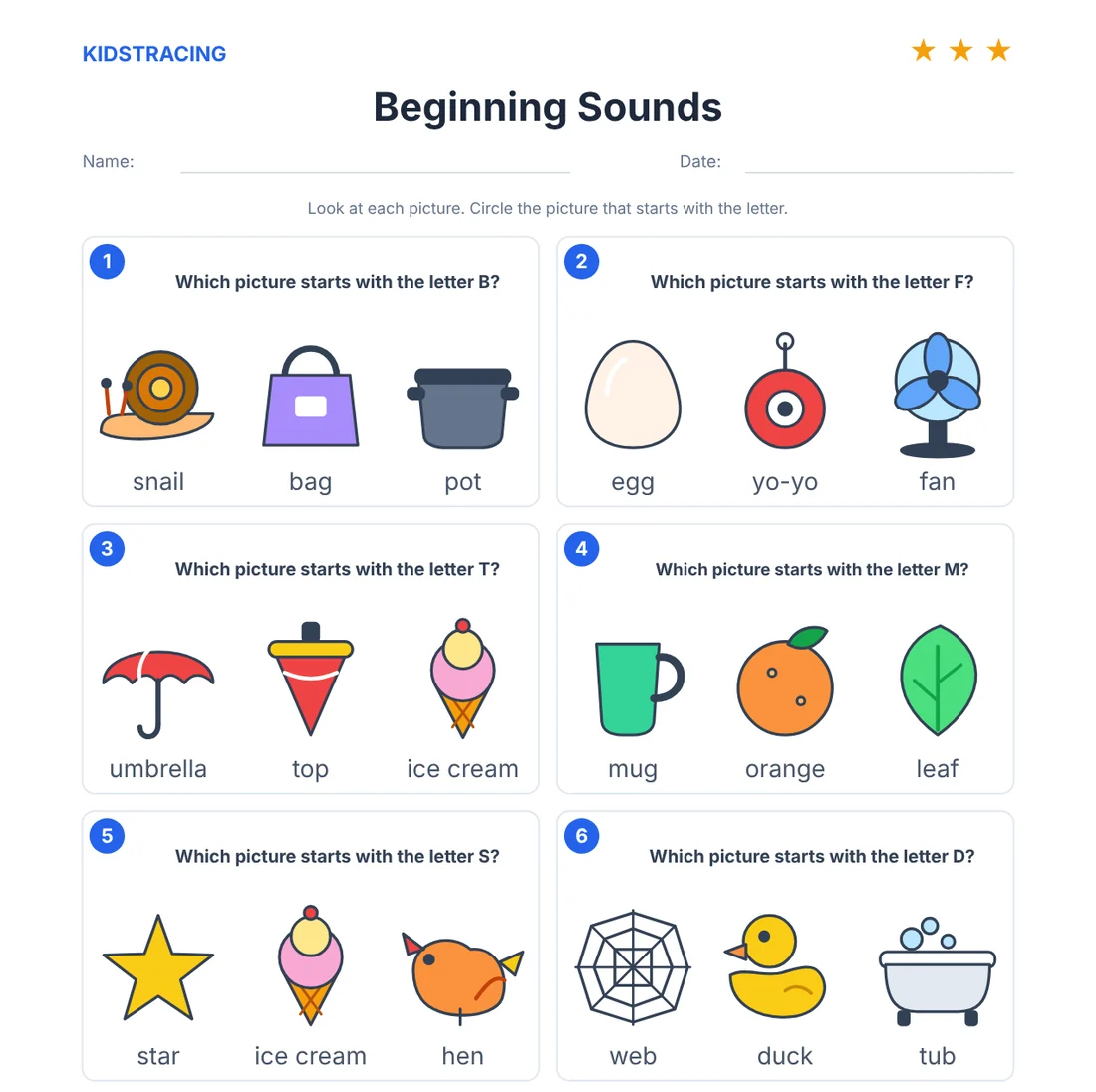
- First sounds. Before a child can link a sound to a letter, they need to hear the first sound in a word. The beginning sounds for preschool sheet uses eight clear consonants (B, D, F, H, M, P, S and T), and six questions is a full session.
- Letter shapes. Introduce a few letters at a time with letter formation worksheets, starting with the letters in your child’s name. Say the letter name and its sound together.
Math worksheets for preschool (ages 3 to 4)
Counting comes before writing numbers. For most 3- and 4-year-olds, the first number skills are saying the number words in order and counting objects one at a time. Once your child can count three blocks and tell you there are three, they are ready to see what the numeral 3 looks like.
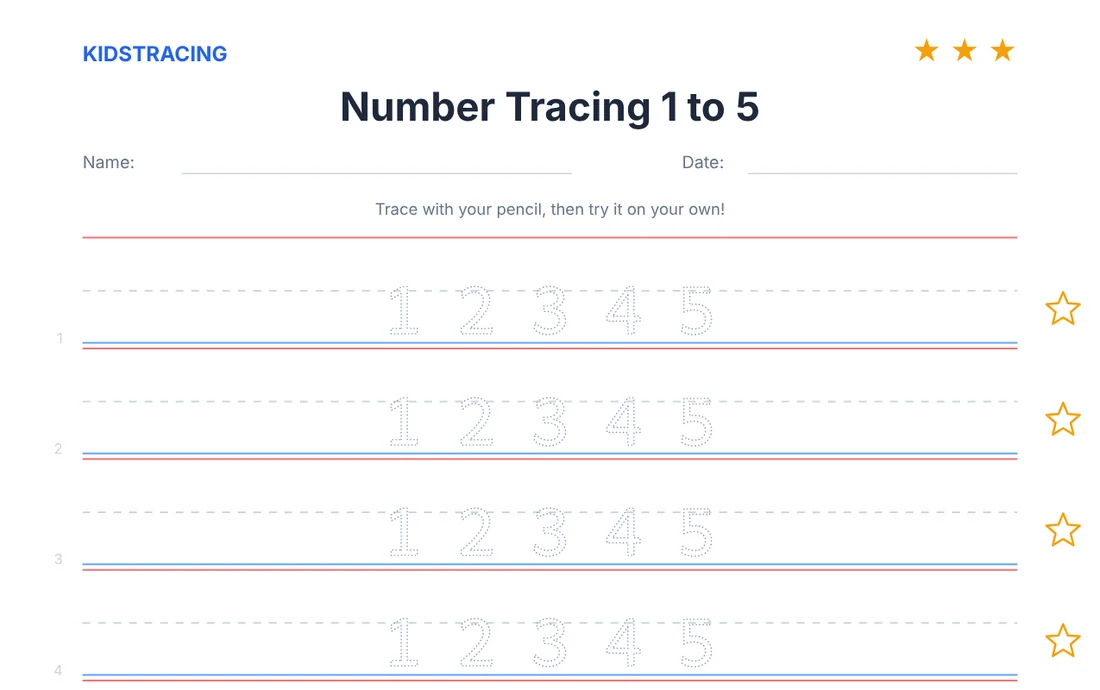
That is why the number tracing for preschool worksheet stops at 5 and uses big numbers. A long list of tiny digits is discouraging at this age. Here is a simple routine:
- Count five small objects together, such as blocks, buttons or crackers.
- Show your child the matching number on the sheet.
- Trace one number with a finger first, then with a crayon.
- Do one or two rows and stop. Praise the counting, not how neat the number is.
Not every math activity needs a pencil. Shape tracing, picture matching and shadow matching train the careful looking that numbers and letters need later. Counting stairs, snack pieces and toy cars during the day counts too.
Math activity sheets for kindergarten (ages 5 to 6)
In kindergarten, math moves from counting objects to writing numbers. The Common Core standard K.CC.A.3 asks children to write the numbers from 0 to 20 and to match a written numeral to a group of objects. Some countries call this subject “maths,” but the skills are the same.
The number tracing for kindergarten sheet shows each numeral beside its word, such as 7 seven. Numbers 1 to 10 are on page one and 11 to 20 on page two.
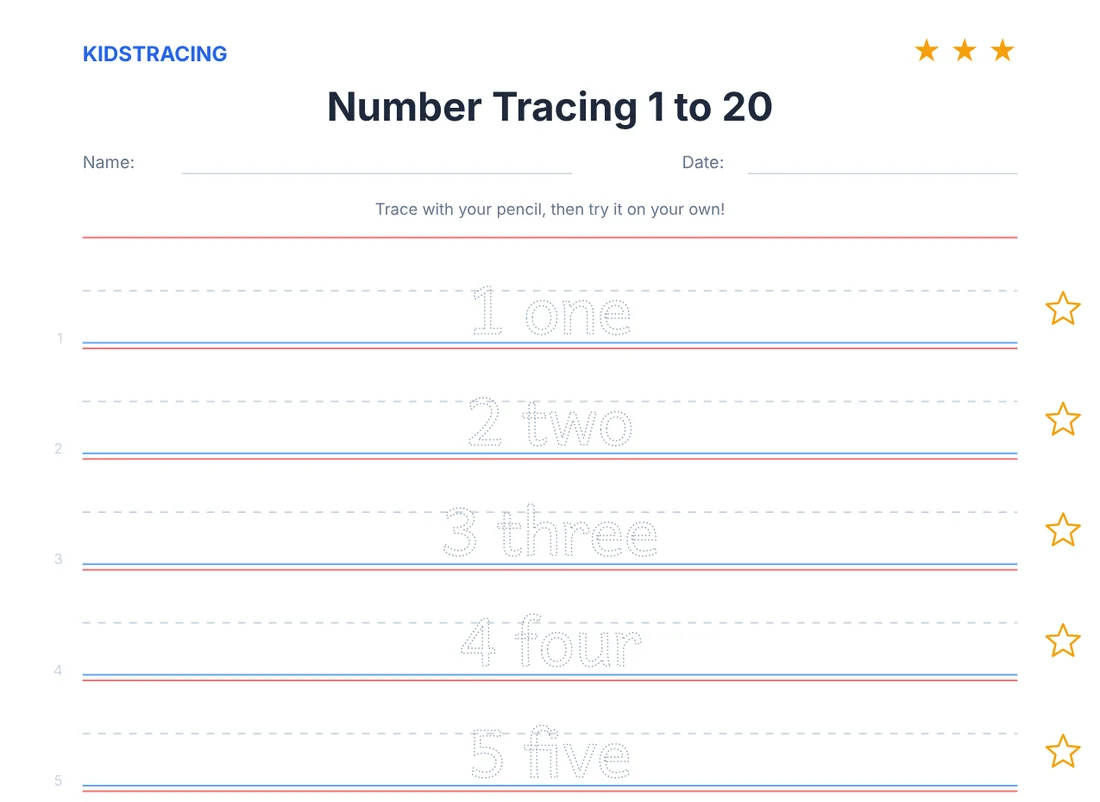
Three ideas make these activity sheets work better:
- Watch the teens. Numbers 11 to 19 are the hardest part, and many children write 13 as 31 because we say the ones first. Build 13 with objects: one group of ten and three more.
- Use a simple ten frame. Draw two rows of five boxes on paper and put one counter in each box to make 10, then use a second frame for 11 to 20.
- Add skip counting. Our skip counting worksheets trace 2s, 5s and 10s. Count socks in pairs for 2s and fingers on a hand for 5s before you trace.
English worksheets for KG (ages 5 to 6)
Kindergarten English is about connecting letters to sounds and sounds to words. The Common Core reading standard RF.K.3 asks kindergartners to give the main sound for each consonant and to link the long and short sounds with the common spellings of the five vowels. A good order for worksheets is:
- Letter formation, a few lowercase letters at a time.
- Beginning sounds for kindergarten, which uses all 26 letters.
- Missing letters to practice the order of the alphabet.
- CVC words, starting with short a.
Our kindergarten worksheets page groups all of these in one place, and the preschool worksheets page does the same for ages 3 to 4.
CVC words short a worksheet
CVC stands for consonant-vowel-consonant. Words like cat, pan and sad have three sounds and a short vowel in the middle, so children can read them by sounding out and blending. Short a is the usual starting point, and practicing one vowel at a time keeps things focused. The Common Core standard RF.K.2.d asks kindergartners to say the first, middle and last sounds of CVC words, and it leaves out words ending in /l/, /r/ or /x/.
- bat
- cat
- hat
- mat
- rat
- sat
- cap
- map
- nap
- tap
- lap
- bag
- tag
- can
- fan
- man
- pan
- ran
- van
- jam
- ham
- sad
- mad
- dad
Here is how to use a short a worksheet step by step:
- Say the sounds. Tap one finger for each sound: c-a-t. Then blend them smoothly: cat.
- Match pictures to words. Picture matching lets children link a word to meaning.
- Fill the sound boxes. Sound boxes give three boxes per picture, so your child writes one sound in each box.
- Build word families. Add different letters in front of -at, -an or -ap to make cat, bat and mat.
- Read a sentence. Try “The cat sat on the mat.” or “Dad has a tan van.”
In the CVC words generator, short a is already selected. Pick an activity (word reading, picture match, missing letter, word families or sound boxes), choose how many questions you want and turn on the answer key page if you need it.
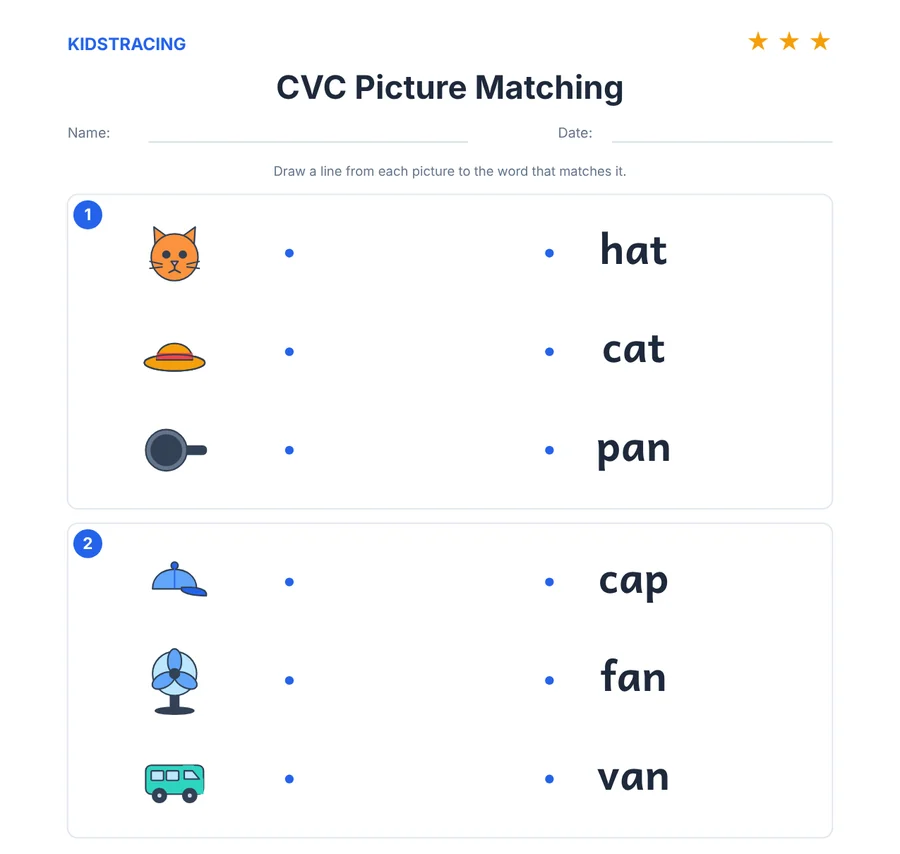
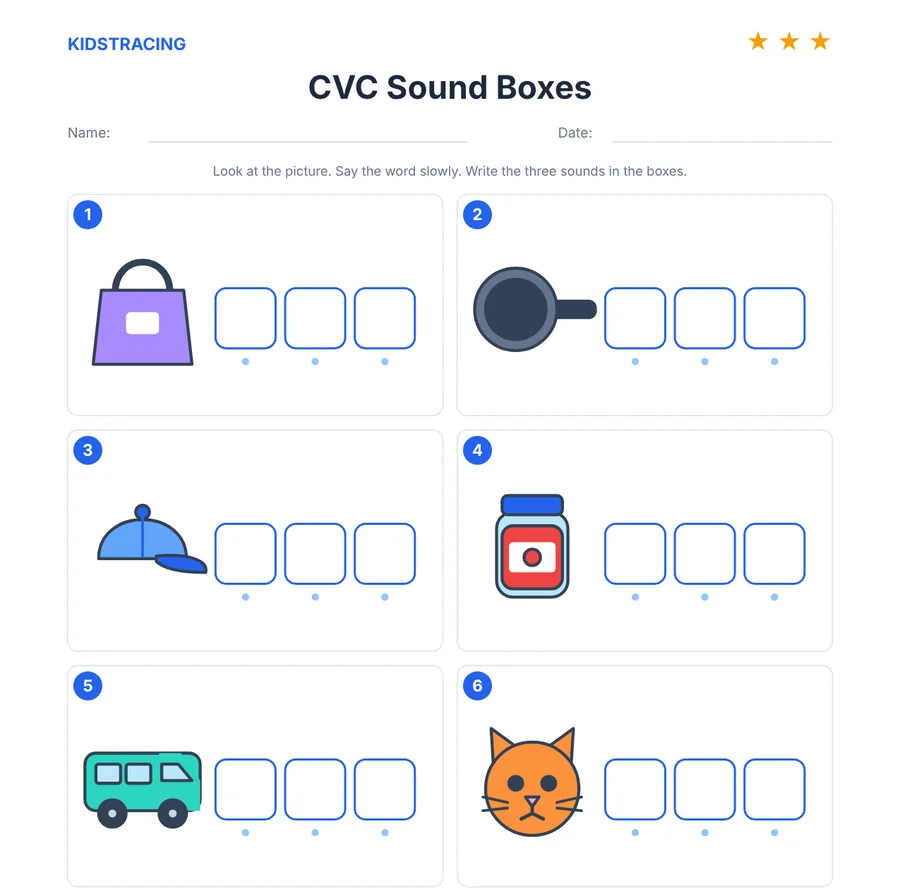
For longer word lists for all five vowels, see our CVC words list.
A simple weekly plan
Ten minutes a day, four days a week, is enough. Keep one day free for play and let counting and sound games happen in daily life.
| Day | Preschool (ages 3 to 4) | Kindergarten (ages 5 to 6) |
|---|---|---|
| Mon | Dotted name tracing, one row | Letter formation, two or three letters |
| Tue | Count five objects, then trace 1 to 5 | Number tracing 1 to 20, one page |
| Wed | Preschool line tracing | CVC short a picture match |
| Thu | Beginning sounds, four to six questions | Skip counting by 10s, then 5s |
| Fri | Picture or shadow matching | CVC sound boxes and reading two sentences |
If your child resists, stop and try again another day. Our guide on handwriting practice at home explains how long and how often to practice, and how to tell when it is time to stop.
Free printables to go with this guide
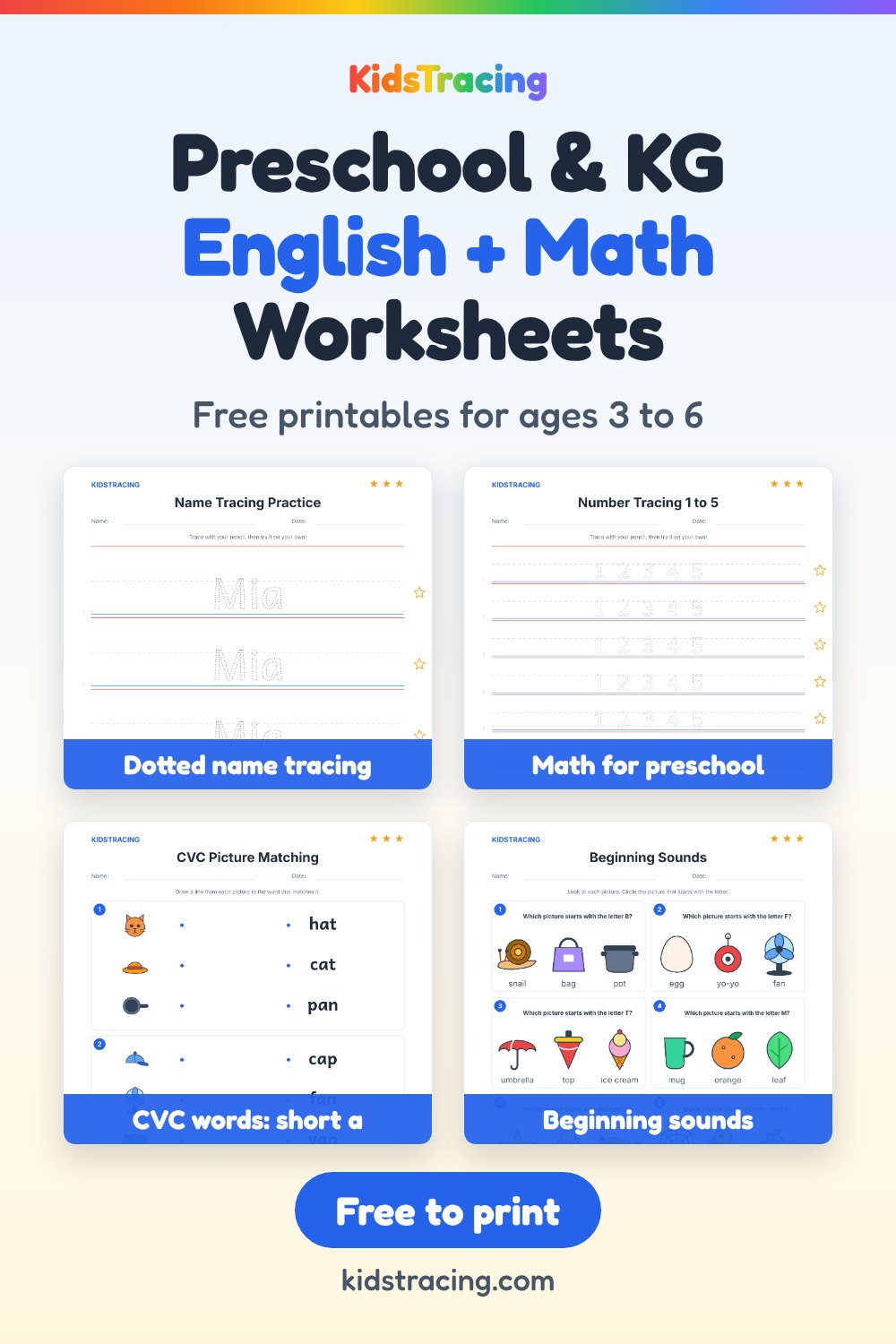
Put this guide into practice with our free generators: name tracing, preschool line tracing, beginning sounds for preschool, number tracing for preschool, number tracing for kindergarten, skip counting and CVC words.
Free workbooks to go with this guide
- Number Tracing and Counting Book – Trace, count and color every number from 1 to 20, then practice number words and skip counting.
- ABC Tracing Book – Every letter A to Z with numbered stroke arrows, a picture to color and a word to trace.
- CVC Words Workbook – Read, build, trace and write short a, e, i, o and u words with pictures, sound boxes and sentences.
Keep reading
- How to Teach a Child to Write Their Name – Simple steps, fun activities and free name tracing practice.
- How to Teach a Child to Write Numbers 1 to 10 – Number writing, step by step.
- Pre-Writing Activities for Preschoolers: 15 Fun Ideas – Fun ways to build the strokes and strength children need before writing.
Sources
- CDC, Milestones by 3 Years, by 4 Years and by 5 Years (Learn the Signs. Act Early.).
- Common Core State Standards, Mathematics, Kindergarten K.CC.A.3.
- Common Core State Standards, English Language Arts, Reading: Foundational Skills, Kindergarten (RF.K.2 and RF.K.3).
This guide gives general information, not medical or professional advice. If you are worried about your child’s development, talk to your child’s doctor or teacher.
Follow KidsTracing for new printables and guides.
Frequently asked questions
What math should a preschooler learn?
Mostly counting and noticing: saying the numbers in order, counting a few objects one by one, and starting to recognize the numerals 1 to 5. Shapes and matching games build the same careful looking. Writing numbers comes after counting feels easy.
What English worksheets are best for a nursery or preschool child?
Start with dotted name tracing, pre-writing lines and beginning sounds. Add letter formation a few letters at a time, beginning with the first letter of your child’s name. Keep each sitting to five or ten minutes.
Is dotted name tracing right for a 3-year-old?
It can be, if your child is interested. Many 3-year-olds are still learning to hold a crayon and draw a circle, so aim for tracing the first letter with a finger or a fat crayon and stop while it is still fun. If it feels too hard, play with play-dough and big scribbles first and try again in a few weeks.
When can a child start CVC words?
Many children start CVC words in kindergarten, around ages 5 and 6, once they know most consonant sounds and a short vowel. Short a is the usual first vowel because its sound is clear. If your child is younger and curious, play sound games out loud before using paper.
How many worksheets should my child do each day?
One short activity of five to ten minutes is enough for most 3- and 4-year-olds. Kindergarten children can usually manage two short sheets, one for English and one for math. It is better to stop early than to finish a page that has turned into a struggle.