Picture Matching Worksheets for Preschool & Kindergarten
Join pictures that are the same, or pictures that belong together, like a bee and a flower. Pick the pairs, then print or save a PDF.
Customize
Pairs that go together use pictures from every group.
More options
The preview updates as you change the settings.
Free Printable Match the Same Picture Worksheet (Ready-Made PDF)
Here is a finished matching page you can print right away: draw a line from each picture to the identical picture. Cat, dog, pig, bear, frog and mouse, with an answer key.
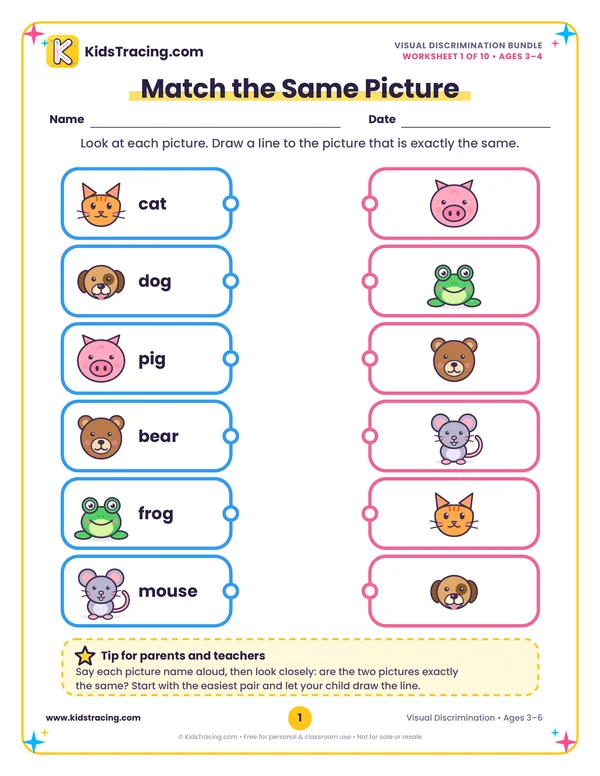
More ready-made looking worksheets, including differences, patterns and counting, are on the visual discrimination page.
Free for personal, home and classroom use. Not for sale or resale.
What are picture matching worksheets?
Picture matching asks children to join two pictures that go together. It builds attention, memory and early reasoning, and it is a gentle way to practice holding a pencil and drawing a straight line from one point to another. This generator makes two kinds of sheets so you can match the activity to your child.
Two ways to match
- Same picture shows a column of pictures and a shuffled column with the same pictures. Your child joins each one to its twin. This is the simplest form and works well for the youngest children.
- Things that go together uses pairs that belong with each other, for example a bee and a flower, a hen and an egg, a spider and its web, or an owl and the moon. Your child has to think about how the two pictures are connected, so it is a good talking point.
How to use the generator
- Choose Same picture or Things that go together.
- For same-picture sheets, choose one or more picture groups. Related pairs use pictures from all groups, so the group buttons are hidden for that mode.
- Choose the number of pairs (4 to 10) and the number of pages.
- Switch on Show picture names if you want a word under each picture. This helps children who are learning English or starting to read.
- Press Generate new worksheet, then print or save a PDF. The answer key draws the correct lines for you.
Why related pairs are useful for talking
When children explain why a pair goes together, they practice vocabulary and reasoning: “the owl comes out at night, so it goes with the moon”. There can be more than one sensible answer in everyday life, so the sheets use the most obvious links. If your child finds a different connection, listen to the idea and then show the answer on the key.
Good to know
The pictures are original simple drawings, so they stay clear at small sizes. The right-hand column is always shuffled, and the generator avoids leaving the sheet “already solved”. If you request several pages, it uses fresh pictures or pairs on each page for as long as there are enough to choose from.
A first picture-matching lesson
- Start with four identical pairs. Choose one familiar picture group and leave picture names off so the task is about looking.
- Model one match. Point to a picture on the left, find its twin on the right and describe the detail that makes them the same.
- Let your child point before drawing. Once the pair is chosen, draw a line between them. Pointing lets children show their answer even if pencil control is still developing.
- Talk about one choice. Ask, "What did you notice?" Accept a short answer such as "both have wheels."
Make matching easier or harder
If the page feels crowded, return to four pairs and cover the lower part while you discuss the first pair. Increase the number of pairs when the child can scan both columns comfortably. Change only one thing at a time: more pairs, a new picture group, or the related-pairs mode.
For another careful-looking task, try visual discrimination worksheets. For matching a picture to its outline, use shadow matching worksheets. These activities practice different ways of comparing pictures; children can move between them as needed. Older children can match fingerprints in the Mini Detectives Comic Book, a mystery comic for ages 6 to 8.
Why picture matching is important in the classroom
Picture matching is one of the simplest activities a teacher can set up, and it practices several early skills at once. Children have to look carefully, remember what they saw and decide which two pictures belong together. These are the same habits they need later to tell similar letters apart, such as b and d, and to follow a pattern or a story.
- Visual attention: the child scans a column of pictures and keeps the target in mind while searching for its partner.
- Memory and reasoning: with “things that go together”, the child has to think about the link, such as a hen and an egg.
- Vocabulary and talking: naming each picture and saying why two belong together is a natural speaking activity for circle time or small groups.
- Pencil control: drawing a line from one picture to its partner is a gentle first step toward steady strokes.
- Independence: the answer key lets a child or a helper check the work without waiting for the teacher.
In a busy classroom, picture matching works well as a quiet early-finisher task, a center activity or a warm-up before tracing. Start with same-picture sheets, move to related pairs when children match quickly, and use shadow matching or visual discrimination worksheets as the next step.
Matching games to print
The printable memory match games have 12 cards on a page for the classic find-the-pair game, and the picture scavenger hunts ask children to find 12 pictures in a themed scene.
Frequently asked questions
What is the difference between picture matching and shadow matching?
In picture matching your child joins two colored pictures, either identical or related. In shadow matching they join a colored picture to its dark outline. Shadow matching is a little harder because there is no color or detail to help.
How many related pairs are there?
The library has 17 related pairs, and a sheet never uses the same picture twice, so the biggest sheet has 10 pairs. If you make several pages, the generator avoids repeating a pair until it has used them all.
Can I turn off the words?
Yes. “Show picture names” is off by default, so children match by looking. Turn it on if you want to add reading practice.
Is there an answer key?
Yes. Turn on “Include answer key page” or press “Show answer key” to see the same page with the correct lines drawn in green.
Is there a ready-made picture matching worksheet?
Yes. The ready-made section on this page has a printable match-the-same-picture worksheet for ages 3 to 4 in US Letter and A4, with an answer key.
Why is picture matching important for preschoolers?
It builds careful looking, memory, reasoning and vocabulary, and the line the child draws gives gentle pencil-control practice. It is also easy to use in a classroom, because children can work on their own and check their work with the answer key.
Free printable workbooks
Want a planned set instead of a single page? These free PDF workbooks use the same worksheets in a step-by-step order.
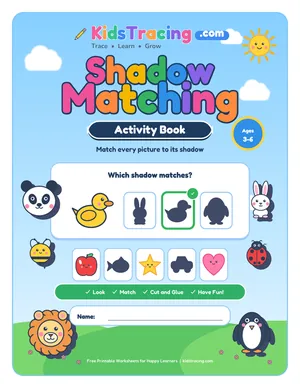
Shadow Matching Activity Book
Draw lines, circle, find twins and odd shadows, and cut and glue, from three big pairs to shadows that face the wrong way. With an answer key.
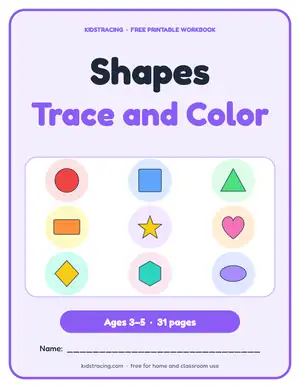
Shapes Tracing and Coloring Book
Ten shapes to trace, hunt for and color, plus tracing practice and matching games.
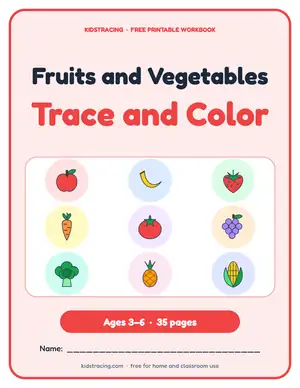
Fruits and Vegetables Tracing and Coloring Book
Color 26 fruits and vegetables, trace each word and write it alone, then review with matching games.
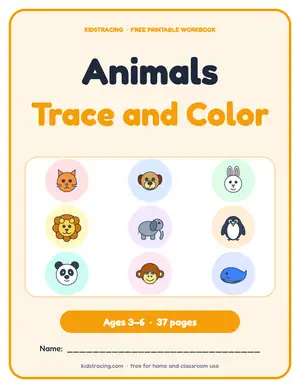
Animals Tracing and Coloring Book
Color 28 animals from the farm, the garden and the wild, trace each name and write it alone.
Animal workbook: My Little Zoo: Color and Trace Book (has an animal homes matching page) · All free printable workbooks
Related worksheet tools
Explore more: Matching & Visual Thinking Worksheets · Preschool Worksheets · All free worksheet tools
Guides for parents and teachers: Shadow Matching Activities for Preschoolers