Mini Detectives Comic Book for Kids: 4 Mystery Stories, 40 Pages, Ages 6–8 (Free PDF)
This free printable detective comic book for ages 6 to 8 tells four short mystery stories about three young detectives: Pip Raccoon, Mia Mouse and Tilly Turtle. Children read the comic panels, find the clues and help solve each case. Then the puzzle pages put them to the test with a word search, secret codes, logic puzzles, a maze, spot the differences, fingerprint matching and a suspect line-up. Download the PDF in US Letter or A4, with a 7-page answer key.
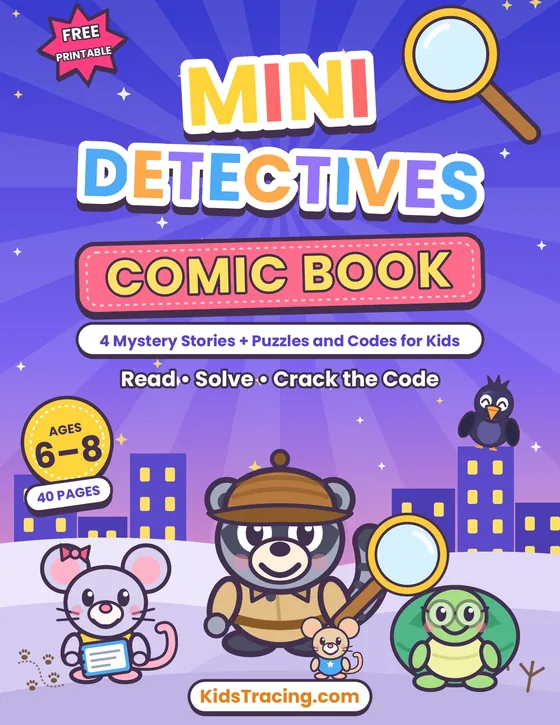
Download Mini Detectives Comic Book
- 40 pages for ages 6–8, plus a 7-page answer key
- Four gentle mystery stories in eight comic panels each, then puzzles, codes and a make-your-own-mystery section
- Free for personal, home and classroom use, with no sign-up or email address
- Two PDF files: US Letter (8.5 × 11 in) and A4, or one zip file with everything
Answer key (7 pages, separate file):
Answer key, US Letter PDF · 1.3 MB of the Mini Detectives Comic Book answer key (7 pages)Answer key, A4 PDF · 1.3 MB of the Mini Detectives Comic Book answer key (7 pages)
Print at 100% (Actual size). Choose US Letter in the United States and Canada, and A4 almost everywhere else. How to print a workbook
Please note: this book is free for personal, home and classroom use. It is not for sale or resale.
A detective comic book with puzzles, codes and clues
This is a mystery comic and a puzzle book in one. Each story is told in eight comic panels over two pages, with clues hidden in the pictures and the speech bubbles. After each story, a reading check or a puzzle page lets children prove what they noticed: whose footprints are these, what is the secret message, who is the thief. It is made for children who can read short sentences and like puzzles, and it gives them a reason to read closely and think.
Compare with: Halloween Comic Book, Forest Friends Comic Book and Space Pals Comic Book (the younger comics for ages 3 to 5), and Animal Mazes Activity Book
Who this detective comic book is for
The book is made for ages 6 to 8, which is usually first to third grade in the United States. Ages are a guide, not a deadline, and every child moves at their own speed.
Children need to read short sentences in speech bubbles, so it suits beginning and growing readers. Some pages are deliberately harder: the code messages on page 17, the logic puzzles on page 18, the last row of patterns on page 29 and the shift code on page 32. Some 6-year-olds may need a grown-up to help, and that is part of the fun.
If your child is just starting to read, try the younger comics first: Forest Friends and Space Pals are made for ages 3 to 5.
The four mystery stories
Each story has two pages of comic panels. The mysteries are gentle and every case ends kindly. There are no scary villains: the culprits are a hungry little cookie lover, a crow that loves shiny things and a kitten who came in through an open window.
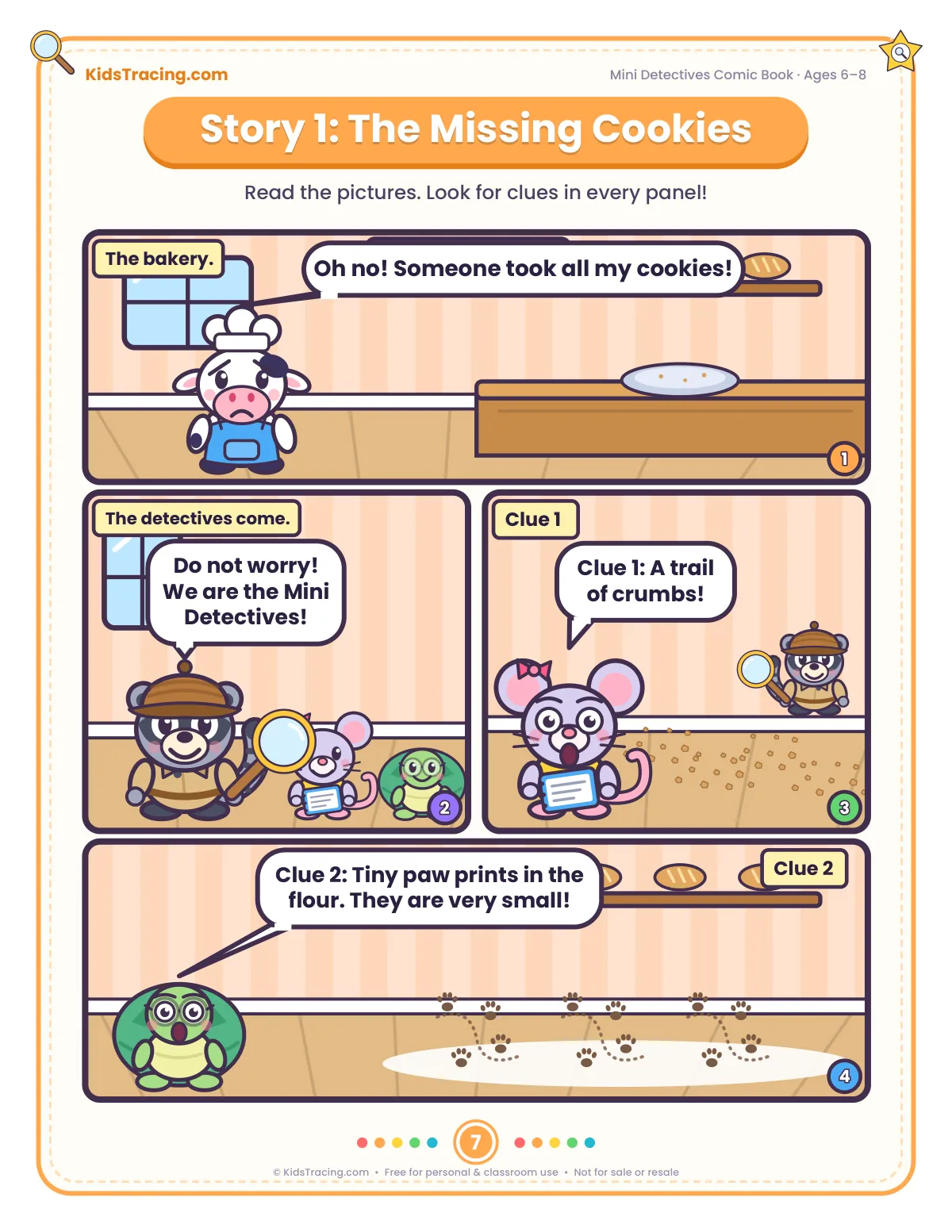
- Story 1: The Missing Cookies. Mrs. Moo’s cookies have vanished from the bakery. The Mini Detectives follow a trail of crumbs and tiny paw prints in the flour, and find the little cookie lover. He says sorry, and the case is closed with a warm cookie.
- Story 2: The Shiny Trophy. The big trophy is gone on Sports Day, and the race starts in one hour. Clues include a black feather and muddy prints with three long toes. Something shiny is in a tree, and the detectives find out who took it and why.
- Story 3: The Secret Code. A secret letter in numbers arrives at Pip’s clubhouse. Tilly has an idea: A = 1, B = 2, C = 3 and so on to Z = 26. The decoded message leads the detectives to dig by the big tree.
- Story 4: The Midnight Library. Something is making noise in the library at night. Clues include books on the floor, an open window, a yarn ball and orange fur. The detectives follow the clues to a surprising visitor.
The cast is Pip Raccoon, Mia Mouse and Tilly Turtle, the three detectives, with four helpers: Mrs. Moo, Milo, Kai the crow and Luna the kitten. All of them are original characters made for this book, and all of them are friendly.
What is inside the Mini Detectives Comic Book
The first pages introduce the detectives, a detective ID card and a few detective words and tools. Then come the four stories, each followed by a reading check or puzzle page that uses clues from the story. The second half of the book is a mix of puzzles, and the last pages let children plan and make their own mystery.
Inside the book you will find:
- A detective ID card, a detective promise and “How a Detective Thinks” (look, find, think, solve)
- Meet the Mini Detectives, detective words to trace and copy (CLUE, CASE, SUSPECT, EVIDENCE, MYSTERY) and a detective tools matching page
- Reading checks with multiple-choice questions after Story 1 and after Stories 2, 3 and 4
- Whose Footprints Are These? and Match the Fingerprint, two evidence pages
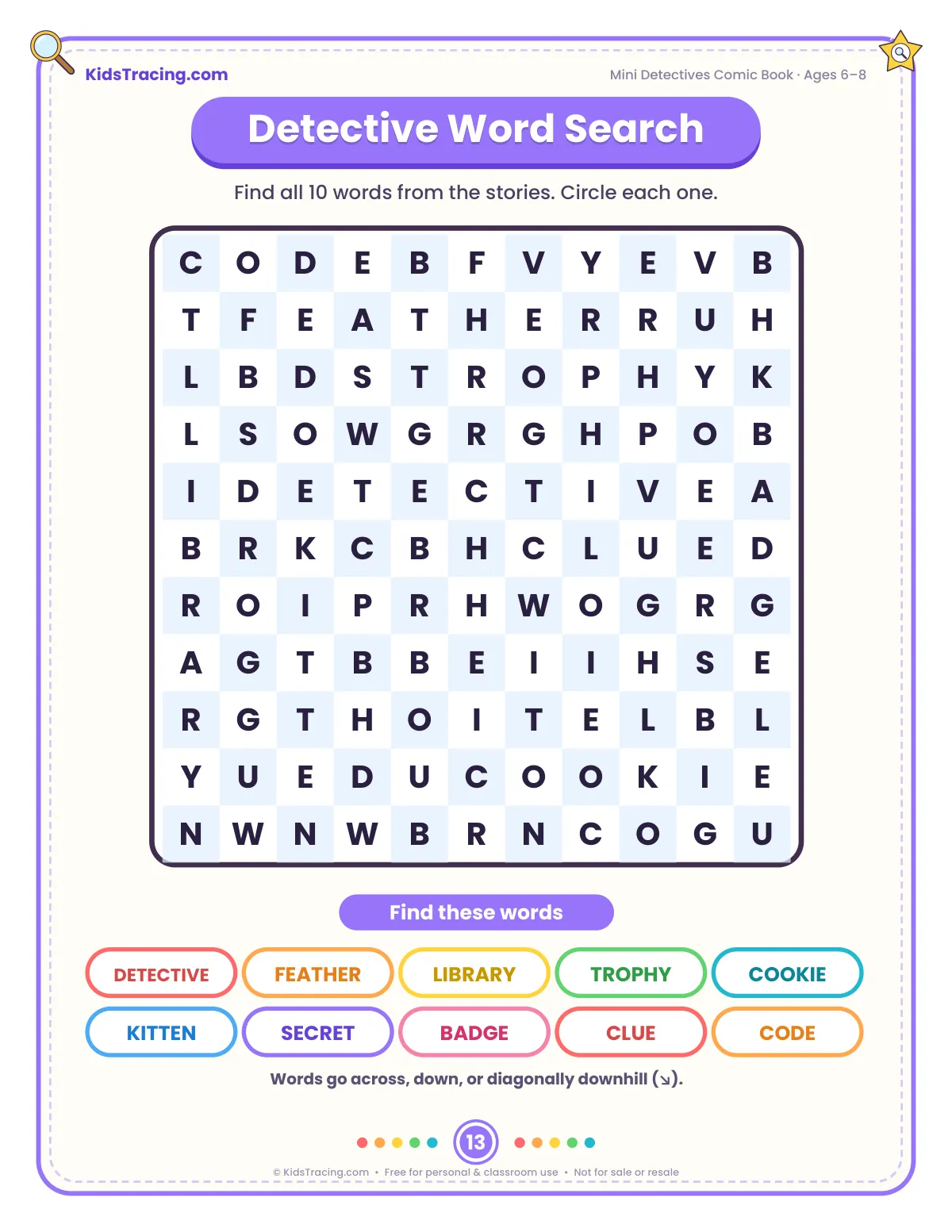
- A detective word search with ten words and an unscramble-the-clue-words page
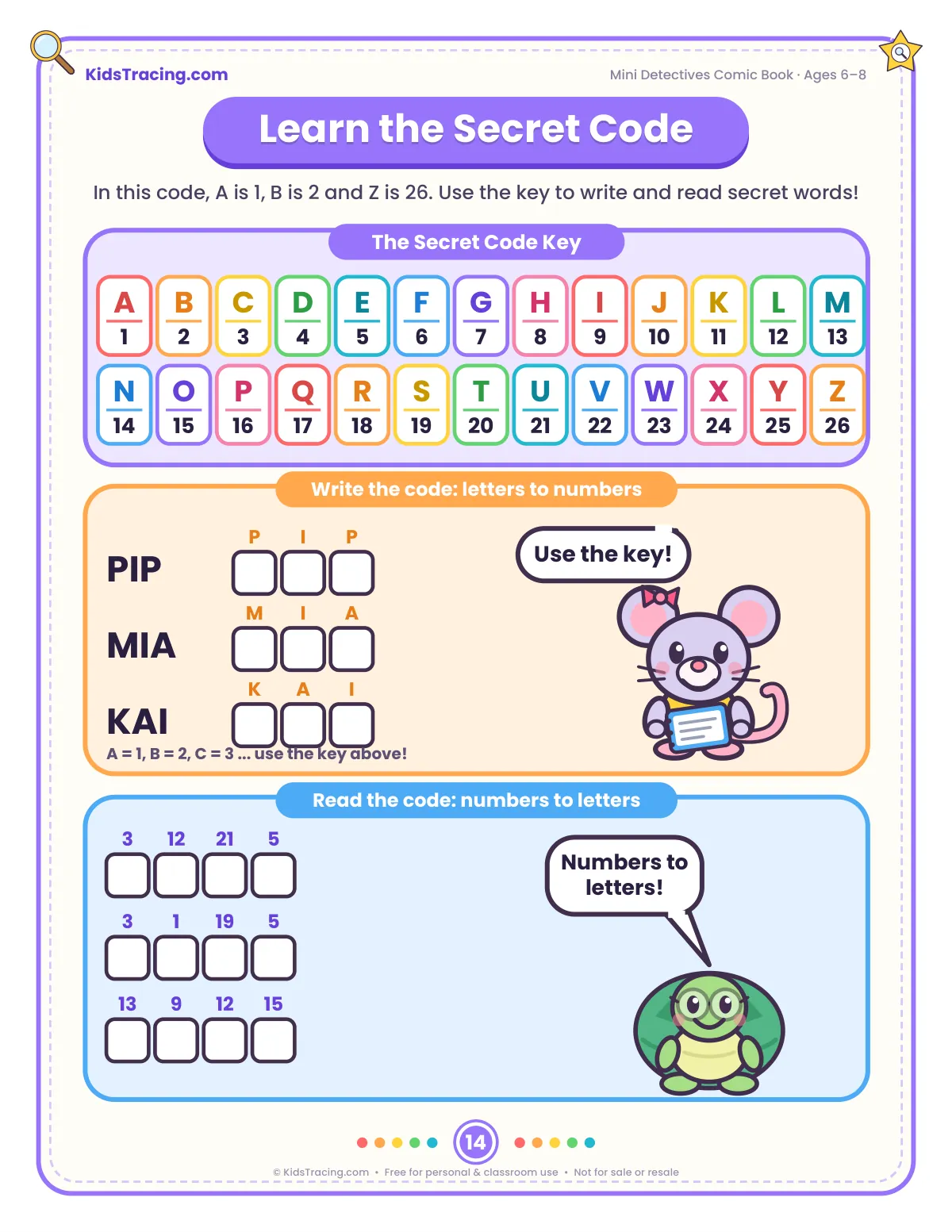
- Secret codes: learn the number code A = 1 to Z = 26, crack three coded messages and try a shift code where each letter becomes the next one
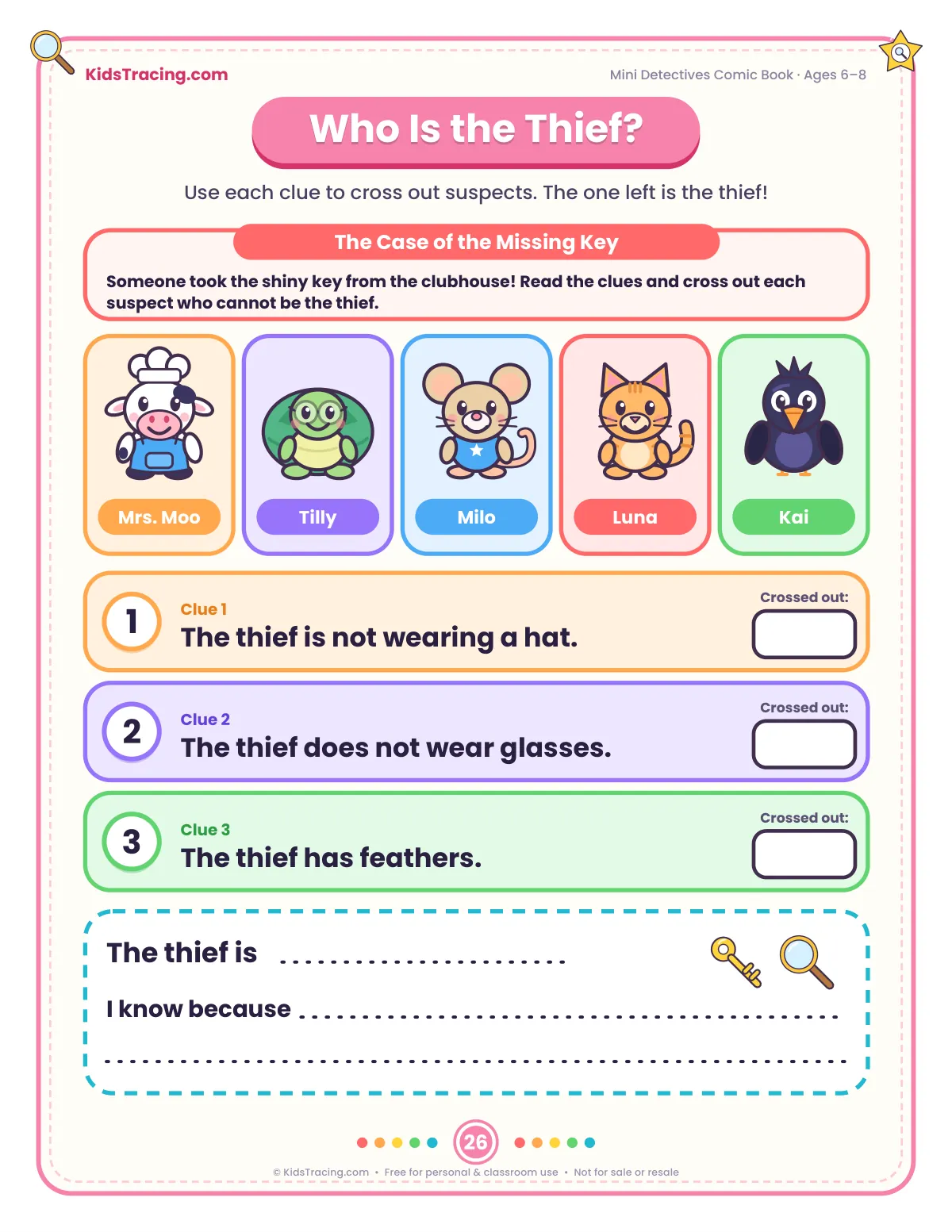
- Logic puzzles (who has which tool, who sits where), a suspect line-up (Who Is the Thief?) and Spot 6 Differences
- Story order pages for Story 2 and Story 4, a detective maze, number and picture patterns where children write the rule, and a 30-dot dot-to-dot magnifying glass
- Make-your-own-mystery pages: a four-box comic, a six-box comic, a planning page, a Wanted poster to draw the suspect and a detective badge to design
- A detective notebook, a progress page, a “Case Closed!” page and a Super Detective certificate
| Pages | Section | Number of pages |
|---|---|---|
| 1–3 | Cover, This Case File Belongs To (detective ID card), How to Read a Comic | 3 |
| 4–6 | Meet the Mini Detectives, Detective Words and Detective Tools | 3 |
| 7–10 | Story 1: The Missing Cookies, Story 1 Reading Check and Whose Footprints Are These? | 4 |
| 11–14 | Story 2: The Shiny Trophy, Detective Word Search and Learn the Secret Code | 4 |
| 15–18 | Story 3: The Secret Code, Crack the Code and Logic Puzzles | 4 |
| 19–22 | Story 4: The Midnight Library, Stories 2–4 Reading Check and Unscramble the Clue Words | 4 |
| 23–27 | Put Story 2 in Order, Put Story 4 in Order, Spot 6 Differences, Who Is the Thief? and My Detective Notebook | 5 |
| 28–32 | Detective Maze, Pattern Detective, Dot to Dot (30 dots), Match the Fingerprint and Shift Code Challenge | 5 |
| 33–37 | Make Your Own Mystery Comic, Six Box Mystery Comic, Plan Your Own Mystery, Wanted: Draw the Suspect and Design Your Detective Badge | 5 |
| 38–40 | My Detective Progress, The End (Case Closed!) and the Certificate | 3 |
Sample pages
Four pages from the finished Mini Detectives Comic Book. The PDF is sharp enough to print at full size.
Skills your child practices
- Reading speech bubbles and captions and answering reading-check questions
- Finding clues and evidence in pictures and text
- Word search and unscrambling words
- Using a number code (A = 1) and a shift code (each letter becomes the next one)
- Logic puzzles and elimination: who has which tool, who sits where, who is the thief
- Story order, spot the difference and fingerprint matching
- Mazes, number and picture patterns with a written rule, and dot-to-dot up to 30
- Planning, drawing and writing their own mystery comic
How to think like a detective
Look
Look carefully at every panel. Clues are often small: a feather, footprints, crumbs, an open window. Ask your child what they notice before you read the words.
Find
Point to each clue and say it aloud. Many stories number the clues (Clue 1, Clue 2, Clue 3), so children can keep track of the evidence.
Think
Ask “What does this clue tell us?” and “Who could it be?” This is the same skill as inferring in reading: using clues in the text and pictures to work out what is not said.
Solve
Let your child say who they think did it before the last panels. Then read the ending together and check the guess.
Write it down
The Detective Notebook page lets children record the case name, the clues, the suspects and how the clues helped them.
How to use this detective comic book at home or in class
Print a few pages at a time
Choose US Letter or A4 above and print a story with its puzzle page instead of all 40 pages. Type a page range in the print window. The cover and certificate have full-color backgrounds, so printing the inner pages only saves ink.
Read one case a day
A story takes about five to ten minutes to read. Follow it with the reading check or puzzle page that goes with it.
Work in pairs
Pairs of children can read the bubbles in turn and solve the codes and logic puzzles together. Talking through a puzzle is part of the learning.
Use the answer key last
Print the answer key separately and keep it for yourself. Let children check their own work against it once they have tried.
Finish with their own mystery
The last pages guide children through planning and drawing a mystery. Plan, draw, then swap comics with a friend to solve each other’s cases.
Answer key for the Mini Detectives comic book
The answer key is a separate 7-page PDF, so children do not see the answers inside the book. Green marks the right answers. It covers the reading checks, the detective tools and footprints pages, the word search with all ten words marked, the unscramble page, the secret codes and the shift code, the logic puzzles, the suspect line-up, the patterns, the story-order pages, the six differences, the fingerprint matches, and the maze and dot-to-dot.
The ID card, notebook, make-your-own-mystery, plan, Wanted poster, badge and progress pages are open-ended, so they have no single right answer. Praise the thinking rather than the neatness.
Printing tips: A4 or US Letter?
- US Letter (8.5 × 11 inches) is the standard paper size in the USA and Canada. A4 (210 × 297 mm) is used in most other countries, including the UK, India, Pakistan, Australia and Europe.
- Choose the PDF that matches your paper. Print at 100% or Actual size, not Fit to page, so nothing gets cut off.
- The cover and the certificate have full-color backgrounds. A home printer may leave thin white edges and use a lot of ink on those two pages, so printing the inner pages only is a good option.
- Draft mode saves ink if you are printing many pages.
- Use slightly thicker paper if your child will use markers, so the color does not show through.
- Staple or hole-punch the pages to make a book.
More help: how to print a workbook.
Free worksheet generators to go with this book
The comic pages are ready to print. For extra practice with other pictures, these free tools make single pages in seconds.
Maze Worksheets
Easy, medium and hard mazes with a start and finish picture. Solutions included.
Dot to Dot
Connect the dots 1
Counting
Count pictures, then write or circle the number, 1 to 20.
Shadow Matching
Join each picture to its shadow: 4 to 10 pairs at three levels.
Color by Number
Pick a picture and 4, 6 or 9 colors. Prints with a color key.
Patterns
AB, AAB, ABB, ABC and AABB patterns with shapes, colors or pictures.
More practice: maze worksheets, counting worksheets, dot to dot worksheets and word tracing worksheets.
Guides for parents and teachers
Coloring Activities for Preschoolers: A Practical Guide
Try six preschool coloring activities with practical teaching tips, easy adjustments, free printable coloring pages and activity books in A4 and US Letter.
Pre-Writing Activities for Preschoolers: 15 Fun Ideas
Explore practical preschool pre-writing activities, sample play sessions, materials, adjustments and line tracing ideas for home or classroom.
How Long Should Preschoolers Practice Tracing?
How long should a preschooler trace each day? Get simple time guides by age, a 10-minute tracing routine, and signs it is time to stop or move on.
More free printable workbooks
Halloween Comic Book
Four friendly picture stories in comic panels, then sound-word tracing, counting, mazes and make-your-own-comic pages.
Forest Friends Comic Book
Four happy stories with a bear, a bunny, a fox and an owl, then sound-word tracing, counting, mazes and make-your-own-comic pages. With an answer key.
Space Pals Comic Book
Four happy space stories with an astronaut pup, an alien, a robot and a star, then sound-word tracing, counting, mazes and make-your-own-comic pages. With an answer key.
All comic books · All free printable workbooks · All free worksheet tools
Frequently asked questions
Is the Mini Detectives comic book free?
Yes. You can download it free and print it for your own children or classroom. It is free for personal, home and classroom use, and it is not for sale or resale. Please do not put the file on another website. No sign-up or email address is needed.
What age is the Mini Detectives comic book for?
It is made for ages 6 to 8, usually first to third grade in the United States. Children need to read short sentences. Some pages (the code messages, the logic puzzles and the shift code) are harder, and a grown-up can help younger children.
Is the detective comic scary?
No. The mysteries are gentle: missing cookies, a lost trophy, a secret code and a noise in the library. Every case ends kindly, and there are no scary villains.
How do the secret codes work?
One page teaches a number code where A = 1, B = 2 and so on up to Z = 26, and children use it to write and read messages. A later page uses a shift code, where each letter becomes the next letter of the alphabet. Both codes are explained on the pages, and the answers are in the answer key.
Which size should I print, A4 or US Letter?
Choose the one that matches your paper. US Letter is standard in the United States and Canada, and A4 is standard in most other countries. Both PDFs have the same 40 pages.
How do I print it?
Print at Actual size or 100%, not Fit to page. The cover and the certificate have full-color backgrounds, so a home printer may leave thin white edges and use a lot of ink on those pages. Printing the inner pages only is a good option.
Is there an answer key?
Yes. A separate 7-page answer key PDF has the answers to the reading checks, word search, unscramble page, codes, logic puzzles, suspect line-up, patterns, story order, differences, fingerprints, maze and dot-to-dot. Open-ended pages have no single right answer.
Do I need to print all 40 pages at once?
No. Print a few pages at a time and keep the rest on your device. Open the PDF, choose a page range in the print window and print only the pages you need. The contents table above shows the page numbers.
Can I use it in a classroom or for homeschool?
Yes. Teachers and homeschool parents can print copies for their own students. The book is free for personal, home and classroom use, and it is not for sale or resale.