How Long Should a Child Study at Home? An Age-by-Age Guide (Ages 4 to 9)
Published by Hasnat N, Founder · November 7, 2026 · Updated November 7, 2026 · 8 min read
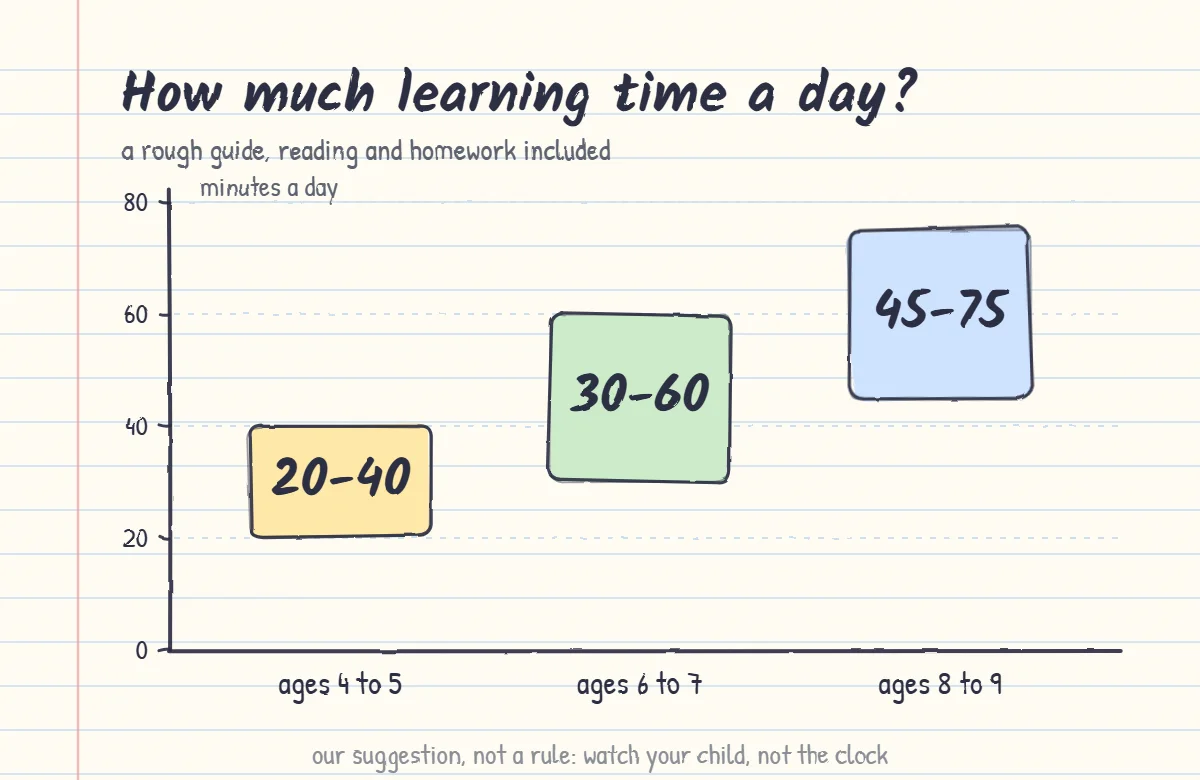
Quick answer: About 20 to 40 minutes a day at ages 4 to 5, 30 to 60 minutes at ages 6 to 7 and 45 to 75 minutes at ages 8 to 9, with reading and homework counted in. Work in blocks of 10 to 25 minutes and take a break in between. Nobody has an official number for learning at home, so these are our suggestions, not science. Sleep, play and moving around matter just as much.
| Age | Per day | One block | Break |
|---|---|---|---|
| 4 to 5 | 20 to 40 minutes | 5 to 15 minutes | 5 to 10 minutes, moving around |
| 6 to 7 | 30 to 60 minutes | 15 to 20 minutes | 5 to 10 minutes |
| 8 to 9 | 45 to 75 minutes | 20 to 25 minutes | 5 to 10 minutes |
What counts as studying at home?
When we say studying, we mean the whole learning side of the day, not only handwriting. Reading aloud, reading alone, counting games, letters and sounds, a little writing, and school homework if there is any. Free play and helping with dinner teach plenty too, but we leave them out of the totals because they are the other half of the day.
You will not find one official answer for how long young children should study at home. Schools differ, children differ, and the advice online disagrees. So treat the table above as a starting point. If your child is happy and focused, five extra minutes is fine. If they are rushing, crying or staring out of the window, stop for the day.
Handwriting has its own guides, so we will not repeat them here: how long to practice handwriting at home and how long preschoolers should trace. This post is about the whole day.
Ages 4 to 5: how long should a young child learn at home?
Think in minutes, not hours. Two or three short blocks add up to 20 to 40 minutes, and one block of about 10 minutes is a good target. Take 5 to 10 minutes between blocks and make the break a moving one: jumping, dancing, a run around the yard. Choose a time when your child is not hungry or sleepy. After a snack and some play usually works better than right before dinner.
What goes in those blocks? Letter and sound games, counting toys, matching and shape puzzles, a little tracing and a picture book together. Reading together counts as learning at this age. The American Academy of Pediatrics recommends shared reading from birth and at least through kindergarten, and it stresses print books for young children because digital books do not give the same parent-child interaction (AAP on HealthyChildren.org). The AAP page does not mention minutes, so the 10 to 15 minute bedtime story below is just our suggestion.
For ideas, try our preschool worksheets or these beginning sounds activities. If your child is already in kindergarten, the kindergarten worksheets are a better fit.
| Time block | Activity | Minutes |
|---|---|---|
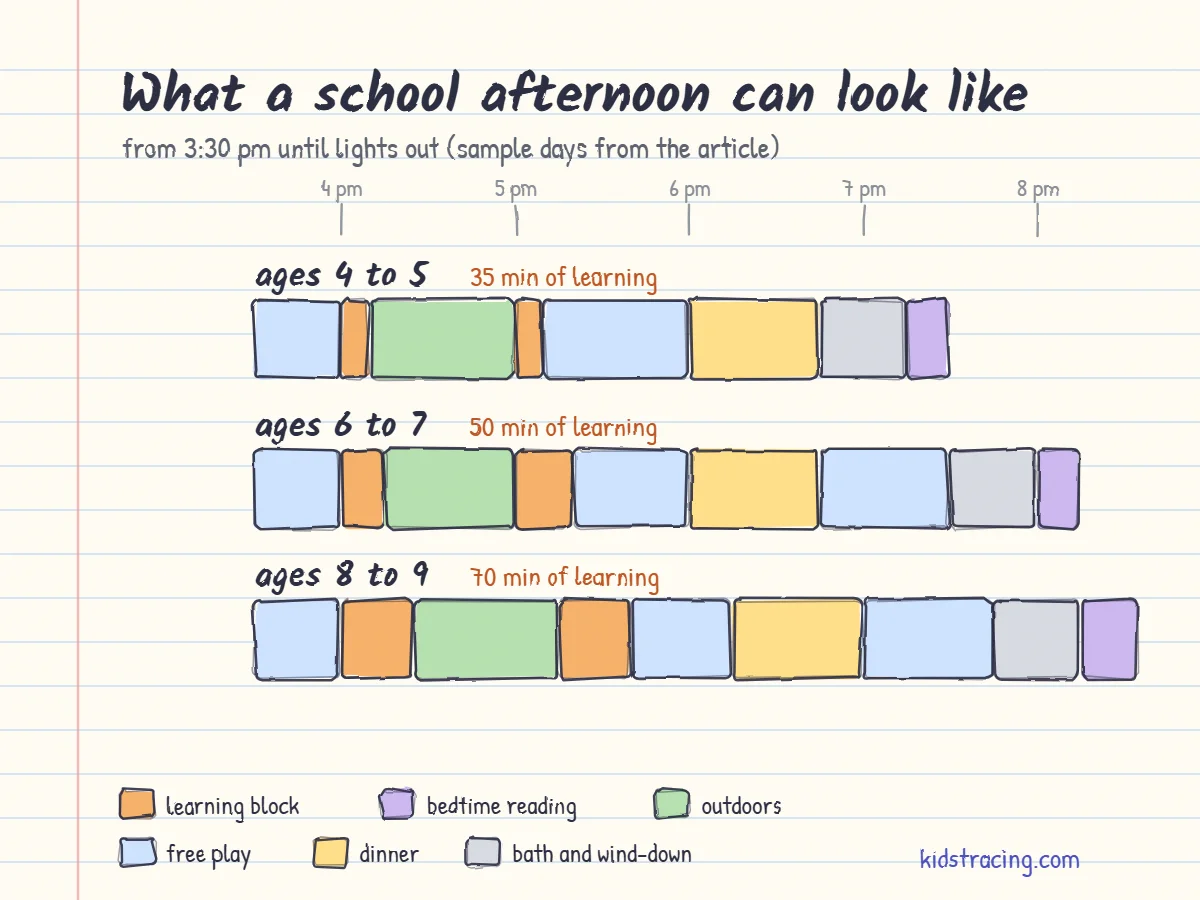
| 3:30 to 4:00 | Snack and free play | 30 |
| 4:00 to 4:10 | Learning block 1: one short worksheet (letters, tracing or counting) | 10 |
| 4:10 to 5:00 | Outdoor play or active games | 50 |
| 5:00 to 5:10 | Learning block 2: a game (matching, puzzles, counting objects) | 10 |
| 5:10 to 6:00 | Free play, or help with dinner | 50 |
| 6:00 to 6:45 | Dinner and family time | 45 |
| 6:45 to 7:15 | Bath and quiet play | 30 |
| 7:15 to 7:30 | Bedtime reading together | 15 |
| Learning time (blocks 1 and 2 plus reading) | 35 |
Ages 6 to 7: how long should my child study at home?
Children this age read and write more on their own, so keep each block short and stop while they still feel okay about it.
- Per day: 30 to 60 minutes, with reading and school homework included.
- One block: 15 to 20 minutes.
- Break: 5 to 10 minutes. A snack, a stretch or a quick game outside works well.
- Best time: after a snack and some movement, and well before bedtime.
- In the blocks: reading aloud and alone, number facts through games, short writing, spelling words and homework.
If writing is the hard part, use our handwriting routine for that block instead of adding more time.
| Time block | Activity | Minutes |
|---|---|---|
| 3:30 to 4:00 | Snack and free play | 30 |
| 4:00 to 4:15 | Learning block 1: homework or a short worksheet | 15 |
| 4:15 to 5:00 | Outdoor play or active games | 45 |
| 5:00 to 5:20 | Learning block 2: reading aloud or alone | 20 |
| 5:20 to 6:00 | Free play | 40 |
| 6:00 to 6:45 | Dinner and family time | 45 |
| 6:45 to 7:30 | Free time, hobbies or a game | 45 |
| 7:30 to 8:00 | Bath and bedtime routine | 30 |
| 8:00 to 8:15 | Bedtime reading together | 15 |
| Learning time (blocks 1 and 2 plus reading) | 50 |
Ages 8 to 9: how long should my child study at home?
Eight and nine year olds can start to plan their own time. Aim for 45 to 75 minutes with homework and reading included, in blocks of 20 to 25 minutes with a 5 to 10 minute break in between. Drink some water, stretch, move around, then come back. Do homework first, then pick from reading, math practice, spelling or a small project. Let your child choose the order of two tasks, and set a kitchen timer so they can see the end. Again, after a snack and some activity works best, before screens and before the evening gets tired.
| Time block | Activity | Minutes |
|---|---|---|
| 3:30 to 4:00 | Snack and free play | 30 |
| 4:00 to 4:25 | Learning block 1: homework | 25 |
| 4:25 to 5:15 | Outdoor play, sport or active games | 50 |
| 5:15 to 5:40 | Learning block 2: math practice, spelling or a project | 25 |
| 5:40 to 6:15 | Free play | 35 |
| 6:15 to 7:00 | Dinner and family time | 45 |
| 7:00 to 7:45 | Free time or a hobby | 45 |
| 7:45 to 8:15 | Bath and wind-down | 30 |
| 8:15 to 8:35 | Reading in bed | 20 |
| Learning time (blocks 1 and 2 plus reading) | 70 |
What about the 10 minutes per grade rule?
You may have heard of a rule of 10 minutes of homework per grade level. In an advice column, the National Education Association says that “many districts follow the guideline of 10 minutes per grade level” and calls it “a good rule of thumb” that can be changed for individual students (NEA).
Two things to keep in mind. It is about homework, not all the learning a child does at home. And it is a rule of thumb, not a law. Following the arithmetic, first grade would be about 10 minutes and second grade about 20, but grade names and ages differ from country to country, so check your own school’s policy first. If homework already fills your child’s time, do not add extra study on top.
Sleep, movement and play come first
Children usually learn more happily when they are rested and have had time to move.
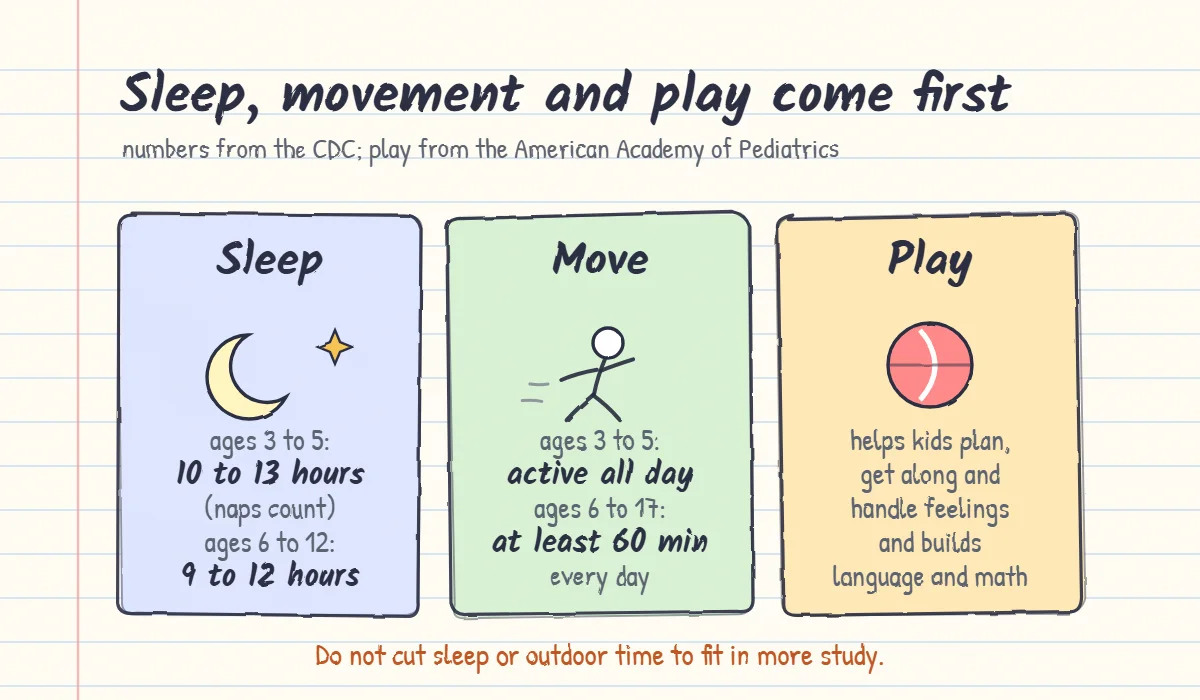
- Sleep: the CDC says children aged 3 to 5 need 10 to 13 hours a day, naps included, and children aged 6 to 12 need 9 to 12 hours (CDC). Do not cut sleep to fit in more study.
- Movement: the CDC says children aged 3 to 5 should be active throughout the day, and children aged 6 to 17 need at least 60 minutes of physical activity every day (CDC).
- Play: the American Academy of Pediatrics says play can improve children’s ability to plan, organize, get along with others and manage emotions, and it helps with language, math and social skills (AAP on HealthyChildren.org).
- Screens: the AAP suggests screen-free zones, including during homework and before bed, and a “one screen at a time” rule (AAP on HealthyChildren.org).
School days and holidays: should the time change?
On school days your child has already worked hard. Count homework as part of the total and keep the rest light. One block of reading and one block of homework or practice is plenty for many families.
In the holidays, keep a light routine: one or two blocks a day at the low end of your child’s range, four or five days a week. Use real life. Cook together, count the change at the shop, write a postcard, read on the trip. And take real days off too.
Too much, or too little?
Your child will tell you, just not in words. Here is what to watch for.
| Might be too much | Might be too little |
|---|---|
| Tears, anger or stalling every day | Your child asks to do more and finishes easily |
| Careless mistakes that get worse as time goes on | They forget letters, sounds or numbers you practiced last week |
| No time left for play, outdoors or sleep | Reading has been skipped for many days in a row |
| “I hate it” about everything | They are bored and not challenged |
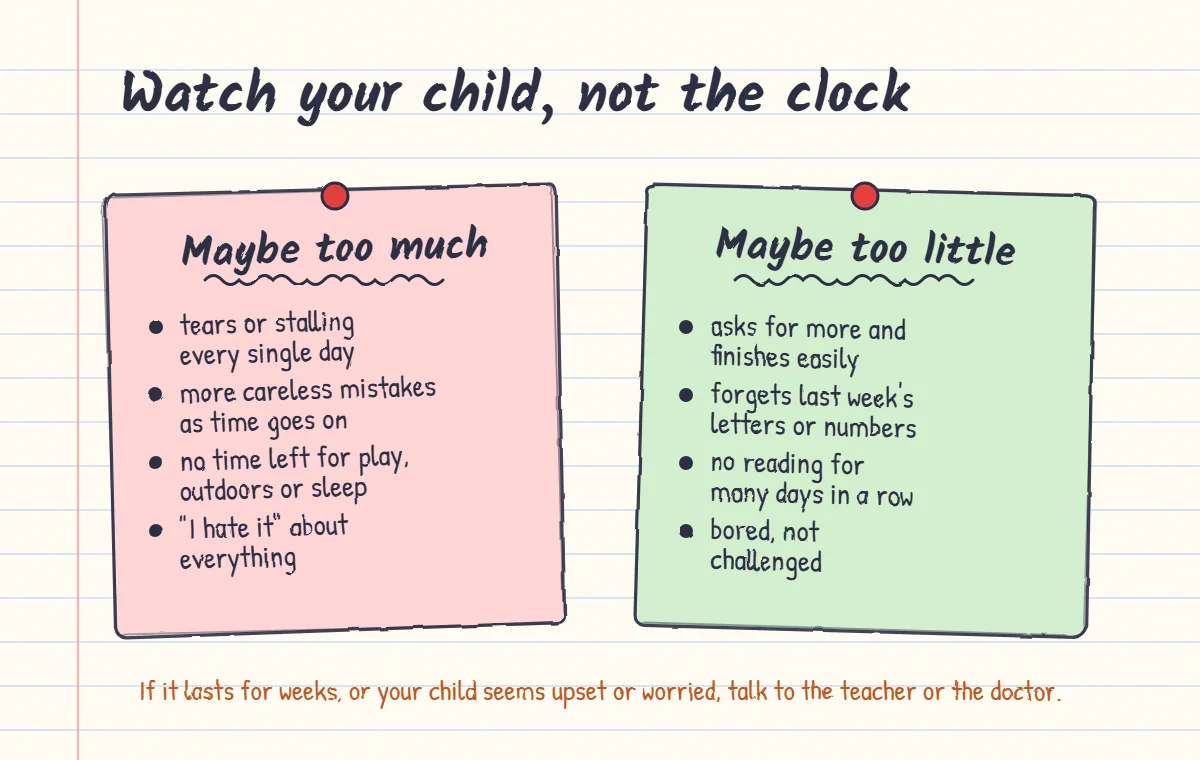
If the problems last for several weeks, or your child seems upset or worried, talk to your child’s teacher or your doctor. This guide is general information, not medical advice. If the trouble is mostly with writing, see what to do when a child refuses to write and whether your child is behind in writing.
Free printables to go with this guide
Short pages for short blocks: preschool worksheets, kindergarten worksheets, kindergarten math printables, phonics worksheets and all free worksheet generators.
Free workbooks to go with this guide
Alphabet Activity Book
70 picture pages to trace, match, color and solve: letter puzzles, beginning sounds, a letter hunt and a certificate.
Free PDF Download US Letter · PDF of the Alphabet Activity Book
Counting Activity Book
Count to 20 with ten frames, tally marks and dice, then compare, skip count, add and take away. With an answer key.
Free PDF Download US Letter · PDF of the Counting Activity Book
CVC Words Workbook
Read, build, trace and write short a, e, i, o and u words with pictures, sound boxes and sentences.
Free PDF Download US Letter · PDF of the CVC Words WorkbookSources
Where we give numbers from outside sources, they are listed here. The session lengths and the sample days are our own suggestions.
- NEA: How much homework is too much? says many districts follow 10 minutes per grade level and calls it a rule of thumb.
- CDC: About Sleep lists 10 to 13 hours for ages 3 to 5 (naps included) and 9 to 12 hours for ages 6 to 12.
- CDC: Child Activity, an overview says ages 3 to 5 should be active throughout the day and ages 6 to 17 need at least 60 minutes a day.
- AAP: Shared reading starting at birth recommends shared reading from birth through at least kindergarten.
- AAP: How to make a family media plan suggests screen-free zones, including during homework and before bed.
- AAP: The power of play explains how play supports planning, social skills, language, math and coping with stress.
Keep reading
- Handwriting Practice at Home: How Long and How Often – Plan manageable handwriting practice at home with sample sessions, specific feedback, useful observations and ways to adjust difficulty.
- How Long Should Preschoolers Practice Tracing? – How long should a preschooler trace each day? Get simple time guides by age, a 10-minute tracing routine, and signs it is time to stop or move on.
- My Child Refuses to Write: What to Do (Ages 3 to 6) – Child refuses to write? Learn why preschoolers avoid writing and 9 gentle, practical ways to help, from play to short sessions and free printables.
- Is My Child Behind in Writing? What to Expect at Ages 3 to 6 – Worried your child is behind in writing? See what is typical from scribbling to writing a name at ages 3 to 6, signs to watch, and how to help.
- Preschool and KG Worksheets: English and Math Activities for Ages 3 to 6 – Choose preschool and kindergarten English and math worksheets by skill, with worked lessons, practical adaptations and free printable activities.
Frequently asked questions
How long should a 5-year-old study at home?
About 20 to 40 minutes a day, in two or three short blocks of 5 to 15 minutes, plus a bedtime story. It is a rough guide, not a rule. If your child is tired or upset, stop early.
Does reading count as studying?
In this guide, yes. Reading together or alone is a big part of learning at every age from 4 to 9, so it is part of the daily total.
Is it better to study all at once or in short blocks?
Usually in short blocks. Two shorter sessions with a break and some movement in between suit most children better than one long sitting.
My child finishes in five minutes. Should I add more?
Add a little challenge first, such as a harder worksheet or a new game, instead of more time. Then follow your child’s mood.
Can my child use a tablet to study?
It can help, but the American Academy of Pediatrics suggests screen-free zones, including during homework, and a one screen at a time rule. Try paper first, and switch the tablet off when the block ends.