Handwriting Practice at Home: How Long and How Often
Published by Hasnat N, Founder · October 6, 2026 · Updated November 14, 2026 · 8 min read
Quick answer: Short and often beats long and rare. As a guide, aim for 3 to 5 minutes at age 3, 5 to 10 minutes at age 4 and 10 to 15 minutes at ages 5 and 6, two to five days a week depending on age. Stop while your child is still enjoying it.
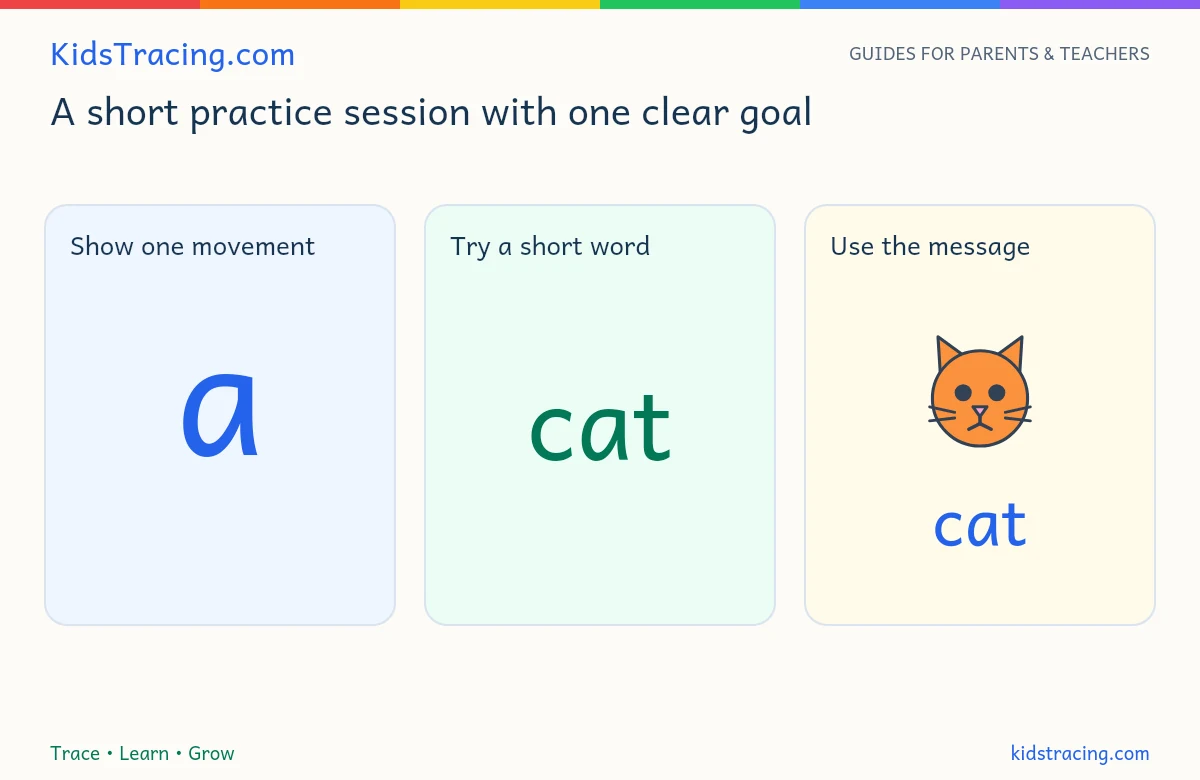
Handwriting is a physical skill. Like any skill that uses small muscles, it improves with regular, brief practice and gets worse with long, tired sessions. A tired hand grips harder, forms letters badly and teaches itself bad habits. That is why short routines work better than a big weekly session.
How long should a child practice handwriting?
| Age | Session length | Times a week | What to practice |
|---|---|---|---|
| 3 | 3 to 5 minutes | 2 to 3 | Pre-writing lines, play with big movements, the first letter of the name. |
| 4 | 5 to 10 minutes | 3 to 4 | Pre-writing lines, big movements, the first letter of the name, then the whole name. |
| 5 | 10 to 15 minutes | 3 to 5 | Name, a few letters at a time, numbers 1 to 10. |
| 6 | 10 to 15 minutes | 3 to 5 | Letters, short words, numbers to 20, simple sentences. |
These numbers are guidelines, not rules. A child who is happy to keep going can do a little longer, and a child who is having a hard day can do much less. If your child attends school, they may also be writing in class, so home practice can be shorter.
Set up for success
- Seating. Your child’s feet should rest flat on the floor or a box, the back should be supported and the table should be about elbow height.
- Paper position. Tilt the top of the paper slightly to the left for right-handers, and to the right for left-handers. Left-handers also do better when the paper is not covered by their hand.
- Pencil. A short, regular pencil or a chunky crayon works well for beginners. Short tools encourage the fingers to do the work.
- Light and quiet. Turn off the TV. Good light on the paper makes tracing easier.
A 10-minute handwriting routine
- Warm up (1 to 2 minutes). Squeeze play dough, wiggle fingers or write big letters in the air.
- Trace (3 to 4 minutes). A few rows of tracing. Choose a style that is easy, see dotted, outline or solid tracing.
- Write (2 to 3 minutes). One line on blank handwriting paper, copying or writing from memory.
- Finish well (1 minute). Let your child choose the best letter and color it, add a sticker, or say what they like about it.
For children under 5, cut the routine to the warm-up and a short trace.
A simple weekly plan
| Day | Focus |
|---|---|
| Monday | Name: name tracing worksheets |
| Tuesday | Two letters: letter formation worksheets |
| Wednesday | Numbers: number tracing worksheets |
| Thursday | Play day: chalk, sand or play dough, or pre-writing worksheets for little ones |
| Friday | Free choice: any favorite, or write a card for someone |
Rest on the weekends unless your child asks to write. Practice becomes a habit more easily when it is the same time each day, such as after a snack.
How to make it fun
- Let your child choose the color of the pencil or the order of the activities.
- Use stickers or stars. Our name tracing sheets end each line with a star to color.
- Write on different surfaces: a window with a dry-erase marker, a chalkboard, a tray of sand.
- Write for a reason. A birthday card, a shopping list or a label for a toy gives writing a purpose.
- Practice together. Write your own line beside your child’s.
Signs that it is time to stop
- Pressing very hard, or the pencil tip breaking
- Shaking or rubbing the hand
- Letters getting messier or rushed
- Moving away from the table, or tears
When you see these signs, stop for the day and try again tomorrow with an easier activity.
If your child does not want to practice
First, shorten the session. Even two minutes counts. Then change the activity to something your child chooses: their name, a favorite animal word, or a game. If it is still a battle, go back to play-based activities and check whether your child is ready with the handwriting readiness checklist.
Keep it positive
- Praise one specific thing: “I love how you started at the top.”
- Correct only one thing at a time.
- Keep a folder with dated sheets. Looking back after a month shows progress that is hard to see day to day.
Not sure which letters to start with? Try our suggested letter formation order. If the writing lines themselves are the problem, read Sky Line, Grass Line, Worm Line.
Try this at home: a measurable five-day routine
- Monday: Draw 3 large vertical lines, then 3 horizontal lines. Let the child choose a favorite one.
- Tuesday: Trace 3 circles with a finger first, then with a crayon. Stop before grip becomes tense.
- Wednesday: Write the first letter of the child’s name in the air, on a large sheet, then on a line.
- Thursday: Copy one short word from a model. Compare letter size rather than speed.
- Friday: Let the child choose the easiest activity from the week and show it to a caregiver.
Use this as a flexible example, not a test. If the child becomes tired or frustrated, shorten the activity.
Choose a goal small enough to notice
"Practice handwriting" can mean many things. Choose one observable focus instead: starting a letter at the top, leaving a gap between two words, or placing a number on a line. Keep the spelling, letter style and page size familiar while working on that focus.
Example session: make a label for a drawing
- Ask the child what they want to draw and help choose a short label.
- Model one letter that needs attention, saying the movement briefly.
- Offer a trace or copy of that letter, followed by an attempt in the label.
- Read the label together and notice the chosen focus. Stop before the activity becomes a struggle.
A custom word tracing sheet can provide the model. A child who already writes the word may only need blank handwriting paper. There is no benefit in printing a complete pack when one useful line serves the goal.
Give feedback a child can act on
Describe one successful action: "You left a gap, so I can see the two words." Then offer one manageable next step: "On the next word, start this tall letter at the top." Avoid asking for speed, smaller writing and better spelling at the same time.
If the attempt is hard to read, compare it calmly with the model. Ask which part the child wants help with rather than covering the page with corrections. Read their message aloud so the reason for writing remains clear.
Review the routine, not only the finished page
- Did the child understand what the activity was for?
- Was the model close enough to see without repeatedly searching?
- Was the page comfortable to use, with room for their current writing size?
- Did the chosen adjustment make the task easier to begin?
Keep one earlier sample if it is useful, but compare similar tasks. A careful copied sentence and a quickly written shopping list show different demands. If practice repeatedly causes discomfort or strong distress, pause and discuss the pattern with the teacher rather than extending the session.
What the CDC says about drawing and writing at ages 3 to 5
Before you plan any practice time, it helps to know what is typical. In its milestone checklists, the CDC lists drawing a circle when you show your child how at age 3 (CDC, 3 years). At age 4 it lists drawing a person with three or more body parts, and holding a crayon or pencil between the fingers and thumb, not in a fist (CDC, 4 years). At age 5 it lists writing some letters in their name, and naming some letters when you point to them (CDC, 5 years).
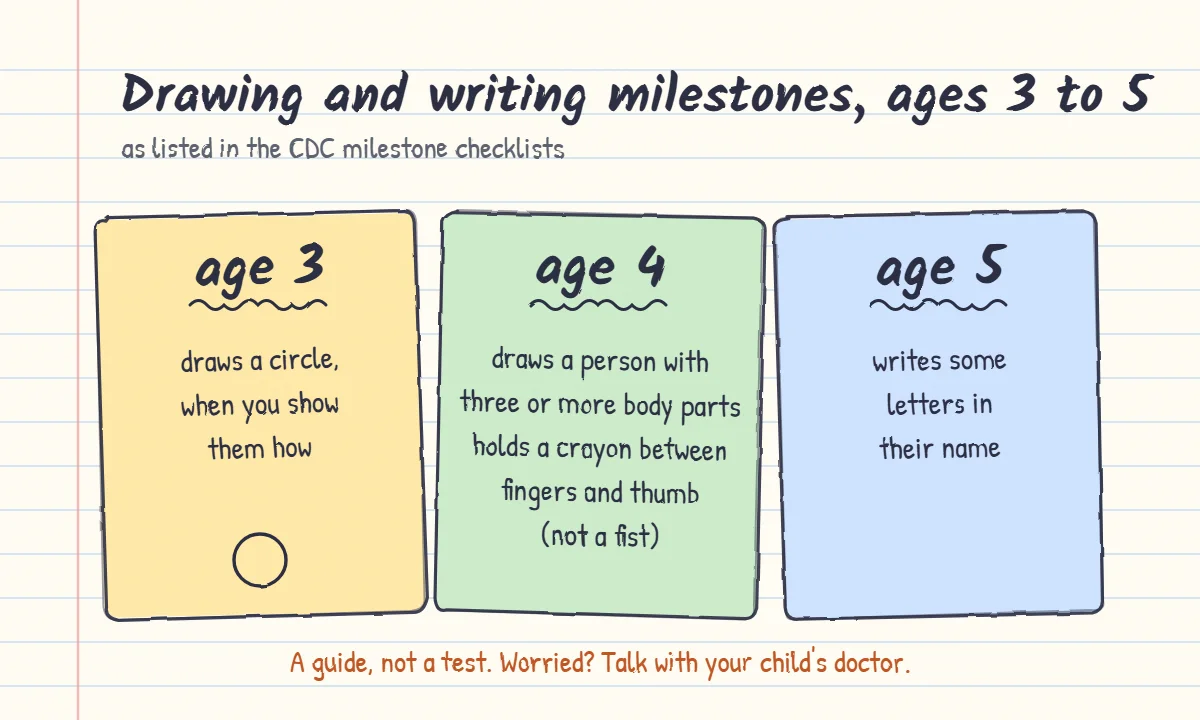
Milestones are a guide, not a test. The CDC says that if your child is not meeting one or more milestones, has lost skills they once had, or you have other concerns, you should talk with your child’s doctor and ask about developmental screening. The session lengths and routines in this guide are our own suggestions, not CDC rules.
Sources
- CDC: Milestones by 3 Years includes drawing a circle when shown how.
- CDC: Milestones by 4 Years includes drawing a person with three or more body parts and holding a crayon or pencil between the fingers and thumb.
- CDC: Milestones by 5 Years includes writing some letters in their name and naming some letters.
Free printables to go with this guide
Put this guide into practice with our free generators: name tracing worksheets, letter formation worksheets, number tracing worksheets, blank handwriting paper, pre-writing worksheets.
Free workbooks to go with this guide
- ABC Tracing Book – Every letter A to Z with numbered stroke arrows, a picture to color and a word to trace.
- Number Tracing and Counting Book – Trace, count and color every number from 1 to 20, then practice number words and skip counting.
- Fruits and Vegetables Tracing and Coloring Book – Color 26 fruits and vegetables, trace each word and write it alone, then review with matching games.
Keep reading
- Handwriting Readiness Checklist: Is Your Child Ready to Write? – A simple handwriting readiness checklist for ages 3 to 6: ten signs your child is ready to start writing, and what to do if they are not there yet.
- Dotted vs Outline vs Solid Gray Tracing: Which Style Comes First? – Dotted, outline or solid gray tracing letters? See what each style is for, which one to start with and how to fade support as your child gains confidence.
- Letter Formation Order: Which Letters to Teach First – A simple letter formation order: group letters by how they are written and teach straight-line letters first. Capital and small letter groups, with a week plan.
- Sweden Brings Back Books and Handwriting: Facts for Parents – Is Sweden banning tablets? See what changed in its schools, what research says about handwriting vs typing, and a paper-first plan for ages 3 to 6.
- How Long Should a Child Study at Home? An Age-by-Age Guide (Ages 4 to 9) – How long should a child study at home? Ages 4 to 9: daily minutes, session length, breaks, sample timetables, and signs it is too much.
- 7 Finger Spacing Activities for Kindergarten (Easy Word Spacing Practice) – Try 7 easy finger spacing activities for kindergarten: finger and craft-stick spacers, dots, word cards, a 5-minute routine and free handwriting paper.
Keep the habit going
A 30-day challenge or a reward chart can make a daily ten minutes easier to remember.
Frequently asked questions
How long should a preschooler practice handwriting each day?
Three to five minutes at age 3 and five to ten minutes at age 4 is plenty, and many days it is fine to skip it for play. A short session your child enjoys is better than a long one they dread.
How often should a kindergartener practice handwriting at home?
Three to five short sessions a week of 10 to 15 minutes, in addition to what they write at school. If your child writes a lot at school, less may be enough.
Is it better to practice every day?
Daily short practice builds a habit, but it is not required. Three or four sessions a week with rest days works well for most young children.
Should I correct my child's mistakes?
Gently, and one at a time. Praise something specific first, then show one correction, such as where to start a letter. Too many corrections discourage a young writer.