Handwriting Readiness Checklist: Is Your Child Ready to Write?
Published by Hasnat N, Founder · October 4, 2026 · Updated November 14, 2026 · 9 min read
Quick answer: Look at comfort, interest, paper handling and intentional mark making to choose useful support. These ten observations are not a validated assessment or a pass/fail score. A child can explore drawing and meaningful writing while still developing the skills on this list.
There is no exact birthday for handwriting. Two children of the same age can be at very different places, and both can be developing normally. What matters more than age is whether the hands, eyes and attention are ready for the job. The demands of a particular task matter too: a child may enjoy large drawing movements while finding small letter rows difficult.
Use this checklist to see where your child is today. It is not a test, and there are no wrong answers.
The 10-point handwriting readiness checklist
Read each statement and tick the ones that are mostly true. “Mostly” is enough. Children do not need to do every item every time.
- Prefers one hand. Many children show a clear favorite hand by 4 or 5. Some take longer and switch back and forth, which is fine. Just notice which hand they choose for drawing and eating.
- Holds a crayon with the fingers, not the whole fist. Toddlers start with a fist grip and move to the fingers over time. A grip with the thumb, index and middle finger is a good goal, but any comfortable grip that lets the fingers move is fine at this stage.
- Draws lines and circles on purpose. Scribbles that turn into up-and-down lines, side-to-side lines and round shapes show that your child is steering the crayon, not just moving the whole arm.
- Copies a vertical line, a horizontal line and a circle. These are the first strokes of most letters. Our guide to pre-writing shapes by age shows the usual order.
- Copies a cross (+). A cross needs two strokes that meet, which is the same skill letters such as t and f use later. Many children can do it around age 4.
- Cuts along a straight line. Cutting uses the same small hand muscles as writing, and it asks both hands to work as a team. See how to teach a child to use scissors.
- Has enough hand strength for small tasks. Can your child squeeze play dough, pinch a clothespin, thread large beads, turn single pages or twist a lid?
- Sits and focuses for about five minutes. Wiggling is normal. The question is whether your child can stay with an activity they enjoy for a few minutes at a table.
- Knows their own name, or the first letter of it, by sight. Most children want to write their own name before anything else, and recognizing it is a strong motivator.
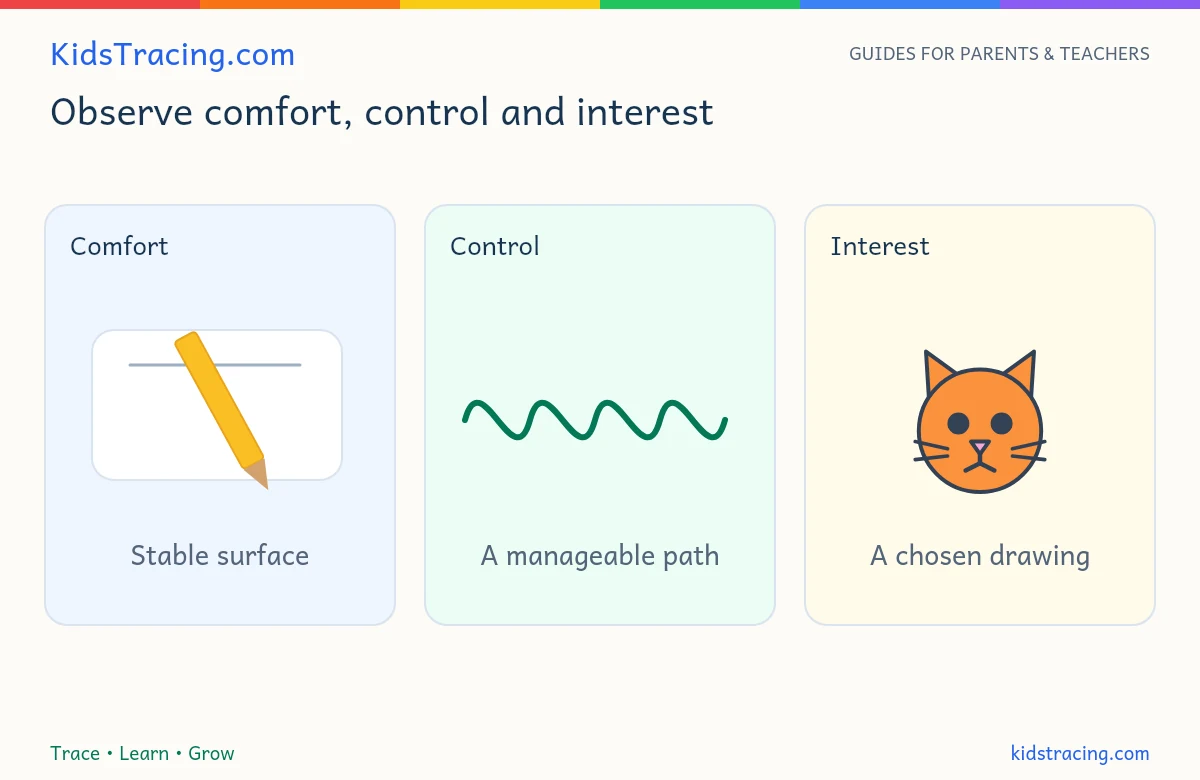
- Shows interest. They pretend to write, add scribbles to their drawings “as words”, or ask how to write a word. Interest matters more than any other item on this list.
How to use your observations
Do not total the ticks to decide whether the child is ready. Pick one activity they enjoy and one support that could make it more comfortable: a stable page, a larger model or a shorter route. Review the same kind of activity later and note what help was useful.
Interest in letters can be encouraged with a name model, while pre-writing play provides practice with lines and curves. Neither requires completing the entire checklist.
What your child does not need before starting
- Knowing the whole alphabet. Children can learn to write the letters in their name before they know all 26.
- A perfect pencil grip. A comfortable, working grip beats a textbook grip held with tears.
- Neat letters. At first, the movement matters more than how the letter looks. Neatness follows practice.
- Long periods at a desk. Five minutes is a real session at this age.
How to build the skills that are not there yet
Almost every skill on the list can be built through games. Choose one or two to focus on each week.
| Skill | Easy ways to practice |
|---|---|
| Hand strength | Squeezing and rolling play dough, picking up small objects with tongs, squeezing water from a sponge, using a spray bottle. |
| Finger control | Threading beads, peeling stickers, using clothespins, building with small blocks, tearing paper into pieces. |
| Drawing strokes | Drawing lines and circles in sand, shaving foam or flour, or with chalk on the pavement. Then try preschool line tracing on paper. |
| Cutting | Snipping paper strips, cutting along thick lines, practicing with scissor skills worksheets. |
| Attention | Short, predictable routines at the same time each day. Stop while your child is still enjoying it. |
Starting gently when they are ready
- Lines first. Trace straight and curved lines on a large page. Work from left to right and from top to bottom.
- Then their name. Trace the first letter, then the next. Do not rush to the whole name.
- Then a few letters. Pick two or three at a time from the letter formation worksheets, which number every stroke.
- Then numbers. Counting objects first and tracing second works best. Try number tracing for preschool.
You can find more age-appropriate tools on our preschool worksheets page.
Once your child is writing letters, the next question is where each one sits on the line. Sky line, grass line, worm line explains the line names and which letters are tall, short or have tails.
Handwriting readiness assessment: a quick look at home
Parents and teachers often search for a “handwriting readiness assessment”. A formal assessment is done by a professional, such as an occupational therapist, using standard tests. What you can do at home or in class is a simple informal check: watch your child for a few days during play and everyday tasks, tick what you see on the checklist above and write one short note. Look at how they hold a crayon, whether they use both hands together, how long they stay with a drawing and whether they try to copy lines and circles.
The result is not a score or a diagnosis. Use it to choose what to practice next, such as hand strength play, pre-writing lines or letter shapes. If something stays hard for a long time or worries you, talk to your child’s teacher or doctor. To see what usually comes next, read pre-writing shapes by age.
When to ask a professional
Every child develops at their own pace, and most late starters catch up. Still, it is worth mentioning your concerns to your child’s doctor, teacher or an occupational therapist if your child has pain, persistent difficulty with everyday hand activities or ongoing avoidance that concerns you. Do not wait for a particular birthday to ask about pain or significant difficulties. This guide is general information only, not a diagnosis.
Observe skills during play, not only on paper
- Control: Can the child draw a line between two wide boundaries without rushing?
- Imitation: Can the child copy a simple circle or cross after watching a demonstration?
- Comfort: Can the child use a crayon for a short activity without pain or strong frustration?
These are informal observations, not a developmental diagnosis or pass/fail checklist.
Use a note about support instead of a readiness score
Two children can have the same number of ticks and need different help. One may enjoy writing but find it difficult to keep the paper still. Another may draw comfortably but have little interest in a printed letter task. A total hides those differences, so treat each observation as a planning clue.
An example observation record
| Activity | What happened | Next support |
|---|---|---|
| Drawing a road | Enjoyed the task; paper moved while drawing. | Offer a stable surface and show how the free hand can help. |
| Copying a circle | Copied after watching a large model. | Keep the model and offer another playful circle activity. |
| Writing a first letter | Recognized it but asked the adult to write. | Demonstrate once and invite a finger trace without demanding a copy. |
Make the activity accessible before judging the skill
Check that the child can reach the surface, see the model and use a tool that makes a mark without excessive pressure. Offer a larger drawing area or a preferred material. These changes help separate the writing task from an avoidable setup problem; they are not a reason to insist on one grip or one hand.
For a child who enjoys drawing, add a meaningful word such as their name beneath a picture. For a child who prefers movement, start with a large chalk route or a finger path. The pre-writing activities guide offers alternatives to seated letter practice.
Share concrete observations with the child's teacher when you need help: the activity, the material, how long it was comfortable and what support helped. Avoid labels such as "lazy" or "not ready" based on a single page. Pain or persistent difficulty deserves advice without waiting for a particular birthday.
The next step can be one familiar shape, a first name letter, or more drawing play. None requires completing every item on this informal checklist.
Free printables to go with this guide
Put this guide into practice with our free generators: pre-writing worksheets, shape tracing worksheets, scissor skills worksheets, name tracing worksheets.
Free workbooks to go with this guide
- ABC Tracing Book – Every letter A to Z with numbered stroke arrows, a picture to color and a word to trace.
- Number Tracing and Counting Book – Trace, count and color every number from 1 to 20, then practice number words and skip counting.
- Pen Control and Pre-Writing Book – Lines, curves, zigzags, loops and spirals, plus paths from a bee to a flower, to build pencil control.
Keep reading
- Kindergarten Age Requirements & Cutoff Dates – Find your child’s US kindergarten starting age, understand birthday cutoff dates and compare typical ages by grade.
- Pre-Writing Shapes by Age: When Can Kids Draw Each Shape? – The pre-writing shapes in order, with the usual age children can copy each one: line, circle, cross, square, diagonals and triangle, and how to practice.
- How to Teach a Child to Use Scissors – How to teach a child to use scissors: the right grip, the best first scissors and a step-by-step cutting plan from snipping to cutting out shapes.
- Handwriting Practice at Home: How Long and How Often – Handwriting practice at home: how long and how often for ages 3 to 6, a 10-minute routine, setup tips and the signs that it is time to stop.
- Preschool and KG Worksheets: English and Math for Ages 3 to 6 – What to practice in English and math at ages 3 to 6, with free printables and a weekly plan.
- Sweden Brings Back Books and Handwriting: Facts for Parents – Is Sweden banning tablets? See what changed in its schools, what research says about handwriting vs typing, and a paper-first plan for ages 3 to 6.
- 7 Finger Spacing Activities for Kindergarten (Easy Word Spacing Practice) – Try 7 easy finger spacing activities for kindergarten: finger and craft-stick spacers, dots, word cards, a 5-minute routine and free handwriting paper.
Ready? Here is a year to follow
Once your child shows the signs on this list, the Preschool year of our free curriculum adds pencil play, tracing and name writing in small steps across 36 weeks.
Frequently asked questions
At what age should a child start writing?
Most children begin writing letters at school, around age 5 in kindergarten. Many preschoolers enjoy tracing their name earlier, and that is fine as long as it stays short and fun. Readiness depends more on hand skills and interest than on age.
My 4-year-old does not want to draw. Is that a problem?
Not necessarily. Some children avoid drawing because it feels hard. Try bigger movements first, such as chalk outdoors or fingers in sand, and keep sessions very short. If avoidance persists or comes with other concerns, talk to your child's teacher or a qualified professional. Ask about pain or significant difficulties at any age.
Does pencil grip matter?
A comfortable grip that lets the fingers move and does not tire the hand quickly is what counts. Many different grips work well. It is worth getting advice if your child's hand hurts, or if they grip so tightly that the paper tears.
Should my child learn capital or small letters first?
Start with the letters in your child's name, whatever case they are in. After that, follow a simple order such as the one in our letter formation order guide.