My Child Refuses to Write: What to Do (Ages 3 to 6)
Published by Hasnat N, Founder · November 3, 2026 · Updated November 3, 2026 · 9 min read
Quick answer: A child who refuses to write is usually telling you that writing feels too hard, too long, too boring or too risky. Find the reason first, then make the task smaller and more playful: warm up the hands, keep sessions to a few minutes, offer choices and praise effort. If your child is in pain, avoids all small-hand tasks or seems very anxious, talk to a teacher or a pediatrician.

Why children refuse to write
Refusing is rarely about being difficult. For a young child, writing asks the hands, eyes, memory and attention to work together, and every part is still developing. When it feels too hard, saying no is the easiest way to avoid feeling bad.
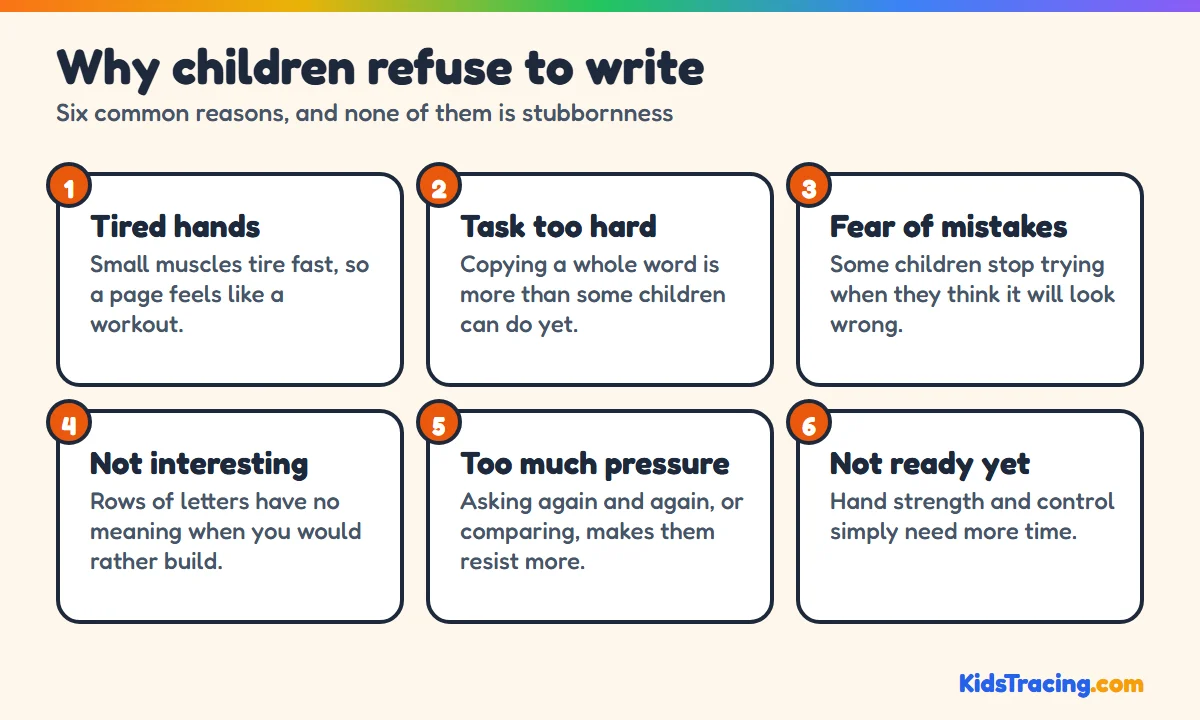
- Tired or weak hands. The small muscles that control a pencil get tired quickly, so a page of writing can feel like a long workout.
- The task is too hard. Copying a whole word or a row of letters can be more than a child can do yet.
- Fear of mistakes. Some children stop trying when they think their letters will look wrong, especially after being corrected.
- It is not interesting. Rows of letters have no meaning for a child who would rather build, draw or run.
- Too much pressure. Being asked again and again, or compared with a sibling or classmate, can make a child resist more.
- Not ready yet. Some children simply need more time to build hand strength and control before writing feels comfortable.
First, find out what is behind it
A few days of quiet watching will tell you more than any worksheet. Ask yourself:
- When does your child refuse: always, or only at certain times of day, such as when tired or hungry?
- Does your child also avoid drawing, coloring, cutting and building with small pieces, or only writing?
- Do the hands tire quickly, or does your child drop the pencil after a minute?
- Does your child get upset about mistakes?
- Does it help when you sit beside your child, or when you turn it into a game?
The answers point to the next step. A child who avoids every small-hand task needs more hand-strengthening play. A child who fears mistakes needs low-pressure, success-first activities. A child who is bored needs a reason to write.
9 gentle ways to help your child start writing
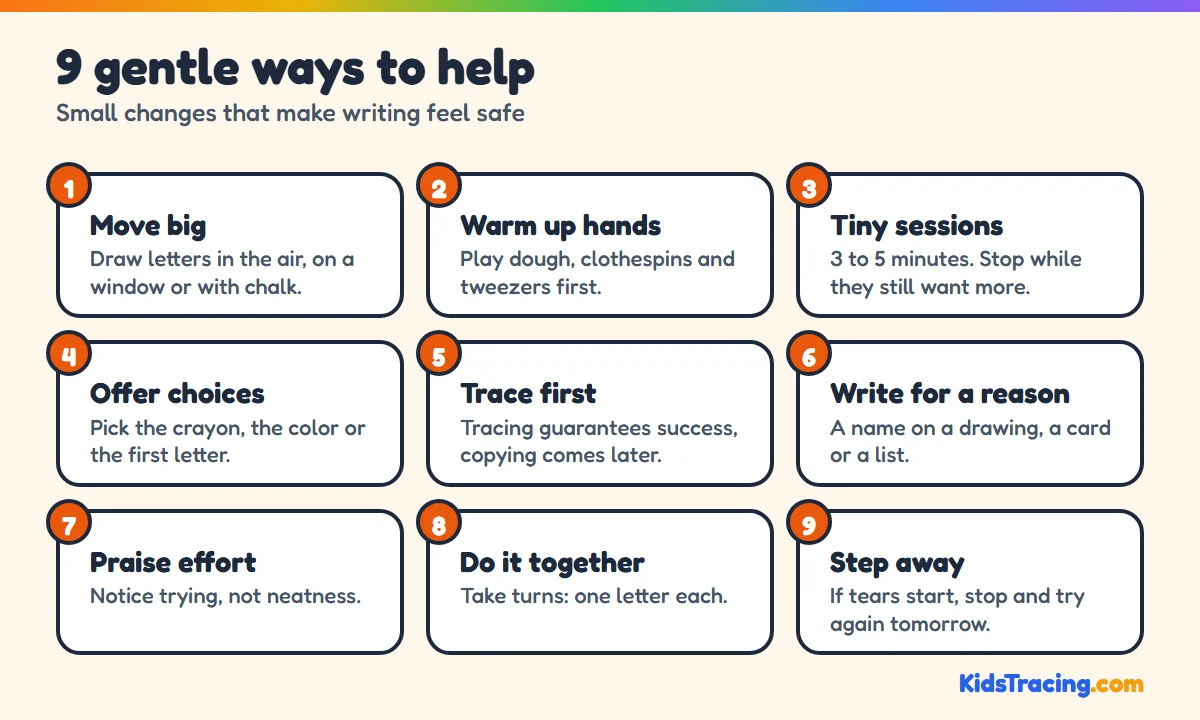
- Start with big movements. Draw letters in the air, on a window with a washable marker, with chalk on the ground or with a wet brush on the pavement. Big, loose movements are easier and more fun than small pencil marks.
- Warm up the hands first. Squeeze play dough, pinch clothespins, use tweezers to move pom-poms, thread large beads or tear paper. A minute of play before writing makes the pencil feel lighter.
- Keep sessions tiny. Three to five minutes is a real session at age 3, and five minutes is a good start at age 4. Stop while your child still wants a little more, so tomorrow feels welcome.
- Offer choices. Let your child pick the crayon, marker or chalk, the color and the first letter. A small choice gives back some control.
- Trace first, then copy. Tracing guarantees success, because the path is already there. Try a name tracing sheet or a pre-writing lines worksheet, and move to copying later.
- Write for a real reason. A name on a drawing, a birthday card, a shopping list or a label on a toy box gives writing a purpose.
- Praise effort, not neatness. Say “You kept going on that tricky curve” instead of “That is neat.” Skip correcting every letter. Fix one small thing at a time, or nothing at all on a hard day.
- Do it together. Take turns: you write one letter, your child writes the next. Or sit side by side and write your own list while your child draws.
- Step away and try again. If tears start, stop and do something calm. Pressure usually makes refusing stronger. Try again tomorrow with an easier task.
What to avoid
- Long sessions. Ten minutes of tears teaches your child that writing is bad. Five good minutes teaches the opposite.
- Correcting every letter. Constant correction can make children stop trying.
- Comparing. Comparing with other children, even gently, increases pressure.
- Grip battles. A comfortable grip that lets the fingers move is enough for now. Fighting over how the pencil is held often ends writing for the day.
- Turning every activity into a test. Keep some drawing, coloring and play with no goal at all.
A simple 5-minute starter routine
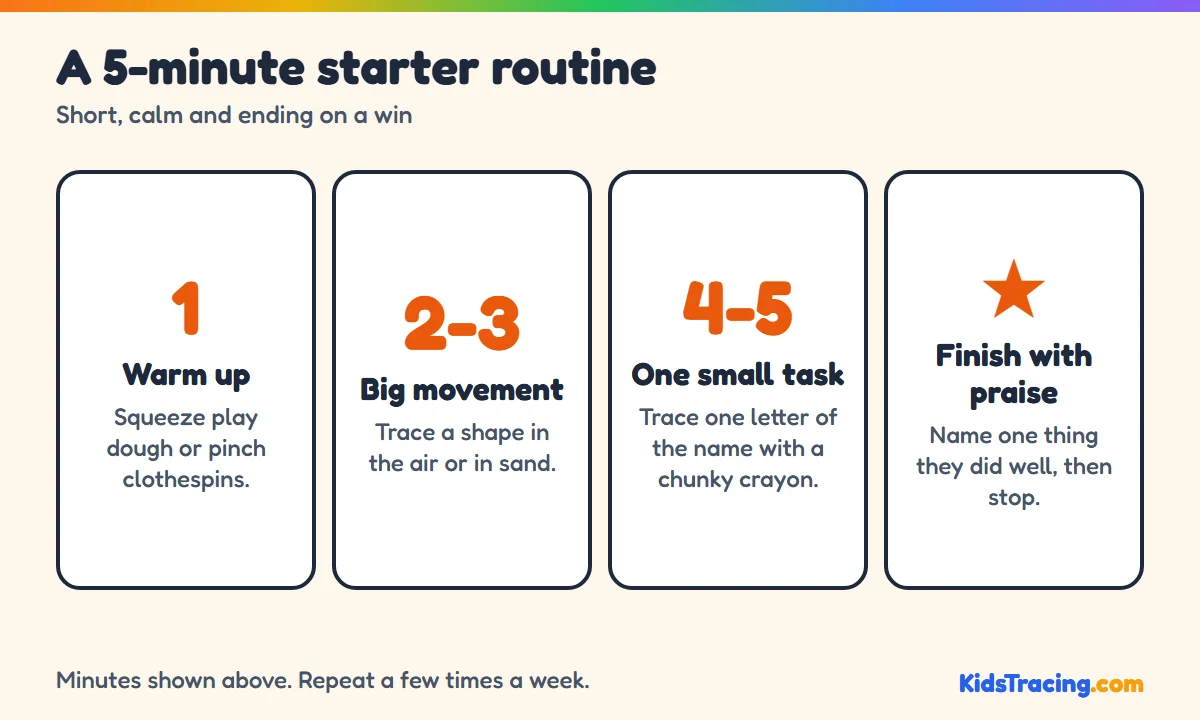
- Minute 1: warm-up. Squeeze play dough or pinch clothespins together.
- Minutes 2 to 3: big movement. Trace a letter or shape in the air or on a tray of salt or sand with a finger.
- Minutes 4 to 5: one small mark-making task. Trace one letter from your child’s name with a chunky crayon, or color a picture.
- Finish with praise. Name one thing your child did well, then stop.
Repeat it a few times a week. When your child comes to it willingly, you can slowly add a minute or move from tracing to copying.
When to talk to someone
Many children go through a phase of refusing. Talk to your child’s teacher or pediatrician if:
- your child says writing or drawing hurts, or the hand looks swollen or painful;
- your child avoids nearly all small-hand tasks, such as cutting, buttoning or using utensils, and not only writing;
- the refusal comes with big worry, tears or anger that do not settle with simple support;
- you are worried about vision, hearing or attention, or the difficulty has lasted for several months despite regular, gentle practice.
A teacher, pediatrician or occupational therapist can check what is going on and suggest next steps. This guide is general information and not medical advice.
Free printables to go with this guide
Low-pressure practice that starts with success: name tracing worksheets, pre-writing worksheets, dot-to-dot worksheets, color by number and scissor skills worksheets.
Free workbooks to go with this guide
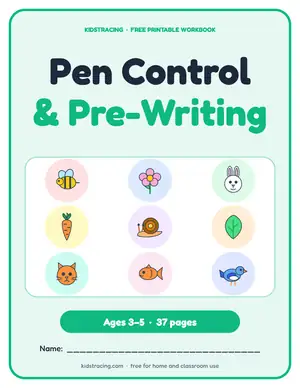
Pen Control and Pre-Writing Book
Lines, curves, zigzags, loops and spirals, plus paths from a bee to a flower, to build pencil control.
Free PDF Download US Letter · PDF of the Pen Control and Pre-Writing Book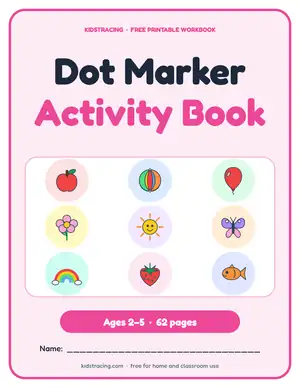
Dot Marker Activity Book
Big letters, numbers, shapes and pictures filled with circles for dot markers, stickers or fingertips.
Free PDF Download US Letter · PDF of the Dot Marker Activity Book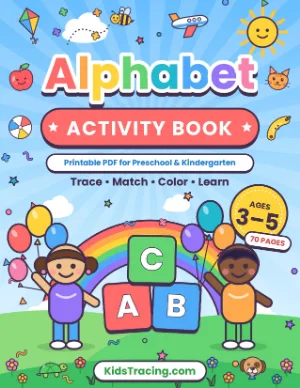
Alphabet Activity Book
70 picture pages to trace, match, color and solve: letter puzzles, beginning sounds, a letter hunt and a certificate.
Free PDF Download US Letter · PDF of the Alphabet Activity BookSources
For the milestones and when to ask for advice, see:
- CDC: Milestones by 4 years says to talk with your child’s doctor, share your concerns and ask about developmental screening.
- HealthyChildren.org (American Academy of Pediatrics): Developmental milestones, 3 to 4 year olds lists, among signs to raise with a pediatrician, not being able to grasp a crayon between thumb and fingers or having difficulty scribbling.
Keep reading
- Handwriting Readiness Checklist: Is Your Child Ready to Write? – Use practical handwriting readiness observations to notice comfort, control and interest, choose activities and support early writing without a pass/fail score.
- How to Teach a Child to Use Scissors – Teach scissor skills with supervised snips, straight lines and curves, including setup, paper-hand guidance, practical adjustments and free activities.
- Handwriting Practice at Home: How Long and How Often – Plan manageable handwriting practice at home with sample sessions, specific feedback, useful observations and ways to adjust difficulty.
- Is My Child Behind in Writing? What to Expect at Ages 3 to 6 – Worried your child is behind in writing? See what is typical from scribbling to writing a name at ages 3 to 6, signs to watch, and how to help.
- How Long Should Preschoolers Practice Tracing? – How long should a preschooler trace each day? Get simple time guides by age, a 10-minute tracing routine, and signs it is time to stop or move on.
Frequently asked questions
Is it normal for a 4-year-old to refuse to write?
Yes, it is common. Many 4-year-olds are still building hand strength and control, and writing is not yet comfortable. Keep the experience light, use play to build hand skills and try short, tracing-based activities. If your child refuses everything with small hands or seems unusually upset, speak with a teacher or pediatrician.
Should I make my child write every day?
A few short, positive sessions a week are enough at this age. Daily practice is fine if it is brief and enjoyable. If it turns into a daily fight, take a break and go back to play-based activities for a while.
My child will draw but not write letters. Why?
Drawing is open-ended, so there is no wrong answer. Letters have exact shapes, which can feel risky. Try tracing, large movements and writing for real purposes such as signing a drawing, and praise any attempt.
What if my child cries when I ask them to write?
Stop and comfort your child. Crying means the task is too hard or too stressful right now. Return later with something easier, such as tracing one letter or drawing a big line in the air, and keep the session very short.
Does a refusal to write mean my child will struggle in school?
Not necessarily. Many children who resist at 3 or 4 start writing happily once their hands are stronger and the activities feel playful. If the refusal continues for months, ask the teacher how your child manages in class and consider a check with a professional.