Body Parts Names Worksheets
Free tracing sheets for the names of body parts, ready to print.
Customize
More options
The preview updates as you change the settings.
Free Printable Body Parts Tracing Sheets
Body parts are some of the first nouns children learn to read and spell, and they are easy to link with actions. This worksheet gives each word its own line: head, eyes, ears, nose, mouth and more, with dotted letters to trace and three-line guides to write on.
Page one has ten common words (head to foot). Use the Quick layout buttons to print all 20 words on one page (smaller letters) or on two pages (bigger letters). Edit the list to match your lesson. The words are in lowercase because they are common nouns, but you can type capital letters if you prefer them.
Activities to Go With the Worksheet
Play Simon Says and touch each body part as you say the word. Draw a simple person on a sheet of paper and let your child label it with the words they have traced. Singing a head-and-shoulders action song is another easy way to make the vocabulary stick.
Short words such as arm, leg, ear and toe are great for early spelling because they are easy to sound out. Start with those, then move on to longer words like shoulder and finger.
Spelling Patterns in Body Words
Many body words are short and easy to sound out, such as arm, leg and neck. A few have trickier spellings: knee starts with a silent k, and tongue ends in ue. Some have unusual plurals, like one foot and two feet, or one tooth and many teeth. Tracing the word slowly helps these spellings stick.
Labeling Activities
Ask your child to draw a picture of themselves and label the head, arms and legs with the words they have traced. For a game, call out a word and let children touch that body part and then find the matching line on the worksheet.
Topic Links for Teachers
These words fit well into a My Body topic, a five senses lesson or a health and hygiene unit. Edit the list in the text box to match your lesson, for example by adding eyebrow, wrist or ankle.
Which body words first? A simple order by age
Start with words your child can point to on their own body. This order works for many children, but follow your child’s interest: if they love hair and teeth, begin there.
- Ages 4 to 5: head, eyes, ears, nose, mouth, hand, arm, leg and foot. They are short, concrete and easy to act out.
- Ages 5 to 6: neck, back, knee, toes, hair and teeth. These bring in a few new letter patterns.
- Ages 6 to 7: shoulder, elbow, finger, tummy and tongue. They are longer, with trickier spellings.
Some words have one tricky part. Point it out before your child traces the word, and the spelling is much easier to remember.
| Word | What to notice |
|---|---|
| knee | The k is silent, so the word sounds like “nee”. |
| teeth | The plural of tooth, and not “tooths”. |
| toes | One toe, two toes. Add s to the end. |
| tummy | Two m’s keep the u short, as in “summer”. |
| shoulder | The ou says a long o, like in “boulder”. |
| tongue | It ends in ue but sounds like “tung”. |
A quick routine for each word: say it, touch that body part, then trace it once. It takes about a minute and uses hearing, movement and writing together.
Frequently asked questions
Which body parts are included?
Twenty common words: head, eyes, ears, nose, mouth, neck, arm, hand, leg, foot, shoulder, elbow, finger, knee, toes, tummy, back, hair, teeth and tongue.
Can I use these for English learners?
Yes. The vocabulary is simple and everyday, so it suits young English learners. Add or remove words in the text box to match your class.
What age are these worksheets for?
Mostly ages 4 to 7. Younger children can trace a few words at a time, and older ones can write each word again on the lines.
Free printable workbooks
Want a planned set instead of a single page? These free PDF workbooks use the same worksheets in a step-by-step order.
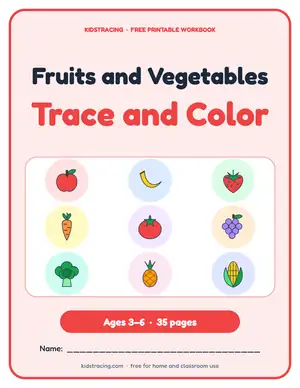
Fruits and Vegetables Tracing and Coloring Book
Color 26 fruits and vegetables, trace each word and write it alone, then review with matching games.
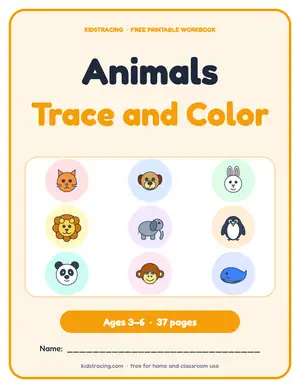
Animals Tracing and Coloring Book
Color 28 animals from the farm, the garden and the wild, trace each name and write it alone.
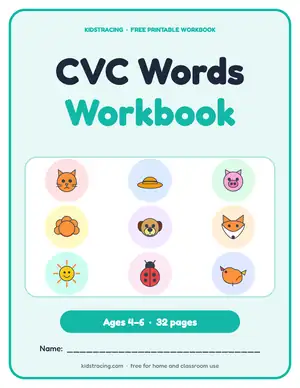
CVC Words Workbook
Read, build, trace and write short a, e, i, o and u words with pictures, sound boxes and sentences.
Related worksheet tools
Explore more: Handwriting and Tracing Worksheets for Kids · Kindergarten Worksheets · All free worksheet tools
Guides for parents and teachers: Dotted vs Outline vs Solid Gray Tracing: Which Style Comes First?