Animal Mazes Activity Book: 30 Easy, Medium and Hard Mazes with Answers (Free PDF)
A free printable maze book with 30 animal mazes. Help a bee reach a flower, a monkey find a banana and an octopus search for a treasure chest. There are 10 easy, 10 medium and 10 hard mazes, each with exactly one path, a fun fact about the animal and a full answer key at the back. Download the 40-page PDF in US Letter or A4 and print it at home or in class.
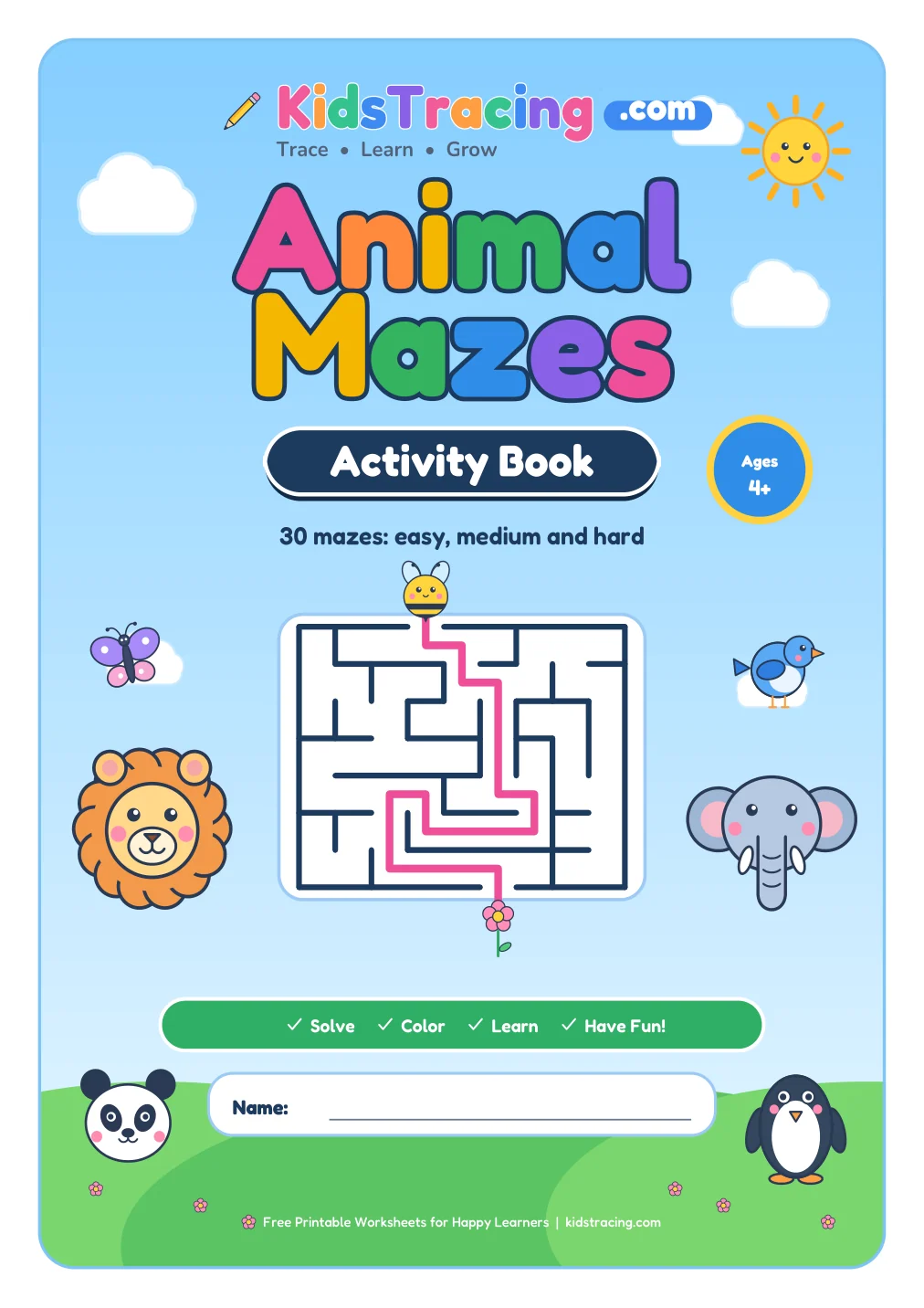
Download Animal Mazes Activity Book
- 40 pages with 30 mazes for ages 4–8
- Easy, medium and hard levels, ten mazes each
- Exactly one path through every maze, with an answer key
- Free for home and classroom use, with no sign-up or email address
- Two PDF files: US Letter (8.5 × 11 in) and A4
Print at 100% (Actual size). Choose US Letter in the United States and Canada, and A4 almost everywhere else. How to print a workbook
Who this book is for
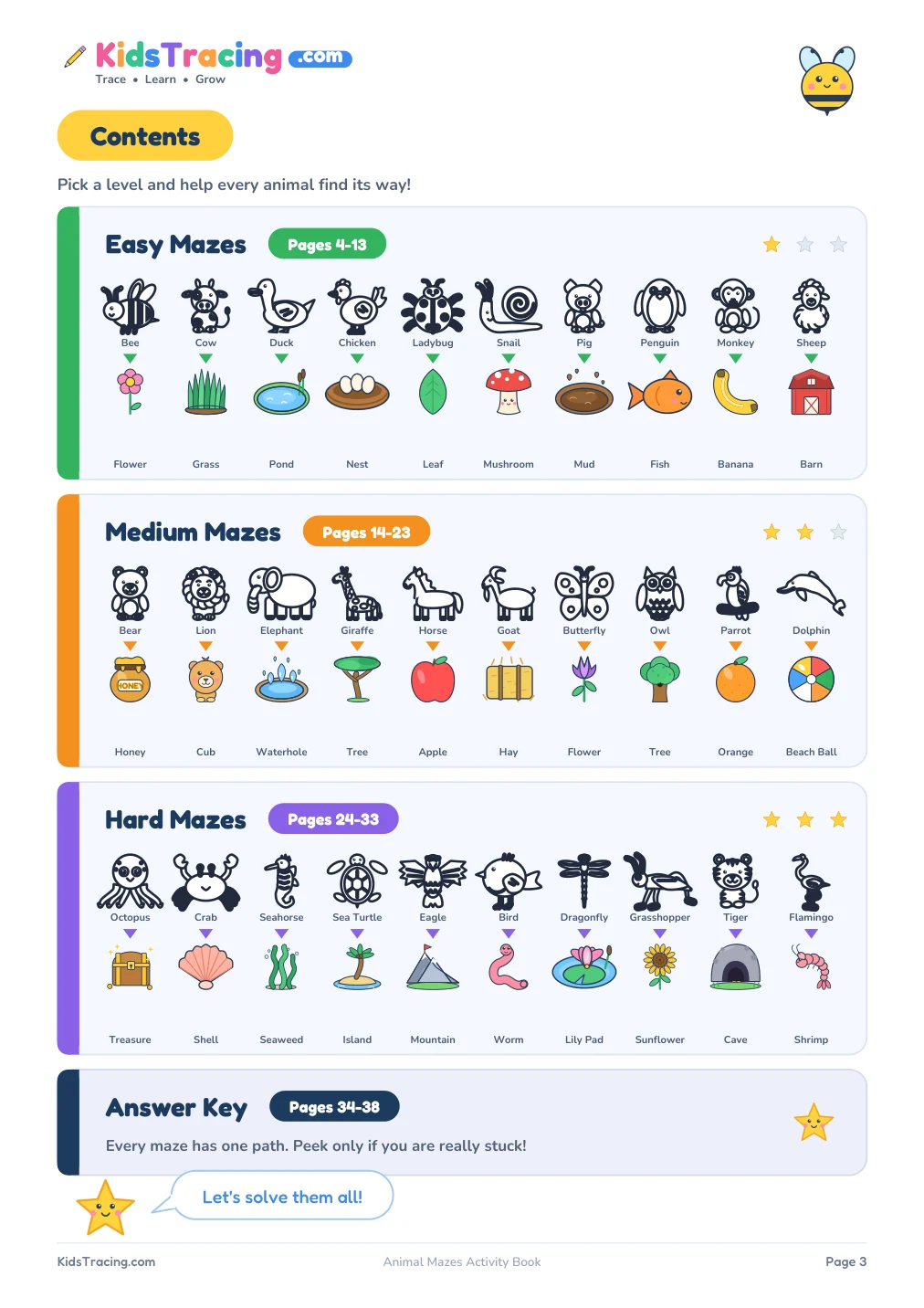
This is a book of thirty animal mazes for children from about age 4 to 8. Each maze has an animal at the START and the thing it is looking for at the FINISH: a bee flies to a flower, a monkey climbs for a banana, an octopus searches for a treasure chest. The child draws a path from the animal to its goal without crossing a wall. That small story is often enough to get a young child to pick up a pencil and keep going.
The mazes grow slowly. The first ones, on pages 4 to 13, are only five to seven squares wide, with corridors about 17 to 25 mm (roughly 0.7 to 1 inch) wide, so a four-year-old can follow a path with a fat crayon. The medium mazes add more turns and more places to go wrong, and the ten hard mazes at the end are as big as 16 squares wide and are meant for children who like a real puzzle. Because the book is in order, a child can finish the easy section, feel proud, and move on when ready.
Every animal is a clear black-and-white line drawing that a child can color after the maze is solved, and the goals are in full color. Each page ends with a short fun fact about the animal. The answer key at the back shows every solution, so a parent or teacher can help a child who is stuck without having to solve the maze first. If you would rather make your own mazes of a size you choose, our maze worksheet generator makes a new one every time you click.
What is inside the Animal Mazes Activity Book
The book has 40 pages, and every page is numbered in the bottom corner, so you can print one section at a time. Every maze page has the animal and a START sign on one side of the maze and the goal and a FINISH sign on the other. On most pages the animal is at the top and the goal at the bottom, and on a few pages it is the other way round, so a bee can fly down to a flower, but a monkey climbs up to the banana.
| Pages | Section | Number of pages |
|---|---|---|
| 1–3 | Cover, a page for parents and teachers, and contents | 3 |
| 4–13 | Easy mazes: 10 mazes with wide corridors and short paths | 10 |
| 14–23 | Medium mazes: 10 mazes with more turns and more dead ends | 10 |
| 24–33 | Hard mazes: 10 mazes with narrow corridors and long paths | 10 |
| 34–38 | Answer key: all 30 solutions, six to a page | 5 |
| 39 | Certificate of achievement | 1 |
| 40 | Back cover | 1 |
Start here (pages 1–3)
The cover shows a sample maze with its pink answer route. Page 2 is the page for adults. It explains how to use the book in six steps and shows the START and FINISH signs, and it has a box for your child’s name. Page 3 is the contents. It shows all 30 animals with their goals in three rows, so a child can pick the maze they like best.
Easy mazes (pages 4–13)
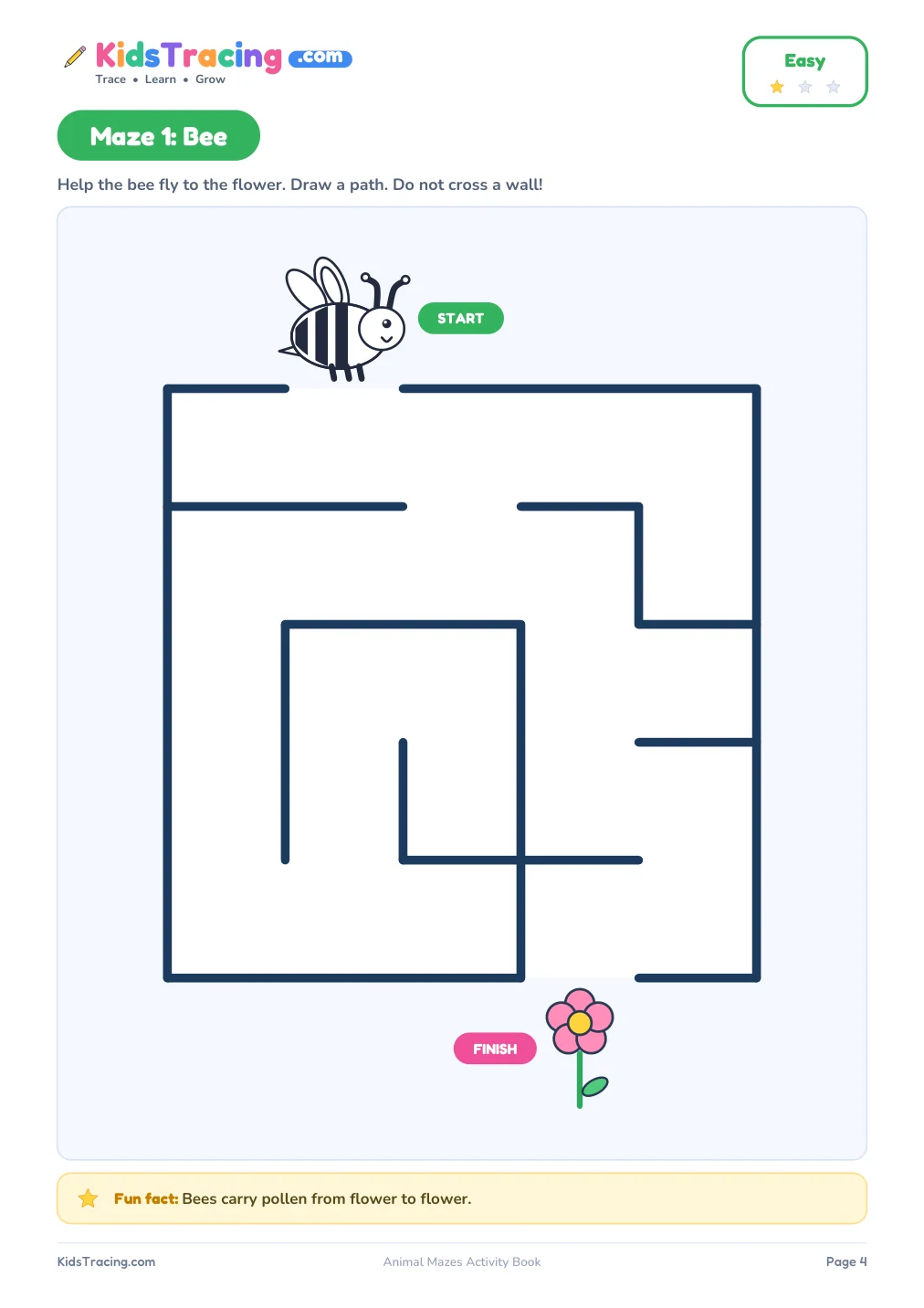
Ten mazes between 5 × 5 and 7 × 7 squares. The walls are thick and the corridors wide, so a crayon or a thick marker fits easily. The route from START to FINISH is short, and there are only a few places where a child has to choose.
| Page | Animal and goal | Size | Squares on the route |
|---|---|---|---|
| 4 | Bee to the flower | 5 × 5 | 9 |
| 5 | Cow to the grass | 5 × 5 | 9 |
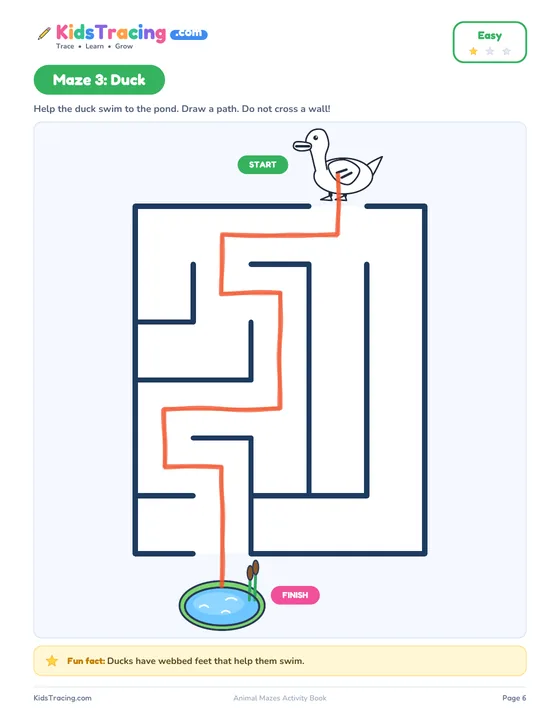
| 6 | Duck to the pond | 5 × 6 | 12 |
| 7 | Chicken to the nest | 6 × 5 | 11 |
| 8 | Ladybug to the leaf | 6 × 6 | 14 |
| 9 | Snail to the mushroom | 6 × 6 | 14 |
| 10 | Pig to the mud | 6 × 7 | 16 |
| 11 | Penguin to the fish | 7 × 6 | 16 |
| 12 | Monkey to the banana | 7 × 7 | 19 |
| 13 | Sheep to the barn | 7 × 7 | 19 |
Medium mazes (pages 14–23)
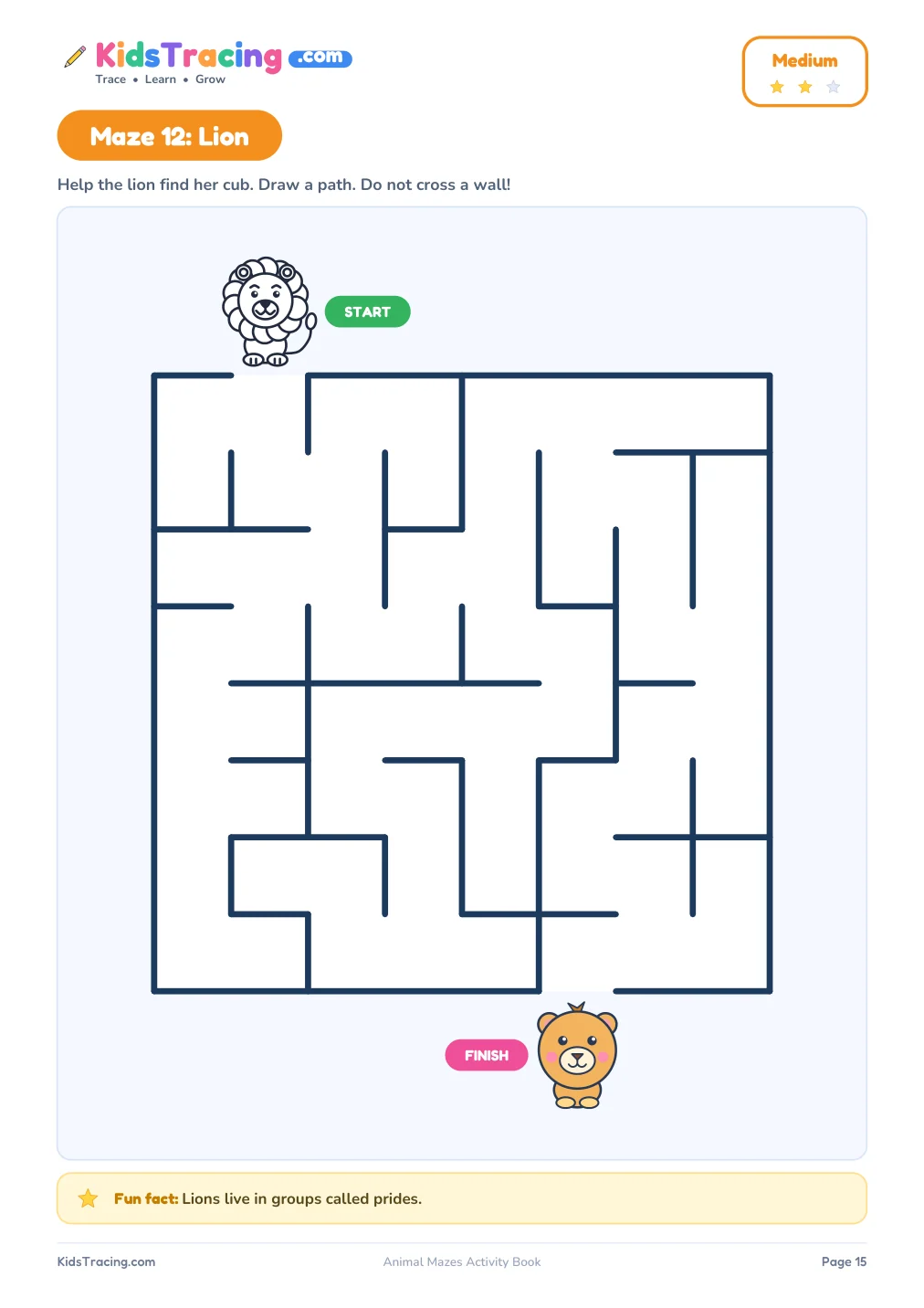
Ten mazes between 8 × 7 and 11 × 10 squares. There are more turns, more junctions and more dead ends, and the route is about twice as long as in the easy mazes. A pencil or a thin marker works best.
| Page | Animal and goal | Size | Squares on the route |
|---|---|---|---|
| 14 | Bear to the honey | 8 × 7 | 21 |
| 15 | Lion to her cub | 8 × 8 | 24 |
| 16 | Elephant to the waterhole | 9 × 8 | 27 |
| 17 | Giraffe to the tree | 9 × 8 | 27 |
| 18 | Horse to the apple | 9 × 9 | 30 |
| 19 | Goat to the hay | 10 × 8 | 30 |
| 20 | Butterfly to the flower | 10 × 9 | 33 |
| 21 | Owl to the tree | 10 × 9 | 33 |
| 22 | Parrot to the orange | 11 × 9 | 36 |
| 23 | Dolphin to the beach ball | 11 × 10 | 41 |
Hard mazes (pages 24–33)
Ten mazes between 12 × 10 and 16 × 14 squares. The corridors are narrow, so a sharp pencil is a good choice. A child has to plan ahead, notice dead ends early and sometimes go back and try another way. The biggest maze has 224 squares, and the route from START to FINISH goes through 85 of them.
| Page | Animal and goal | Size | Squares on the route |
|---|---|---|---|
| 24 | Octopus to the treasure | 12 × 10 | 45 |
| 25 | Crab to the shell | 12 × 11 | 47 |
| 26 | Seahorse to the seaweed | 13 × 11 | 53 |
| 27 | Sea Turtle to the island | 13 × 12 | 56 |
| 28 | Eagle to the mountain | 14 × 12 | 53 |
| 29 | Bird to the worm | 14 × 12 | 63 |
| 30 | Dragonfly to the lily pad | 15 × 12 | 65 |
| 31 | Grasshopper to the sunflower | 15 × 13 | 60 |
| 32 | Tiger to the cave | 16 × 13 | 79 |
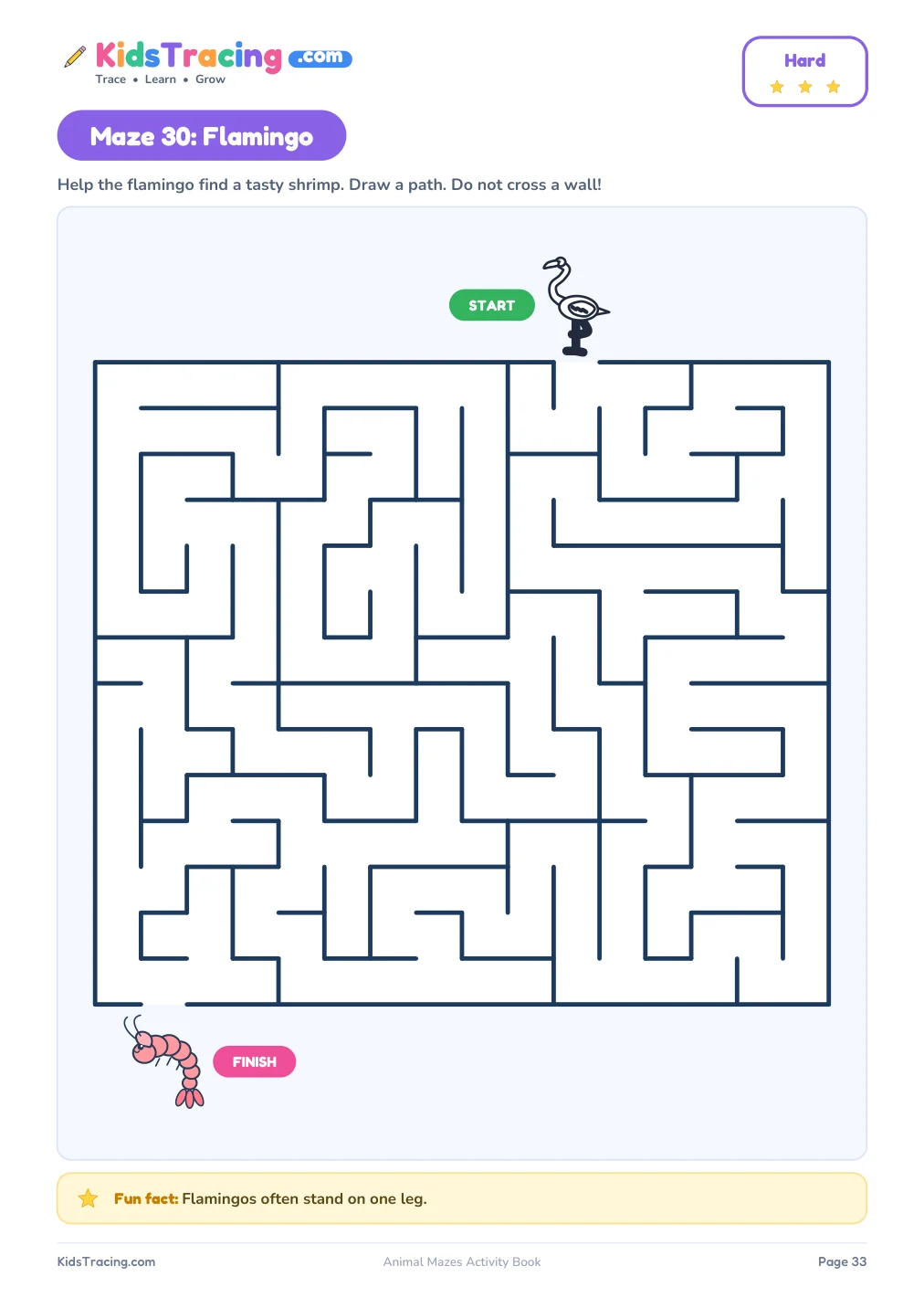
| 33 | Flamingo to the shrimp | 16 × 14 | 85 |
Answer key, certificate and back cover (pages 34–40)
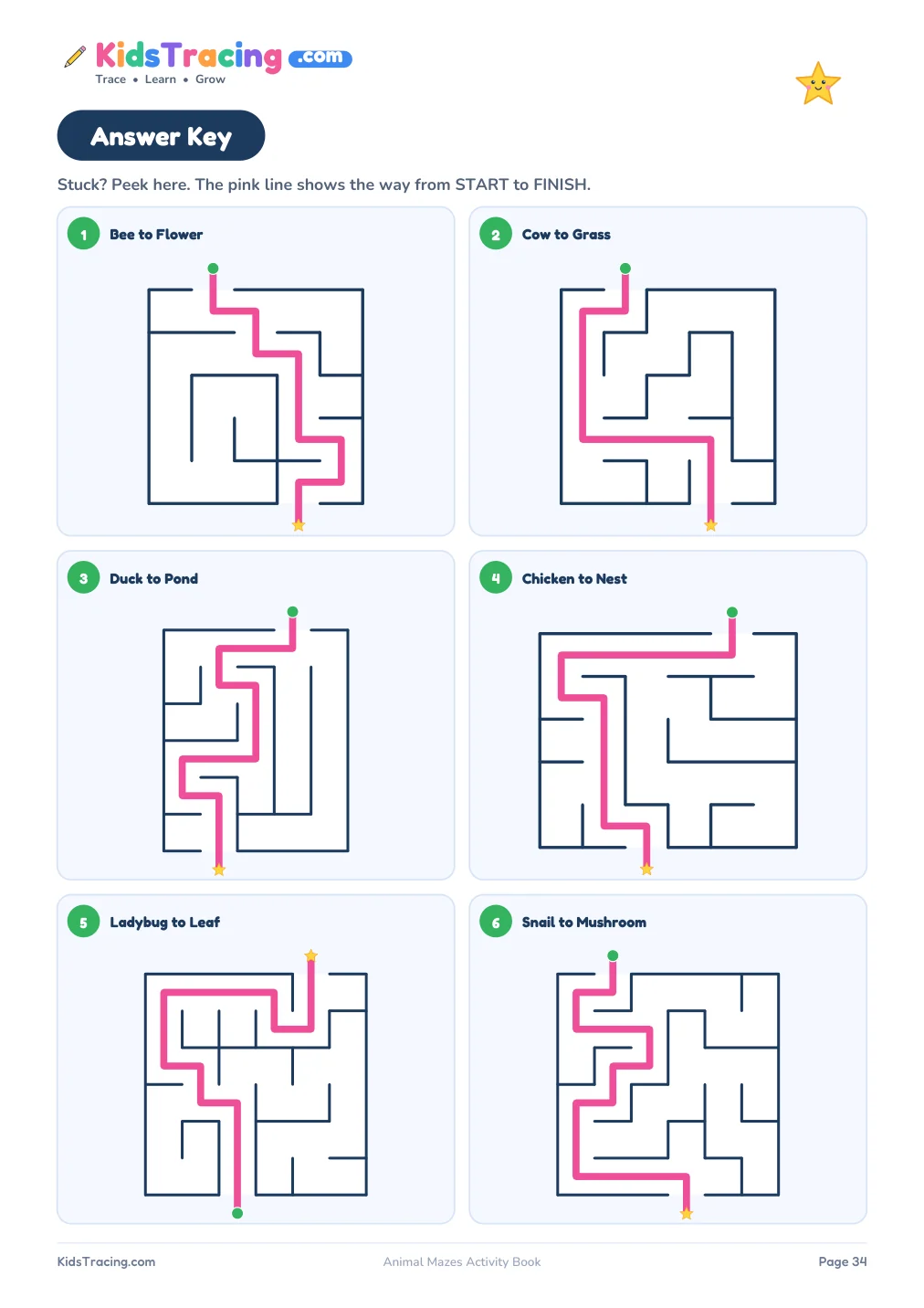
Pages 34 to 38 show all 30 solutions, six on a page, with the route drawn as a pink line from a green dot at the START to a star at the FINISH. Page 39 is a certificate of achievement with lines for the name, the date and a parent or teacher signature, and page 40 is the back cover.
Sample pages
A few pages from the finished workbook. The PDF is sharp enough to print at full size.
Skills your child practices
- Pencil control: steering a line between two walls
- Planning ahead and spotting dead ends
- Following a path with the eyes (visual tracking)
- Trying again when a path does not work (persistence)
- Naming animals and the places and foods they look for
- Coloring the animal and the goal when the maze is solved
How to use this workbook
Print the book
Print the US Letter or A4 file at 100% (Actual size) on one side of the paper. Leave out the answer key (pages 34–38) if you do not want your child to see the solutions.
Pick a level
Start with the easy mazes on pages 4 to 13. Move to the medium mazes when your child can follow a route without help.
Find the START and the FINISH
The animal and the START sign are at one opening in the outer wall, and the goal and the FINISH sign are at the other. Read the sentence at the top of the page together.
Draw a path
Draw a line from the animal to its goal without crossing a wall. Use a finger first if your child likes, and a pencil so that a wrong turn can be erased.
Color and talk
Color the animal and read the fun fact. Ask your child where the animal lives and what it likes to do.
How hard are the mazes?
The table shows the three levels. The width of the corridors is measured on the printed page, and it is the same on US Letter and A4, because the mazes are the same size on both. The route length is the number of squares the path passes through on the way from START to FINISH.
| Level | Pages | Size of the maze | Width of the corridors | Squares on the way from START to FINISH |
|---|---|---|---|---|
| Easy | 4–13 | From 5 × 5 to 7 × 7 squares | About 17 to 25 mm (0.67 to 0.98 inch) | 9 to 19 squares |
| Medium | 14–23 | From 8 × 7 to 11 × 10 squares | About 13 to 19 mm (0.50 to 0.73 inch) | 21 to 41 squares |
| Hard | 24–33 | From 12 × 10 to 16 × 14 squares | About 9 to 13 mm (0.37 to 0.51 inch) | 45 to 85 squares |
A longer route is not the only thing that makes a maze harder. The number of junctions on the way matters just as much, because every junction is a place where a child can take a wrong turn. On the route from START to FINISH the easy mazes have 3 to 4 junctions, the medium mazes 7 to 8 and the hard mazes 12 to 14. Every maze has its own shape, so there is no pattern to learn.
Every maze has exactly one path
This matters more than it sounds. A maze with two ways through can confuse a child who is told “there is only one way”. Every maze in this book has exactly one route from START to FINISH, and every square can be reached. We checked each maze by computer, and we also checked the printed pages themselves by solving the picture of each page, in both paper sizes, and comparing the result with the answer key.
What children practice with mazes
Pencil control. Drawing a line between two walls is a steering task. The child has to slow down at the turns, keep the pencil in the corridor and stop at the end. It is practice in controlling a line, which is the same skill used in tracing and early writing. The corridors in the easy mazes are wide, and in the hard mazes they are narrow, so a child can build up control step by step.
Looking ahead. A maze is a small planning problem. Many children start by drawing straight into the first corridor. After a few mazes they learn to look at the junction first, to follow the path with a finger or the eyes, and to spot a dead end before they enter it. That habit of thinking before acting is useful well beyond mazes.
Visual tracking. Following a path through a busy picture with the eyes is a skill used in reading, where the eyes have to follow a line of text from left to right. The maze pages give children plenty of practice at it.
Persistence. Every maze has a dead end somewhere. A child who meets one learns that it is fine to go back and try again. The pencil can be erased, a different color can mark a second try and the answer key is there if the frustration grows too large.
Vocabulary and stories. Each page names an animal and the place it is going, and the fun fact tells the child one thing about the animal. Talk about where each animal lives and why it wants to get to its goal.
What it is not. Mazes are not a handwriting course. They build the control and the attention that handwriting needs. When your child is ready for letters, move on to the Pre-Writing Lines and Shapes Book or the ABC Tracing Book.
Tips for a child who gets stuck
- Use a finger first. Let your child trace the route with a finger or the back of a pencil before drawing. It costs nothing and it can be rubbed out for free.
- Look at the FINISH sign. Many mazes are easier to solve from the end. Ask your child to put a finger on the goal and follow the path back to the animal.
- Mark dead ends. A small cross at the end of a dead end tells the child “I’ve been here”. Children enjoy this, and it makes the maze easier to read.
- Use a different color for a second try. It stops one wrong turn from spoiling the page.
- Talk, but do not take over. Ask “Which way do you think?” and “What do you see ahead?” instead of pointing to the path. Look at the answer key only when your child asks for help or when the frustration is more than the fun.
- Go back a level. If a medium maze is too hard, a few more easy mazes will not hurt. Repeating an easy maze with a different color is also fine.
Printing and pencils
Print at 100% (Actual size) on one side of the paper, and choose US Letter or A4 to match your printer. The mazes are the same in both books, and the walls and the corridors are the same size. The only difference is the shape of the page. Ordinary copy paper is fine for pencils, crayons and washable markers. Use thicker paper if you want to use paint markers or watercolors.
Choose the writing tool to match the level. A thick crayon or a jumbo pencil works for the easy mazes, a regular pencil or a thin marker for the medium mazes and a sharp pencil for the hard ones. The animals are line drawings, so a child can color them with the same crayons. The goal pictures are already in color. They print in shades of gray on a black-and-white printer, which works fine. To save ink, print the book in grayscale, because the mazes themselves are navy blue and print clearly in black.
You can print just the pages you need. For example, pages 4–13 are the easy section, pages 14–23 the medium section and pages 24–33 the hard section. Print the answer key (pages 34–38) only for yourself, or keep it for the adult in the room.
Free worksheet generators to go with this workbook
Make extra mazes and practice pencil control with free printable generators.
Mazes
Easy to hard mazes with a picture at the start and finish.
Dot to Dot
Connect numbers, letters or skip counts to reveal a picture.
Pre-Writing Lines
Lines, curves, waves, loops and spirals at three levels.
Scissor Skills
Cutting practice: lines, zigzags, curves, shapes and pictures.
Shape Tracing
Dotted or solid shapes, names and a coloring strip.
Fine Motor Skills
Scissor skills and cutting practice.
Guides for parents and teachers
Pre-Writing Activities for Preschoolers: 15 Fun Ideas
Fifteen fun pre-writing activities for preschoolers that build the strokes, strength and control children need before they start writing letters and names.
Handwriting Readiness Checklist: Is Your Child Ready to Write?
A simple handwriting readiness checklist for ages 3 to 6: ten signs your child is ready to start writing, and what to do if they are not there yet.
Handwriting Practice at Home: How Long and How Often
Handwriting practice at home: how long and how often for ages 3 to 6, a 10-minute routine, setup tips and the signs that it is time to stop.
More free printable workbooks
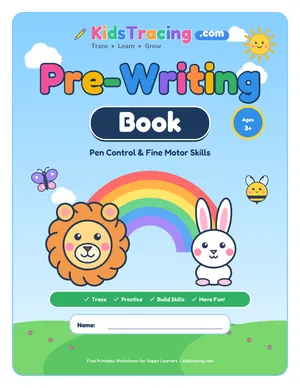
Pre-Writing Lines and Shapes Book
Sixteen tracing pages of lines, curves, shapes, patterns and animal paths, one stroke per page.
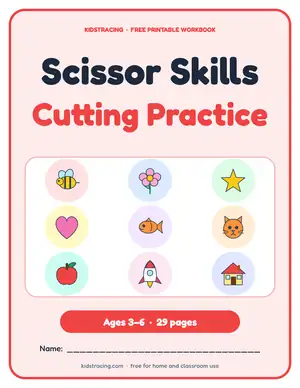
Scissor Skills Cutting Practice Book
Cutting practice from first snips to zigzags, shapes and pictures to cut out and color.
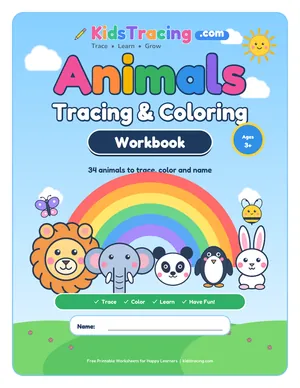
Animals Tracing and Coloring Workbook
Trace the outline, color the picture and trace the name of 34 animals, each with a fun fact.
Frequently asked questions
Is the Animal Mazes Activity Book really free?
Yes. There is nothing to pay and nothing to sign up for. Print the book as often as you like for your own children, your students or a kids’ club, and share the link to this page with other parents and teachers. We only ask that you do not sell the PDF, post the file on another website or present it as your own work.
What age is it for?
The cover says ages 4 and up, and the book is written for ages 4 to 8. The easy mazes suit a four- or five-year-old with a thick crayon. The medium mazes suit most five- to seven-year-olds, and the hard mazes are for children who like a challenge, including many older children and adults.
How many mazes are there, and are there different levels?
There are 30 mazes in three levels of ten: easy on pages 4 to 13, medium on pages 14 to 23 and hard on pages 24 to 33. Each level has bigger and more complicated mazes than the one before, and within a level the mazes also get gradually harder.
Does every maze have only one solution?
Yes. Every maze has exactly one path from START to FINISH, every square can be reached and there are no loops. We checked each maze by computer and then checked the printed pages in both paper sizes by solving the picture of every page and comparing the result with the answer key.
Are the mazes the same in the A4 and the US Letter book?
Yes. The two books contain the same 30 mazes with the same answers, and the mazes are the same size on both papers. Only the shape of the page is different. A4 is a little taller and narrower than US Letter, so choose the size that matches your printer.
Where are the answers?
The answer key is on pages 34 to 38. Each page shows six mazes with the solution drawn as a pink line from a green dot at the START to a star at the FINISH. You can leave those pages out when you print if you do not want your child to see them.
What should my child draw with?
A crayon, a pencil or a washable marker. Choose a thick tool for the easy mazes, because the corridors are wide, and a sharp pencil for the hard mazes, because the corridors are narrow. A pencil is handy because a wrong turn can be erased.
My child gets frustrated with mazes. What can we do?
Start with the easy mazes and let your child trace the route with a finger before drawing. Try solving from the FINISH back to the START, mark dead ends with a small cross and use a new color for a second try. If it is still too much, put the book away for a few days and come back to it. The tips section on this page has more ideas.
Can I print only some of the pages?
Yes. In the print window, enter a page range instead of printing the whole file. Entering 4–13 gives you the easy mazes, and 24–33 gives you the hard ones. The contents table above shows where each section begins.
How is this book different from the maze worksheet generator?
The maze worksheet generator makes a new random maze every time you click, in a size and level that you choose. This book is a finished set of 30 mazes with animals, goals, fun facts, an answer key and a certificate, so it is ready to print and hand to a child.
Do I need a color printer?
No. The mazes and the animals print clearly in black and white. The goal pictures and the colored tabs print in gray, and the book still works well. Color is nicer for the cover and the certificate.