Pre-Writing Lines and Shapes Book: Pen Control Practice for Ages 3 to 5 (Free PDF)
A free pre-writing workbook that teaches one stroke per page. Sixteen short tracing pages take your child from straight lines, curves, zigzags and waves to circles, squares, triangles, rectangles and diagonals, then finish with a patterns page, mixed paths and five animal paths that lead each animal to its food or home. Download the 21-page PDF in US Letter or A4 and print it at home or in class.
Download Pre-Writing Lines and Shapes Book
- 21 pages for ages 3–5
- Free for home and classroom use, with no sign-up or email address
- Two PDF files: US Letter (8.5 × 11 in) and A4
- Prints in black and white or in color
Print at 100% (Actual size). Choose US Letter in the United States and Canada, and A4 almost everywhere else. How to print a workbook
Who this workbook is for
This workbook is made for children who enjoy scribbling but cannot yet copy a line or a circle on purpose: usually ages 3 to 5 in preschool and pre-K. Each page practices one stroke, so a session is short and easy to finish, and a child who finds one page hard can repeat it on another day instead of being pushed on to the next. Every dotted path has a green dot where the pencil starts and a red arrow where it stops. That gives children the habit of starting and finishing a stroke in the right place and the right direction before any letters appear.
It is a first workbook. If your child has already traced lines and wants more variety, the Pen Control and Pre-Writing Book is longer (37 pages) and adds spirals, castle-wall paths and a Level Up section. When circles and straight lines feel easy, letters are the natural next step: try My ABC Tracing Workbook or the ABC Tracing Book. A child who is not ready for a pencil yet can build hand strength first with the Dot Marker Alphabet and Numbers Book or the Scissor Skills Cutting Practice Book.
What is inside the Pre-Writing Lines and Shapes Book
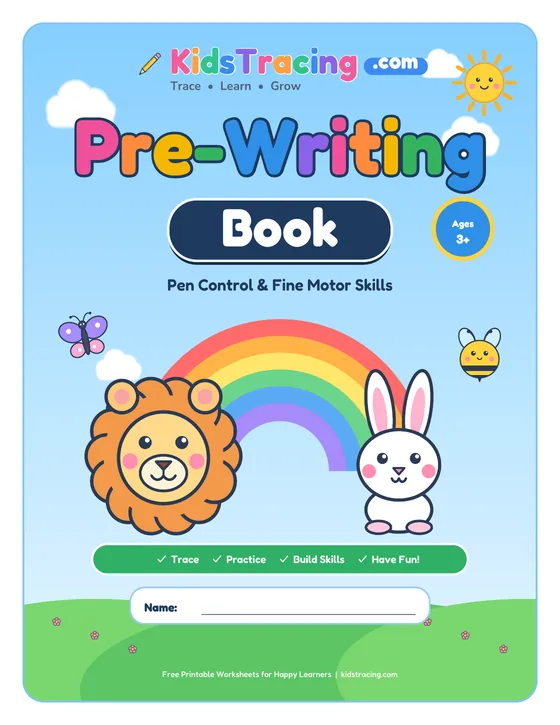
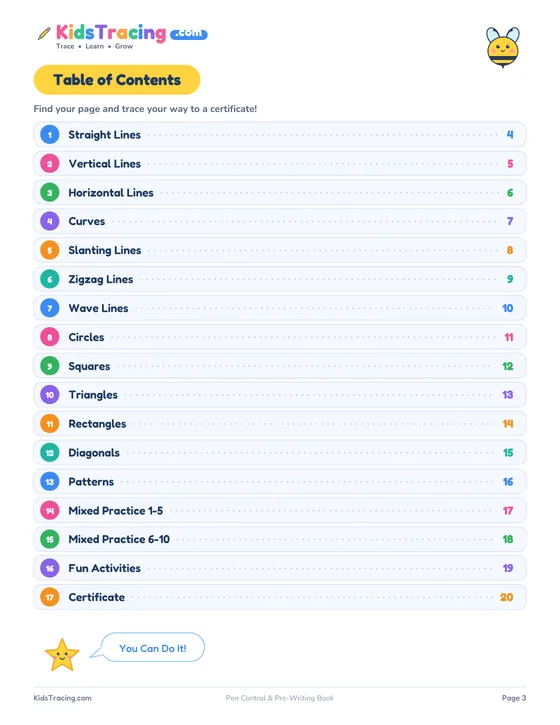
The workbook has 21 pages. Every page is numbered in the bottom corner and page 3 lists all 16 sections, so you can print one section at a time. The cover reads “Pre-Writing Book: Pen Control & Fine Motor Skills”.
| Pages | Section | Number of pages |
|---|---|---|
| 1–3 | Cover, a page for parents and teachers, and the table of contents | 3 |
| 4–10 | Lines: straight, vertical, horizontal, curves, slanting, zigzag and wave | 7 |
| 11–15 | Shapes: circles, squares, triangles, rectangles and diagonals | 5 |
| 16 | Patterns to finish | 1 |
| 17–19 | Mixed practice 1–5, mixed practice 6–10 and fun activities | 3 |
| 20 | Certificate of achievement | 1 |
| 21 | Back cover | 1 |
Start here (pages 1–3)
A bright cover with a lion, a rabbit and a rainbow, a welcome page and a table of contents. The welcome page gives six short tips for adults: print at 100%, offer a thick pencil or a triangular crayon, start at the green dot and follow the dots to the red arrow, remember that most lines run from left to right while a few run from top to bottom, sit tall with both feet on the floor and hold the paper still with the other hand, and do one or two pages a day. A small key shows the green start dot and the red finish arrow, and there is a box for your child’s name.
Lines (pages 4–10)
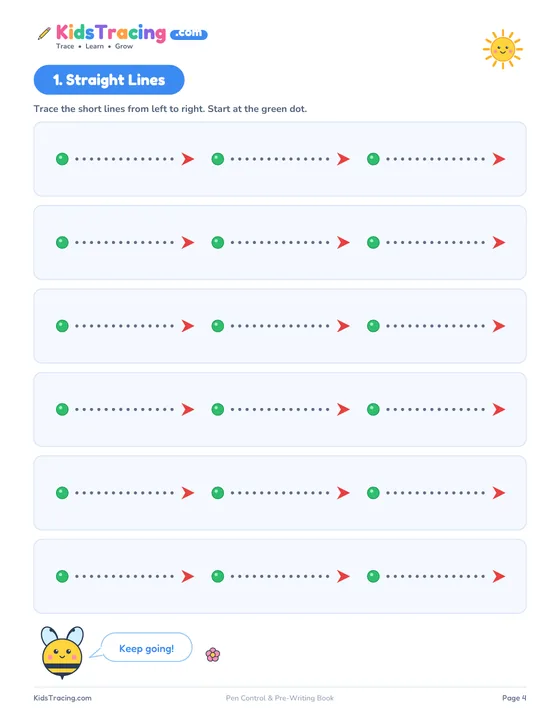
Seven pages, each with one kind of line to trace from the green dot to the red arrow. Page 4 has six rows of three short straight lines, a gentle first step. Page 5 has four rows of eight vertical lines to trace from top to bottom, and page 6 has five rows of long horizontal lines, two to a row, that make the hand travel across the page. Page 7 has curved hills (five rows of four arches), page 8 has five rows of slanting lines that slide down to the red arrow, page 9 has zigzags and page 10 has waves. The pages move from simple straight strokes to strokes that change direction, which is the order most children find easiest.
Shapes (pages 11–15)
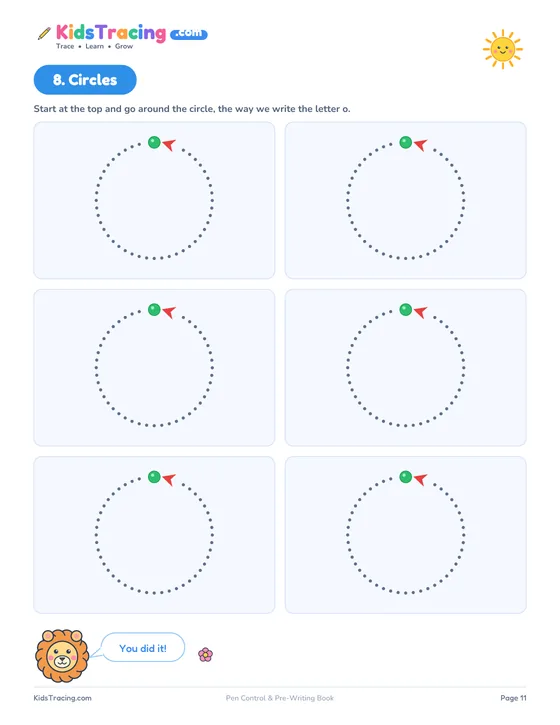
Five pages with several copies of the same shape on each, so your child gets repeated practice on one page. Page 11 has six circles, each started at the top and traced around, the way we begin the letter o. Pages 12 and 14 have six squares and eight rectangles that start at the green dot and go right, down, left, then up. Page 13 has six triangles that start at the top, slide down, go across and climb back up. Page 15 has six crossed diagonals, each line traced from the green dot at the top to the red arrow. The squares come before the triangles and diagonals because a square only needs right-angle turns, while a triangle needs the hand to judge a slanting line.
Patterns (page 16)
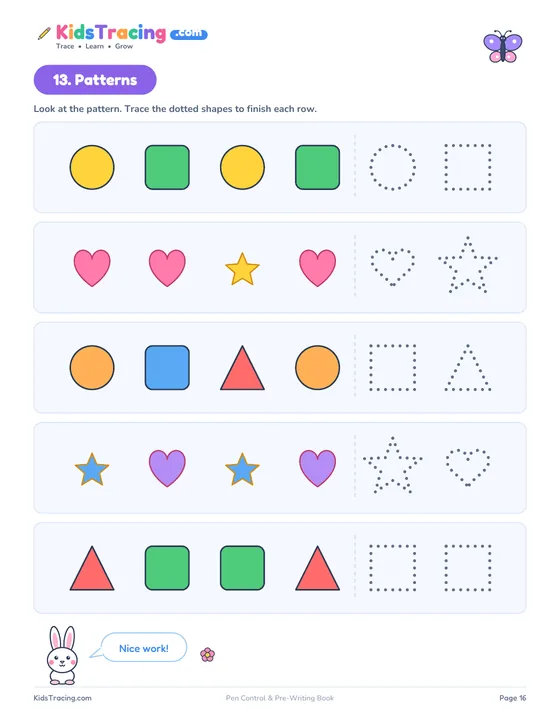
Five rows of colored shapes that repeat in a pattern, such as circle, square, circle, square, or heart, heart, star, heart, heart, star. Each row shows the first four shapes in color and leaves two dotted shapes at the end for your child to trace and finish the pattern. The rows use AB patterns (circle and square, star and heart), an AAB pattern (heart and star), an ABB pattern (triangle and square) and an ABC pattern (circle, square and triangle). There is no start dot on this page, because the task is to notice what comes next, not to follow a path.
Mixed practice and fun activities (pages 17–19)
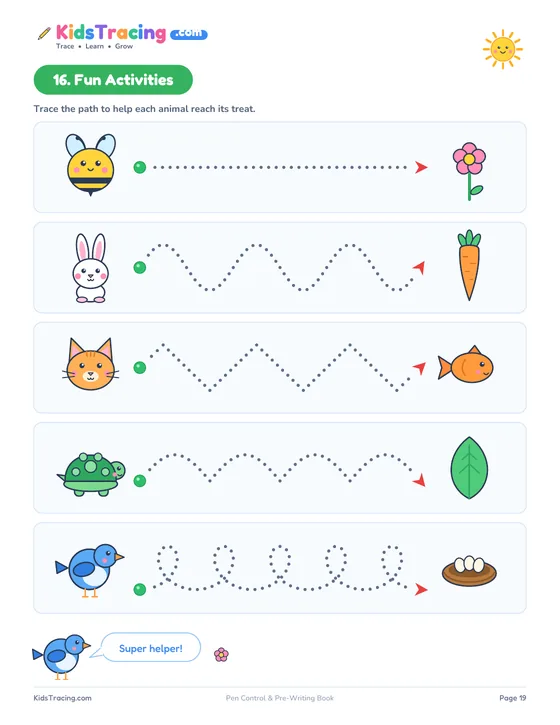
Pages 17 and 18 join two or three kinds of line into one numbered path, for example a straight line that turns into waves, arches that end in a straight line, a zigzag followed by waves, or a castle wall of square steps. On page 18, three of the five paths join three kinds of line and three of them include loops. Children have to change direction without lifting the pencil, which is closer to real handwriting than a row of identical strokes. Page 19 has five paths with a picture at each end: a bee flies to a flower along a straight line, a rabbit hops to a carrot along waves, a cat follows a zigzag to a fish, a turtle crosses hills to reach a leaf and a bluebird loops its way to a nest.
Certificate and back cover (pages 20–21)
Page 20 is a certificate of achievement with space for your child’s name, the date and a signature from a parent or teacher. Page 21 is the back cover.
Sample pages
A few pages from the finished workbook. The PDF is sharp enough to print at full size.
Skills your child practices
- Starting and stopping a line at the right place, from the green dot to the red arrow
- Drawing straight, curved, slanting, zigzag and wavy lines
- Left-to-right and top-to-bottom direction, the way we read and write
- Copying circles, squares, triangles, rectangles and diagonals
- Noticing a repeating pattern and finishing it
- Eye-hand coordination and steady pencil control
How to use this workbook
Choose a size and print
Pick US Letter or A4 above, open the PDF and print at 100% (Actual size). To print only some pages, type a page range, for example 4-7 for the first four line pages.
Get ready to write
Feet flat on the floor, a table at elbow height and the free hand holding the paper still. Offer a thick pencil, a short crayon or a triangular crayon.
Trace with a finger first
Run a finger along the dotted path from the green dot to the red arrow and say “ready, go, stop”. It shows your child where to start and where to finish before the pencil comes out.
Go slowly, then repeat
A slow, wobbly line is better than a fast, scribbled one. The same page on another day is better practice than a new page on the same day.
Finish with the animal paths and the certificate
Page 19 turns the strokes into a game, and the certificate on page 20 gives your child a real milestone to celebrate.
Why lines and shapes come before letters
Every letter and number is built from a small set of strokes. A small b is a vertical line and a circle, a t is a vertical line and a short horizontal one, and a w is two pairs of slanting lines. Children who can already draw those strokes with some control have far less to think about when letters arrive, because the hand knows what a vertical line, a curve or a diagonal feels like. That is why this workbook spends 16 pages on strokes and shapes and none on letters.
The table below shows which strokes in the book prepare which letters and numbers. Use it to choose pages when your child is about to start a particular letter, such as the first letter of their name.
| Strokes in the book | Pages | Letters and numbers they prepare |
|---|---|---|
| Vertical and straight lines | 4, 5 | l, i, t, b, d, h, p and the numeral 1 |
| Horizontal lines | 6 | The bars of t, f, e, A, H, E and the numeral 7 |
| Curves, waves and circles | 7, 10, 11 | o, a, c, d, g, q, s, e and the numerals 0, 2, 3, 6, 8, 9 |
| Slanting lines, zigzags and diagonals | 8, 9, 15 | v, w, x, y, z, k, A, M, N and the numeral 7 |
| Squares and rectangles | 12, 14 | The corners in E, F, L, H and the numeral 4 |
| Triangles | 13 | A, V, W, Z and the numeral 4 |
The usual ages at which children can copy each shape are listed in our guide to Pre-Writing Shapes by Age. They are typical ranges, not deadlines. If a page feels too hard, go back to the previous one for a few days. If a child is over five and still avoids drawing lines or circles altogether, the Handwriting Readiness Checklist explains what to look for and when to ask a teacher or therapist.
A four-week plan for the 16 tracing pages
There is no need to follow a schedule, but many parents like to know how long a workbook takes. At four pages a week, the 16 tracing pages fit into four weeks. That leaves two or three days a week with no workbook at all, which is where the play activities in our pre-writing activities guide fit in: drawing in a tray of sand, painting with water on a fence or rolling play dough snakes.
| Week | Pages | What your child practices |
|---|---|---|
| Week 1 | 4–7 | Straight lines, vertical lines, horizontal lines and curves: the simplest strokes, drawn in one direction |
| Week 2 | 8–11 | Slanting lines, zigzags, waves and circles: the strokes that change direction or curve all the way around |
| Week 3 | 12–15 | Squares, triangles, rectangles and diagonals: corners, angles and crossing lines |
| Week 4 | 16–20 | Patterns, the two mixed practice pages and the animal paths, then the certificate on page 20 |
Keep sessions to five or ten minutes. One page may take a child longer than another, and that is fine. A single page done calmly and finished with a smile is worth more than three pages done in a hurry.
Free worksheet generators to go with this workbook
Print extra practice with the same strokes. These tools make single pages in seconds.
Pre-Writing Lines
Lines, curves, waves, loops and spirals at three levels.
Preschool Line Tracing
Straight, slanted and curved lines for beginners.
Curves, Waves and Loops
Bridges, waves, loops and spirals to trace.
Shape Tracing
Dotted or solid shapes, names and a coloring strip.
Patterns
AB, AAB, ABB and ABC patterns: what comes next, what is missing.
Mazes
Easy to hard mazes with a picture at the start and finish.
Guides for parents and teachers
Pre-Writing Shapes by Age: When Can Kids Draw Each Shape?
The pre-writing shapes in order, with the usual age children can copy each one: line, circle, cross, square, diagonals and triangle, and how to practice.
Pre-Writing Activities for Preschoolers: 15 Fun Ideas
Fifteen fun pre-writing activities for preschoolers that build the strokes, strength and control children need before they start writing letters and names.
Handwriting Readiness Checklist: Is Your Child Ready to Write?
A simple handwriting readiness checklist for ages 3 to 6: ten signs your child is ready to start writing, and what to do if they are not there yet.
More free printable workbooks
Pen Control and Pre-Writing Book
Lines, curves, zigzags, loops and spirals, plus paths from a bee to a flower, to build pencil control.
My ABC Tracing Workbook
A picture for every letter A to Z to trace, color and circle, plus four review tests and a certificate.
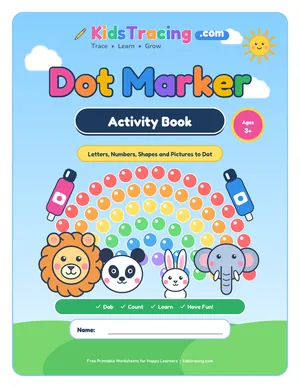
Dot Marker Alphabet and Numbers Book
Dab capital and small letters A to Z, count and dab numbers 1 to 10, then shapes and 15 pictures.
Frequently asked questions
Is the Pre-Writing Lines and Shapes Book really free?
Yes. Download it, print as many copies as you need for your own children or your own students and use it at home or in class. Please do not sell the file or put it on another website. No sign-up or email address is needed.
How is it different from the Pen Control and Pre-Writing Book?
Both books build pencil control, but they are made for different stages. This book has 21 pages: 16 short tracing pages that each practice one kind of line or shape, a patterns page, two mixed practice pages and one page of animal paths. The Pen Control and Pre-Writing Book has 37 pages and adds spirals, castle-wall paths, many more path pages and a Level Up section with tighter patterns. Start with this book if your child is new to tracing, then move to the longer one when these pages feel easy.
What age is the workbook for?
It is written for ages 3 to 5. Some children are ready for the straight line pages with a chunky crayon at about two and a half, while others do not feel like copying shapes until they are four. Use the pages your child can do happily and come back to the harder ones later. Children who find every page easy are usually ready to move on to letters.
Which pencil or crayon should my child use?
A thick pencil, a short crayon or a triangular crayon is easiest for small hands. A short tool encourages the fingers to sit close to the tip, which supports a relaxed grip. Move to a regular pencil when your child’s lines are steady. Washable markers also work if your child prefers them.
How long does the workbook take?
About four weeks at four pages a week, or about two weeks if your child enjoys two pages a day. Shorter, happier sessions work better than long ones, so there is no need to rush. The two mixed practice pages and the animal paths are good to repeat, because the same page often looks different on a second try.
Can I print only some of the pages?
Yes. Open the PDF, choose a page range in the print window and print only the pages you need. For example, 4-7 prints the four line pages in week 1 of the plan above. The contents table on this page and page 3 of the workbook show the page numbers.
My child says it is too hard or avoids pencil work. What should I do?
Slow down and go back a step. Let your child trace the dotted path with a finger first and say “ready, go, stop” at the green dot and the red arrow. Shorten the session to one row instead of a whole page, and check posture, because a chair that lets both feet touch the floor and a table at elbow height make a big difference. If drawing on paper is still hard, try the same strokes in sand, shaving foam or with chalk outside, then come back to the page.
Do I need a color printer?
No. The pages are designed in color, but the dotted paths print clearly in black and white. To save ink, choose grayscale in the print window. Only the patterns page uses color to tell the shapes apart, and the shapes are still easy to see in grayscale.