Dot Marker Alphabet and Numbers Book: Letters, Numbers, Shapes and Pictures to Dot (Free PDF)
A free dot marker book in which every page is made of circles. Dab the capital and small letters from A to Z, the numbers 1 to 10 with objects to count, six shapes as a ring and as a fill, and 15 pictures to finish in your favorite colors. Use dot markers, round stickers, a bingo dauber or a fingertip. Download the 62-page PDF in US Letter or A4 and print it at home or in class.
Download Dot Marker Alphabet and Numbers Book
- 62 pages for ages 3–6
- Free for home and classroom use, with no sign-up or email address
- Two PDF files: US Letter (8.5 × 11 in) and A4
- Circles are about 14 mm (9/16 inch) wide
Print at 100% (Actual size). Choose US Letter in the United States and Canada, and A4 almost everywhere else. How to print a workbook
Who this book is for
Dot marker pages are popular because the task is easy to understand: find a circle, press the marker, lift and move on. There is no pencil grip to get right and no line to stay inside. This book is written for ages 3 to 6. A three-year-old can dab the picture panels with a little help, and a five- or six-year-old can say each letter and number name while dabbing, count the dots and name the shapes. Teachers use pages like these as a quiet center activity during literacy or math time, and parents use them for calm moments at the kitchen table.
What makes this book different is that every page has two parts. On the letter pages your child dabs the capital and small letter and then a picture whose name begins with that letter. On the number pages the child dabs the numeral and then counts and dabs exactly that many objects. On the shape pages the first panel has a ring of circles around the outline and the second panel asks the child to fill the shape. The 15 picture pages end the book with bigger pictures, a small colored example to copy and a tip on each page.
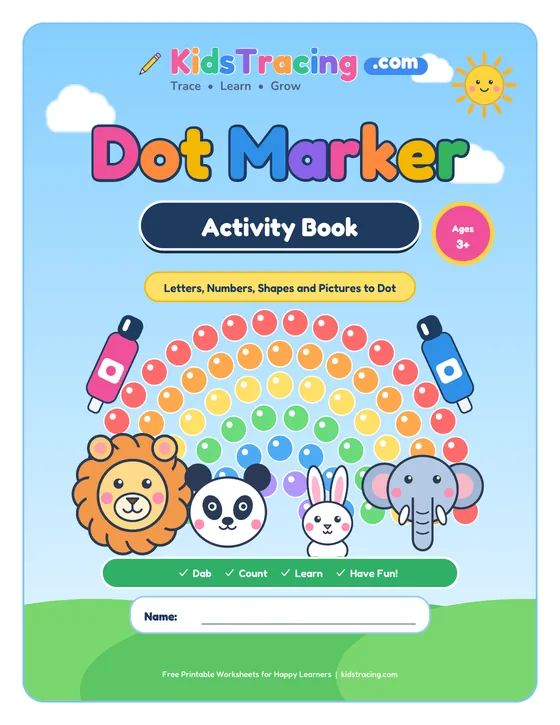
The cover and the PDF are titled Dot Marker Activity Book, with the subtitle “Letters, Numbers, Shapes and Pictures to Dot”. On this website it is called the Dot Marker Alphabet and Numbers Book so that you can tell it apart from the older Dot Marker Activity Book, which is the simpler of the two: ages 2 to 5 with one big capital letter, number, shape or picture on each page. Use that one for toddlers and this one for children who are ready to match letters, numbers and pictures. Neither book is a handwriting book, so for pencil practice move on to the Pre-Writing Lines and Shapes Book or the ABC Tracing Book.
What is inside the Dot Marker Alphabet and Numbers Book
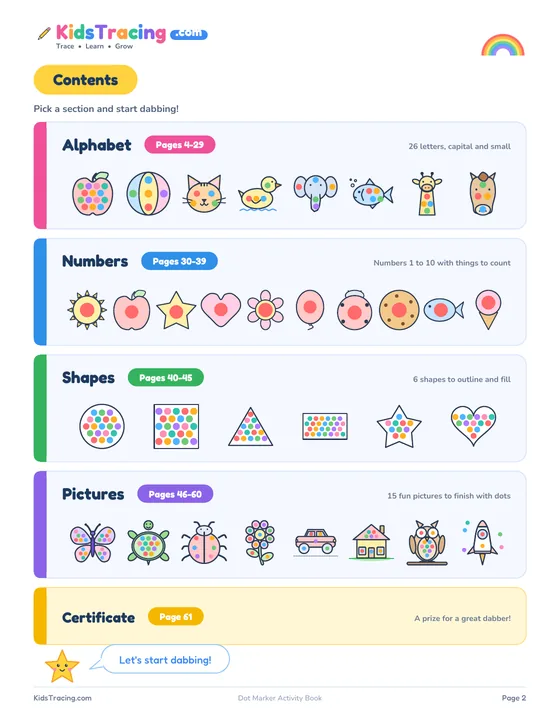
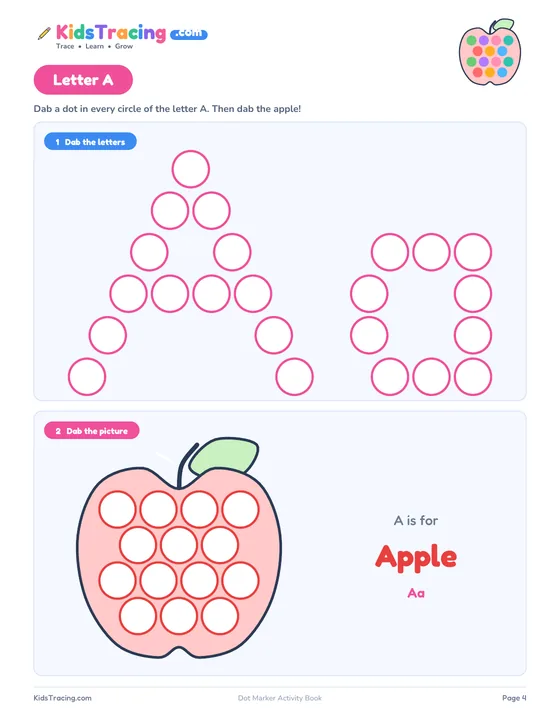
The book has 62 pages. Every page is numbered in the bottom corner, so you can print one section at a time. Each page has a colored tab at the top and one line of instructions that tells your child what to do, such as “Dab a dot in every circle of the letter A. Then dab the apple!”.
| Pages | Section | Number of pages |
|---|---|---|
| 1–3 | Cover, contents and a page for parents and teachers | 3 |
| 4–29 | Alphabet: capital and small letters A to Z, each with a picture to dab | 26 |
| 30–39 | Numbers 1 to 10, each with things to count and dab | 10 |
| 40–45 | Shapes: circle, square, triangle, rectangle, star and heart | 6 |
| 46–60 | Pictures: 15 pictures to finish with dots | 15 |
| 61 | Certificate of completion | 1 |
| 62 | Back cover | 1 |
Start here (pages 1–3)
The cover shows the title, “Ages 3+” and a line for your child’s name. Page 2 is the contents, with a row of small pictures for each of the four sections. Page 3 is the page for adults. It explains how to use the book in six steps: print on one side at 100% (Actual size), slide a spare sheet underneath, press straight down and lift straight up, say each letter, number or shape aloud while you dab, use stickers or a fingertip if you have no dot markers, and do one or two pages a day. It also has a box called “About the circles” that shows one circle at full size, so you can check how your marker fits before you print the rest of the book, and a line for “This book belongs to”.
Alphabet (pages 4–29)
One page for every letter from A to Z. The first panel, “Dab the letters”, shows the capital and the small letter side by side, each made of large circles. The second panel, “Dab the picture”, has a picture whose name starts with the letter, filled with circles to dab, and the words “A is for Apple” with “Aa” underneath. A small finished copy of the picture sits at the top right of the page. The colors change from page to page.
| Pages | Letters and picture words |
|---|---|
| 4–8 | A apple, B ball, C cat, D duck, E elephant |
| 9–13 | F fish, G giraffe, H horse, I ice cream, J jellyfish |
| 14–18 | K kite, L lion, M monkey, N nest, O octopus |
| 19–23 | P penguin, Q quilt, R rainbow, S sun, T tree |
| 24–29 | U umbrella, V van, W watermelon, X xylophone, Y yo-yo, Z zebra |
The picture words include a few that are hard to find in a first alphabet: nest for N, quilt for Q, xylophone for X and yo-yo for Y. If your child does not know a word, say it together and talk about what it is. That is a good vocabulary moment, and the dabbing keeps little hands busy while you do.
Numbers (pages 30–39)
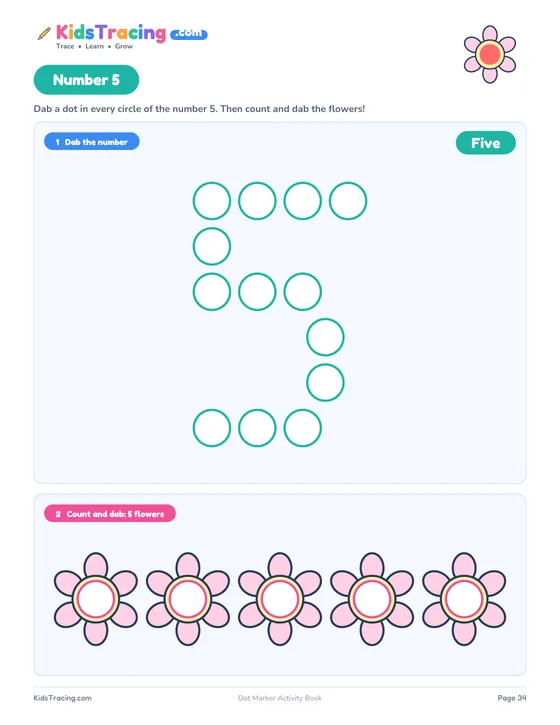
One page for each number from 1 to 10. The first panel, “Dab the number”, shows the numeral made of circles, with the number word in a colored badge at the top right of the panel. The second panel, “Count and dab”, shows that many objects in a row, and each object has one circle in the middle. Your child dabs each circle and counts aloud, so the number of dabs is exactly the number on the page. From 6 upward the objects sit in two rows.
| Page | Number | Number word | Things to count and dab |
|---|---|---|---|
| 30 | 1 | One | 1 sun |
| 31 | 2 | Two | 2 apples |
| 32 | 3 | Three | 3 stars |
| 33 | 4 | Four | 4 hearts |
| 34 | 5 | Five | 5 flowers |
| 35 | 6 | Six | 6 balloons |
| 36 | 7 | Seven | 7 ladybugs |
| 37 | 8 | Eight | 8 cookies |
| 38 | 9 | Nine | 9 fish |
| 39 | 10 | Ten | 10 ice creams |
The numeral itself is built from more circles than the number it shows. The 5, for example, takes 13 circles, so the count-and-dab panel is the part that practices counting. Ask your child to count the objects, not the circles in the numeral, and then point to the numeral and say its name.
Shapes (pages 40–45)
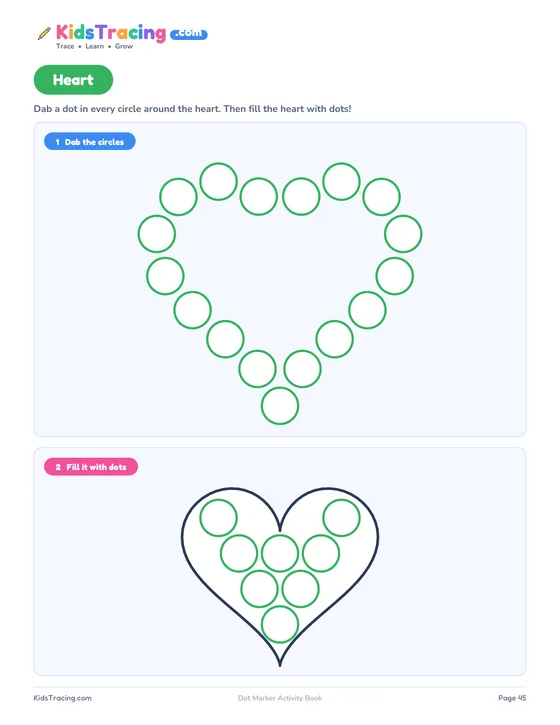
Six shapes: circle, square, triangle, rectangle, star and heart. The first panel, “Dab the circles”, has a ring of circles that make the outline. The second panel, “Fill it with dots”, shows the same shape drawn as a line, packed with circles. Dabbing the ring teaches the outline of the shape, and filling it shows that a shape also has an inside. The square and rectangle pages make good practice for counting by rows, and the star has five points to count.
Pictures (pages 46–60)
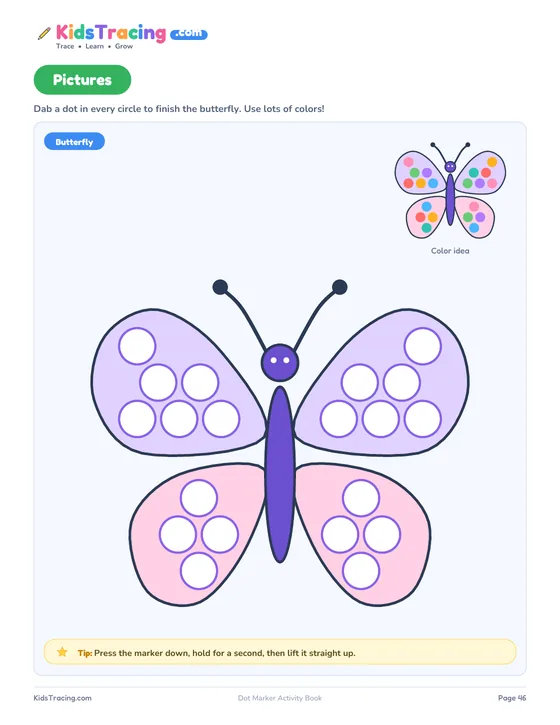
Fifteen pictures to finish, each on a page of its own, with a small colored example in the top corner labeled “Color idea”. The pictures are a butterfly, a turtle, a caterpillar, a ladybug, a flower, a snail, an owl, a car, a house, balloons, a cupcake, a robot, a rocket, a train and a snowman. Each page has a tip at the bottom, such as “Try a new color for every dot. Rainbow dots look great!” or “Count the dots out loud as you dab them.” Color ideas are only a suggestion, and any colors are fine.
| Pages | Pictures |
|---|---|
| 46–50 | butterfly, turtle, caterpillar, ladybug, flower |
| 51–55 | snail, owl, car, house, balloons |
| 56–60 | cupcake, robot, rocket, train, snowman |
Certificate and back cover (pages 61–62)
Page 61 is a certificate of completion with a line for the child’s name, the date and a parent or teacher signature, with the words “Great dabbing, big dots and lots of fun!”. Page 62 is the back cover.
Sample pages
A few pages from the finished workbook. The PDF is sharp enough to print at full size.
Skills your child practices
- Hand and finger strength from pressing and lifting a marker
- Aiming at a target (hand-eye coordination)
- Recognizing capital and small letters A to Z and the picture word for each
- Counting objects one by one and linking numerals 1 to 10 to number words
- Naming six basic shapes and seeing the outline and the space inside
- Choosing colors and finishing a picture
How to use this workbook
Print on thicker paper
Choose US Letter or A4 and print at 100% (Actual size) on one side only. Thicker paper or cardstock works best, because marker ink can soak through.
Protect the table
Slide a spare sheet of paper or a piece of cardboard under the page. It also gives the marker a little cushion.
Check the fit
Dab the sample circle in the “About the circles” box on page 3. If your marker makes a bigger dot than the circle, switch to a mini marker or round stickers before you start the book.
Press down, count to one, lift
Dab a dot inside every circle. Press straight down, count “one”, then lift straight up. Please do not slide the marker.
Say it while you dab
Say the letter, number or shape out loud and count the dots together. Do one or two pages a day.
What dot marker pages teach
Hand strength and control. Pressing a marker straight down and lifting it straight up is a different movement from drawing a line. It uses the muscles of the hand and fingers and teaches the child to aim, press and release. That is useful preparation for holding a pencil, and it does not ask a child to hold a pencil in any particular way.
Aiming at a target. Every circle is a clear target. The child has to look, move the marker to the right place and press, which is early eye-hand coordination. The circles are about 14 mm wide, large enough that a three-year-old can hit them but small enough to take some care.
Letter and number recognition. Each letter page shows the capital and the small letter next to each other and links them to a picture word, so the letter name, its shape and its first sound can be talked about together. Each number page links the numeral, the number word and a group of objects to count. If your child can already say the letter or number, the page is revision. If not, it is a gentle introduction.
One-to-one counting. A dab and a count belong together: one press, one number. That matching of one count to one object is what makes counting accurate, and it is the reason the page asks for the child to say the numbers aloud.
Shapes. Dabbing a ring of circles around a shape shows its outline, and filling the shape afterwards shows that it also has an inside. Triangles have three corners, squares have four equal sides and a rectangle is longer than it is tall, and your child can see all of this on the page.
What it is not. Dotting a letter follows its shape, but it does not teach the direction of the strokes. A child can dab the circles of an A in any order. When your child is ready to write, switch to tracing pages with numbered arrows, such as the ABC Tracing Book, or use our letter formation worksheets.
Choosing a dotting tool
Every circle in the book is the same size: about 14 mm, or 9/16 inch, across. Dot markers are sold in several sizes. Mini markers make a dot of about 7/16 inch (11 mm), many sets use a tip of about 15 mm and some sets make dots about 3/4 inch (19 mm) wide. The table shows how each tool fits.
| Tool | Size of the dot | How it fits |
|---|---|---|
| Mini dot marker | About 7/16 inch (11 mm) | Fits inside the circle with a thin white edge to spare |
| Dot marker with a 15 mm tip | About 15 mm (a little under 5/8 inch) | Almost the same size as the circle. The dot may touch the outline, which does no harm |
| Large dot marker | Up to about 3/4 inch (19 mm) on some sets | Bigger than the circle, so dots will overlap their neighbors. Choose a different tool for this book |
| Round sticker | 1/2 inch (12.7 mm) stickers are the right size | Fits inside the circle. Larger stickers will cover the outline of the next circle |
| Cotton swab and washable paint | Depends on how hard you press | Dab two or three times inside the circle for a full dot |
| Fingertip and washable paint | Depends on the finger | Works well for young children. Use a very thin layer of paint |
Before you print the whole book, check the fit on the sample circle in the “About the circles” box on page 3. If your marker makes a dot that is bigger than that circle, a mini marker, round stickers or a cotton swab will give a neater result. Washable markers are the cleanest option, and because wet ink can soak through paper, print on thicker paper or cardstock when you can, print on one side only and slide a spare sheet or a piece of cardboard under the page.
How long will each page take?
The number of circles varies a lot from page to page, so the amount of time does too. The table counts the circles on both panels of a page, and it applies to the US Letter and A4 editions. The counts are the same in both sizes, except that the star page has one circle more in the US Letter edition.
| Section | Pages | Circles on one page | Fewest and most |
|---|---|---|---|
| Letters | 4–29 | 19 to 37 | I has the fewest (19) and A the most (37) |
| Numbers | 30–39 | 10 to 31 | Number 1 has the fewest (10) and number 10 the most (31) |
| Shapes | 40–45 | 25 to 48 | Heart and star have the fewest (about 25) and the rectangle the most (48) |
| Pictures | 46–60 | 5 to 20 | Car and robot have the fewest (5) and the butterfly the most (20) |
The pictures are the shortest pages, because most of them have fewer than ten circles. A child who tires quickly can finish one in a few minutes and still see a complete, colorful picture. The longest pages are the rectangle and the letter A, followed by a handful of other letters such as R, B, M, Q and X. These are better for an older child, or for a day when your child is calm and keen. The book suggests one or two pages a day, because short, happy practice beats a long session.
Three ways to work through the book
| Way | How it goes | Best for |
|---|---|---|
| Cover to cover | Letters first, then numbers, shapes and pictures. At one page a day on weekdays, the 57 activity pages take about eleven weeks | Teachers following the alphabet, and children who like to know what comes next |
| Mix it up | One letter page, then a number, shape or picture page the next day, so every session feels different | Children who get bored with a long run of the same kind of page |
| Easy start | Begin with the picture pages that have the fewest circles (car 53, robot 57, ladybug 49, balloons 55, caterpillar 48 and rocket 58), then shapes, numbers and letters | The youngest children, and anyone who tires quickly |
Free worksheet generators to go with this workbook
Add pencil practice and counting with free printable generators.
Fine Motor Skills
Scissor skills and cutting practice.
Letter Formation
A–Z strokes with numbered arrows and dotted tracing.
Number Tracing 1-10
One big number per line, 1 to 10, with a stroke guide.
Shape Tracing
Dotted or solid shapes, names and a coloring strip.
Counting
Count pictures, then write or circle the number. Compare groups too.
Dot to Dot
Connect numbers, letters or skip counts to reveal a picture.
Guides for parents and teachers
Pre-Writing Activities for Preschoolers: 15 Fun Ideas
Fifteen fun pre-writing activities for preschoolers that build the strokes, strength and control children need before they start writing letters and names.
Letter Formation Order: Which Letters to Teach First
A simple letter formation order: group letters by how they are written and teach straight-line letters first. Capital and small letter groups, with a week plan.
How to Teach a Child to Write Numbers 1 to 10
How to teach a child to write numbers 1 to 10: how to form each digit, a simple practice plan and tips for numbers written backwards.
More free printable workbooks
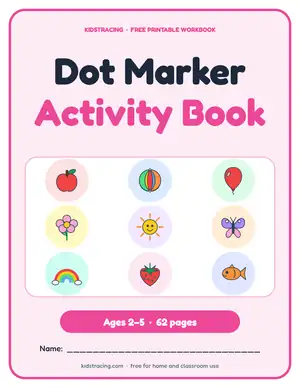
Dot Marker Activity Book
Big letters, numbers, shapes and pictures filled with circles for dot markers, stickers or fingertips.
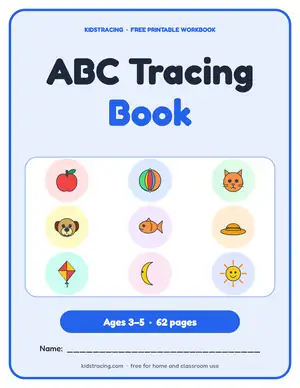
ABC Tracing Book
Every letter A to Z with numbered stroke arrows, a picture to color and a word to trace.
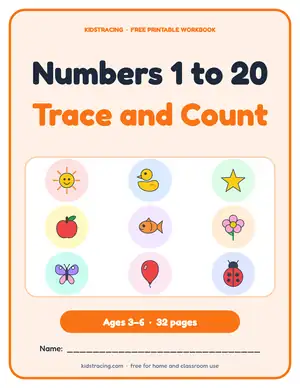
Number Tracing and Counting Book
Trace, count and color every number from 1 to 20, then practice number words and skip counting.
Frequently asked questions
Is the Dot Marker Alphabet and Numbers Book really free?
Yes. Download it, print as many copies as you need for your own children or your own students and use it at home or in class. Please do not sell the file or put it on another website. No sign-up or email address is needed.
How big are the circles, and will my dot markers fit?
Each circle is about 14 mm (9/16 inch) wide. Mini markers and markers with a tip of about 15 mm fit well. Some sets make larger dots, up to about 3/4 inch, and these will overlap their neighbors. Check your marker on the sample circle on page 3 of the PDF before you print the whole book. A round sticker of 1/2 inch, a cotton swab dipped in washable paint or a fingertip all work too.
How is it different from the Dot Marker Activity Book on this site?
The Dot Marker Activity Book is the simpler book for ages 2 to 5, with one big capital letter, number, shape or picture on each page. This book is for ages 3 to 6 and has two panels on each page: capital and small letters plus a picture for each one, numbers with objects to count and dab, shapes with a ring and a fill, and 15 pictures with a color idea. Both PDFs are titled Dot Marker Activity Book on the cover, which is why this page uses a longer name.
What age is it for?
The cover says ages 3 and up, and the book is written for ages 3 to 6. A younger child can dab the picture panels with help, and an older child can name the letters, count the dots and say the number words. For children under three, the older Dot Marker Activity Book may be an easier start.
Do I need dot markers?
No. Round stickers, a bingo dauber, a cotton swab dipped in washable paint, pom-poms or a fingertip can all do the job. If you use a marker, choose a washable one. Check any new tool on a spare circle first.
Will the ink soak through the paper?
It can. Wet markers and paint can soak through ordinary copy paper, so print on thicker paper or cardstock if you can. Print on one side only and slide a spare sheet or a piece of cardboard under the page so the table and the pages below stay clean.
Why does the numeral have more circles than the number?
The numeral is drawn with a line of circles, so a 5 takes a lot more than five. The counting happens in the second panel, where there are exactly as many objects as the number, each with one circle in the middle. Ask your child to count the objects.
Which pages are the quickest?
The picture pages. Car and robot have 5 circles each, ladybug and balloons 6, and caterpillar and rocket 7. Letters have between 19 and 37 circles on a page, so they take longer. The table on this page shows the range for every section.
Can I print only some of the pages?
Yes. Open the PDF, choose a page range in the print window and print only the pages you need. For example, 4-8 prints the letters A to E, and 46-60 prints all 15 pictures. The contents table above shows where each section starts.
Do I need a color printer?
No. The circles and outlines print clearly in black and white, though the colored rings print in gray. Color is nicer, but it is not required. The cover, the contents and the certificate look best in color.