Pre-Writing Activities for Preschoolers: 15 Fun Ideas
Published by Hasnat N, Founder · October 1, 2026 · Updated October 25, 2026 · 9 min read
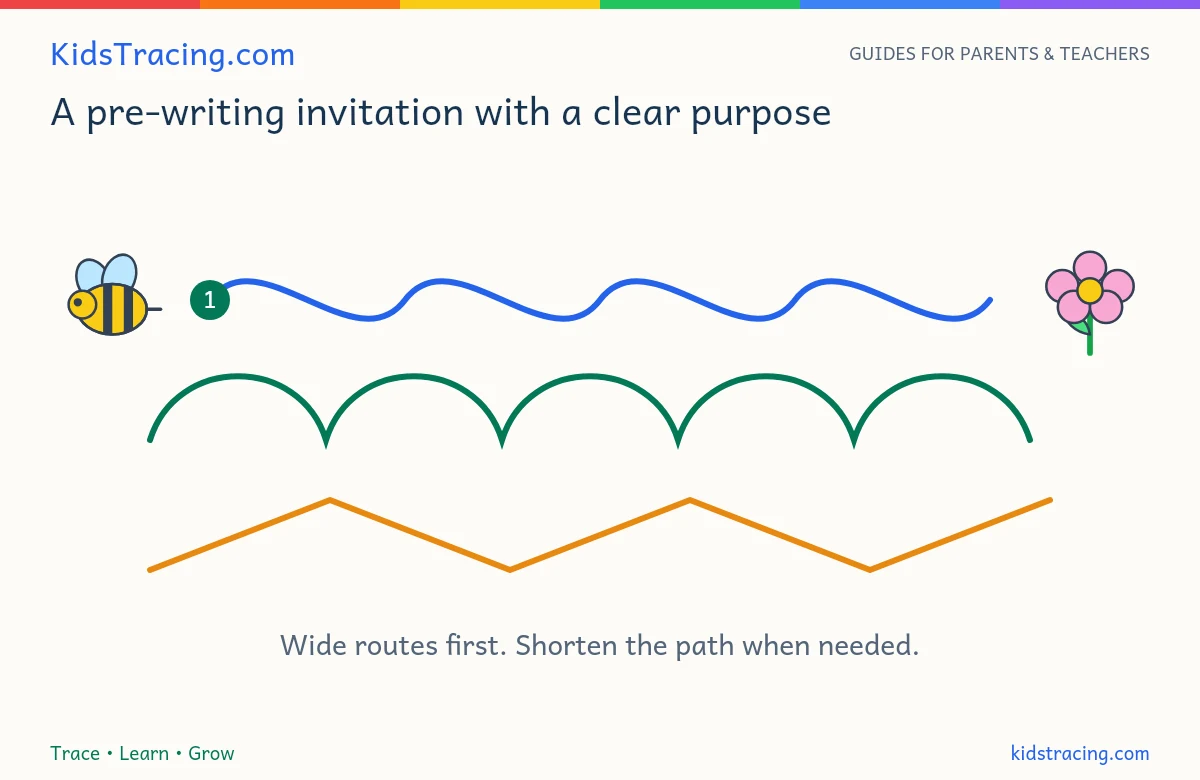
Before a child can write letters, they need to build the strength, control and shape skills that handwriting depends on. These skills are called pre-writing skills, and the best way to build them is through play. This guide explains what pre-writing is, which strokes children usually learn first, and fifteen simple pre-writing activities for preschoolers that you can do with everyday items at home or in class.
What are pre-writing skills?
Pre-writing skills are the building blocks of handwriting. They include hand and finger strength, hand-eye coordination, a comfortable pencil grip, and the ability to draw basic lines and shapes. They also include sitting well, crossing the middle of the body with one hand, and paying attention for a few minutes. A child who is not ready for letters is not behind. They are simply still building these foundations.
The pre-writing strokes
Letters are made from a small set of shapes. Children usually master them in roughly this order, although ages are only a guide and every child develops differently:
- Vertical line (around age two)
- Horizontal line (around two to three)
- Circle (around three)
- Cross (around four)
- Square (around four to five)
- Diagonal lines and triangle (around five)
If your child can draw most of these comfortably, they are usually ready to trace letters and their name. If not, keep playing with the strokes and enjoy the process.
Pencil grip: what to expect
Grip develops in stages. Toddlers often hold a crayon in a fist, then use their fingers with the palm facing down, and later settle into a relaxed tripod grip using thumb, index and middle finger. Many children reach a comfortable grip between four and six. Offer short, chunky crayons and avoid forcing a particular grip too early. Strong hands and arms usually lead to a better grip naturally.
Fifteen pre-writing activities
Sensory activities
- Write in a tray: spread salt, sand, rice or sugar on a tray and draw lines, circles and zigzags with a finger.
- Shaving foam art: spray foam on a table and make shapes and swirls. It is messy, but children love it.
- Playdough snakes: roll playdough into long snakes and form lines, circles and letters.
- Paint with water: give a child a brush and a bucket of water to paint shapes on a fence or wall.
Fine motor activities
- Threading beads: threading large beads or pasta onto a string builds finger strength and coordination.
- Tongs and tweezers: moving pompoms or cotton balls between bowls strengthens the muscles used for gripping.
- Tearing and sticking: tearing paper into small pieces and gluing them into shapes works the same muscles as holding a pencil.
- Clothes pegs: pinching pegs onto a card or a bowl rim is a great finger workout.
Gross motor activities
- Wall and window drawing: drawing large shapes on a vertical surface strengthens shoulders and encourages a good wrist position.
- Big arm movements: draw giant circles and lines in the air, or with chalk on the sidewalk.
- Obstacle courses: crawling, climbing and balancing build the core strength needed for sitting and writing.
Drawing and early writing activities
- Dot-to-dot and tracing lines: follow straight, curved and zigzag lines from one side of a page to the other.
- Mazes and paths: guiding a pencil along a path builds control and attention.
- Coloring inside shapes: start with big shapes and move to smaller ones as control improves.
- Draw and describe: ask your child to draw a picture and tell you about it. Drawing is the root of writing.
Make it part of the day
Pre-writing does not need a set time. Squeezing a sponge in the bath, kneading dough, hanging washing with pegs and digging in the sandpit all build the same muscles. Keep sessions short, five to ten minutes at a time, and let your child lead. If they lose interest, change activities rather than pushing on.
When to introduce letters and their name
When your child can draw most of the basic strokes and shows interest in letters, you can introduce the first letter of their name. Begin with tracing, using large dotted letters, and keep sessions short. Our free name tracing generator lets you type any name and print one to three big lines, which is plenty for beginners. For a full routine, read our guide on how to teach a child to write their name.
Simple handwriting name practice ideas
Even before pencil work, you can prepare for handwriting name practice with play:
- Spell the name with magnetic letters
- Build the first letter from playdough
- Find the first letter on signs, labels and books
- Trace the first letter on a tablet or in the air
These games link the sight and sound of letters with the movement needed to make them.
Choosing tools
- Chunky crayons, short pencils and triangular pencils are comfortable for small hands.
- Large paper gives room for big movements.
- An easel or a wall-mounted board encourages good posture.
- Washable markers keep sessions relaxed.
Troubleshooting
My child avoids drawing and writing
Make it playful. Use sensory activities, big movements and games, and let your child choose the materials. Try drawing together and avoid correcting.
Their grip looks awkward
Offer short crayons and keep up the strength-building activities. Grip usually improves with time and strength.
They get tired quickly
Sitting and holding a pencil are hard work. Keep sessions brief and add breaks for movement.
Should I be worried?
Children develop at different speeds. If you are concerned about your child's hand skills, coordination or progress, talk to your child's teacher, a doctor or an occupational therapist, who can look at the whole picture.
Frequently asked questions
At what age should preschoolers start pre-writing?
Many children begin exploring marks and scribbles from age one or two. Structured pre-writing play usually starts around three and continues until they begin writing letters.
Do I need worksheets for pre-writing?
Worksheets can help, but play-based activities do most of the work. Use simple line and shape tracing pages alongside sensory games.
How can I tell if my child is ready for letters?
Look for a comfortable grip, the ability to copy a circle and a cross, and interest in letters and their own name.
Final thoughts
Pre-writing is about play, strength and control, not perfect letters. Offer a mix of sensory, fine motor and big-movement activities, keep sessions short and happy, and move to tracing letters and names when your child is ready. Our guides on cursive handwriting and cursive letters A to Z are there for the next stage, many years down the road.
Three ready-to-try pre-writing activities
- Road to the garage: Draw two parallel lines across a page. Have the child drive a pencil “car” between them without crossing the edges.
- Rain to the puddle: Draw clouds above puddles. Ask the child to add straight downward lines as raindrops.
- Curvy caterpillar: Draw a caterpillar head and invite the child to continue its body using connected loops.
Offer thick crayons and larger shapes first; narrow tracing spaces can come later.
Build a pre-writing invitation around one movement
Choose a movement before choosing a material. For example, a bee traveling to a flower can invite a curved route; a toy car crossing a bridge can invite a straight line. The story gives the child something to do without asking them to write letters before they want to.
Example invitation: a road for a toy
Draw two widely spaced boundaries on a large sheet. Put a toy at one end and a picture or block at the other. First, move the toy along the road together. Then invite the child to draw a route through the middle. They can choose a different color for a second journey, or stop after one.
Talk about the movement: "Your line went around the bend" or "You stopped before the edge." This gives more usable information than simply calling the page neat. Later, a pre-writing worksheet can offer a similar route at a smaller size.
Adapt an activity without changing the learning goal
| Situation | Adaptation |
|---|---|
| Messy materials are unwelcome | Use a dry wipe board, crayons or a finger on a clean tabletop. |
| The page slides around | Use a stable surface and let the other hand help hold the paper. |
| The route is too demanding | Make the path shorter and wider before introducing more turns. |
| The child wants to draw freely | Keep the drawing and ask about its lines or shapes rather than replacing it with a drill. |
Use age-appropriate materials with adult supervision. Small beads and loose objects are not suitable for children who mouth objects; choose larger alternatives. For cutting activities, follow the supervised sequence in the scissor skills guide.
Progress may mean choosing to make another mark, steering around one bend or needing less adult help. It does not have to mean a harder worksheet every day. Return to a familiar activity when the child enjoys it, and use the readiness observations to plan variety rather than to award a score.
Free printables to go with this guide
Put this guide into practice with our free generators: pre-writing worksheets, shape tracing worksheets, letter formation worksheets, number tracing worksheets.
Free workbooks to go with this guide
- Pen Control and Pre-Writing Book – Lines, curves, zigzags, loops and spirals, plus paths from a bee to a flower, to build pencil control.
- Shapes Tracing and Coloring Book – Ten shapes to trace, hunt for and color, plus tracing practice and matching games.
- Dot Marker Activity Book – Big letters, numbers, shapes and pictures filled with circles for dot markers, stickers or fingertips.
Keep reading
- Coloring Activities for Preschoolers - Six picture-based invitations, practical adjustments and free printable coloring resources.
- Pre-Writing Shapes by Age: When Can Kids Draw Each Shape? – The pre-writing shapes in order, with the usual age children can copy each one: line, circle, cross, square, diagonals and triangle, and how to practice.
- Handwriting Readiness Checklist: Is Your Child Ready to Write? – A simple handwriting readiness checklist for ages 3 to 6: ten signs your child is ready to start writing, and what to do if they are not there yet.
- How to Teach a Child to Use Scissors – How to teach a child to use scissors: the right grip, the best first scissors and a step-by-step cutting plan from snipping to cutting out shapes.
- Sweden Brings Back Books and Handwriting: Facts for Parents – Is Sweden banning tablets? See what changed in its schools, what research says about handwriting vs typing, and a paper-first plan for ages 3 to 6.