Sky Line, Grass Line, Worm Line: Handwriting Lines Explained
Published by Hasnat N, Founder · November 12, 2026 · 10 min read
Quick answer: On the four-line grid used in the Fundations program, the sky line is the top line, the plane line is the dashed one below it, the grass line is the floor that most letters stand on, and the worm line is the bottom line that tails reach. Tall letters such as b and h go up to the sky line. Short letters such as a and o fill the space between the plane line and the grass line. Letters with tails, such as p and y, drop to the worm line. Many handouts use only three names for the same spaces: sky, grass and dirt.
Why the lines have names
"Write it neatly" gives a child very little to work with. "Start on the sky line" gives them a place. That is the whole idea behind naming the lines of a handwriting grid. Wilson Language Training, the publisher of the Fundations reading and handwriting program, says that its grid lines are given specific names and used as reference points.
The names usually come with a spoken script. For the letter b, the Fundations script goes: point to the sky line, go down to the grass line, start back at the sky line and go around to the plane line, and around again to the grass line. Say it slowly and the lines do the explaining. The straight stem runs the full height of the grid, and the round part fits in the lower space.
If your child brings home a sheet that mentions a "sky line letter" or a "worm line," this guide is the translation. It also works for families who homeschool and pick their own materials, because the idea is the same whatever the program is called.
Two sets of names for the same space
You'll run into two systems, and they are easy to mix up.
The first names the spaces between the lines. Understood.org, a resource for parents, describes a game called Sky, Grass, Dirt. The row between the top and middle lines is the sky. The row between the middle and bottom lines is the grass. The row below the bottom line is the dirt. A National Health Service occupational therapy handout for schools puts the same picture in three short sentences: tall letters touch the sky, short letters stay on the grass, and long letters have roots in the ground. A children's occupational therapy service in Wales uses the same idea with "mud" where others say "dirt," a small sign that the names are not standardized.
The second names the lines themselves. The Wilson grid has four of them: the sky line, the plane line, the grass line and the worm line. Put the two side by side and they turn out to describe the same piece of paper.
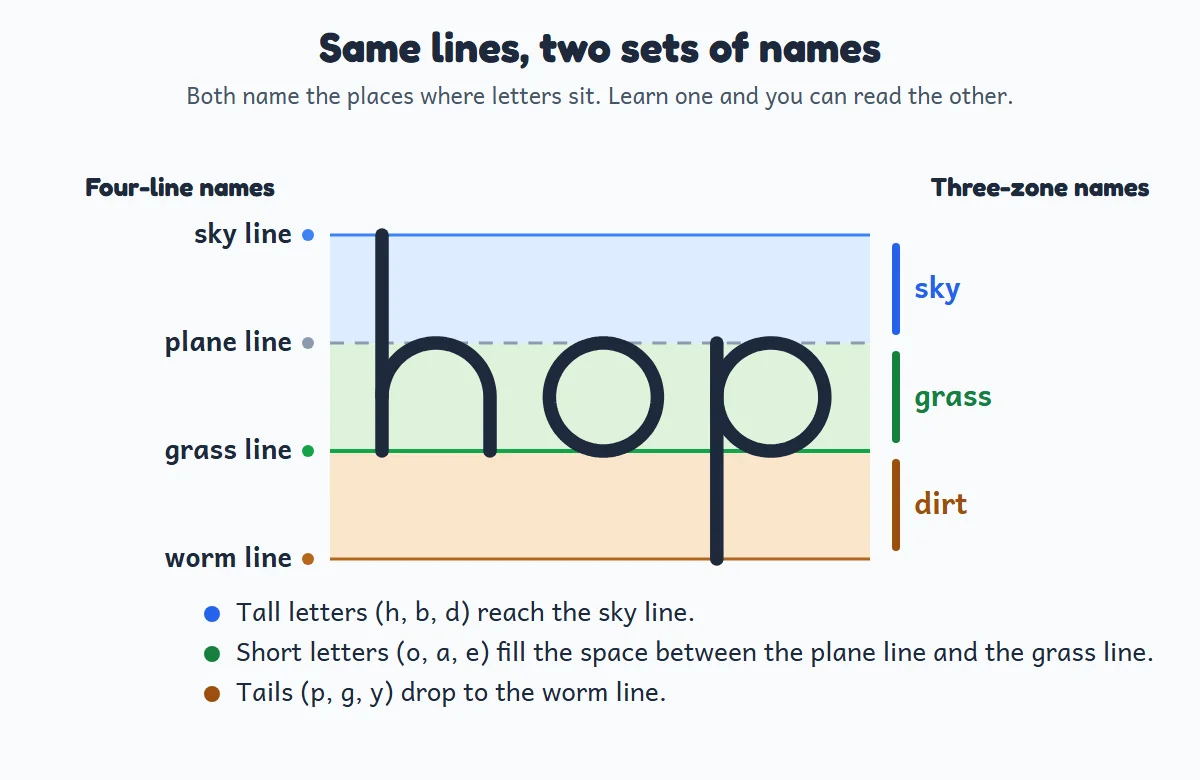
| Compare | Sky, grass, dirt | Sky, plane, grass, worm |
|---|---|---|
| What gets a name | The three spaces between lines | The four lines |
| Where it shows up | Therapist handouts and parent guides | Fundations materials |
| Tall letters | Touch the sky | Reach the sky line |
| Short letters | Stay on the grass | Sit between the plane line and the grass line |
| Letters with tails | Drop into the dirt | Reach the worm line |
| What a child hears | “Is it a sky, grass or dirt letter?” | “Start on the plane line and go around to the grass line.” |
The matching in the picture is our own reading of the two systems, so treat it with some care. The three-name games don't give the dirt a line of its own, which makes the worm line simply the edge where that space ends. Neither system is the standard: a school picks a program, and the program picks the names. Fundations is a registered trademark of Wilson Language Training, and KidsTracing has no connection to it. We describe its terms only so you can follow a school handout. If your child's teacher uses a word that isn't in this guide, go with the teacher's word.
Which lowercase letters sit where
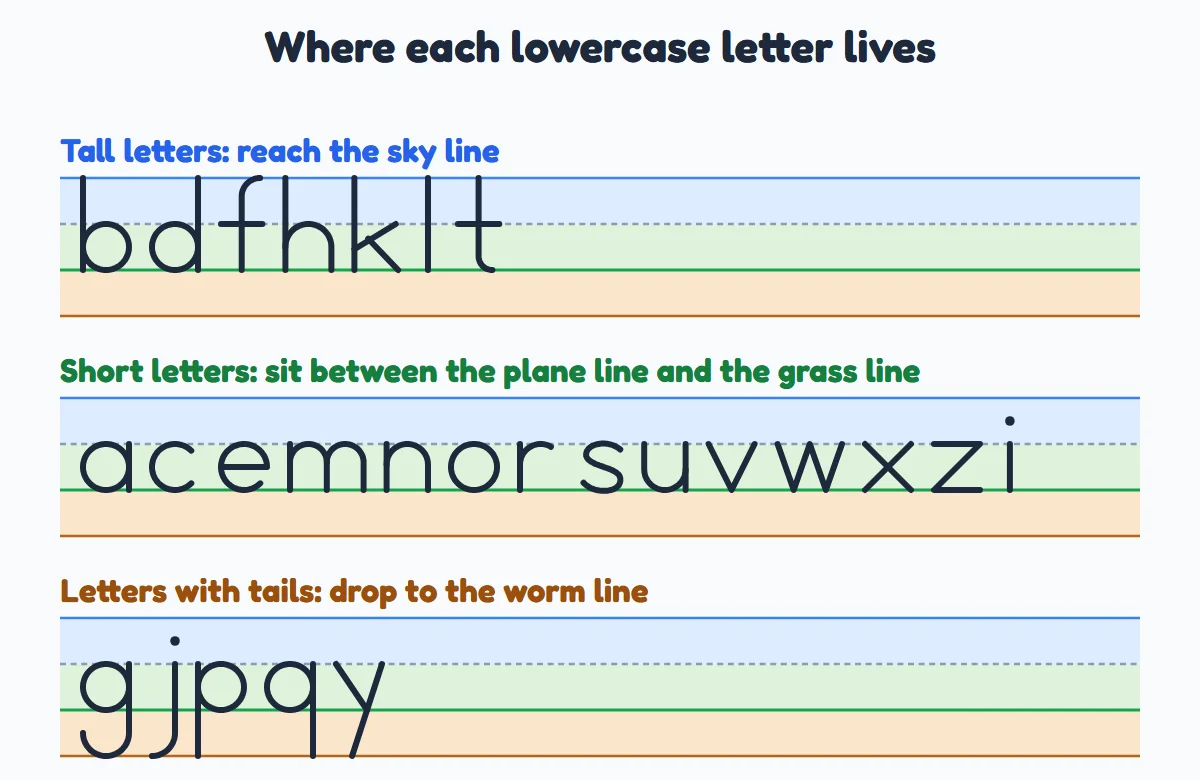
Seven lowercase letters are tall: b d f h k l t. Fourteen stay short: a c e i m n o r s u v w x z. Five have tails: g j p q y. Capital letters are all tall, so they reach the sky line too.
Two details trip parents up. The first is the dots. An i or a j has a dot floating above the dashed line, but the body of the letter decides the group, so i stays short and j drops a tail.
The second is that school charts don't always sort letters by height. Wilson's chart lists t b f l h k as sky line letters. It puts n m i u r p j in a plane line group, c o a g d s q in a plane line round group (with e set apart as special), and v w y x z in a plane line slide group. Those groups follow where each letter starts, not how tall it ends up. That's why d sits with the round letters even though it climbs to the sky line, and why p and j are plane line letters even though they drop below the grass line. If a worksheet calls d a plane line letter, nothing is wrong.
One more variable: printed models disagree about the height of t. We drew it full height, like the Wilson chart, and the Welsh OT handout also lists t as a tall letter. Some fonts and workbooks draw it shorter, so follow the model your child's school uses.
Practice at home, from big to small
Wilson's handwriting sequence moves from large movements to small ones. Children first sky write a letter, which means drawing it big in the air, then trace it, then copy it, and finally write it from memory. The order makes sense with any handwriting program, so we suggest using it at home.
- Touch and name the lines. Let your child point to each line and say its name before anyone picks up a pencil.
- Sky write the letter in the air, saying the steps out loud.
- Trace a gray model of the letter on the grid.
- Copy the letter next to the model.
- Write the letter with the model covered.
Take the word happy. Before writing, ask three questions. Which letter touches the sky line? (h.) Which letter sits between the plane line and the grass line? (a.) Which letters drop to the worm line? (the two p's and the y.) Then write the word on the grid and check each letter against your answers. Because the spaces have names, a letter that lands in the wrong one is easy to spot and easy to talk about.
The trace-and-write page below puts gray models on four-line grids, one row for each group of letters and two words at the bottom. Keep each session short: a few letters is plenty, and our guide to how long preschoolers should practice tracing has more on timing.
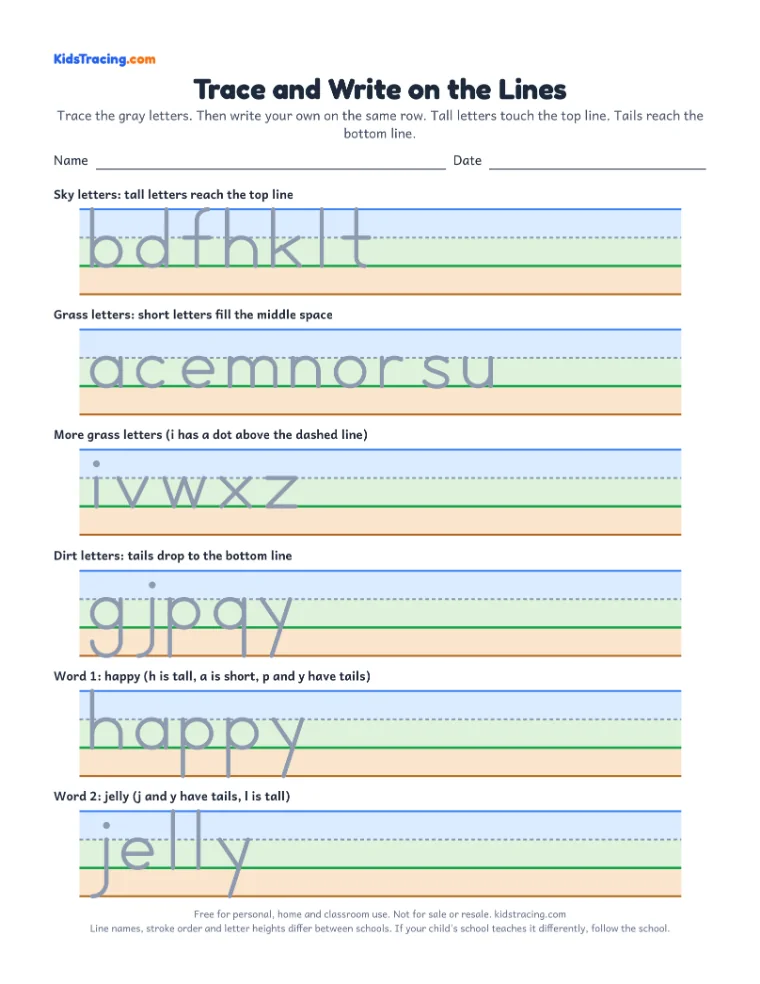
Download the practice page as a US Letter PDF or an A4 PDF. The gray letters are a model to follow, not a stroke-order lesson, because schools teach different starting points.
More letters to practice? Two free workbooks take your child through the whole alphabet, one letter at a time.
ABC Tracing Book
Every letter A to Z with numbered stroke arrows, a picture to color and a word to trace.
My ABC Tracing Workbook
A picture for every letter A to Z to trace, color and circle, plus four review tests and a certificate.
Games that make the spaces stick
Understood describes two ways to play Sky, Grass, Dirt with a short word. In the hand-signal version, tall letters get a thumb pointed up to the sky, short letters get a fist for the grass, and letters that descend get a thumb pointed down to the dirt. Say a letter, and your child answers with the matching hand signal.
We suggest a few variations that need no supplies. Sort magnetic letters into three trays, one for each space. Call out a word and ask for the sky letters only. Switch roles so that your child quizzes you, and give a wrong answer now and then so they can correct you.
Our letter sort worksheet turns the same idea into paper. Children color sixteen letter cards by group, then write each letter on its own row. The answer key is a separate file, so your child doesn't see it first.
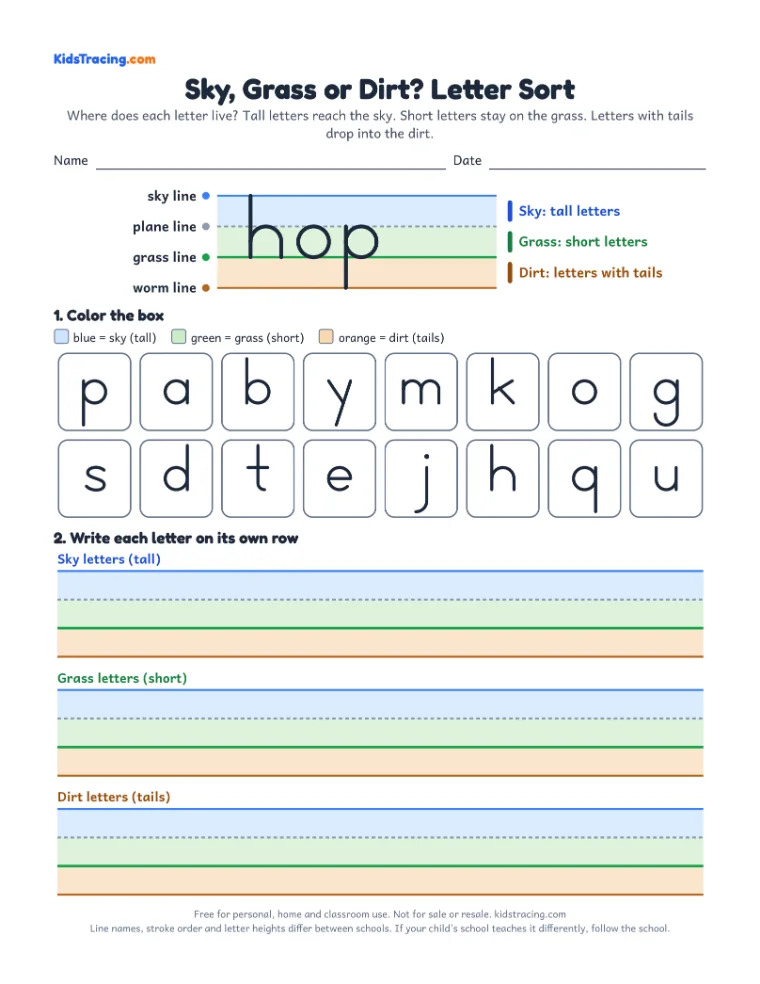
Print the sort page as a US Letter PDF or an A4 PDF. The answer key comes as a US Letter PDF or an A4 PDF.
When letters come out the wrong size
Understood opens its Sky, Grass, Dirt tip with a question many parents will recognize: does your child write hOpS instead of hops? A lined grid makes that kind of problem visible. The same word can go wrong in different ways, and each way points to a different fix.
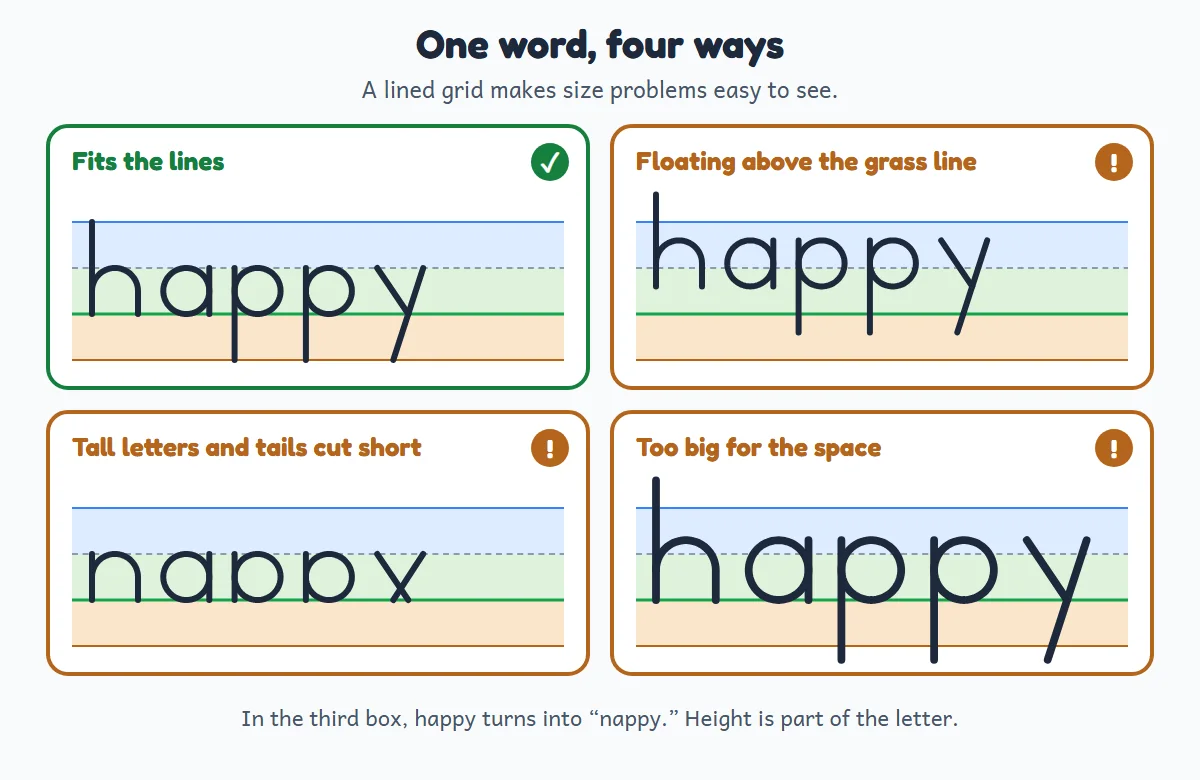
If the letters float above the grass line, the baseline is the problem. Draw the grass line with a thick marker and ask your child to let every letter stand on it. If tall letters and tails are cut short, a word can turn into a different word, as happy does when it becomes nappy. Go back to the hand signals and slow down. If the letters are too big for the space, a physical cue can help. Understood suggests tracing the lines with glue or puffy paint so that a child can feel the pencil bump into them.
Wide grids are easier to fit letters into. If letters are too big and the lines are narrow, we suggest starting on a larger grid and shrinking it later.
From the colored grid to plain paper
The colored grid is a support, and supports are meant to come off. An NHS occupational therapy resource suggests that once a child has mastered color-coded lines, the colored lines can be replaced with faint lines and then removed altogether.
Our suggestion is to fade in steps. Begin with the four-line grid. Once most letters land in the right spaces, move to three-line paper: a top line, a dashed line in the middle and a base line. Our blank handwriting paper page prints exactly that layout: red on top, a dashed line in the middle and blue at the bottom. After that, try a single base line.
Spacing between words is a different skill, so it can wait. When your child is ready for it, the finger spacing activities for kindergarten cover it. If you are unsure how much of a tracing model to give, dotted, outline and solid gray tracing compares the options.
Two free pages to go with this step.
Blank Handwriting Paper
Printable lined paper with red top, dashed middle and blue base lines.
Letter Formation Worksheets
Letters A to Z with numbered stroke arrows and dotted tracing.
What about cursive?
Cursive uses the grid too. In Wilson's overview, the cursive f is taught as a loop letter that starts on the grass line, glides up to the sky line and loops back down to the worm line. If your child is learning cursive, our guides to teaching cursive handwriting and the cursive writing worksheets cover it in more detail.
When to talk with the teacher
Understood advises asking the teacher whether handwriting challenges are making it hard for your child to learn. That is a reasonable step if the letters stay mixed up after several weeks of short, regular practice. Bring two or three pages of your child's writing and ask which line names the classroom uses. A child who is still building pencil control may need earlier steps first, and the handwriting readiness checklist is a good place to look. The order in which letters are usually introduced is in our letter formation order guide.
Free printables to go with this guide
Put this guide into practice with our free generators: blank handwriting paper, letter formation worksheets, name tracing worksheets.
Free workbooks to go with this guide
- ABC Tracing Book – Every letter A to Z with numbered stroke arrows, a picture to color and a word to trace.
Keep reading
- Letter Formation Order: Which Letters to Teach First – Choose a practical letter formation order using movement families, name letters and school models, with worked lessons and targeted follow-up practice.
- Handwriting Practice at Home: How Long and How Often – Plan manageable handwriting practice at home with sample sessions, specific feedback, useful observations and ways to adjust difficulty.
- 7 Finger Spacing Activities for Kindergarten (Easy Word Spacing Practice) – Try 7 easy finger spacing activities for kindergarten: finger and craft-stick spacers, dots, word cards, a 5-minute routine and free handwriting paper.
Frequently asked questions
Is the worm line the same as the dirt?
Nearly. In the sky, grass, dirt games the dirt is the space below the grass line, and the worm line is the line at the bottom of that space. So the dirt is the space, and the worm line marks where it ends.
Why does my child's sheet call d a plane line letter?
Some charts sort letters by where they start, not by height. The letter d starts at the plane line, goes around, and then climbs to the sky line. It is still a tall letter, and it belongs with the round letters in that chart.
What if my child's school uses different names?
Use the school's names. The idea behind them is the same in every system, so the practice pages in this guide still work. Just read the label above each row and say the school's word instead. If a school model draws a letter a little taller or shorter than ours, follow the school's model.
Do capital letters follow the same lines?
Capitals are tall, so they reach the sky line and stand on the grass line. The lowercase letters are where the three spaces matter most, because their heights differ.
Do I need to teach the line names at all?
No. The names are a tool. If your child already places letters well, you do not need them. They help most when letters wander in size or float off the baseline, because they give both of you a quick way to say what to fix.