Rhyming Words Worksheets
Make a rhyming worksheet with pictures in seconds. Pick the word families, choose circle, match or odd one out, then print or save a PDF with an answer key.
Customize
More options
The preview updates as you change the settings.
Free Printable Rhyming Words Worksheets (Ready-Made PDFs)
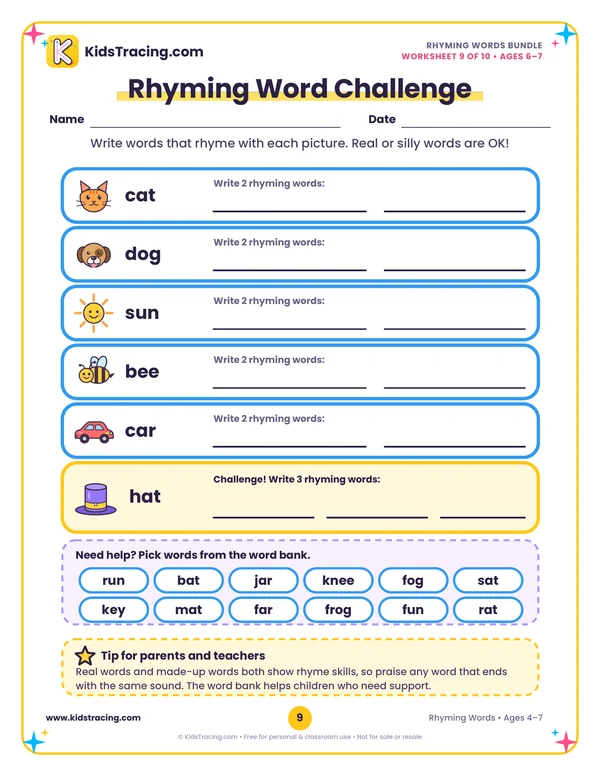
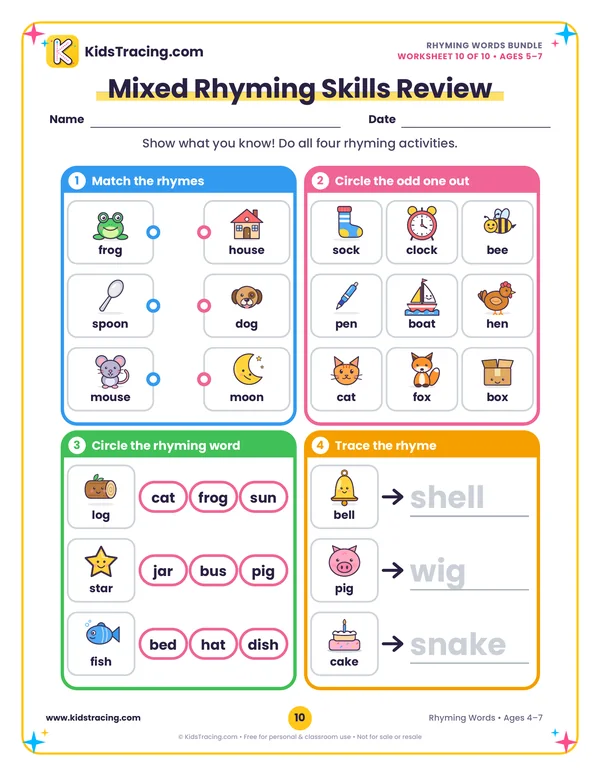
Prefer a finished page? These 10 printable rhyming worksheets are ready to print: matching pictures by ear, circling the rhyming word, odd one out, word families and a review page. Every worksheet has an answer key.
Download all, US Letter PDF (all 10 rhyming words worksheets)Download all, A4 PDF (all 10 rhyming words worksheets)All answer keys, US LetterAll answer keys, A4
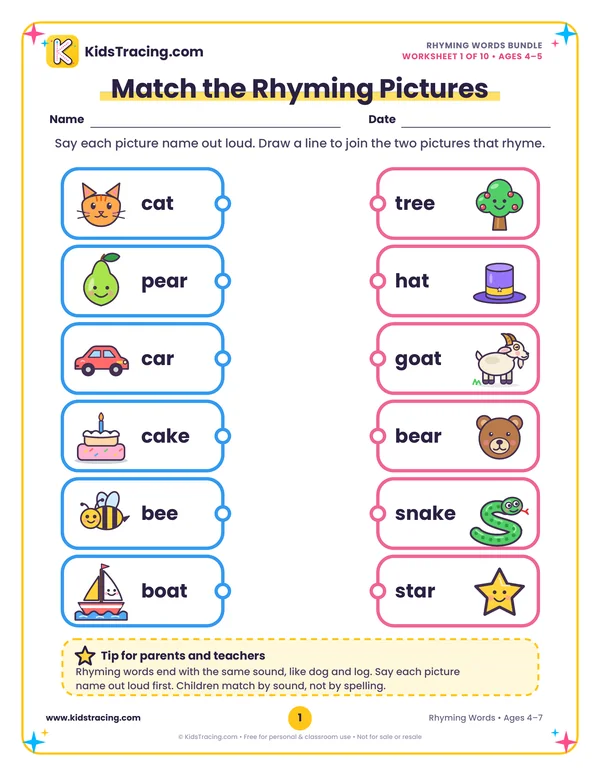
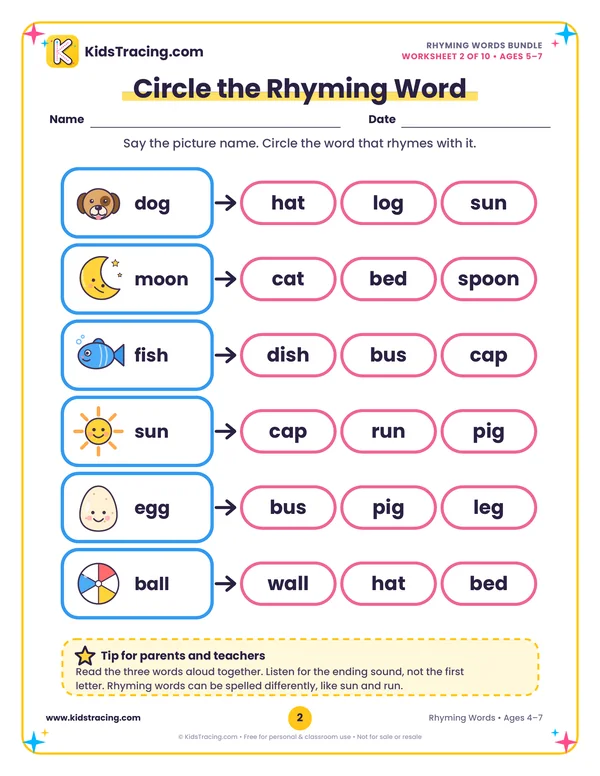
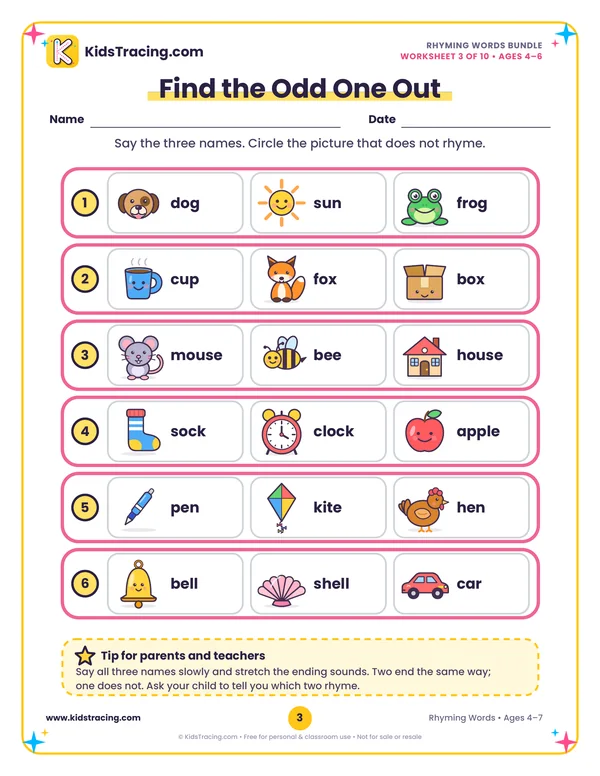
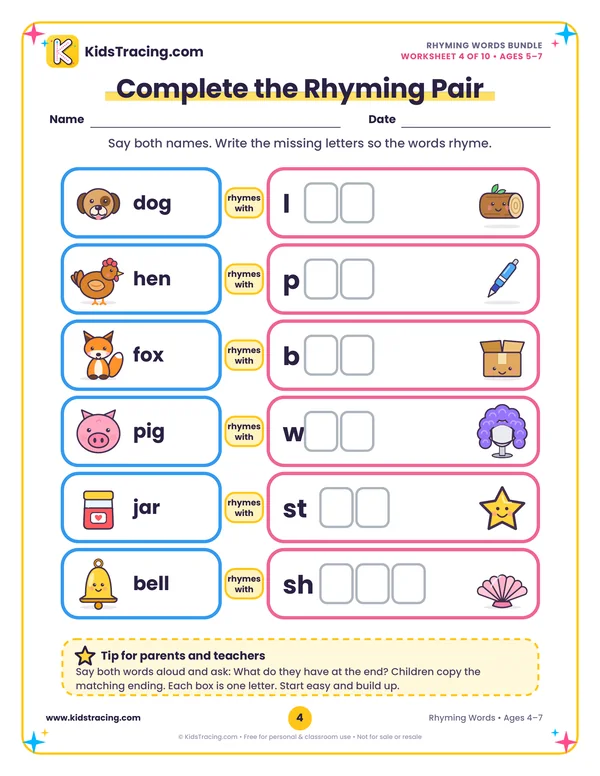
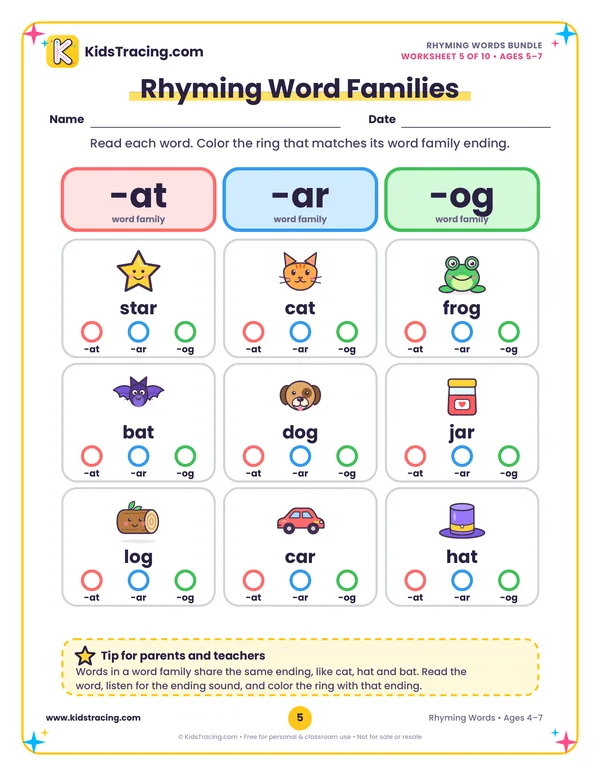
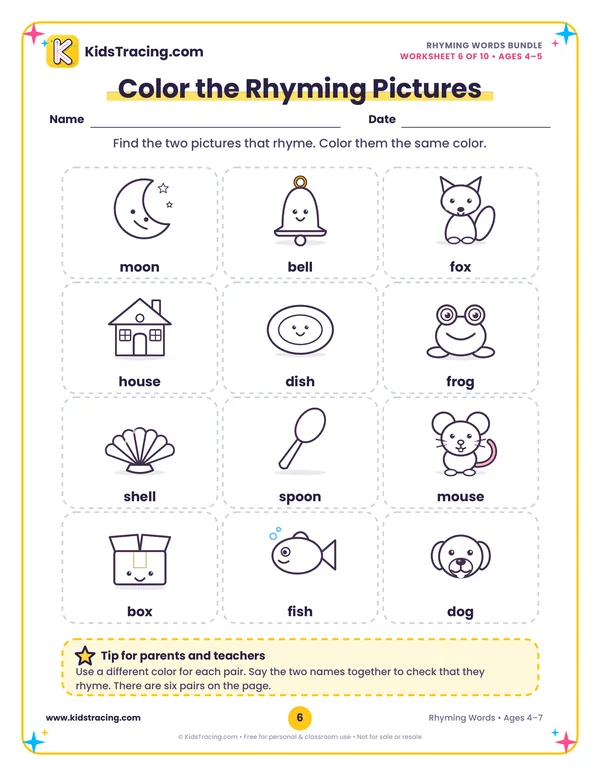
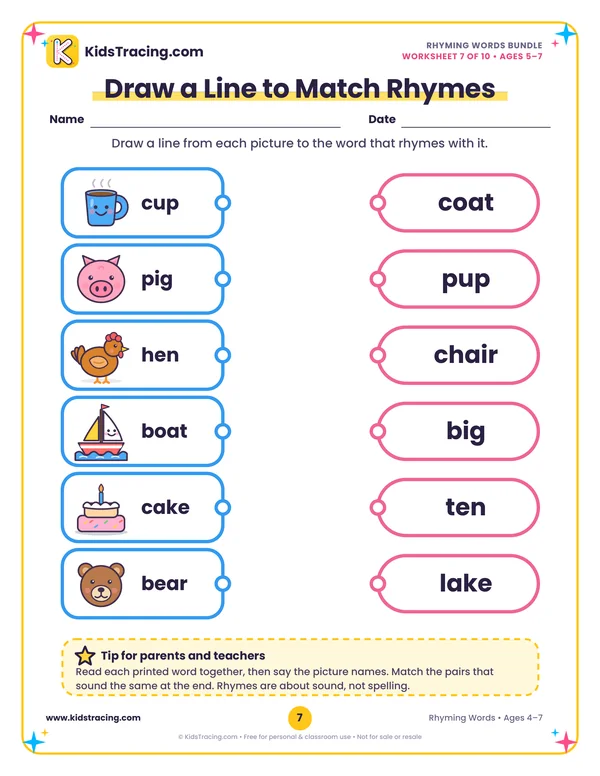
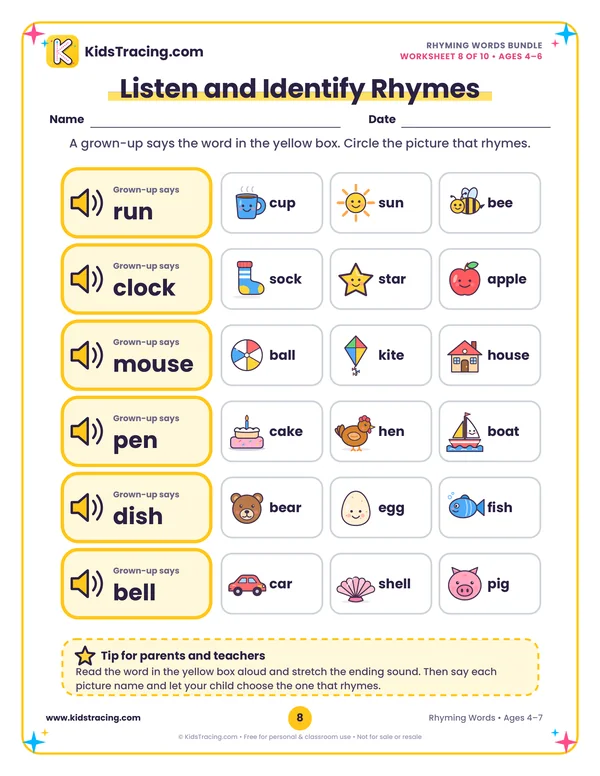
Next steps: beginning sounds, syllable counting and CVC words. A planned set is in the CVC Words Workbook.
Free for personal, home and classroom use. Not for sale or resale.
Check understanding aloud
Before your child answers, say the picture names slowly and stretch the ending: c-at, h-at. Ask, “Do they end the same?” If you can hear the same ending, the words rhyme. Children who are still learning can point and say the words with you.
What are rhyming words?
Rhyming words end with the same sound. Cat and hat rhyme, and so do dog and log. Listening for rhymes trains children to hear the small sounds inside words, which is the skill behind blending sounds, reading and spelling. It also works for children who are not reading yet, because the whole activity is spoken.
How to use the generator
- Choose an activity: circle the rhyming picture, circle the rhyming word, find the odd one out, match rhyming pairs, or a mix.
- Pick a level and the word families you want to practice. Leave all families on for a general review.
- Press Generate new worksheet for a new set, then print or save as PDF. Turn on the answer key to check the pairs.
The five activities
- Circle the picture: one picture on the left, a choice of pictures on the right. Circle the one that rhymes.
- Circle the word: the same idea, but the choices are printed words. A good bridge from listening to early reading.
- Odd one out: three pictures, two rhyme. Circle the one that does not.
- Match rhymes: draw a line between the two pictures that rhyme. Good for pencil control as well as listening.
- Mixed: a bit of everything for a quick review.
Word families in the generator
Every family below uses only pictures that rhyme, so each question has exactly one right answer.
- -at: cat, hat
- -an: fan, pan, van
- -ar: car, star, jar
- -ee: bee, tree, key
- -en: hen, pen
- -et: net, jet
- -ig: pig, wig
- -og: dog, log, frog
- -op: top, mop
- -ox: box, fox
- -ug: bug, mug, rug, jug
- -uck: duck, truck
- -oon: moon, balloon
- -air: chair, pear
Easy, medium and hard
On easy the wrong answers sound and look very different, so children can succeed by listening. Medium mixes in random pictures. On hard there is one more choice and the wrong answers often start with the same letter, so children must listen to the ending and not the beginning.
Tips for parents and teachers
Always say the names out loud before choosing. Do not worry about spelling: pear and chair rhyme even though they are spelled differently. If your child picks a word with the same first sound, say both words slowly and ask, “Which part sounds the same, the beginning or the end?”
Rhyming games to play away from the page
- Rhyme hunt. Find two things at home whose names rhyme, like a mug and a rug.
- Rhyme chain. Say a word and take turns saying a rhyming word until you run out. Made-up words count.
- Clap the pair. Clap once each time you hear a rhyming pair in a nursery rhyme or a picture book.
- Pick a pair. Lay picture cards face down and turn two over. Keep them if they rhyme.
Once rhymes are easy, beginning sounds, syllable counting and CVC words are the next steps. Word families are a good bridge to reading: see the CVC words list.
Frequently asked questions
What age are rhyming worksheets for?
Most children enjoy them from about age four, when they can say picture names clearly and listen for the ending sound. Start with the picture activities, then add the word activity once your child is reading simple words.
Do rhyming words have to be spelled the same?
No. Rhyming is about sound, not spelling. Pear and chair rhyme even though their endings look different, and so do bee and key. Say the words out loud before choosing an answer.
Can I choose only some word families?
Yes. Each chip, such as -at, -og or -ug, is a word family. Switch families on or off to practice just the endings your child is working on. The matching activity needs at least three families.
What do the levels change?
On easy, the wrong answers sound and look very different from the target. On medium they are random pictures. On hard there is an extra choice and the wrong answers often start with the same letter, so children must listen to the ending sound.
How are the answers shown?
Turn on the answer key page. It lists each question with the rhyming pair and the number of the correct choice.
Are there ready-made rhyming worksheets with answer keys?
Yes. The ready-made section above has 10 printable rhyming worksheets for ages 4 to 7 in US Letter and A4, and every page has an answer key.
Why are some answers open on the Rhyming Word Challenge?
That worksheet asks children to write their own rhyming words, so the answer key lists examples. Any word that ends with the same sound is correct, and made-up words are fine.
Free printable workbooks
Want a planned set instead of a single page? This free PDF workbook uses the same word families in a step-by-step order.
Related worksheet tools
Explore more: Phonics Worksheets for Kids · Kindergarten Worksheets · All free worksheet tools
Guides for parents and teachers: CVC Words List: Short A, E, I, O and U · How to Teach Syllables to Preschool and Kindergarten Children