How to Teach Syllables to Preschool and Kindergarten Children
Published by Hasnat N, Founder · October 7, 2026 · Updated October 25, 2026 · 7 min read
Quick answer: A syllable is one beat of a word, and each syllable has one vowel sound. To teach it, say a word slowly, clap once for every beat and count the claps: cat has one, ta-ble has two, ba-na-na has three. Start with your child’s name, then move on to pictures of one- to four-syllable words.
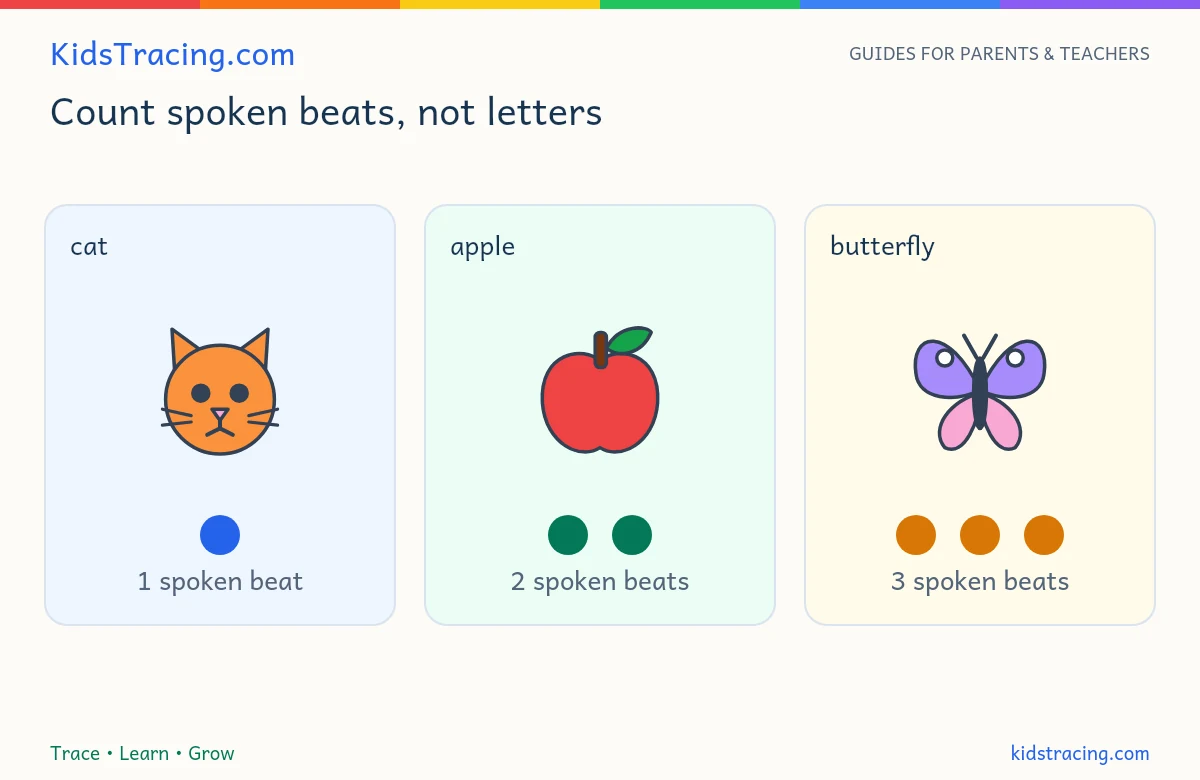
Syllable awareness is one of the first phonological awareness skills, which means it is about the sounds of speech and not about letters. It can develop alongside rhyming, listening games and early letter-sound work; there is no need to complete these skills in a rigid sequence. Children can learn it long before they can read, just by clapping and talking.
What is a syllable?
A syllable is a single beat in a word, like one “pulse” of sound. Every syllable has one vowel sound, and that is why you can count them. The word dog has one beat. The word rab-bit has two. The word but-ter-fly has three.
Three easy ways to count syllables
- Clap. Say the word slowly and clap once for each beat. Clapping works well because children can both hear and feel the rhythm.
- Chin drop. Put a hand under your chin and say the word. Jaw movement can offer a useful cue, but it is not an exact counter for every word or speaker. Listen to the naturally spoken word and model the beats if needed.
- Stomp, tap or jump. Use a drum, a spoon on the table, or jump once for each beat.
A four-step plan
- Start with names. Children love their own name. Sam has 1 beat, Ruby has 2, Jessica has 3 and Alexander has 4. Clap the names of everyone in the family, and see who has the most.
- Move to one- and two-syllable words. Use pictures or objects: cat, dog, apple, tiger. Say the word, clap it, and count the claps aloud.
- Add three and four syllables. Banana, elephant, watermelon, caterpillar. This is a fun stage, because long words feel like a challenge.
- Connect to reading and writing. Once children can count syllables, show them how a long word can be read in chunks: sun-flow-er. Later they can write the number of syllables under each picture.
Word lists by number of syllables
| Syllables | Words |
|---|---|
| 1 | cat, dog, sun, bed, frog, bus, cup, fish |
| 2 | apple, tiger, pizza, rabbit, spider, monkey, flower, pencil |
| 3 | banana, elephant, butterfly, umbrella, dinosaur, tomato, kangaroo |
| 4 | watermelon, caterpillar, alligator, helicopter, motorcycle |
| 5 | hippopotamus, refrigerator, tyrannosaurus |
Tricky words and common mix-ups
- Silent e. Cake and home each have one syllable, because the final e is silent.
- Words ending in -ed. Jumped has one syllable, but wanted has two. Say the word to tell.
- Accents. Some words, like family, every or chocolate, are said with different numbers of syllables in different places. Go with the way your child says the word, and avoid arguing about it.
- Clapping letters instead of sounds. A common mistake is to clap for each letter. Clap for the beats you hear, not the letters you see.
Syllable games and activities
- Syllable sort. Make three hula hoops or paper circles labeled 1, 2 and 3. Sort picture cards or small toys into the right circle.
- Stomp and spell. Chalk a hopscotch path. Say a word and hop once for each syllable.
- Robot talk. Talk like a robot, with a pause between syllables: “pen-cil.” Children guess the word.
- Mystery bag. Pull an object from a bag, name it and clap its syllables.
- Syllable bingo. Call out words. Children cover a number from 1 to 4 on their card.
- Print and clap. Our syllable counting worksheets show pictures to clap and count, with 1 to 4 syllables, and an answer key.
Why syllables matter for reading
Hearing the parts of a word helps children break long words into chunks that are easier to read and spell. Syllable awareness also supports the next skills in line: matching first sounds with the beginning sounds worksheets, blending three-letter words from our CVC words list and putting letters in order with alphabetical order worksheets. You can find more activities for this age on our kindergarten worksheets page.
Names are a great starting point for writing too. See how to teach a child to write their name, and count the syllables as you go.
Try a five-word syllable sorting game
- One clap: Say “cat” and “fish”; clap once for each.
- Two claps: Say “rabbit” and “pencil”; clap twice for each.
- Three claps: Say “banana”; clap three times.
- Sort: Draw columns labeled 1, 2 and 3; let the child place a picture or written word in the matching column.
Speak each word naturally before clapping; avoid treating the number of letters as the number of syllables.
Keep three different counts separate
A child can count the letters in a word, its individual speech sounds, or its syllables. These are different tasks. Cat has three letters and usually three phonemes, but one syllable. Apple has five letters and two syllables in ordinary pronunciation. Ask explicitly for the "beats in the spoken word" when that is your goal.
There is no need to display the spelling for an early syllable game. Pictures or familiar objects let the child focus on listening. Written hyphens in examples are teaching cues for spoken chunks; they are not rules for spelling a word across lines.
A worked picture sort
- Choose three familiar pictures, such as cat, apple and butterfly. Name each together.
- Say cat naturally and tap once. Put the picture beside one large marker.
- Say apple, then tap its two beats. Place it beside two markers.
- Repeat for butterfly with three beats and compare the groups.
- Invite the child to choose another picture and try the routine. Model again rather than asking for repeated guesses.
When clapping adds an extra difficulty
A child may hear the beats but find coordinating claps difficult. Try tapping a table, pointing to large markers, or listening while the adult taps. Say the word smoothly first so it stays recognizable; exaggerated chopping can change the way a word sounds.
Some words, including flower and fire, vary with accent and pronunciation. Listen to the word the child actually says, accept a reasonable spoken version, and choose a less variable example if you need a clear demonstration. A chin movement can be an extra cue, but it is not an infallible syllable counter.
Use syllable counting worksheets once the picture vocabulary is familiar. To work on single initial phonemes, switch to beginning sounds activities and explain that you are listening for a smaller sound. These oral skills can develop alongside one another; children do not have to finish a fixed syllable program before enjoying rhymes or learning letter sounds.
Free printables to go with this guide
Put this guide into practice with our free generators: syllable counting worksheets, beginning sounds worksheets, CVC words worksheets, alphabetical order worksheets.
Free workbooks to go with this guide
- Fruits and Vegetables Tracing and Coloring Book – Color 26 fruits and vegetables, trace each word and write it alone, then review with matching games.
- Animals Tracing and Coloring Book – Color 28 animals from the farm, the garden and the wild, trace each name and write it alone.
Keep reading
- CVC Words List: Short A, E, I, O and U – A CVC words list sorted by short vowel (a, e, i, o, u) with sentences to read, a teaching order and easy games for kindergarten and first grade.
- How to Teach a Child to Write Their Name – Learn how to teach a child to write their name with simple steps, fun activities and free printable name tracing practice for preschool and kindergarten.
Frequently asked questions
What is a syllable for kids?
A syllable is one beat in a word. You can feel each beat when you clap as you say the word. Cat has one beat, ta-ble has two and ba-na-na has three.
At what age do children learn syllables?
Many children can clap syllables in names and short words at about 4 years old, and most are comfortable with syllables by the end of kindergarten. Some start earlier and some later.
How do you count syllables in a word?
Say the word slowly and clap once for each beat, or put your hand under your chin and count how many times it drops. Each syllable has one vowel sound.
Why do some people count different numbers of syllables in the same word?
Accents and the speed of speech change how many beats we say in words like family, every and chocolate. Accept the way your child says the word.