CVC Words List: Short A, E, I, O and U
Published by Hasnat N, Founder · October 7, 2026 · Updated November 8, 2026 · 8 min read
Quick answer: CVC words have three sounds: a consonant, a short vowel and a consonant, like cat, pen, pig, dog and sun. Below you will find more than 130 CVC words sorted by short vowel, short sentences to read, a teaching order and simple games.
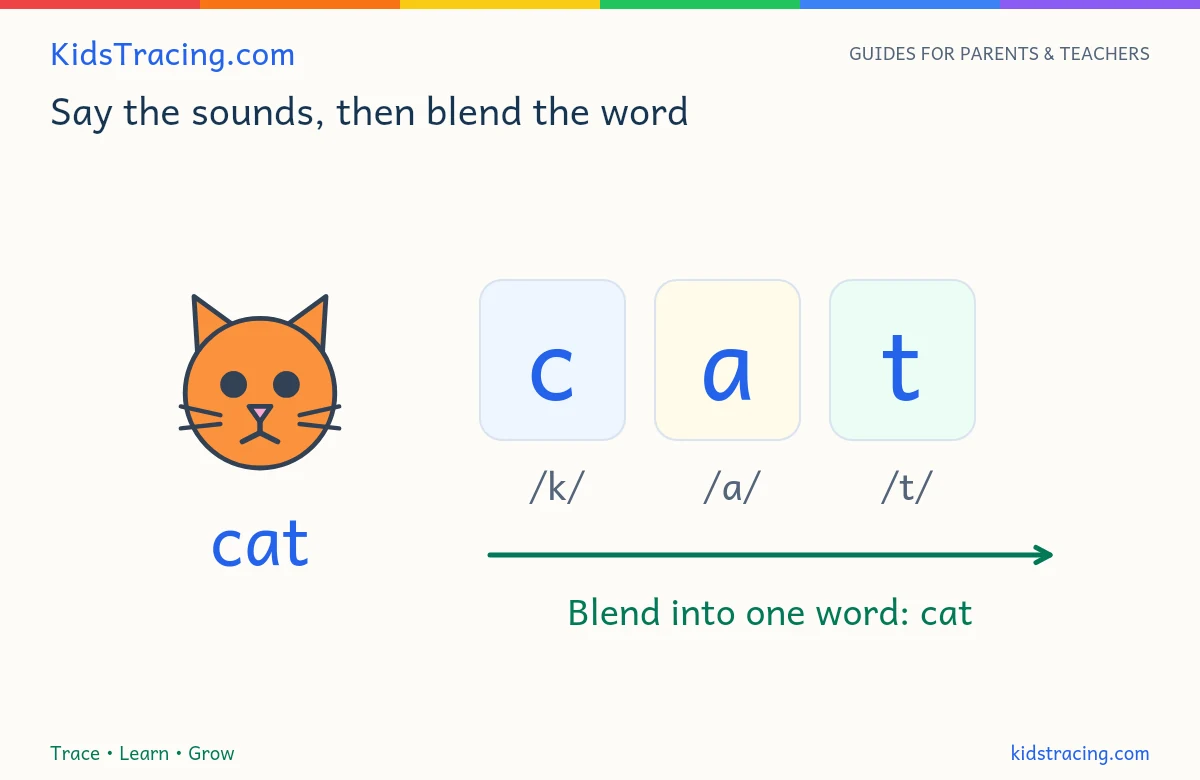
CVC stands for consonant-vowel-consonant. Words like cat, hop and sun are the first words most children learn to read by sounding out each letter and blending the sounds together. Choose words whose sound-spelling correspondences the child has already learned, then model how to blend those sounds.
In this guide the simplest starting examples have three letters representing three phonemes, with a short vowel in the middle. Some broader word lists also include x endings or doubled spellings; those need a separate explanation of letters and sounds. Choose words using correspondences the child already knows.
CVC words with short a
- bat
- cat
- hat
- mat
- rat
- sat
- pat
- cap
- map
- nap
- tap
- lap
- gap
- zap
- bag
- tag
- wag
- rag
- can
- fan
- man
- pan
- ran
- van
- tan
- jam
- ham
- yam
- dad
- bad
- sad
- mad
- pad
- had
CVC words with short e
- bed
- red
- fed
- led
- ten
- hen
- pen
- men
- den
- net
- pet
- wet
- jet
- get
- set
- let
- vet
- web
- peg
- leg
- beg
- yes
- yet
CVC words with short i
- pig
- big
- dig
- wig
- fig
- jig
- pin
- bin
- fin
- win
- tin
- sit
- hit
- bit
- kit
- fit
- pit
- lip
- zip
- dip
- tip
- rip
- sip
- hip
- lid
- kid
- rid
- did
- six
- mix
- fix
The words six, mix and fix use x for /k/ and /s/. They fit a three-letter CVC spelling pattern, but have four phonemes; use them after simpler three-phoneme examples when that matches the teaching sequence.
CVC words with short o
- dog
- log
- fog
- hog
- jog
- pot
- hot
- dot
- cot
- got
- not
- lot
- top
- mop
- hop
- pop
- cop
- box
- fox
- job
- mob
- rod
- nod
Box and fox also use x for two phonemes. Keep this distinction clear if using sound boxes.
CVC words with short u
- sun
- bun
- run
- fun
- bus
- cup
- pup
- bug
- mug
- rug
- hug
- jug
- dug
- tug
- nut
- cut
- hut
- but
- tub
- rub
- cub
- gum
- hum
- mud
- bud
Which order should I teach the vowels in?
Short a is the usual place to start, because it is a clear, open sound that is easy to hear. Many programs go on to i and o, then u and e, since e and i sound similar and can be confused. A common order is a, i, o, u, e. Another approach is simply to follow the vowels as your child meets them in a reading program. Teach one vowel at a time until blending feels easy, then mix two vowels together, and finally all five.
How to read a CVC word: tap, say, blend
- Tap under each letter and say its sound: /c/ /a/ /t/.
- Blend the sounds by sliding your finger from left to right: “caaat.”
- Say it fast: “cat!”
If blending is hard, have your child say the first two sounds together (/ca/), then add the last sound. Be patient: blending is one of the biggest steps in learning to read.
Short sentences to read
Once your child can read single words, try short sentences made only from CVC words and a few common words such as the, a and is.
- Short a: The cat sat on a mat. A fat rat ran past.
- Short e: The hen is in the red pen. Ten pets get wet.
- Short i: The pig did a big dig. A kid can sit and sip.
- Short o: The fox is in the box. The dog got a hot pot.
- Short u: The bug is on the rug. A pup sat in the sun.
Five easy games with CVC words
- Build a word. Use magnetic letters or letter cards. Make cat, then swap the first letter to make hat, then mat.
- Sound boxes. Draw three boxes. Your child says the word slowly and writes one sound in each box.
- Word hunt. Hide word cards around the room. Your child finds one, reads it and acts it out (hop, nap, run).
- Real or silly? Mix real words with made-up CVC words (zim, pab). Children decide which can be read and which are silly.
- Picture match. Match a picture to its word. Try our CVC words worksheets for picture matching, missing letters, word families and sound boxes, with an answer key.
- Sight words. Words such as the, said and you cannot be sounded out, so practice them separately with our sight words worksheets or the free Sight Words Tracing Book.
What comes after CVC words?
When CVC words feel easy, children move on to words with two consonants together at the start or end (frog, jump, stop), then words with letter pairs such as sh, ch and th. Before that, strengthen the sounds with the beginning sounds worksheets and spot the missing letter in a word with the missing letters worksheets. For kindergarten learners, see all of our kindergarten worksheets.
CVC letters and three-phoneme words are not always identical
For a beginner, choose words where three written letters represent three phonemes, such as cat, sit and sun. That makes it easier to connect a sound to each position. A phoneme is a speech sound, not the name of a letter.
Some lists use CVC to describe the written letter pattern. In that sense box has consonant-vowel-consonant letters, but its final x usually represents two phonemes, /k/ and /s/. It needs four sound boxes if the boxes represent phonemes. Words such as bell use more than three letters but usually have three phonemes. Follow the child's phonics program when choosing the next spelling pattern.
A worked lesson: read cat, then build sat
- Check that the child knows the sounds represented by c, a, t and s in these words.
- Point under c-a-t from left to right, say the sounds clearly and blend them into cat.
- Show the picture only after the reading attempt, to discuss meaning rather than encourage picture guessing.
- Change c to s. Point to the changed position and blend the new word sat.
- Say sat without displaying it and invite the child to build it with letter cards. This is spelling practice, so offer help hearing the sounds.
Choose the next step from the response
If each sound is known but the word does not blend, model how to bring the sounds together and try a shorter oral blending game. If the middle vowel changes in the child's reading, compare just that sound before adding more words. Avoid asking for a long mixed-vowel list when one contrast is the difficulty.
Use CVC word activities for a small set of known sound-spelling correspondences. For a child still learning initial sounds, try beginning sounds worksheets. The word tracing tool practices writing, but tracing a word does not establish that the child can decode it.
When using a sentence from this page, check every word against what the child has been taught. An adult can supply an unfamiliar word while keeping the child's reading goal clear. Meaningful talk and shared books continue alongside phonics practice.
Free printables to go with this guide
Put this guide into practice with our free generators: CVC words worksheets, beginning sounds worksheets, missing letters worksheets, syllable counting worksheets.
Free workbooks to go with this guide
- CVC Words Workbook – Read, build, trace and write short a, e, i, o and u words with pictures, sound boxes and sentences.
Keep reading
- Letter Formation Order: Which Letters to Teach First – A simple letter formation order: group letters by how they are written and teach straight-line letters first. Capital and small letter groups, with a week plan.
- How to Teach Syllables to Preschool and Kindergarten Children – How to teach syllables to young children: the clap and chin methods, a 4-step plan from names to long words, word lists for 1 to 4 syllables and games.
- Handwriting Practice at Home: How Long and How Often – Handwriting practice at home: how long and how often for ages 3 to 6, a 10-minute routine, setup tips and the signs that it is time to stop.
- Preschool and KG Worksheets: English and Math for Ages 3 to 6 – What to practice in English and math at ages 3 to 6, with free printables and a weekly plan.
Try a three-word blending check
Write map, mat and mop on separate cards. Point to each letter as you say its sound, then slide your finger under the word while blending. Ask the learner which sound changed between map and mat. If blending is difficult, return to oral sound games before introducing more words.
Frequently asked questions
What are CVC words?
CVC words are three-letter words that follow the pattern consonant, vowel, consonant, with a short vowel sound in the middle, such as cat, pen, pig, dog and sun.
At what age do children learn CVC words?
Many children start reading CVC words in kindergarten, around ages 5 and 6, after they know most of their letter sounds. Some are ready earlier and some later.
Is "box" a CVC word?
Box has a consonant-vowel-consonant pattern in its three written letters, but x usually represents /k/ and /s/, giving four phonemes. It is not a straightforward three-phoneme example; use four phoneme boxes when mapping its sounds.
How many CVC words should my child learn?
There is no set number. Instead of memorizing a list, teach the skill of sounding out and blending. Once your child can blend, they can read hundreds of CVC words.
What should I teach before CVC words?
Letter sounds, especially a few consonants and one short vowel. Beginning sound activities and rhyming games also help.
What are some CVC words with short i?
Short i CVC words include bin, big, dig, fin, hid, hip, kid, lip, pig, pin, sit, tip and win. Say the short i sound as in pig, then blend the three sounds together.
Where can I print a CVC words list?
Use the CVC words worksheets to make your own printable word list or practice sheet, or print the CVC Words Workbook. Both are free.