Visual Discrimination Worksheets
Practice spotting small differences with odd-one-out, matching and same-or-different puzzles at preschool, kindergarten and grade 1 level.
Customize
More options
The preview updates as you change the settings.
Free Printable Visual Discrimination Worksheets (Ready-Made PDFs)
Not in the mood to customize? These printable pages practice finding the different one, noticing which way a picture faces, spotting differences, scanning and counting, matching patterns, finding what is missing and telling look-alike letters apart. Every worksheet has an answer key.
Download all, US Letter PDF (all 10 visual discrimination worksheets, including picture matching and shadow matching)Download all, A4 PDF (all 10 visual discrimination worksheets, including picture matching and shadow matching)All answer keys, US LetterAll answer keys, A4
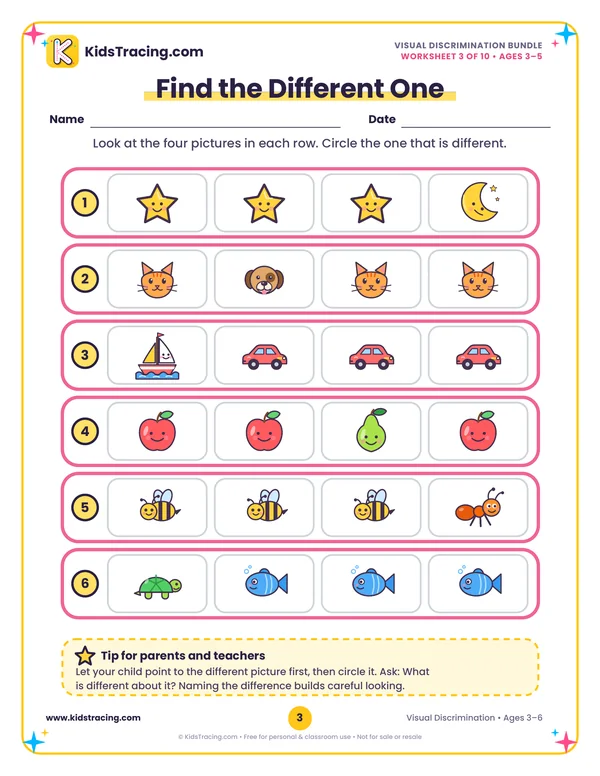
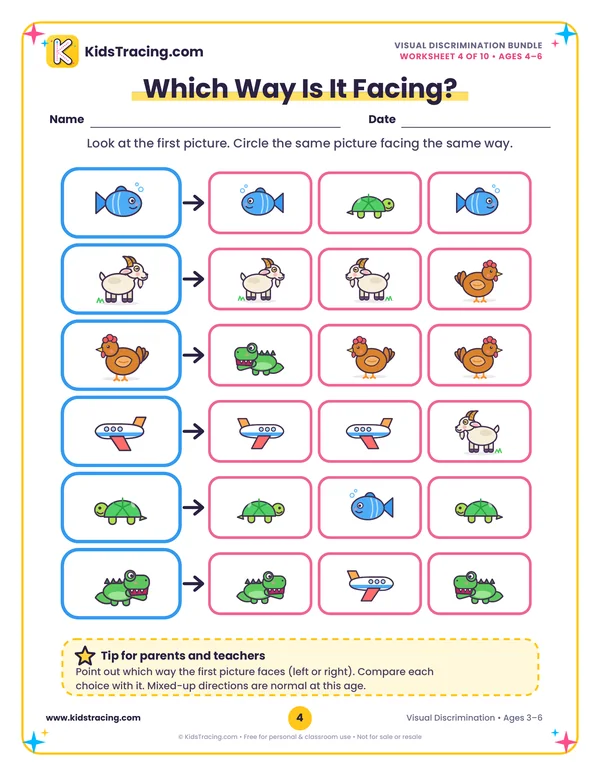
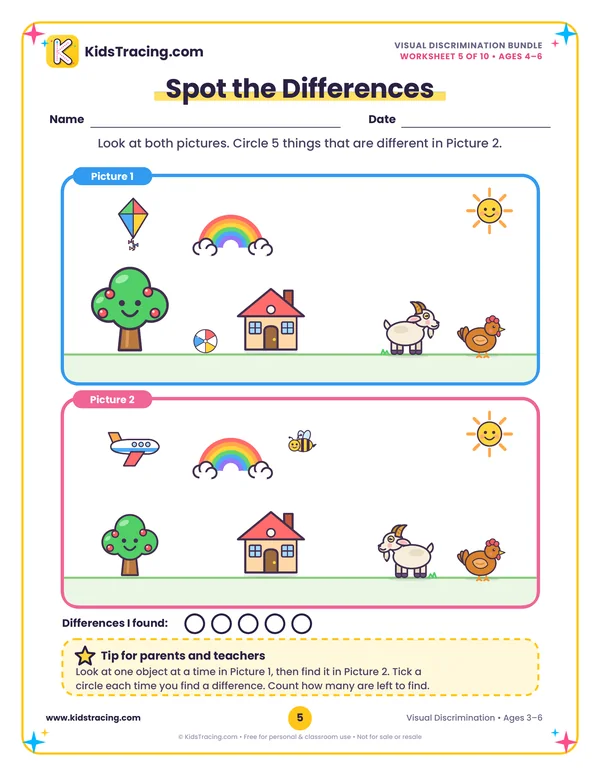
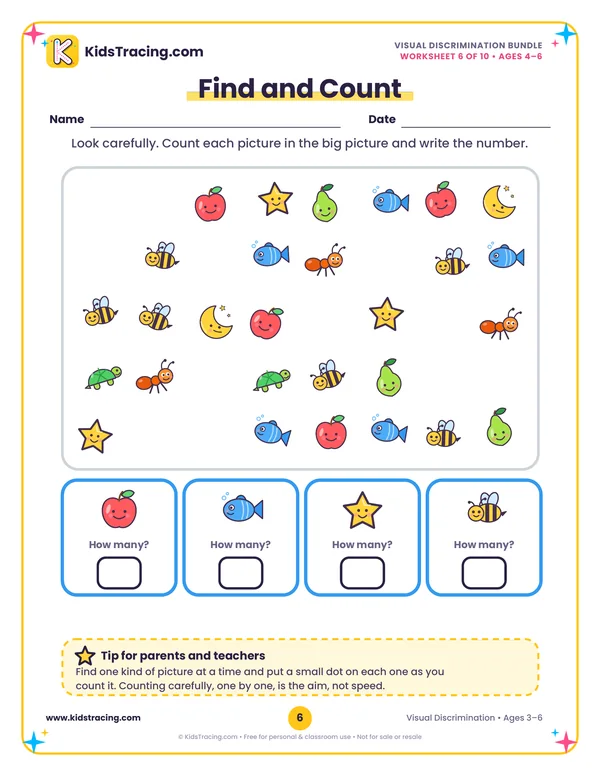
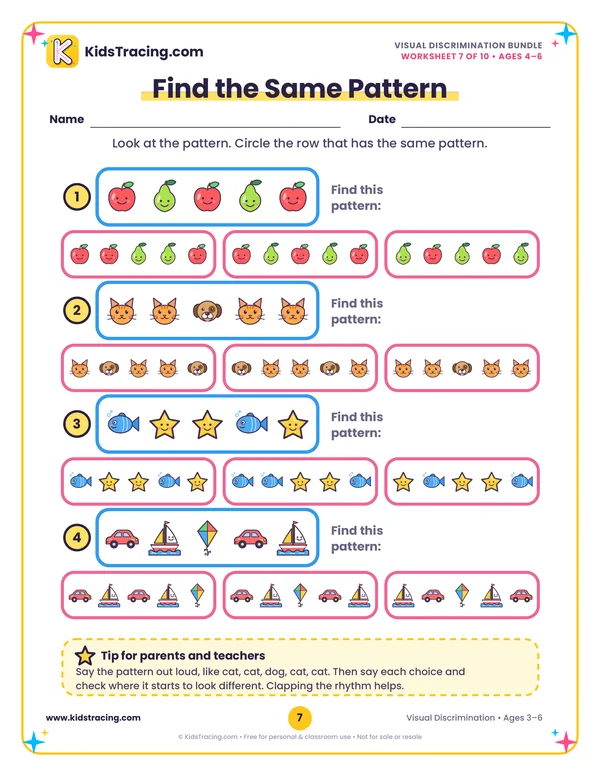
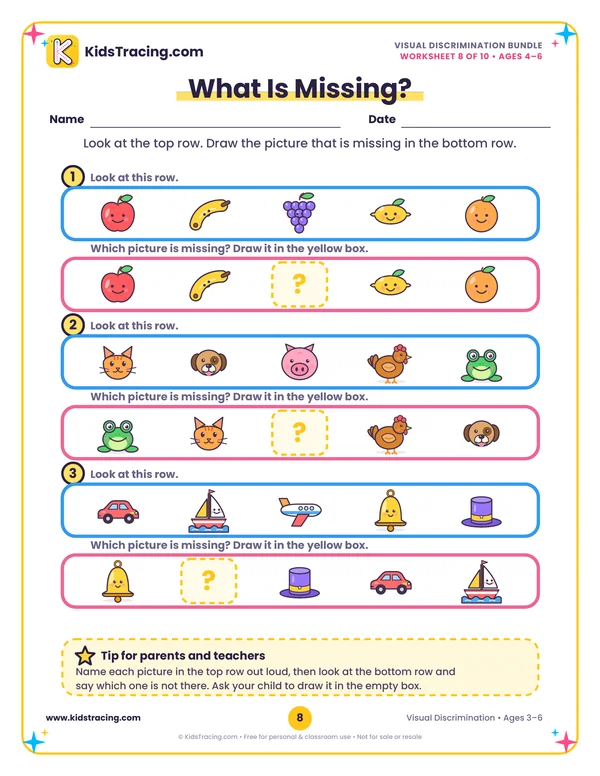
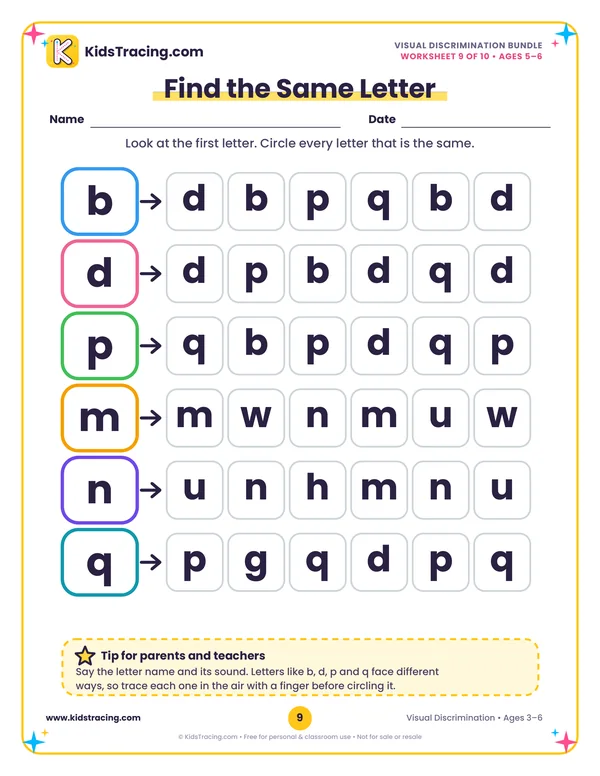
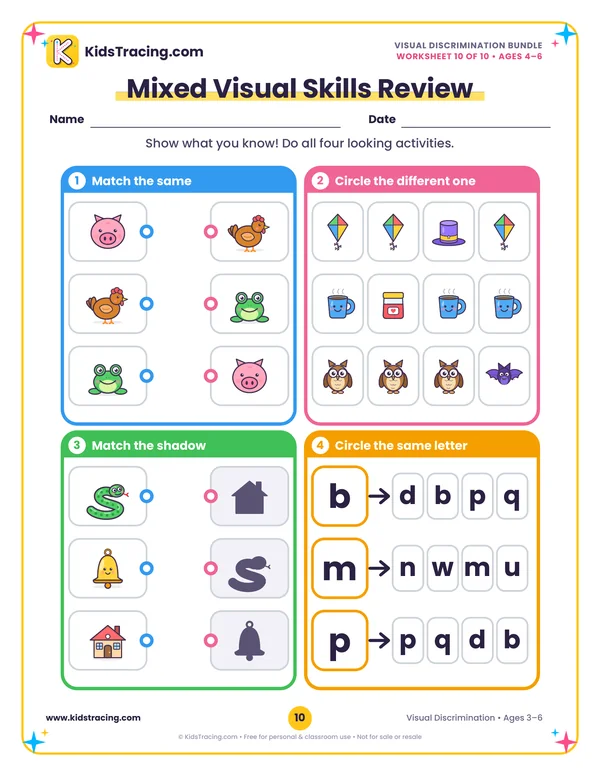
Two more ready-made pages are on Picture Matching (match the same picture) and Shadow Matching. For a bigger set, try the Shadow Matching Activity Book.
Free for personal, home and classroom use. Not for sale or resale.
What is visual discrimination?
Visual discrimination is the ability to notice how things are alike and how they are different. Children use it when they tell a cat from a dog, a circle from an oval, or the letter b from the letter d. Short, playful puzzles are a simple way to practice looking carefully before children begin to read and write.
Three kinds of puzzle
- Find the different one shows a row of items where one is not like the others. Your child circles the odd one out.
- Find the match shows an item in a blue box and a row of choices. Your child circles the choice that matches it exactly.
- Same or different shows two items. Your child decides whether they are the same or different and circles the answer.
Choose Mixed to put all three kinds on one sheet.
What the items can be
- Pictures: animals, fruits, vehicles, toys and objects. Later levels include pictures that face a different way.
- Shapes: colored shapes that differ in color, shape, size or direction.
- Letters: capital letters, look-alike letters such as b and d, and word pairs such as was and saw at grade 1.
- Patterns: short rows of colored shapes where one position or the order has changed.
Three levels
Preschool uses obvious differences and short rows of three or four items. Kindergarten uses more similar items, such as a circle and an oval or the letters E and F, with four or five items per row. Grade 1 uses tricky differences: a picture turned to face the other way, a shape pointing a different direction, mirror-image letters and words, and patterns where the order has changed, with up to six items per row.
How to use the generator
- Choose the kind of puzzle and the level.
- Tap the types of item you want to include. You can pick more than one.
- Choose how many questions you want (a page holds up to six) and press Generate new worksheet.
- Print or save a PDF. The answer key marks the correct answer in green.
Good to know
Reversing letters such as b and d is very common when children are learning to read and write, and it usually fades with practice. If a child continues to struggle with reversals or you have other worries about their vision or reading, it is worth talking to their teacher or a qualified professional. These worksheets are for practice and are not a screening test.
Teach a way to compare, not just an answer
Choose four questions and one item type for the first session. Before your child circles anything, compare two items together: look at their shape, size, color and direction. Name the detail that changes. For a turned picture, say "this one faces the other way" rather than simply saying it is wrong.
Prompts for each puzzle
- Find the different one: "Which pictures share a detail? Which picture changes it?"
- Find the match: "Look back at the picture in the blue box. Does your choice match every detail?"
- Same or different: "Tell me one thing you checked before choosing."
Choose the next activity from what you notice
If scanning a row is difficult, use fewer questions and let your child point while you name the choices. If picture puzzles feel comfortable, try shapes or letters before mixing several item types. The level labels are starting points, not a score or a test.
Use picture matching worksheets to practice finding identical pairs, or find and color letters to look for one target among other letters. For hands-on practice away from the page, sort familiar objects by one visible feature and explain each group.
Game versions of the same skill
Children also practice careful looking with the printable memory match games and the picture scavenger hunts, which need no pencil. The Forest Friends Comic Book adds a Find the Different Friend page, an odd-one-out puzzle set inside a story.
Frequently asked questions
Which level should I start with?
Start with preschool for children of about three to four, kindergarten for about five and grade 1 for about six. These are rough guides, so choose the level where your child can succeed most of the time but still has to think.
Can I make a sheet with only letters?
Yes. Tap Letters and switch off the other types. At kindergarten the letters are similar capitals, and at grade 1 they are lowercase look-alikes and reversed words.
How many questions fit on a page?
Up to six. If you ask for 12 or 18 questions, the worksheet continues on a second or third page. Choose 4 for larger puzzles with more space.
Do the puzzles repeat?
The generator avoids repeating the same puzzle on one worksheet. Pressing Generate new worksheet makes a fresh set.
Is there an answer key?
Yes. Turn on “Include answer key page” or press “Show answer key”. The correct item is highlighted in green on each puzzle.
Are there ready-made visual discrimination worksheets?
Yes. The ready-made section on this page has printable worksheets for ages 3 to 6 in US Letter and A4, each with an answer key. The match-the-same-picture and shadow pages are on the picture matching and shadow matching pages.
Why do the worksheets include b, d, p and q?
These letters are mirror images of each other. Practicing careful looking early helps children tell them apart when they start to read and write.
Free printable workbooks
Want a planned set instead of a single page? These free PDF workbooks use the same worksheets in a step-by-step order.
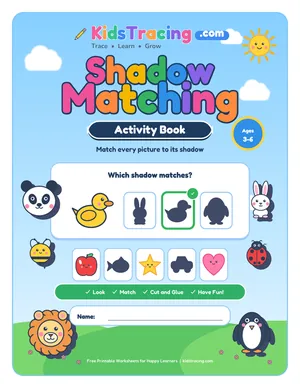
Shadow Matching Activity Book
Draw lines, circle, find twins and odd shadows, and cut and glue, from three big pairs to shadows that face the wrong way. With an answer key.
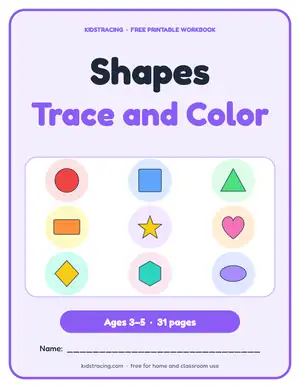
Shapes Tracing and Coloring Book
Ten shapes to trace, hunt for and color, plus tracing practice and matching games.
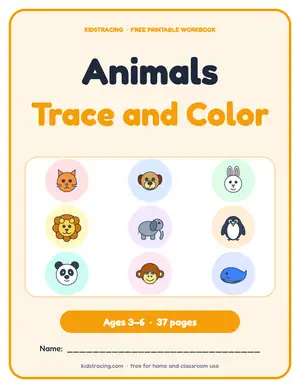
Animals Tracing and Coloring Book
Color 28 animals from the farm, the garden and the wild, trace each name and write it alone.
Animal workbook: My Little Zoo: Color and Trace Book (has a which-one-is-different page) · All free printable workbooks
Related worksheet tools
Explore more: Matching & Visual Thinking Worksheets · Preschool Worksheets · Kindergarten Worksheets · All free worksheet tools
Guides for parents and teachers: Shadow Matching Activities for Preschoolers