Number Tracing 1 to 100
Free number tracing sheets: a row of ten numbers on every line, ten pages in all.
Customize
More options
The preview updates as you change the settings.
Free Printable Counting 1 to 100 Worksheets
Counting to 100 is a milestone in kindergarten and first grade, and many classrooms celebrate the 100th day of school. On this worksheet each page has a row of ten numbers repeated on ten lines, so children trace every number from 1 to 100 ten times over ten pages.
Use the Previous and Next buttons under the preview to flip through all ten pages before you print. Page 1 is 1 to 10, page 2 is 11 to 20, and so on up to page 10, which covers 91 to 100. If you want bigger single numbers, change Layout to One number per line.
Patterns That Make 100 Easier
Point out that each group of ten starts the same way: 21, 22 and 23 all begin with 2, and the last digit repeats 1 to 9. The tens (twenty, thirty, forty and so on) are the milestones along the way. Once children see the pattern they stop memorizing 100 separate numbers and start spotting the rule.
Tips for Longer Practice
Don’t ask for all ten pages in one sitting. One or two pages a day is a good pace. Stick the finished pages in order on a wall to build a long number line, and color the star at the end of each row to mark progress. Mix the tracing with skip number tracing worksheets to see how the numbers jump in 2s, 5s and 10s.
Numbers Only or With Words
This page shows numbers only so the rows stay clean. To add the words, change Layout to One number per line and turn on Show number words. Long words such as ninety-nine still fit, but the letters shrink a little. For word practice on its own, see our number words worksheets.
Use number tracing 1 to 100 in small sections
Choose a group of ten that your child can already say aloud, such as 1-10 or 21-30. Read the numbers together, trace a few rows and ask your child to point to a number you name. Tracing the symbols and understanding their quantities are different tasks; combine early numbers with counting real objects.
Notice what changes after each ten
Compare 18, 19 and 20, then 28, 29 and 30. Ask which digit changes as you move into the next group. For a child who already recognizes the numbers, point to a place in the row and ask what comes before or after it. The printed row stays available as a reference.
Check the page settings before printing
The default uses ten numbers per row and ten practice rows, with one group of ten on each page. Changing the row slider changes repetitions. Switching to "One number per line" changes the layout and lets you include number words. Check the page count and use Previous / Next to confirm that the final number you want is included.
If 1-100 is too much, start with number tracing 1-10 or number tracing 1-20. When recognizing and writing numbers feels comfortable, explore skip counting by 2s, 5s and 10s.
Using the 1 to 100 pages across a week
You do not have to count to 100 in one go. Here is one way to spread the ten pages over a week or two.
- Day 1: trace page 1 (1 to 10) and say each number aloud.
- Day 2: page 2 (11 to 20). Notice that 11 to 19 all start with 1.
- Day 3: skip ahead to page 10 (91 to 100) and compare how 100 looks different from every other number: it has three digits.
- Later days: fill in pages 3 to 9, one or two at a time, and tape the finished pages in a row to make a long number line.
On a hundred chart, each step down one row adds 10 and each step to the right adds 1. Ask your child to put a finger on 34 and find 44 by moving down one row. It is a simple way to start place value without any extra worksheets.
Celebrating the 100th day of school? The free 100th Day of School Workbook has a hundred chart, skip counting, tens and ones, a dot-to-dot and a paper crown.
Frequently asked questions
How many pages are there for 1 to 100?
Ten pages, each with a row of 10 numbers repeated on ten lines. With One number per line you can instead put 10 or 20 numbers on each page. A single PDF can hold up to 10 pages.
Can I count from a different start?
Yes. Change From and To, for example 50 to 100 or 101 to 200. The number of pages is worked out for you.
Does it work on a phone?
Yes. The preview, the Previous and Next buttons and the PDF download all work in a mobile browser.
What age are these worksheets for?
Mostly ages 4 to 7, once children can trace simple numbers. Younger children can start with one page and add more as they gain confidence.
Free printable workbooks
Want a planned set instead of a single page? These free PDF workbooks use the same worksheets in a step-by-step order.
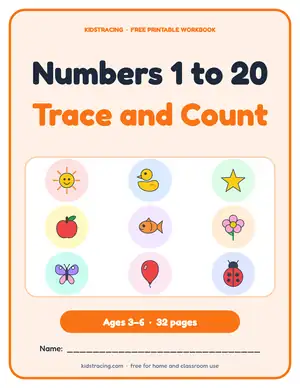
Number Tracing and Counting Book
Trace, count and color every number from 1 to 20, then practice number words and skip counting.
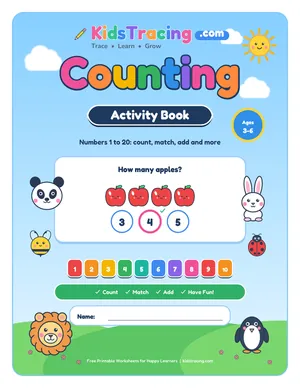
Counting Activity Book
Count to 20 with ten frames, tally marks and dice, then compare, skip count, add and take away. With an answer key.
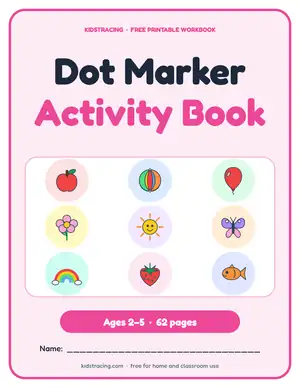
Dot Marker Activity Book
Big letters, numbers, shapes and pictures filled with circles for dot markers, stickers or fingertips.
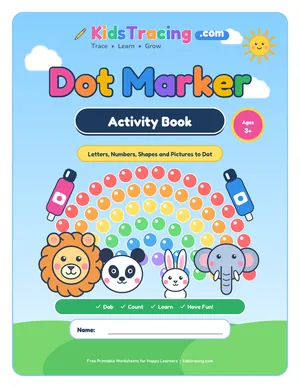
Dot Marker Alphabet and Numbers Book
Dab capital and small letters A to Z, count and dab numbers 1 to 10, then shapes and 15 pictures.
Related worksheet tools
Explore more: Number Worksheets for Kids · Kindergarten Worksheets · Preschool Worksheets · All free worksheet tools
Guides for parents and teachers: How to Teach a Child to Write Numbers 1 to 10 · Pre-Writing Activities for Preschoolers: 15 Fun Ideas · Handwriting Practice at Home: How Long and How Often