Beginning Sounds Activities for Preschool and Kindergarten
Published by Hasnat N, Founder · October 18, 2026 · 10 min read
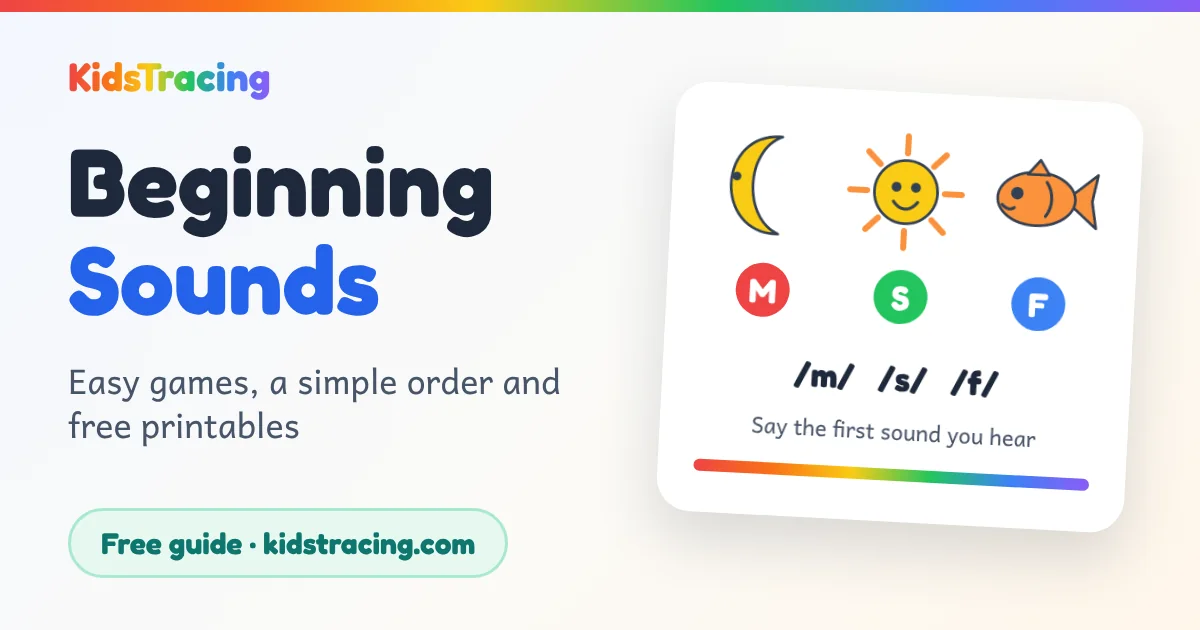
Quick answer: A beginning sound is the first sound you hear in a word: sun starts with /s/ and moon starts with /m/. To teach it, say a word slowly, stretch or bounce the first sound and ask your child what they hear first. Start with sounds you can hold, like /m/, /s/, /f/ and /l/, teach the sound before the letter name, and keep each session to a few minutes of play.
Beginning sounds, also called initial sounds, are one of the first steps in phonemic awareness, which is the skill of hearing and playing with the separate sounds in spoken words. A child who can tell you that sun and sock start the same way is getting ready to connect sounds to letters, and later to sound out and spell words. You do not need special tools for this. Your voice, a few pictures and a little play are enough.
What are beginning sounds?
A beginning sound is the very first sound (or phoneme) of a spoken word. It is about what you hear, not what you see. Cat starts with /k/, ship starts with /sh/, and phone starts with /f/ even though it is written with a p. Letters between slashes, like /k/, mean the sound and not the letter name.
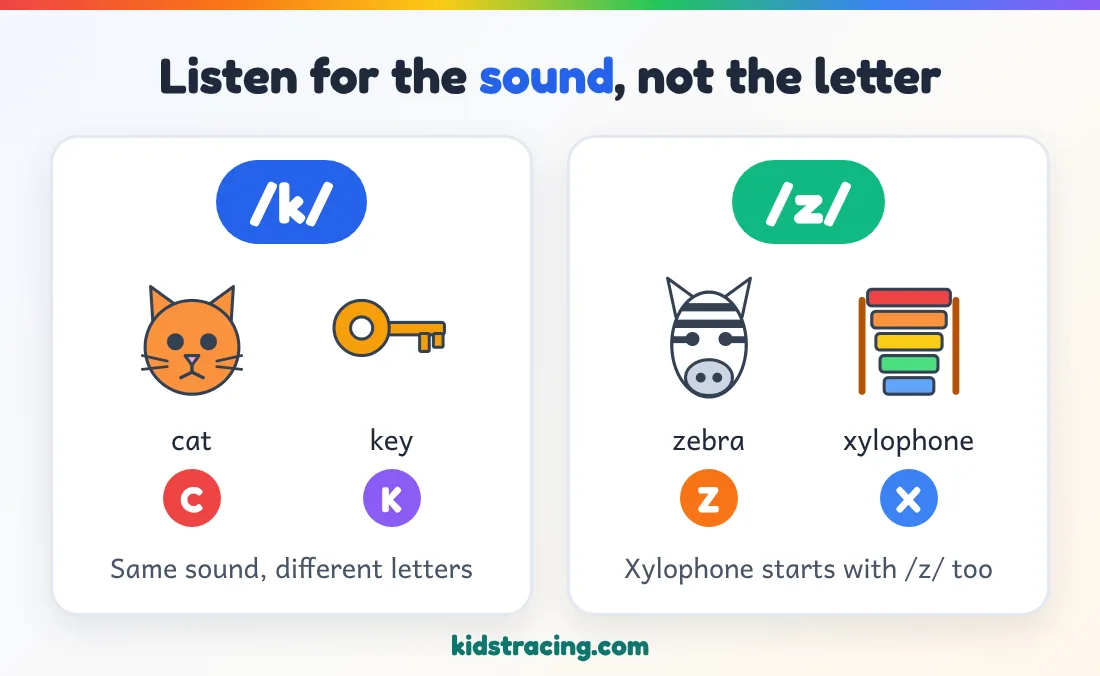
This is why we teach the sound first. A child who knows that /k/ can be written with c or k will find the start of cat and key easier to spell later. A child who only knows letter names can be misled, because the name of a letter does not always match its sound. The name of the letter w, for example, starts with /d/.
When do children learn beginning sounds?
Many children enjoy noticing that words start the same, like Sam, sun and sock, at about age 3 or 4. Picking out the first sound of a word usually gets easier between ages 4 and 6. The Common Core kindergarten reading standards ask children to say the first, middle and last sounds of simple three-sound words and to know the main sound of each consonant (see the standards). These ages are a guide and not a deadline. If your child is not there yet, keep it playful and try again in a few weeks.
Which sounds should you teach first?
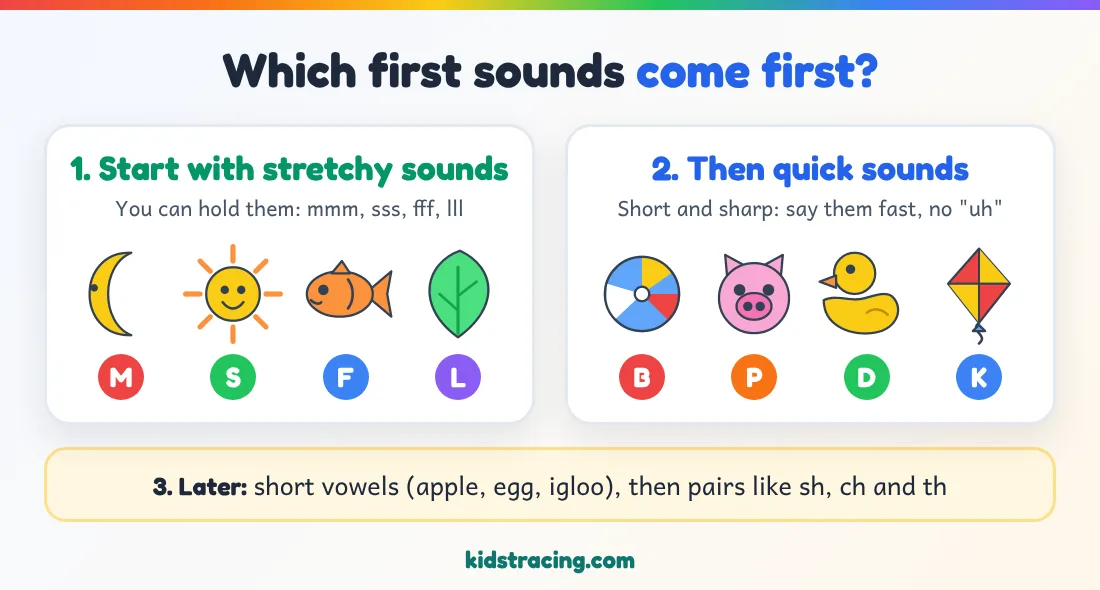
Start with sounds you can stretch. A child hears a first sound more easily when you can hold it: say mmmoon, sssun, fffish. These are often called stretchy (or continuous) sounds. Quick sounds like /b/, /p/, /t/, /d/, /k/ and /g/ cannot be held, so they are a little harder to hear and to say cleanly. Teach them next.
- Begin with your child’s name. It is the most meaningful word they know. If your child is Sam, start with /s/.
- Add two or three new sounds a week. Keep revisiting the old ones in games so they stay fresh.
- Keep look-alike and sound-alike pairs apart. Teach b and d, or /b/ and /p/, or /f/ and /v/ in different weeks, because they are easy to mix up.
- Leave the short vowels (a, e, i, o, u) for later. Short vowel sounds are harder to tell apart, and /e/ and /i/ can sound alike to young ears.
How to say each sound clearly
Say the sound itself, not the letter name, and keep it short. A common mistake is to add “uh” to a quick sound, so that /b/ turns into “buh”. Aim for /b/ with only a puff of air. Hold stretchy sounds for a couple of seconds, like “mmm”, but do not add a vowel. Clean sounds make it much easier to blend them into words later: /k/ /a/ /t/ is easy to hear as cat, while “kuh-a-tuh” is not.
Some letters need a little extra care because the sound is not what the name suggests:
| Letter | Beginning sound | Watch out for |
|---|---|---|
| c | /k/ as in cat | The letter c can also say /s/ (city). Start with /k/. Cat and key begin with the same sound. |
| g | /g/ as in goat | The letter g can also say /j/ (giraffe). Start with the hard /g/. |
| w | /w/ as in web | The letter name “double-u” starts with /d/, so use the sound and not the name. |
| x | /z/ as in xylophone | Very few words start with x. At the end of words, as in box, x says /ks/. |
| y | /y/ as in yo-yo | At the start of a word y is a consonant. Its name starts with /w/, which can confuse children. |
| q | /kw/ as in quilt | In English words q is nearly always followed by u. |
| silent letters | knee starts with /n/, wrap starts with /r/ | Pick pictures with plain spellings at first and leave silent starts for later. |
A simple four-step routine
- Listen first, with no letters. Say two words, like “sun, sock”, and ask, “Do they start the same?” Then ask, “What sound do you hear first in sun?”
- Sort pictures by first sound. Make two piles, for example /m/ and /s/, and sort a few picture cards or small toys into them. Say each word together before you decide.
- Add the letter. Show the letter, say its sound, and trace it with a finger or a crayon. Our letter formation worksheets show the strokes for each letter.
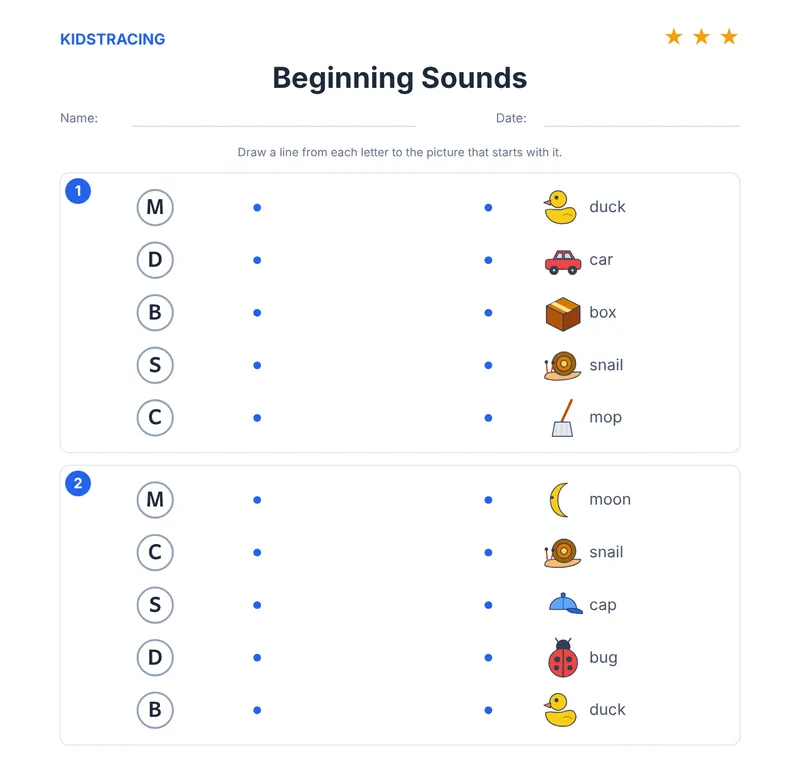
- Practice on paper. Circle the picture, circle the letter or draw a line to match. Five minutes is plenty for this age.
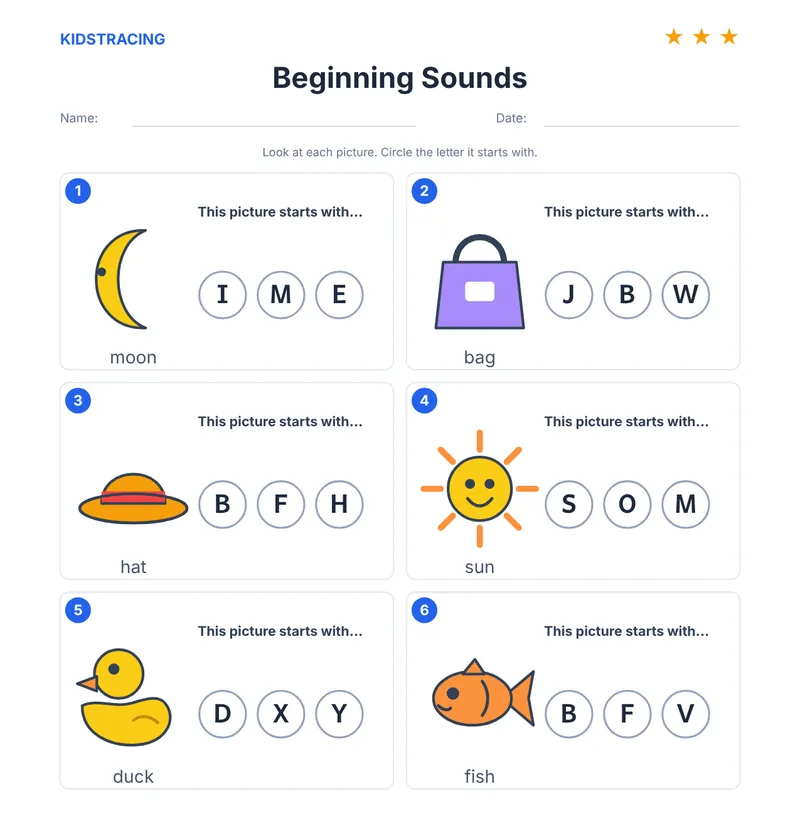
Two of the activities from our worksheet maker look like this:
10 easy beginning sounds games
- I spy with sounds. Say, “I spy something that starts with /s/.” Use the sound, not the letter name.
- Sound sorting. Put two baskets on the floor and sort small objects by first sound, such as a sock and a spoon in one and a mug and a marker in the other.
- Mystery bag. Pull one object out of a bag, say its name and say its first sound.
- Silly puppet. A puppet holds up a sun and says, “This is a bun!” Your child fixes the first sound: “No, it starts with /s/. It is a sun!”
- Name game. Which sound starts your name? Whose name starts with /m/? Whose starts with /s/?
- Sound hunt. Pick one sound and give your child a minute to find things around the room that start with it.
- Beginning sounds bingo. Make bingo cards with pictures. Call out a sound and your child covers a picture that starts with it.
- Salt tray or playdough letters. Say the sound while you trace or shape the letter.
- Hop to the sound. Chalk letters on the ground. Call a sound and your child hops onto the matching letter.
- Print and play. Make a worksheet with the letters you are practicing this week (see below).
Free beginning sounds worksheets
Our beginning sounds worksheet makers do the picture work for you. You choose the letters to include, the activity (pick the picture, pick the letter or match) and the level, then print on US Letter or A4. You can add an answer key as a separate page. Say each picture name together before your child answers, because some pictures have more than one name, like a couch and a sofa or a bunny and a rabbit.
- Beginning sounds worksheets for preschool – six easy picture questions with eight clear letters.
- Beginning sounds worksheets for kindergarten – ten mixed questions using all 26 letters, with an answer key.
- Beginning sounds A to Z – one picture question for every letter, in a new order each time.
- Beginning sounds generator – choose your own letters, activity and level.
Common mistakes to avoid
- Teaching only letter names. Children need the sound of a letter to read and write, so say the sound every time.
- Adding “uh” to quick sounds. Say /b/ and /t/ crisply, with no extra vowel.
- Rushing to reading. If your child cannot yet hear the first sound of a word, sounding out whole words will feel too hard. Give beginning sounds time first.
- Using worksheets only. Games with real objects and your voice do most of the work. Worksheets are for practice after that.
- Correcting accents. Accents change how some sounds are said. Accept the way your child says a sound as long as they can hear the difference between words.
What comes after beginning sounds?
Once your child can find the first sound, try the last sound, then the middle sound, and then blending sounds to read simple words. Counting the beats in a word is another good step: see how to teach syllables. For reading three-letter words, use the CVC words list and the missing letters worksheets. If you are not sure where letters fit in a writing plan, read the letter formation order. You will find more activities for this age on our phonics worksheets page.
Free printables to go with this guide
Put this guide into practice with our free generators: beginning sounds worksheets, missing letters worksheets, CVC words worksheets, syllable counting worksheets.
Free workbooks to go with this guide
- ABC Tracing Book – 62 pages with stroke-by-stroke letter formation for A to Z, picture pages and alphabet games.
- CVC Words Workbook – 32 pages of picture words, sound boxes, tracing and sentences for all five short vowels.
Keep reading
- How to Teach Syllables to Preschool and Kindergarten Children – How to teach beginning sounds: where to start, how to say each sound, 10 easy games and free printable worksheets for ages 3 to 6.
- CVC Words List: Short A, E, I, O and U – A CVC words list sorted by short vowel (a, e, i, o, u) with sentences to read, a teaching order and easy games for kindergarten and first grade.
Frequently asked questions
What are beginning sounds?
A beginning sound is the first sound you hear in a word. Sun starts with /s/ and ship starts with /sh/. It is the sound that matters, not the spelling.
What age should a child know beginning sounds?
Many children can match words that start with the same sound at about age 4, and most can say the first sound of a simple word by the end of kindergarten. Every child is different, so treat these ages as a guide and not a deadline.
What is the difference between a beginning sound and a beginning letter?
The beginning sound is what you hear and the beginning letter is how the word is written. Phone starts with the sound /f/ but its first letter is p. Knee starts with the sound /n/ but its first letter is k.
Which beginning sounds should I teach first?
Start with stretchy sounds you can hold, like /m/, /s/, /f/ and /l/, and with the sounds in your child’s name. Add quick sounds like /b/, /p/, /t/ and /d/ next, and leave the short vowels for later.
How do I teach beginning sounds at home?
Play for a few minutes a day. Say a word, stretch the first sound and ask what your child hears first. Sort pictures by first sound, go on a sound hunt around the house, and then print a worksheet to practice.