Sweden Brings Back Books and Handwriting: What Parents Should Know
Published by Hasnat N, Founder · · 10 min read
Quick answer: Sweden is not banning screens from school. Since 2023 it has paid for printed textbooks, made digital devices optional in preschool and announced a school phone ban. The research on handwriting and reading on paper is encouraging but modest, and it does not prove that screens caused Sweden’s falling scores. For young children the practical lesson is simple: give paper, pencils and books a full share of the day, and use screens on purpose.
A viral post is asking whether Sweden has proved that tablets in classrooms were a mistake, and whether every school should now ban them for young children. The real story is more interesting and more useful for parents. Sweden has made a handful of specific changes, and the science of handwriting, typing and reading on paper is real but small. This guide separates what is confirmed from what is still argued about, then turns it into a plan you can use at home.
What is Sweden actually changing?
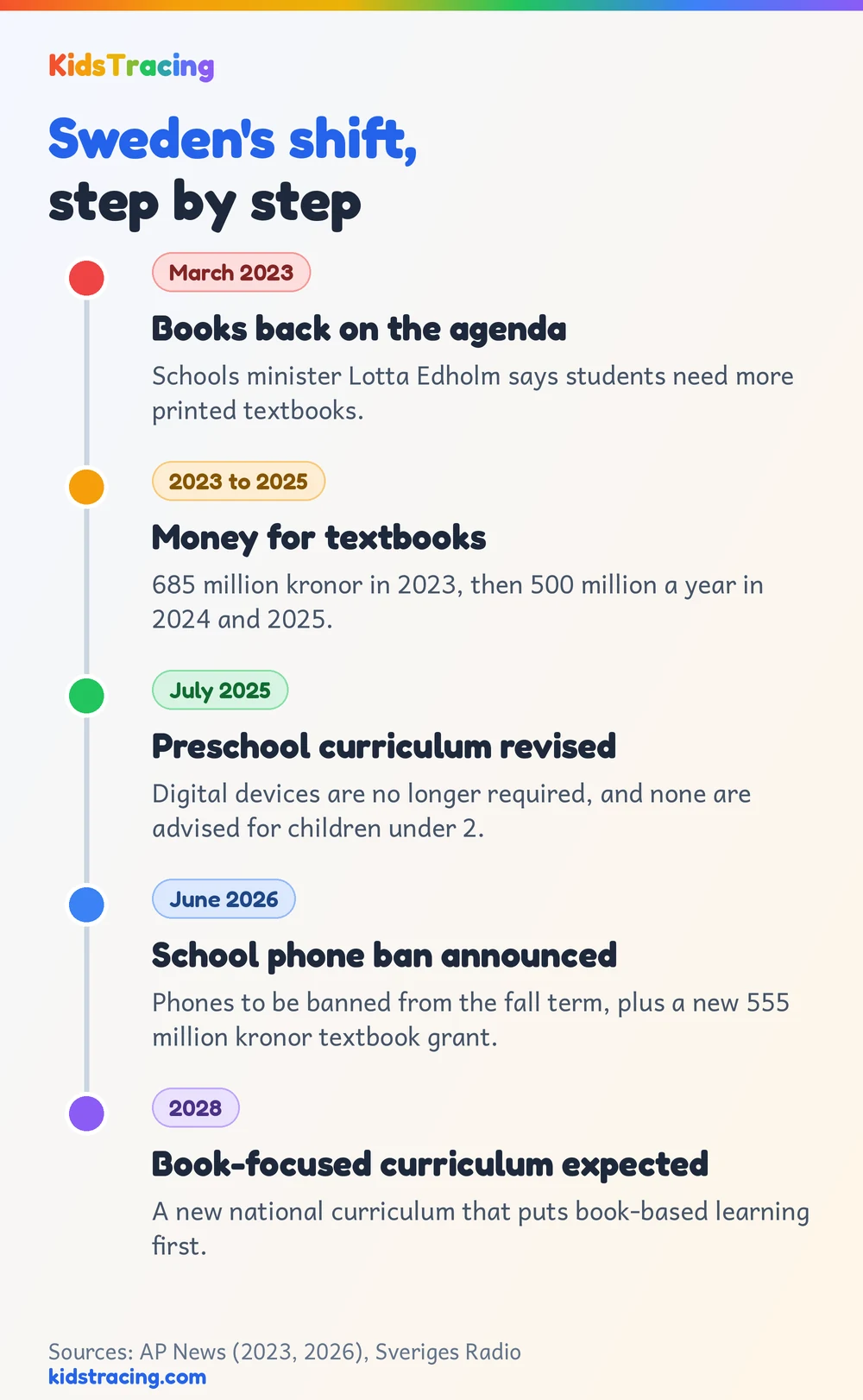
The shift was made in steps by a center-right coalition government, which took office in late 2022 and has favored books over screens since 2023. Schools Minister Lotta Edholm had been a loud critic of Sweden’s heavy use of technology in classrooms. These are the key dates, based on reports from the Associated Press (AP) and Sveriges Radio, Sweden’s public radio:
- Edholm said Swedish students need more textbooks and that physical books matter for learning.
- 2023 to 2025. The government set aside 685 million kronor (about 60 million euros) for school books in 2023, then 500 million kronor a year in 2024 and 2025 to speed up the return of textbooks.
- A revised preschool curriculum dropped the requirement to use digital devices. It now recommends using them in moderation and advises against digital tools for children under two.
- The government announced a school mobile phone ban for the coming fall term, along with a new grant of 555 million kronor for textbooks and teachers’ guides.
- 2028. A new curriculum that puts book-based learning first is expected.
Notice what is missing from that list: there is no national ban on tablets or laptops in school. Some schools, such as Malmö Borgarskola, still give every student a laptop and simply discourage using it in class unless a teacher asks. Because teaching with books is being added and screens are being reduced rather than removed, “recalibration” describes the change better than “reversal.” The AP report did not say which grades the phone ban covers, so check the Swedish government’s own pages for the details and the latest status.
Why are Swedish officials worried?
The concern is about reading and writing. Sweden’s fourth graders scored an average of 544 points in the 2021 PIRLS reading study (Progress in International Reading Literacy Study), down from 555 in 2016. That is still above the European average and tied for seventh place overall, but the direction worried officials. Joar Forsell, who chairs the education committee in Sweden’s parliament, told the AP that officials have seen reading and writing ability decline, especially among younger students, and that he believes books and traditional learning serve children better.
In 2023 the Karolinska Institute, a leading Swedish medical university, published a statement on the national strategy for digitalizing schools. It said that, in its assessment, the evidence shows digital tools impair rather than enhance learning, and it urged a return to printed textbooks and teacher expertise instead of freely available online sources that nobody has checked.
Two facts keep this from being a simple story. First, the AP notes other possible causes of the drop in reading scores, including the COVID-19 pandemic and a growing number of students who do not speak Swedish as a first language. Second, in the 2022 PISA study (Programme for International Student Assessment), 24.3% of Swedish ninth graders did not reach a basic level of reading comprehension, compared with an average of 26.2% across the European Union. On that measure Sweden is slightly better than the EU average, so the worry is less that it lags behind others and more that its own results slipped, and that some officials and experts suspect screen use is part of the reason.
What does the research say about handwriting, typing and paper?
Three studies come up again and again in this debate. None of them tests “tablets in classrooms” as a whole, so none can settle the question, but each says something useful about a specific task.
Printing letters by hand, in preschoolers
In a 2012 study by Karin James and Laura Engelhardt, 15 pre-literate children aged about four to five practiced letters and shapes in three ways: printing them freehand, tracing dotted outlines and finding the keys on a keyboard. Afterward the children looked at the same letters inside an MRI scanner. Letters they had printed switched on more of the brain’s reading network, including a region in the left fusiform gyrus, than letters they had typed or traced. The authors suggest that the varied, self-made shapes of free printing may be the key ingredient. The sample was small, training lasted about 30 minutes and later reading was not measured, so the study supports the idea without proving it.
Handwriting versus typing, in young adults
A 2024 high-density EEG study in Frontiers in Psychology, by Ruud van der Weel and Audrey van der Meer of the Norwegian University of Science and Technology, compared 36 university students writing words in cursive with a digital pen and typing them with one finger. Handwriting produced more widespread connectivity between brain regions, in the theta and alpha frequency bands, than typing did. The authors link those brain rhythms to memory and learning and recommend that children get handwriting practice early. The link to learning is indirect, because the study did not test learning outcomes itself.
Reading on paper versus on a screen
A 2018 meta-analysis by Pablo Delgado and colleagues pooled 54 studies with about 171,000 participants and found a small advantage for paper in reading comprehension, which the authors call screen inferiority. The gap was larger when reading time was limited, and it appeared for informational texts but not in studies that used only stories. The authors also caution that results varied a great deal from one study to the next.
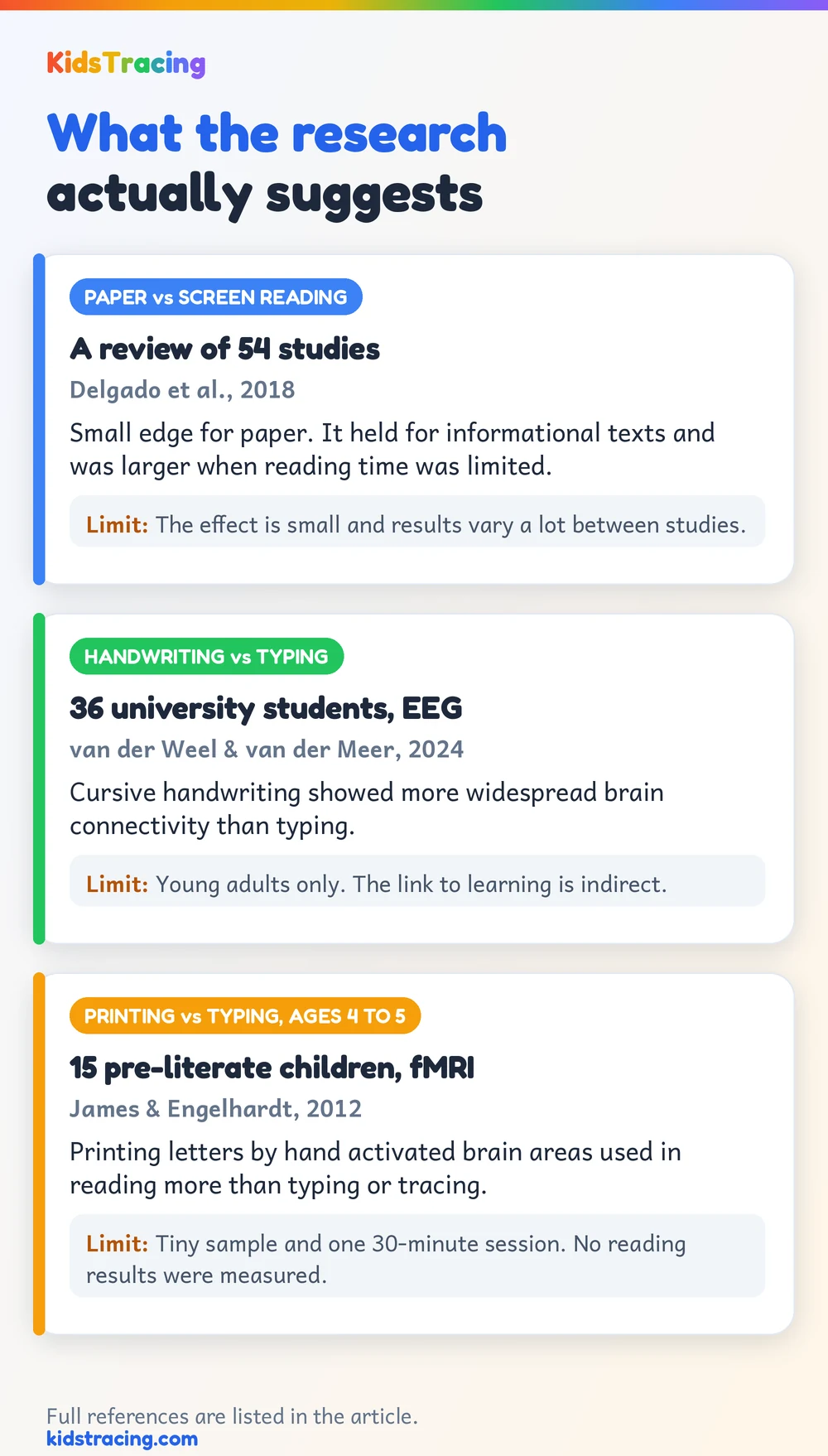
Put together, the evidence points in one fairly consistent direction for young children: the movement of forming letters by hand seems to help, and paper has a modest edge for longer informational reading. It does not show that every digital tool harms learning, and it does not show that screens caused Sweden’s decline in reading scores.
What do technology supporters say?
The critics of the shift make points that deserve a fair hearing. Neil Selwyn, an education professor at Monash University in Australia, told the AP that criticizing technology is popular with conservative politicians. He acknowledged there is no evidence that technology improves learning, but added that there is also no clear evidence about what does work with it.
- Digital skills. The Swedish Edtech Industry trade group warns that a lack of digital skills could lead to shortages and unemployment. It expects 90% of future jobs to need such skills, which is the industry’s own estimate.
- Extra support. Peter Carlsson, chief executive of the software company Imvi Labs, says some programs are valuable for students with learning or reading difficulties.
- Not all screen time is equal. Critics of the new preschool curriculum say it confuses educational digital tools with passive screen time such as scrolling.
- Teachers still lead. UNESCO has urged appropriate use of technology in education and warned that it should never replace in-person, teacher-led instruction.
Both camps agree on more than the headlines suggest: teachers matter most, and tools should be chosen carefully. They disagree about how much weight screens deserve, especially for the youngest children.
Is Sweden alone?
No. According to the AP’s June 2026 report, Finland’s law restricting mobile devices in schools took effect in August 2025, and Denmark looked set to adopt a similar ban. Spain and South Korea have taken steps ranging from classroom phone bans to limits on screen-based homework. Closer to home for American readers, the Los Angeles Unified School District announced plans to ban screens until second grade, cap daily screen time by grade and audit its education technology contracts.
So should schools ban tablets for young children?
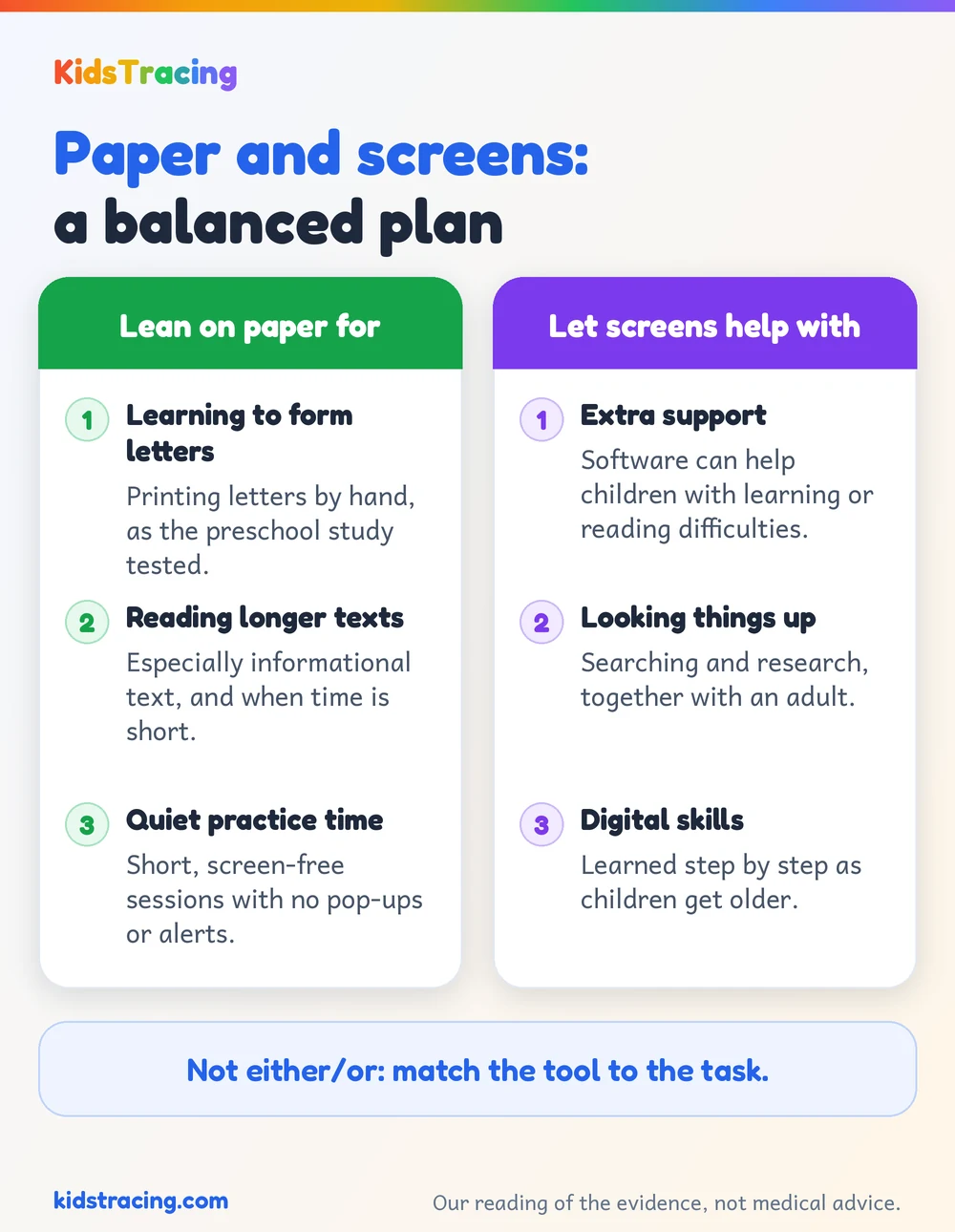
The evidence does not support a simple yes or no. A blanket ban is not what Sweden did, and a fully digital classroom is not what the research recommends for four- to six-year-olds either. A reasonable reading is that the foundation skills of early literacy are physical: holding a pencil, forming letters, listening to stories and handling books. Those are worth learning on paper first. Digital tools can be added later and used for clear purposes, such as extra support for a child who finds reading hard. Whether Sweden’s approach improves results will not be known for years, because the new curriculum is not expected until 2028.
What the evidence supports
- In small studies, handwriting engages brain networks tied to reading and memory more than typing does.
- On average, paper has a small advantage for reading informational text, especially under time pressure.
- Sweden has changed its policies: more money for books, optional devices in preschool and a phone ban.
What is still debated
- Whether screens caused the decline in Swedish reading scores, or whether the pandemic and language background explain more of it.
- Whether well-designed learning apps differ from passive scrolling in their effects on young children.
- Whether Sweden’s changes will raise reading results, and how long that would take to see.
A paper-first plan for ages 3 to 6
You do not need to wait for policy. This simple plan puts the strongest findings to work at home without banning anything.
| Age | On paper | If you use screens |
|---|---|---|
| 0 to 2 | Board books, chunky crayons, play dough and finger paint. | Sweden’s new preschool curriculum advises against digital tools at this age. |
| 3 to 4 | Pre-writing lines and shapes, picture books read aloud and a first name tracing sheet. | Watch together, keep it short and choose slow, interactive content over endless scrolling. |
| 5 to 6 | Letter formation, your child’s name, numbers 1 to 10 and short words. | Use a screen for a purpose, such as a video call or an audio story, rather than as the default. |
- Start with the hand, not the pencil. Squeezing, pinching and drawing big shapes build the control that writing needs. Try these pre-writing activities for preschoolers, then check the handwriting readiness checklist.
- Teach letters in a sensible order. Straight-line letters come first. Our letter formation order shows the groups.
- Keep sessions short. Three to five minutes is plenty at ages 3 and 4. See how long and how often to practice handwriting at home.
- Begin with your child’s name. It is the most meaningful word they know. Follow how to teach a child to write their name and print free name tracing worksheets.
- Read on paper together. Let your child turn the pages, point at pictures and choose the book. It builds the habit that Sweden’s changes are trying to protect.
- Make screen-free zones. Sweden’s public health agency advises parents to model screen limits themselves, for example with screen-free zones in the home.
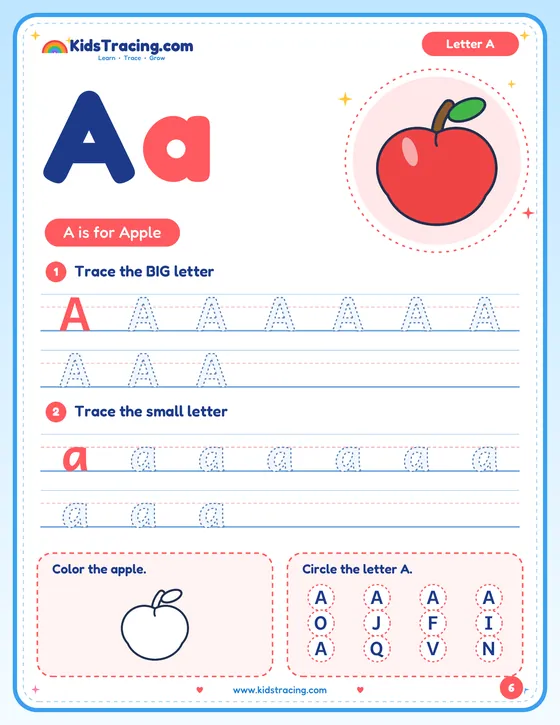
This guide is general information for parents and not medical or educational advice for your child. Policies and studies change, so check the sources below for the latest.
Sources
News reports and policy details come from the Associated Press and Sveriges Radio. The research summaries come from the papers themselves. Figures from the AP are as reported at the time of publication.
- Associated Press, Sweden brings more books and handwriting practice back to its tech-heavy schools (September 10, 2023).
- Associated Press via NPR, Sweden set to ban mobile phones in schools (June 9, 2026).
- Sveriges Radio, Sweden’s new preschool curriculum throws out digital learning tools.
- James, K. H., and Engelhardt, L. (2012), The effects of handwriting experience on functional brain development in pre-literate children, Trends in Neuroscience and Education.
- Van der Weel, F. R., and Van der Meer, A. L. H. (2024), Handwriting but not typewriting leads to widespread brain connectivity: a high-density EEG study with implications for the classroom, Frontiers in Psychology.
- Delgado, P., Vargas, C., Ackerman, R., and Salméron, L. (2018), Don’t throw away your printed books: a meta-analysis on the effects of reading media on reading comprehension, Educational Research Review.
Free printables to go with this guide
Put this guide into practice with our free generators: name tracing worksheets, letter formation worksheets, pre-writing worksheets, blank handwriting paper.
Free workbooks to go with this guide
- My ABC Tracing Workbook – A picture for every letter A to Z to trace, color and circle, plus four review tests and a certificate.
- ABC Tracing Book – Every letter A to Z with numbered stroke arrows, a picture to color and a word to trace.
- Pen Control and Pre-Writing Book – Lines, curves, zigzags, loops and spirals, plus paths from a bee to a flower, to build pencil control.
Keep reading
- Handwriting Readiness Checklist: Is Your Child Ready to Write? – A simple handwriting readiness checklist for ages 3 to 6: ten signs your child is ready to start writing, and what to do if they are not there yet.
- Handwriting Practice at Home: How Long and How Often – Handwriting practice at home: how long and how often for ages 3 to 6, a 10-minute routine, setup tips and the signs that it is time to stop.
- Letter Formation Order: Which Letters to Teach First – A simple letter formation order: group letters by how they are written and teach straight-line letters first. Capital and small letter groups, with a week plan.
Frequently asked questions
Is Sweden banning tablets in schools?
No. Sweden has not banned tablets or laptops nationwide. It has paid for printed textbooks, made digital devices optional in preschool, advised against digital tools for children under two and announced a school mobile phone ban.
Why is Sweden bringing back printed books?
Officials were worried about declining reading and writing results, especially among younger students, and the Karolinska Institute argued that the evidence favors printed textbooks and teacher expertise. Other factors, such as the pandemic and students’ language backgrounds, may also play a part.
Is handwriting better than typing for learning?
Small studies suggest that handwriting engages brain networks linked to learning and reading more than typing does, especially for young children who are learning letters. The research is limited and does not show that typing harms learning in general.
Is reading on paper better than reading on a screen?
On average, a large 2018 meta-analysis found a small advantage for paper, especially for informational texts and when reading time was limited. Studies that used only stories showed no clear difference.
At what age should a child start handwriting?
There is no single age. Many children show readiness signs between about 3 and 6. Start with pre-writing play, then the child’s name and a few letters at a time, and use our handwriting readiness checklist to see where your child is.
Should my child use a tablet at all?
That is a family decision. A reasonable approach is paper first for letters and writing, and screens used on purpose, together with an adult and for a limited time. If you are worried about your child’s development, talk to your child’s teacher or doctor.