Animals Tracing and Coloring Workbook: 34 Animals to Trace, Color and Name (Free PDF)
A free animal workbook with one simple routine that repeats on every page: trace the dotted outline, color the picture, then trace the animal’s name and write it again on the line below. Thirty-four animals are grouped by where they live (wild, farm, sea, birds and insects), and each page ends with a fun fact to read together. Download the 40-page PDF in US Letter or A4 and print it at home or in class.
Download Animals Tracing and Coloring Workbook
- 40 pages for ages 3–6
- Free for home and classroom use, with no sign-up or email address
- Two PDF files: US Letter (8.5 × 11 in) and A4
- Prints in black and white or in color
Print at 100% (Actual size). Choose US Letter in the United States and Canada, and A4 almost everywhere else. How to print a workbook
Who this workbook is for
Animals are the topic young children ask about most, so this workbook uses that interest to practice the hand skills behind writing. It is for ages 3 to 6. Younger children can trace the dotted picture, color it and trace the big dotted word, which is already a lot of fine motor work. Older preschoolers and kindergarteners can write the name again on their own line, read the fun fact aloud and sort the animals into groups.
Every animal page follows the same routine, so after the first page children know what to do and can work with very little help. The workbook is a good next step after the Pre-Writing Lines and Shapes Book, because tracing a dotted animal outline is the same skill as following a dotted line, only with more curves. It sits well beside the Animals Tracing and Coloring Book, which has different pictures, matching games and word-tracing pages, and the Fruits and Vegetables Tracing and Coloring Book, which uses a similar layout for food words.
What is inside the Animals Tracing and Coloring Workbook
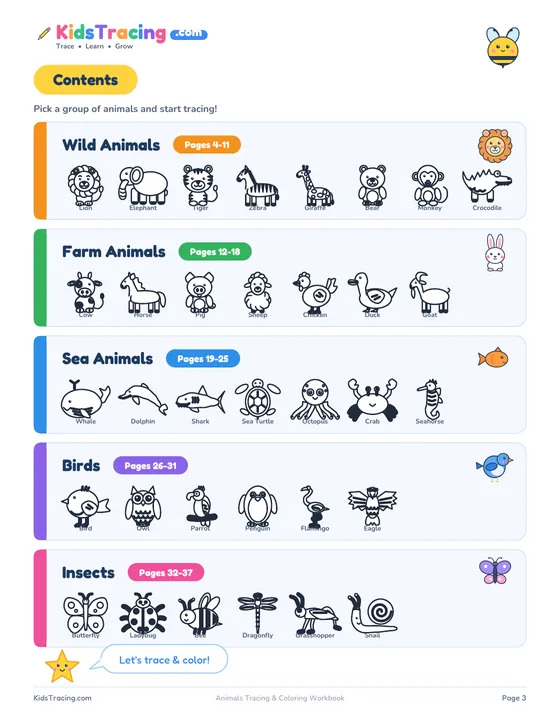
The workbook has 40 pages. Every page is numbered in the bottom corner and page 3 shows all five groups with a small picture of each animal, so you can print one group at a time.
| Pages | Section | Number of pages |
|---|---|---|
| 1–3 | Cover, a page for parents and teachers, and the contents | 3 |
| 4–11 | Wild Animals | 8 |
| 12–18 | Farm Animals | 7 |
| 19–25 | Sea Animals | 7 |
| 26–31 | Birds | 6 |
| 32–37 | Insects | 6 |
| 38 | Good Job: draw your favorite animal | 1 |
| 39 | Certificate of achievement | 1 |
| 40 | Back cover | 1 |
What every animal page looks like
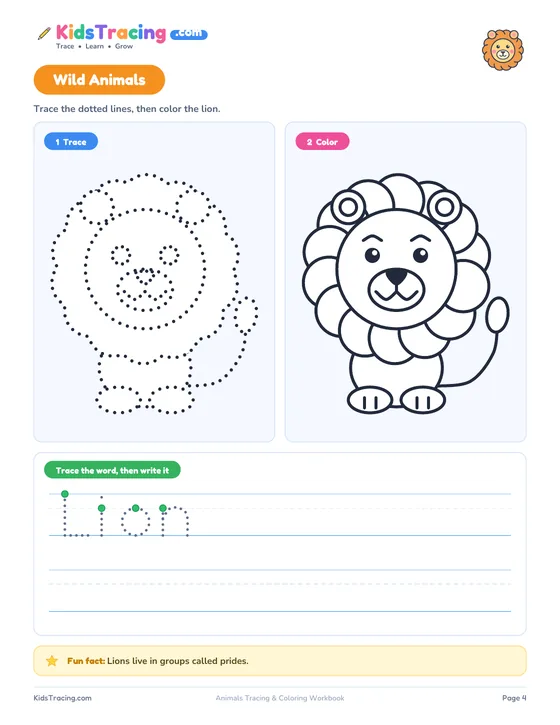
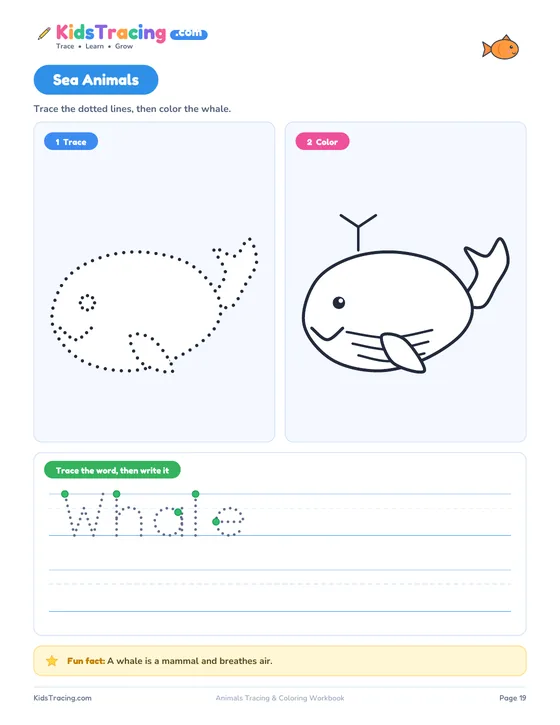
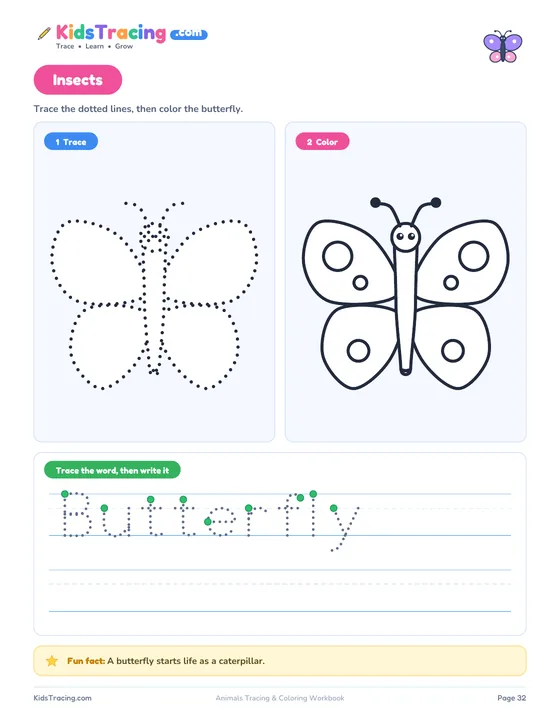
All 34 animal pages have the same four parts, from top to bottom. A colored tab names the group, such as Wild Animals, and one line of instructions says what to do. In the middle are two panels side by side. Panel 1, “Trace”, shows a dotted outline of the animal with its face and body details, and panel 2, “Color”, shows the same animal as a clean outline ready for crayons or colored pencils. Below them, a panel called “Trace the word, then write it” shows the animal’s name in dotted letters on writing lines, with a green dot at the start of every stroke, and a second set of empty lines to write the name again alone. The page ends with a one-sentence fun fact, such as “Lions live in groups called prides” or “A butterfly starts life as a caterpillar”.
The order of the three jobs is on purpose. Tracing the picture warms up the hand with big, easy curves. Coloring gives the hand a break and lets children look closely at the animal. Writing the name comes last, when the hand is warm and the child already knows how the animal looks.
Start here (pages 1–3)
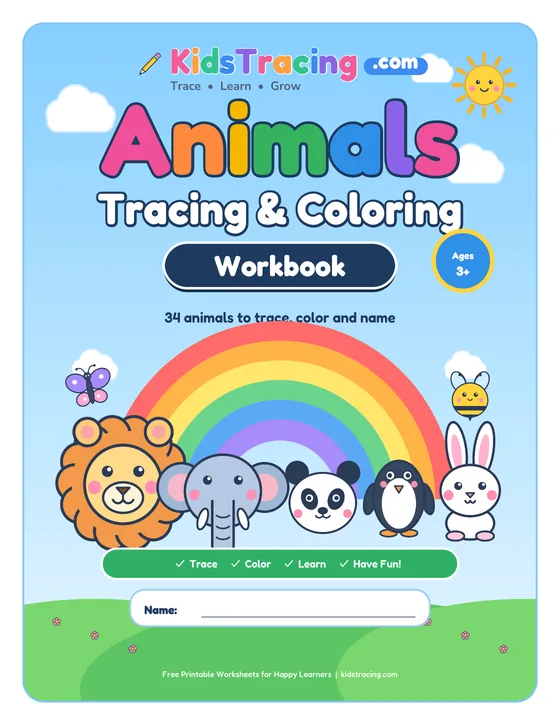
A cover with a lion, an elephant, a panda, a penguin and a rabbit under a rainbow, a welcome page and the contents. The welcome page explains in six short steps how to use the book: print at 100% (Actual size), trace the dotted outline slowly, color the picture on the right, say the animal’s name aloud and trace the dotted letters, read the fun fact together, and do one or two pages a day. A key shows what the dotted “Trace me” circle and the solid “Color me” circle mean, and a box at the bottom says “This book belongs to”.
Wild Animals (pages 4–11)
Eight animals: lion, elephant, tiger, zebra, giraffe, bear, monkey and crocodile. Among the fun facts are “An elephant uses its trunk like a hand”, “No two zebras have exactly the same stripes” and “A giraffe is the tallest animal on land”. Most children already know these animals from picture books and zoo visits, so the pictures need no explanation and your child can concentrate on following the dots. Other facts in the section include “Bears have a very good sense of smell”, “Monkeys are great climbers” and “Crocodiles love to rest in the warm sun”.
Farm Animals (pages 12–18)
Seven farm animals: cow, horse, pig, sheep, chicken, duck and goat. This section has the shortest names in the book (cow, pig, duck, goat), so it is the easiest one for writing the word alone. The fun facts connect the animals to everyday life, for example “Cows give us milk”, “Sheep wool is used to make warm clothes” and “A hen lays eggs that we can eat”.
Sea Animals (pages 19–25)
Seven animals of the ocean: whale, dolphin, shark, sea turtle, octopus, crab and seahorse. The facts point out surprising details, such as “A whale is a mammal and breathes air”, “An octopus has eight arms”, “Crabs walk sideways” and “Seahorses swim standing up”. The octopus is a good page for counting, because children can count the eight arms as they trace.
Birds (pages 26–31)
Six birds: a small bird that is simply called “bird”, an owl, a parrot, a penguin, a flamingo and an eagle. The first page has the general fact “Birds have feathers and most of them can fly”, and the later pages show how different birds can be: a bird that swims instead of flies (“Penguins are birds that swim instead of fly”), one that hunts at night (“Many owls hunt at night”), one that copies words (“Some parrots can copy human words”) and one that often stands on one leg (“Flamingos often stand on one leg”).
Insects (pages 32–37)
Six small creatures: butterfly, ladybug, bee, dragonfly, grasshopper and snail. Facts include “A ladybug is a small beetle”, “Bees carry pollen from flower to flower” and “A dragonfly has four wings”. This section holds the longest names in the book, including grasshopper, which has eleven letters, so it is best saved for last. The section is named Insects but also includes a snail, which is a mollusk, not an insect. You can use that as a talking point about how animals are grouped, and the table later on this page shows how the 34 animals sort into groups.
Good Job, certificate and back cover (pages 38–40)
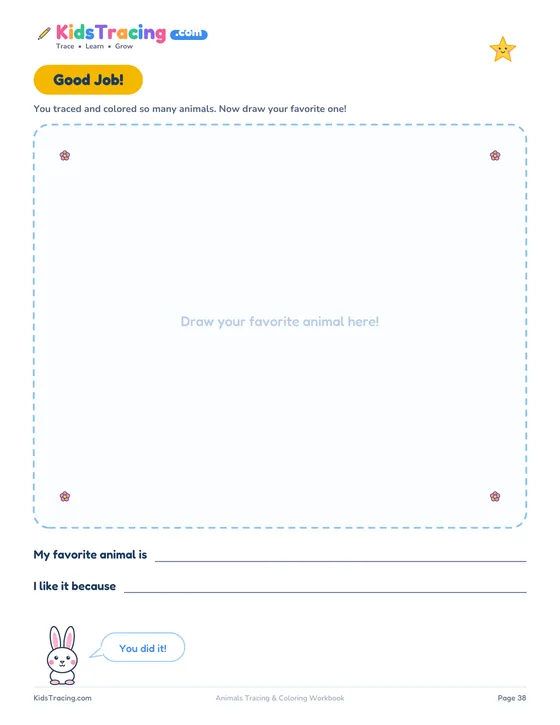
Page 38 is a drawing page called Good Job: a big dashed box with the words “Draw your favorite animal here!” and two lines to finish the sentences “My favorite animal is” and “I like it because”. Page 39 is a certificate of achievement with a line for the child’s name, the date and a parent or teacher signature, and page 40 is the back cover.
Sample pages
A few pages from the finished workbook. The PDF is sharp enough to print at full size.
Skills your child practices
- Tracing curves and outlines with a pencil
- Coloring a picture with care for hand control
- Reading and writing animal names, from cow to grasshopper
- Starting each letter at the green dot and writing on guide lines
- Learning where animals live and how animals are grouped
- Reading a short sentence and talking about it
How to use this workbook
Print a group at a time
Choose US Letter or A4 and print at 100% (Actual size). Type a page range such as 12-18 to print one section, and add the next section when the first one is finished.
Say the name and make the sound
Moo, oink, roar or buzz before anyone picks up a pencil. Sound and movement help children remember a name, and they make the page more fun.
Trace the dotted picture
Use a pencil and go slowly. There is no wrong way around, and a wobbly line is a good start. Older children can try to trace the whole outline without lifting the pencil.
Color the picture
Crayons or colored pencils on the right-hand picture. Every color is a good color, including a purple lion.
Trace the word, write it alone and read the fun fact
Start at each green dot, follow the dotted letters, then write the name again on the empty line. Finish by reading the fun fact aloud and asking where the animal lives.
Sorting and talking about the animals
The workbook is organized by where animals live, because that is how young children usually think about them: the farm, the jungle, the sea, the sky and the garden. Once a child has colored a few pages, you can sort the finished pages in other ways. Which animals have four legs? Which ones fly, swim or crawl? Which ones lay eggs? Sorting like this adds science vocabulary to a handwriting activity without any extra worksheets.
If you want to use the proper names, the table below shows how scientists group the 34 animals in the book. It is also a quick answer to the question every parent hears sooner or later: is a whale a fish? It is not. A whale and a dolphin are mammals that breathe air and feed their young milk.
| Animal group | Animals in the workbook | How many |
|---|---|---|
| Mammals | lion, elephant, tiger, zebra, giraffe, bear, monkey, cow, horse, pig, sheep, goat, whale, dolphin | 14 |
| Birds | chicken, duck, bird, owl, parrot, penguin, flamingo, eagle | 8 |
| Insects | butterfly, ladybug, bee, dragonfly, grasshopper | 5 |
| Fish | shark, seahorse | 2 |
| Reptiles | crocodile, sea turtle | 2 |
| Other animals without a backbone | octopus, crab, snail | 3 |
Plenty of pairs make good conversation: a shark and a dolphin both live in the sea but are different kinds of animal, and a penguin is a bird that swims instead of flies. Ask your child why they think so before you give the answer, and let them look at the picture for clues such as feathers, fur or scales.
Which animals should we start with?
The book follows the contents order, so you can work through it page by page. You do not have to. Names get harder as they get longer, and a child who feels successful on the first few pages is likely to keep going. The table below sorts all 34 animals by the length of their names and gives the page number for each, so you can print the easiest pages first.
| Name length | Animals (page number) | Why start here |
|---|---|---|
| 3 or 4 letters | cow (12), pig (14), owl (27), bee (34), lion (4), bear (9), duck (17), goat (18), crab (24), bird (26) | Short words with simple letters. A good first week for children who are just starting to trace words |
| 5 or 6 letters | tiger (6), zebra (7), horse (13), sheep (15), whale (19), shark (21), eagle (31), snail (37), monkey (10), parrot (28) | The middle of the book: a few tall letters and some letter pairs such as sh and ee |
| 7 or 8 letters | giraffe (8), chicken (16), dolphin (20), octopus (23), penguin (29), ladybug (33), elephant (5), seahorse (25), flamingo (30) | Longer words that are easier to read in syllables, such as pen-guin and el-e-phant |
| 9 letters or more | crocodile (11), sea turtle (22), butterfly (32), dragonfly (35), grasshopper (36) | The longest names. Leave these for children who already trace short words with confidence |
Children also write better when they care about the animal. If your child loves sharks, start with the shark page even if the name is a little longer than cow. For a longer name, ask your child to clap the syllables first: gi-raffe, pen-guin, but-ter-fly. Our guide on How to Teach Syllables to Preschool and Kindergarten Children has a simple method.
A five-week plan
One section a week keeps the book to about five weeks and gives each week a theme. The plan starts with the farm because those names are the shortest.
| Week | Section and pages | Theme ideas |
|---|---|---|
| Week 1 | Farm Animals, pages 12–18 | The shortest names in the book. Make the animal sounds and talk about what each animal gives us |
| Week 2 | Wild Animals, pages 4–11 | A zoo or safari week. Talk about stripes, trunks, manes and where each animal lives |
| Week 3 | Sea Animals, pages 19–25 | An ocean week. Compare animals that swim, such as the shark, with ones that crawl, such as the crab |
| Week 4 | Birds, pages 26–31 | Which of these birds can fly, and which cannot? Look for a bird outside the window |
| Week 5 | Insects, pages 32–37, then pages 38–39 | A garden week, then draw a favorite animal on page 38 and fill in the certificate on page 39 |
Free worksheet generators to go with this workbook
Print extra practice with the same animal words. These tools make single pages in seconds.
Guides for parents and teachers
How to Teach Syllables to Preschool and Kindergarten Children
How to teach syllables to young children: the clap and chin methods, a 4-step plan from names to long words, word lists for 1 to 4 syllables and games.
Handwriting Practice at Home: How Long and How Often
Handwriting practice at home: how long and how often for ages 3 to 6, a 10-minute routine, setup tips and the signs that it is time to stop.
Beginning Sounds Activities for Preschool and Kindergarten
How to teach beginning sounds: where to start, how to say each sound, 10 easy games and free printable worksheets for ages 3 to 6.
More free printable workbooks
Animals Tracing and Coloring Book
Color 28 animals from the farm, the garden and the wild, trace each name and write it alone.
Fruits and Vegetables Tracing and Coloring Book
Color 26 fruits and vegetables, trace each word and write it alone, then review with matching games.
Pre-Writing Lines and Shapes Book
Sixteen tracing pages of lines, curves, shapes, patterns and animal paths, one stroke per page.
Frequently asked questions
Is the Animals Tracing and Coloring Workbook really free?
Yes. Download it, print as many copies as you need for your own children or your own students and use it at home or in class. Please do not sell the file or put it on another website. No sign-up or email address is needed.
How is it different from the Animals Tracing and Coloring Book?
Both books are about animals, but the pages work differently. In this workbook (40 pages, 34 animals) every animal has a dotted picture to trace, a picture to color, a dotted name to trace, a line to write the name alone and a fun fact. The Animals Tracing and Coloring Book (37 pages, 28 animals) has one outline to color per animal, groups the animals into farm and pets, garden creatures and wild and water animals, and adds shadow matching, picture matching and word-tracing pages. Use this workbook for tracing and fun facts and the other one for games and extra word practice.
What age is the workbook for?
It is written for ages 3 to 6. A three-year-old can trace the dotted picture and color it, and may only trace the first few letters of the name. A five- or six-year-old can usually trace the whole word, write it alone and read the fun fact with a little help.
Are the animals in alphabetical order?
No. They are grouped by where they live or what kind of animal they are: wild animals, farm animals, sea animals, birds and insects. The contents on page 3 and the table on this page show the page number for every animal, so you can print any animal you like or work through the book in order.
Why is a snail in the Insects section?
The last section is called Insects, but it also includes a snail, which is a mollusk and not an insect. It is a good chance to talk about how animals are grouped. The table on this page lists the snail with the octopus and the crab as animals without a backbone.
How long does the workbook take?
The 34 animal pages take about five weeks at one section a week, or about seven weeks at one page a day on weekdays. Shorter, happier sessions work better than long ones. Page 38 and the certificate on page 39 make a good finish.
Can I print only some of the pages?
Yes. Open the PDF, choose a page range in the print window and print only the animals you need. For example, 12-18 prints all seven farm animals. The contents table above shows the page numbers.
Do I need a color printer?
No. The animal outlines and the dotted letters print clearly in black and white, and your child adds the color with crayons or colored pencils. The covers and the contents page look best in color, but you can skip them when you print.