Dolch Sight Words List: Pre-Primer to Grade 3
Published by Hasnat N, Founder · October 29, 2026 · 7 min read
Quick answer: The Dolch sight words are a list of 220 common words in five grade-level groups: 40 pre-primer, 52 primer, 41 grade 1, 46 grade 2 and 41 grade 3. Below you will find every word in each list, a plan for teaching them, easy games and free printable practice.
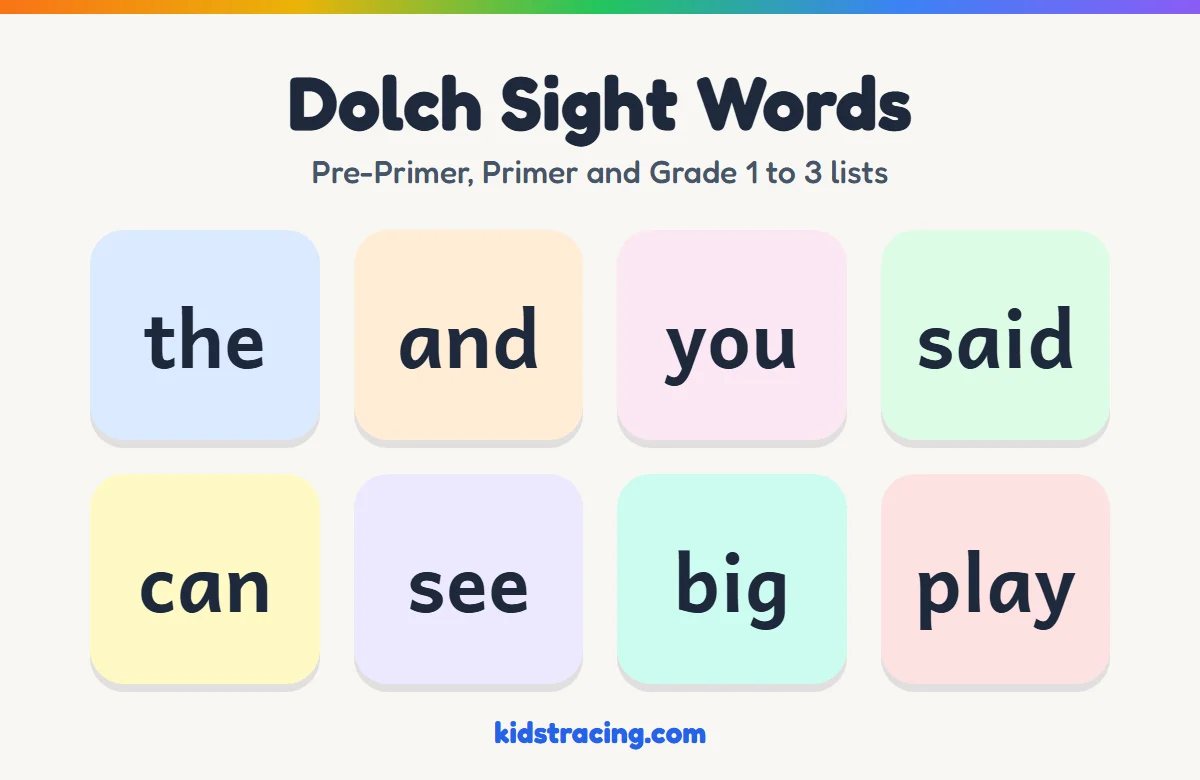
Sight words are common words that children learn to recognize at a glance. When a child can read the, and and said without stopping to sound them out, early books become smoother and more fun. Many sight words cannot be sounded out with simple phonics rules, so children learn them by seeing, saying and writing them again and again.
The best-known sight word list was collected by the educator Edward William Dolch. The Dolch list has 220 words, which he grouped by the grade at which children usually meet them. The grade levels are a traditional guide, and schools vary, so follow your child’s reading level more than the label.
The five Dolch lists at a glance
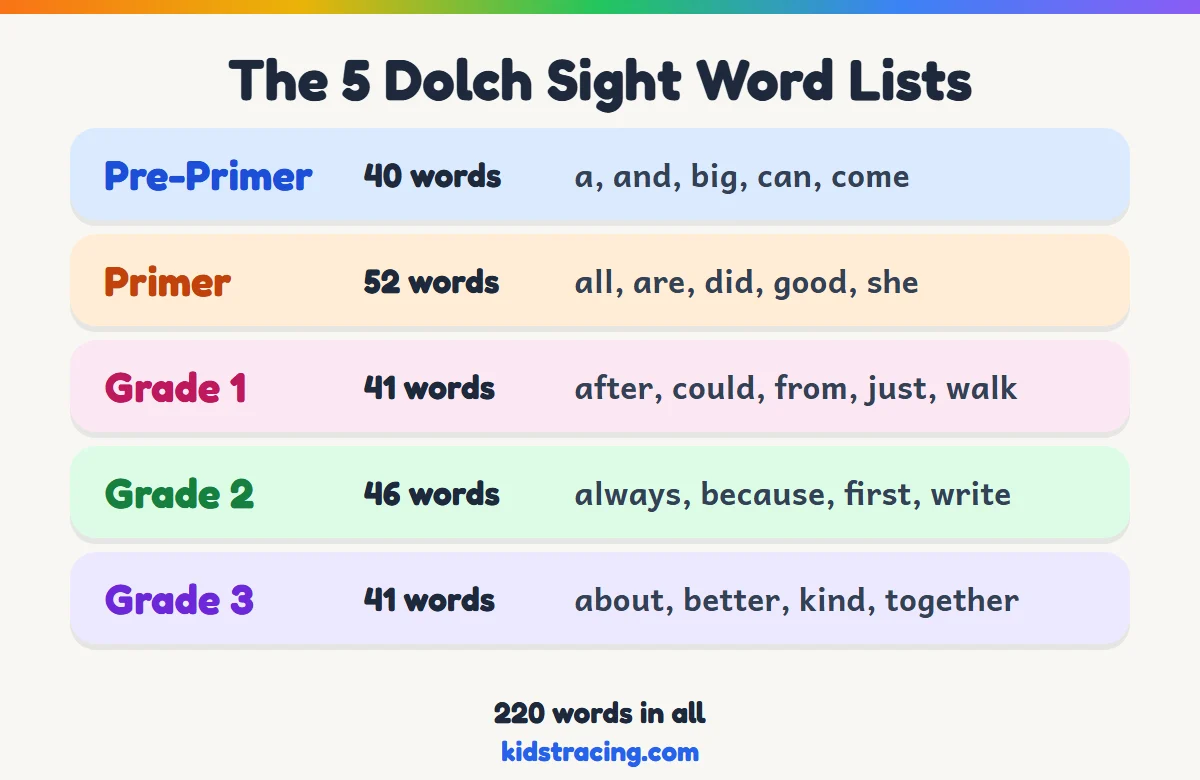
| List | Words | Usually used in |
|---|---|---|
| Pre-Primer | 40 | Pre-K and early kindergarten |
| Primer | 52 | Kindergarten |
| Grade 1 | 41 | Grade 1 |
| Grade 2 | 46 | Grade 2 |
| Grade 3 | 41 | Grade 3 |
The original Dolch collection also has a separate list of 95 common nouns (such as apple, ball and dog). The five lists on this page are the 220 “service words”: the small, common words that hold sentences together.
Pre-primer sight words (40 words)
- a
- and
- away
- big
- blue
- can
- come
- down
- find
- for
- funny
- go
- help
- here
- I
- in
- is
- it
- jump
- little
- look
- make
- me
- my
- not
- one
- play
- red
- run
- said
- see
- the
- three
- to
- two
- up
- we
- where
- yellow
- you
These are the first words to teach. Many of them are short, and some, such as big, can and run, can be sounded out, which makes them a gentle start. Begin with a few words your child sees every day, like I, a, and and the.
Primer sight words (52 words)
- all
- am
- are
- at
- ate
- be
- black
- brown
- but
- came
- did
- do
- eat
- four
- get
- good
- have
- he
- into
- like
- must
- new
- no
- now
- on
- our
- out
- please
- pretty
- ran
- ride
- saw
- say
- she
- so
- soon
- that
- there
- they
- this
- too
- under
- want
- was
- well
- went
- what
- white
- who
- will
- with
- yes
The primer list is the largest. It adds question words (what, who), action words (ate, ran, saw) and colors (black, brown, white). Many kindergarten programs work on the pre-primer and primer lists together.
Grade 1 sight words (41 words)
- after
- again
- an
- any
- as
- ask
- by
- could
- every
- fly
- from
- give
- going
- had
- has
- her
- him
- his
- how
- just
- know
- let
- live
- may
- of
- old
- once
- open
- over
- put
- round
- some
- stop
- take
- thank
- them
- then
- think
- walk
- were
- when
Grade 2 sight words (46 words)
- always
- around
- because
- been
- before
- best
- both
- buy
- call
- cold
- does
- don't
- fast
- first
- five
- found
- gave
- goes
- green
- its
- made
- many
- off
- or
- pull
- read
- right
- sing
- sit
- sleep
- tell
- their
- these
- those
- upon
- us
- use
- very
- wash
- which
- why
- wish
- work
- would
- write
- your
Grade 3 sight words (41 words)
- about
- better
- bring
- carry
- clean
- cut
- done
- draw
- drink
- eight
- fall
- far
- full
- got
- grow
- hold
- hot
- hurt
- if
- keep
- kind
- laugh
- light
- long
- much
- myself
- never
- only
- own
- pick
- seven
- shall
- show
- six
- small
- start
- ten
- today
- together
- try
- warm
The grade 2 and grade 3 lists include longer words such as because, together and myself. For these, it helps to look for smaller words and letter patterns inside each word.
Dolch vs Fry sight words
You may also see the Fry list. It is a longer list of 1,000 words, ordered by how often they appear in print, and it is often split into groups of 100. The Dolch list is shorter and sorted by grade level. Neither is better for every child. Use the list your school uses, and use the other as extra practice. Many words appear on both lists, so time spent on the Dolch words is rarely wasted.
How to teach sight words: a simple 5-step routine
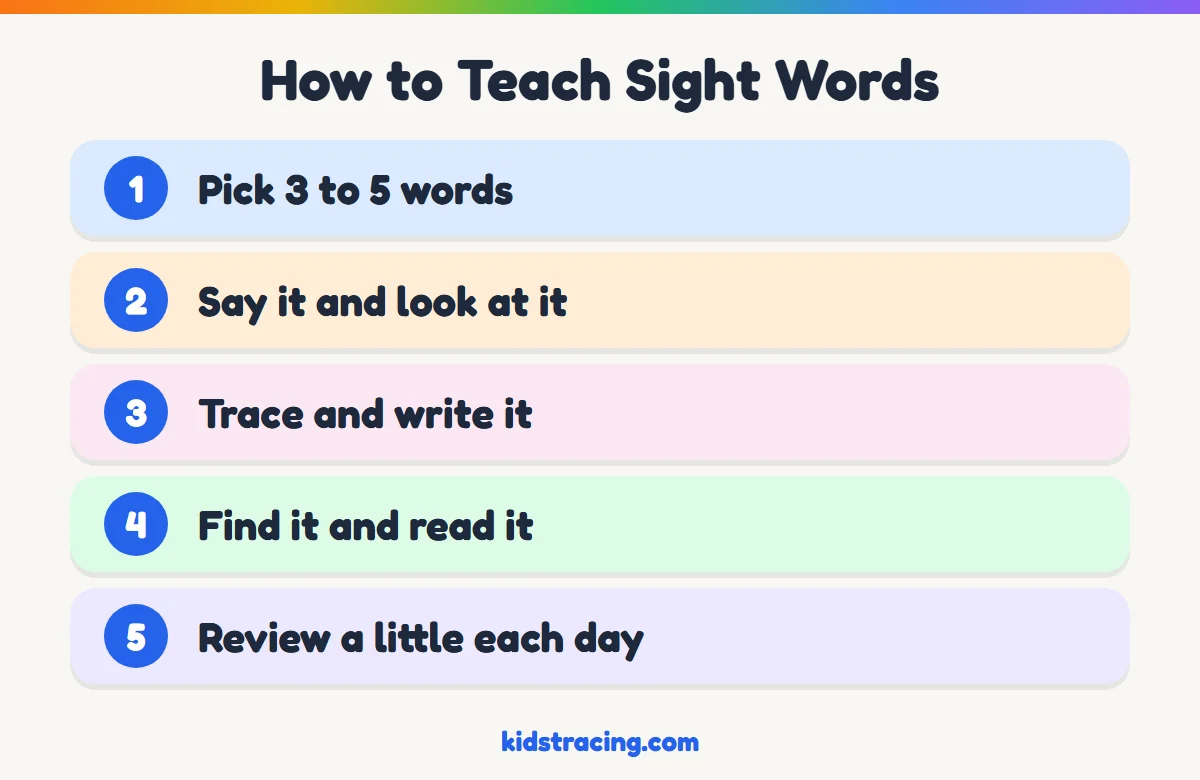
- Pick three to five words. Choose words from the pre-primer or primer list that your child meets often. A small set keeps practice short and successful.
- Say it and look at it. Show the word on a card. Say it, and ask your child to say it and tell you the first letter.
- Trace and write it. Trace the word, then cover it and write it from memory. Our sight words worksheets have trace-and-write pages, and the word tracing tool works with any list.
- Find it and read it. Ask your child to find the word among look-alike words, then in a sentence or a simple book.
- Review often. Keep a pile of known words and flip through it for a minute each day. Move a word to the known pile when your child reads it quickly three days in a row.
Ten minutes a day works better than one long session. The Handwriting Practice at Home guide has ideas for a short daily routine.
Five easy sight word games
- Sight word hunt. Hide word cards around the room. Your child finds a card, reads it and puts it in a basket.
- Memory match. Make two cards for each word and play the usual matching game, reading each word aloud when you turn it over.
- Build it. Use letter tiles or magnets to build a word, then write it on a whiteboard.
- Rainbow writing. Write a word in pencil, then trace over it with three or four colors of crayon.
- Fly swatter. Put several cards on the floor. Say a word, and your child swats the matching card.
Sentences to read with pre-primer words
Once your child knows some words, read short sentences made only of words from the lists. These use only pre-primer words, so every word is one your child can learn first:
- I can see a big red one.
- Look, I can jump up!
- Come and play, you and me.
- We can go and help you.
- Where is the little yellow one?
When you are ready for the primer list, the Sight Words Tracing Book has ten sentences for each list, and every sentence uses only words from the Dolch pre-primer and primer lists.
Sight words and phonics work together
Sight words do not replace phonics. Children still need letter sounds to read new words. A good plan is to practice both: use beginning sounds worksheets and CVC words worksheets for sounding out, and sight words for the common words that do not follow the rules. Our guide to the CVC words list shows how to teach blending.
What research says about sight words
Sight words are useful, but they work best as one part of reading instruction, not the whole of it. Literacy researcher Timothy Shanahan has written that sight word teaching contributes to reading fluency, and that the direct evidence for it is limited, so it should sit alongside phonics. Reading Rockets explains that children store a word for instant recall by linking its sounds to its letters, a process called orthographic mapping, which depends on knowing letter sounds.
In practice this means: make sure your child knows letter names and sounds first, teach a small number of words that cannot be sounded out directly, and let words with regular spelling (such as in, did and on) be learned as part of phonics. Sources are listed at the end of this guide.
Free printables to go with this guide
Put this guide into practice with our free generators: sight words worksheets, word tracing worksheets, CVC words worksheets and beginning sounds worksheets. You can also look through all of our kindergarten worksheets.
Free workbooks to go with this guide
- Sight Words Tracing Book – Trace, write, find and read the 92 Dolch pre-primer and primer words, with sentences and word trackers.
- CVC Words Workbook – Read, build, trace and write short a, e, i, o and u words with pictures, sound boxes and sentences.
Keep reading
- CVC Words List: Short A, E, I, O and U – A CVC words list sorted by short vowel with sentences to read, a teaching order and easy games.
- Beginning Sounds Activities for Preschool and Kindergarten – Simple activities that link letters and sounds before children read whole words.
- Handwriting Practice at Home: How Long and How Often – A ten-minute routine and setup tips for ages 3 to 6.
- Preschool and KG Worksheets: English and Math for Ages 3 to 6 – What to practice at ages 3 to 6, with free printables and a weekly plan.
Frequently asked questions
What are Dolch sight words?
Dolch sight words are a list of 220 common English words, grouped by grade level (pre-primer, primer and grades 1 to 3), that were collected by the educator Edward William Dolch. Children are encouraged to learn them by sight because they appear in almost every book.
How many Dolch sight words are there?
There are 220 words on the main list (the "service words"): 40 pre-primer, 52 primer, 41 grade 1, 46 grade 2 and 41 grade 3. A separate list of 95 common nouns is not included here.
What is the difference between Dolch and Fry sight words?
The Dolch list has 220 words grouped by grade level. The Fry list is longer, with 1,000 words ordered by how often they appear in print. Many teachers use one or the other, or both, so follow your child's school.
How many sight words should a kindergartener know?
It depends on the school and the reading program, so ask your child's teacher which list they use. Many kindergarten classrooms work through the pre-primer and primer lists.
Which sight words should my child learn first?
Start with the pre-primer list, and begin with a handful of words your child sees all the time, such as a, and, the, I, can and see. Add a few new words each week and review the old ones.
Are sight words the same as high-frequency words?
The terms overlap. High-frequency words are words that appear very often in texts. Sight words are words a child reads instantly, without sounding out. Many high-frequency words become sight words with practice.
Should children memorize sight words, or sound them out?
Both help. Some sight words can be sounded out (big, can, run) and others cannot (the, said, you). Teach children to look at the letters in each word, say the sounds they know and then practice the word until it is automatic.
Where can I print sight word worksheets?
Our free sight words worksheet generator lets you pick a Dolch list or type your own words, and print trace-and-write, find-the-word, missing-letter and look-and-write pages. The free Sight Words Tracing Book has 41 ready-made pages.