Pyramid Reading Short Vowels: Free Sentence Pyramids for Ages 4–6 (PDF)
This is a 60-page book of sentence pyramids for children who can already sound out short words. On each page one sentence is built a word at a time. A child reads "The", then "The fat", then "The fat cat", and finishes with the whole sentence, "The fat cat had a nap." There are 50 sentences, nine for each short vowel and five mixed review pages. Download the whole book in US Letter or A4, or take just the vowel you are working on.
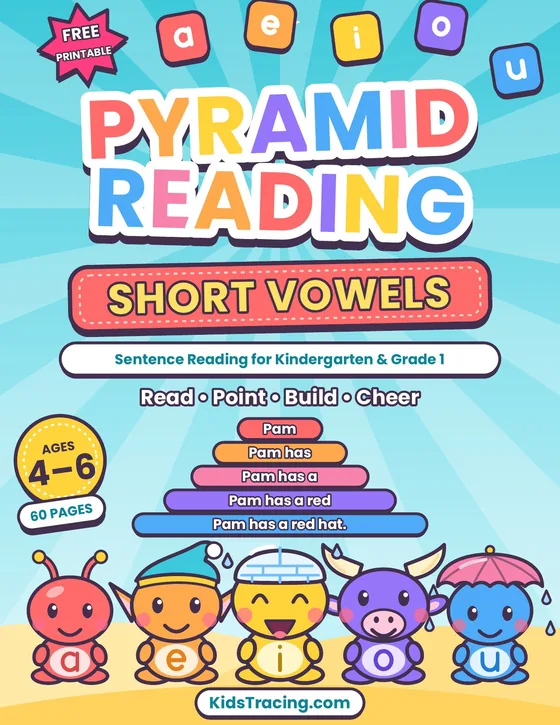
Download Pyramid Reading Short Vowels
- 60 pages for ages 4–6 with 50 sentences to read
- Free for personal, home and classroom use, with no sign-up or email address
- Two PDF files: US Letter (8.5 × 11 in) and A4, or one zip file with both
- Five original vowel friends, a reading tracker and a certificate
- No answer key, because reading pages have nothing to mark
Print at 100% (Actual size). Choose US Letter in the United States and Canada, and A4 almost everywhere else. How to print a workbook
Please note: this book is free for personal, home and classroom use. It is not for sale or resale.
What a sentence pyramid is
A sentence pyramid is one sentence written out in steps. Line one is the first word. Line two is the first two words. Every line adds a word, and the last line is the whole sentence. A child never meets more than one new word at a time, and the words they already read come around again on every line. By the end the sentence reads smoothly instead of word by word.
Pam has
Pam has a
Pam has a red
Pam has a red hat.
You will also see these called sentence expanders or fluency pyramids. It is the same idea. In this book every sentence uses short vowel words only, so a child who can blend cat and pig has what they need to read all of it. Each page also has three stars, because the best use of a pyramid is to read it three times.
Pyramids are one tool and not every child likes them. Reading the same words again and again can make a child sound choppy. So when the last line is done, ask for the whole sentence once more, said the way you would say it to a friend. Keep reading real picture books at the same time, too.
Download one vowel at a time
The full book is 60 pages, and you may only want the short a pages this week. Each part below is a separate PDF cut from the same book, so the page numbers stay the same.
Who this book is for
The book is meant for ages 4 to 6: late pre-K, kindergarten and the start of first grade. What matters more than age is what your child can do. They should know the letter sounds and be able to blend a short word such as cat, pig or bus. They do not need to read fast. The pyramid will help with that.
If your child still guesses words from the first letter or from a picture, take a step back. The CVC Words Workbook and the CVC words worksheets teach one short vowel at a time, and the beginning sounds worksheets help with the first sound in a word. The phonics worksheets page shows the whole path.
For the common words that cannot be sounded out, the Sight Words Tracing Book and the sight words worksheets are a good partner to this one. Only a few of those words show up here (the, a, is, in, on, up, and, at, it, can, has, had and his), and they are printed in a dark color so a child knows not to sound them out.
What is inside the book
Every pyramid page has the same layout, so a child quickly knows what to do. At the top is the vowel friend for that section and three stars to color, one for each time they read the page. Below that are 5 to 7 numbered lines, and the last line is the whole sentence. The short vowel of the section is printed in the color of its vowel friend. At the bottom there is a small reading tip, such as "Clap once for each word in the last line."
Each vowel starts with a Meet page. It shows the letter, says the sound and lists 12 words to read. Before the first pyramid, read those 12 words aloud together. The five vowel friends are Annie Ant, Ellie Elf, Izzy Igloo, Ozzie Ox and Ubby Umbrella, and they were drawn for this book.
| Pages | Section | Number of pages |
|---|---|---|
| 1–3 | Cover, How to Use This Book (with a try-one pyramid) and Meet the Vowel Friends | 3 |
| 4–13 | Short a: a Meet Annie Ant page, then 9 pyramids | 10 |
| 14–23 | Short e: a Meet Ellie Elf page, then 9 pyramids | 10 |
| 24–33 | Short i: a Meet Izzy Igloo page, then 9 pyramids | 10 |
| 34–43 | Short o: a Meet Ozzie Ox page, then 9 pyramids | 10 |
| 44–53 | Short u: a Meet Ubby Umbrella page, then 9 pyramids | 10 |
| 54–58 | Mixed Review: 5 pyramids with all five vowels, each vowel in its own color | 5 |
| 59 | My Reading Tracker, one star for every pyramid | 1 |
| 60 | Certificate: Super Pyramid Reader | 1 |
Sample pages
Four pages from the finished book, shown from the US Letter PDF.
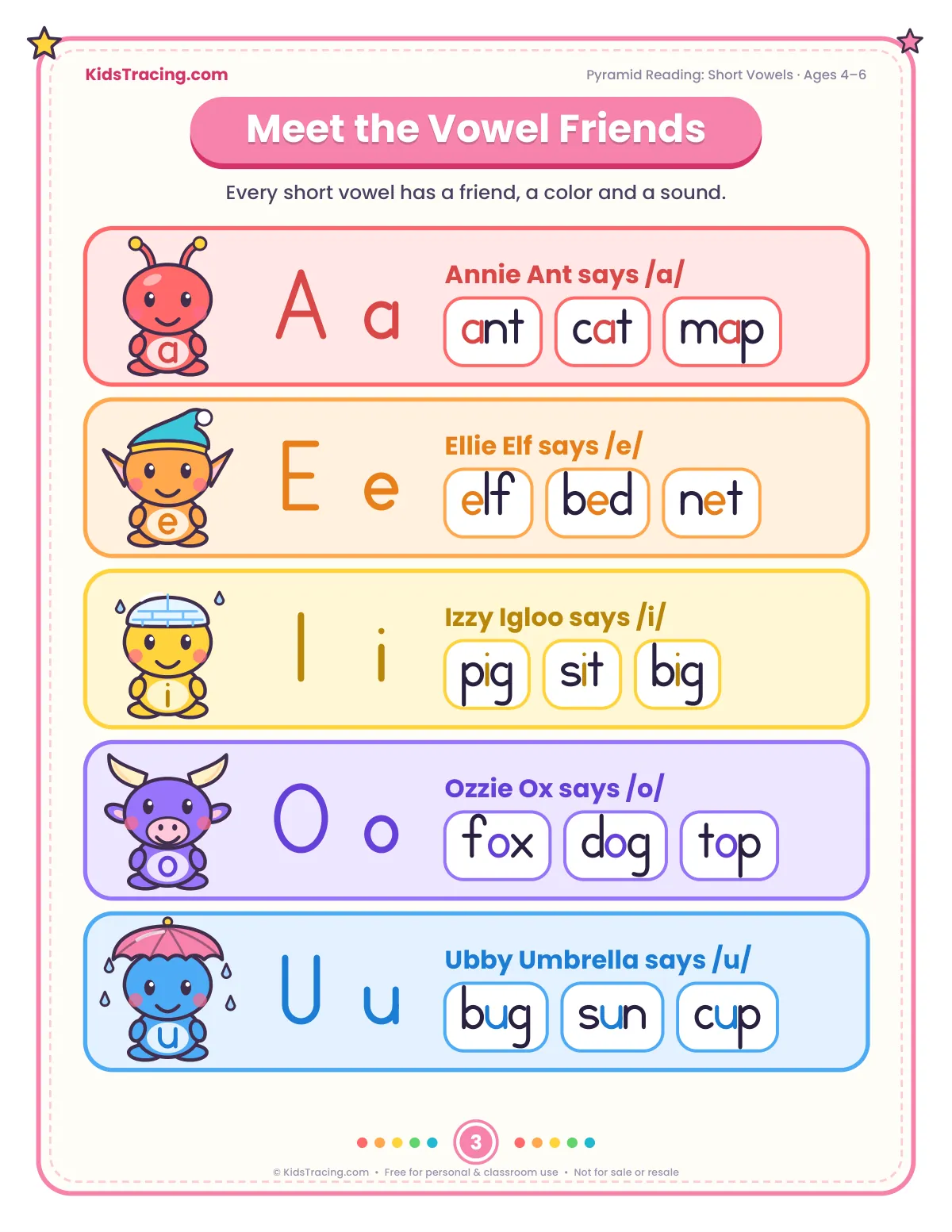
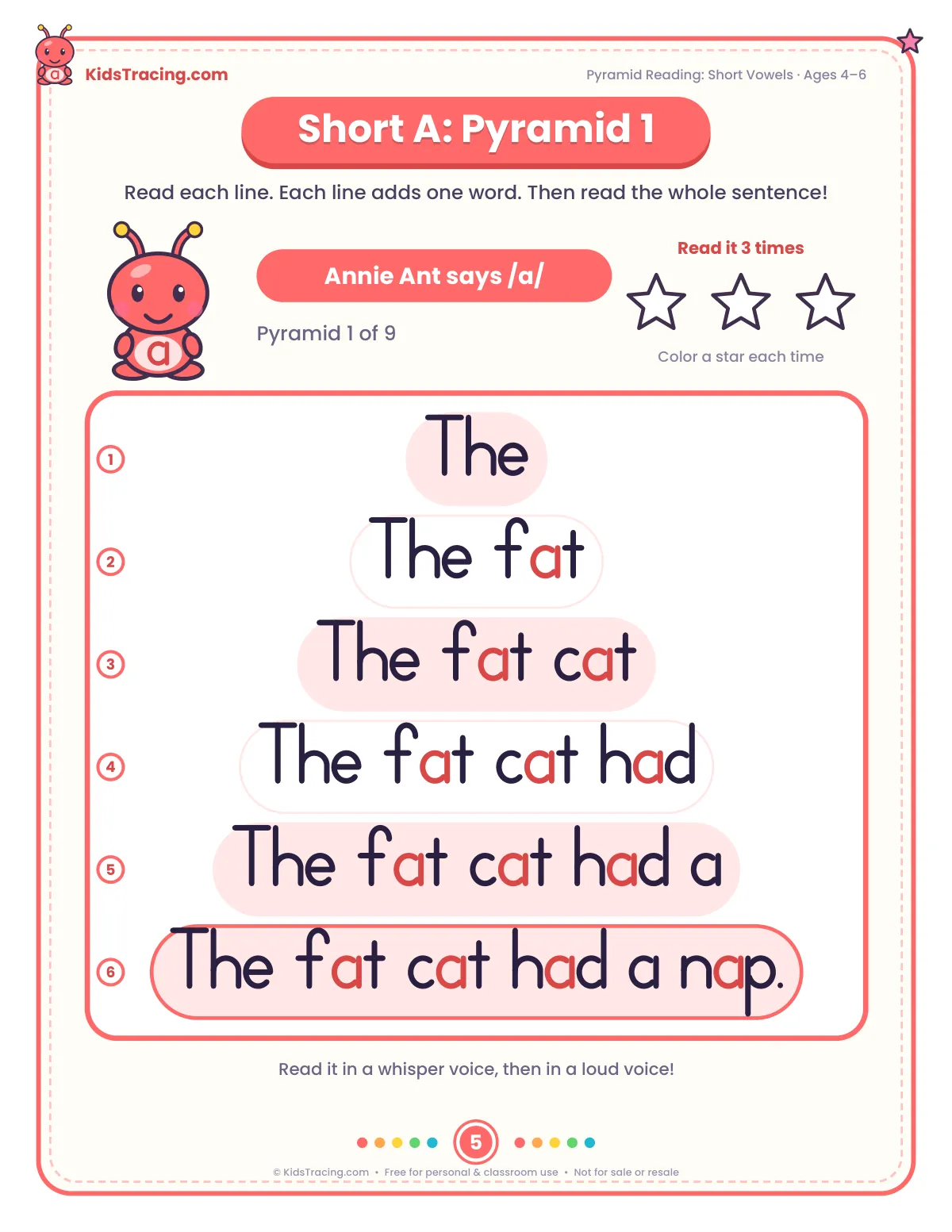
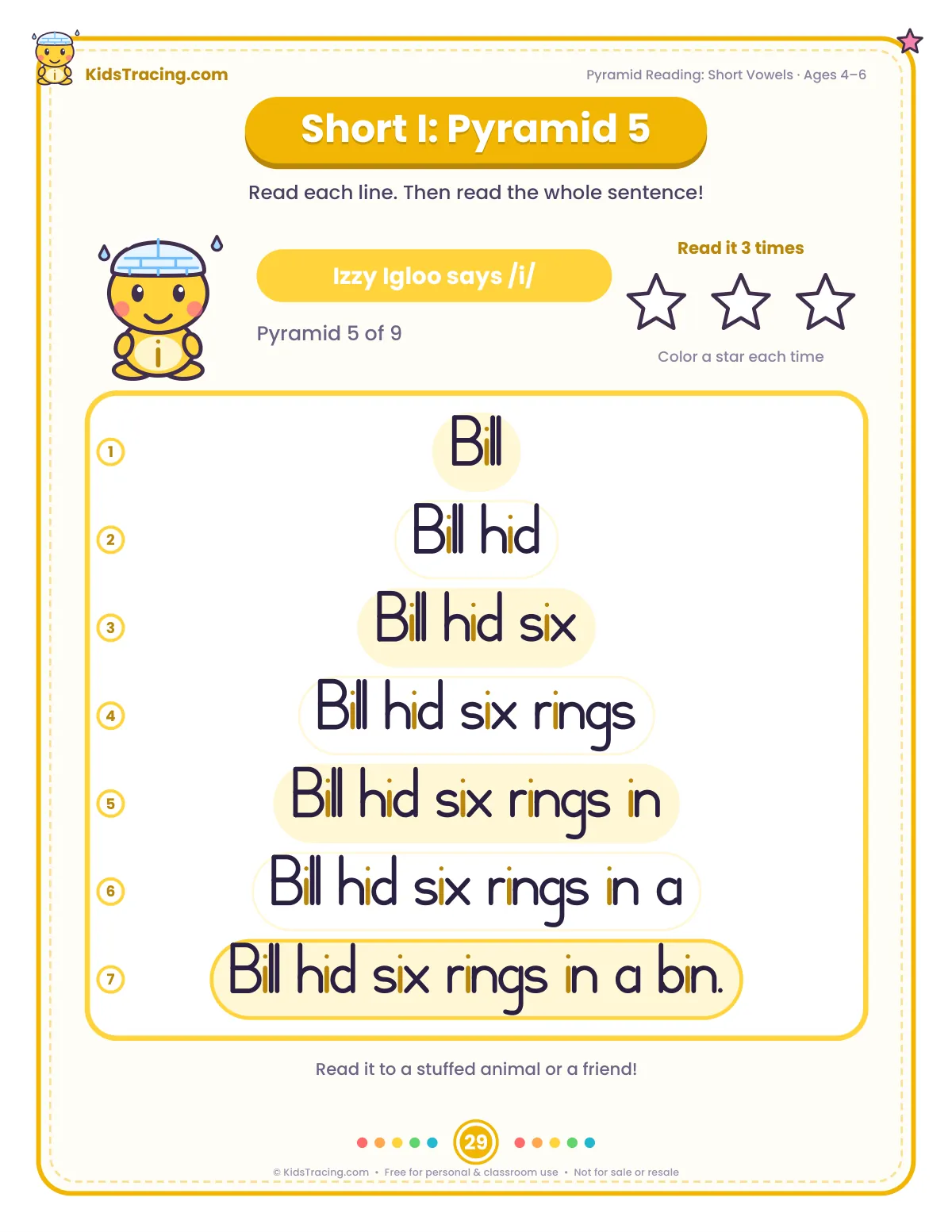
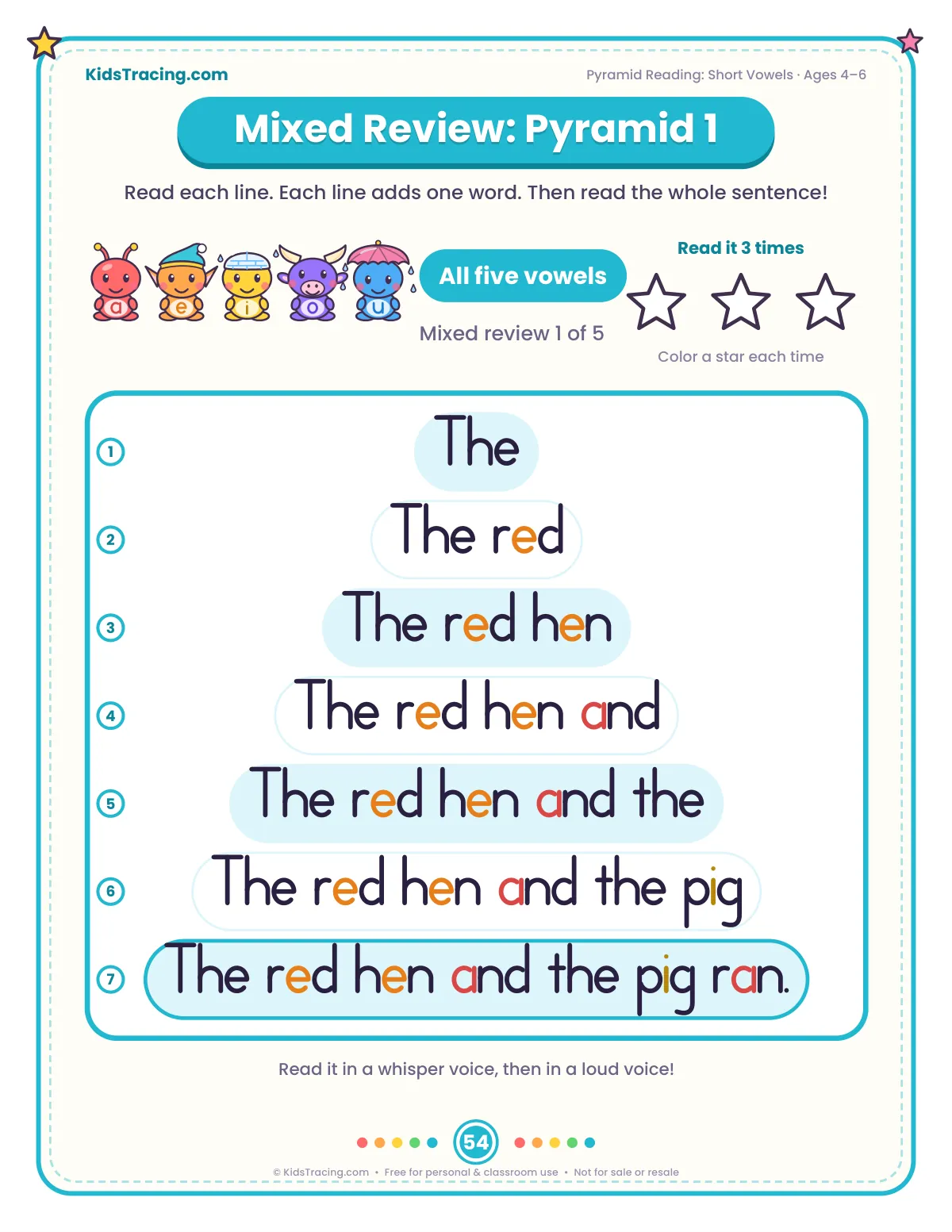
Short a, e, i, o and u sentences in the book
Here is every sentence, so you can see the level before you print. Each one is 4 to 8 words long. The numbers are the page numbers in the book.
Short a sentences (Annie Ant)
- Page 5: The fat cat had a nap.
- Page 6: Dan has a tan van.
- Page 7: A bad bat sat in a bag.
- Page 8: The ant ran on a map.
- Page 9: Pam can pack a snack.
- Page 10: Max and Sam ran a lap.
- Page 11: The mad crab can snap.
- Page 12: The lamp is on a black rack.
- Page 13: The hat is tan and flat.
Words to read on the Meet page: fat, cat, nap, tan, van, bad, bat, sat, bag, ant, ran, map.
Short e sentences (Ellie Elf)
- Page 15: A red hen is on a nest.
- Page 16: Ben and Meg get a pet.
- Page 17: The vet has a red pen.
- Page 18: Ted set ten red pens.
- Page 19: Jen and Ben fed the pets.
- Page 20: The elf is in a red bed.
- Page 21: Meg can step on a net.
- Page 22: The ten men set a tent.
- Page 23: The wet dress is on the bed.
Words to read on the Meet page: red, hen, nest, get, pet, vet, pen, set, ten, pens, fed, pets.
Short i sentences (Izzy Igloo)
- Page 25: The pig did a big jig.
- Page 26: Tim has a big gift.
- Page 27: The kid did a flip.
- Page 28: The fish is in a dish.
- Page 29: Bill hid six rings in a bin.
- Page 30: Rick can sit and sip milk.
- Page 31: The king has a pink ring.
- Page 32: Pip the chick can dig.
- Page 33: Jill can lift a stick.
Words to read on the Meet page: pig, did, big, jig, gift, kid, flip, fish, dish, hid, six, rings.
Short o sentences (Ozzie Ox)
- Page 35: The fox is in a box.
- Page 36: Bob has a hot pot.
- Page 37: The frog is on a log.
- Page 38: Tom and Dot got a top.
- Page 39: The dog can hop on a rock.
- Page 40: Rob can mop a spot.
- Page 41: The ox is not on the dock.
- Page 42: Mom and Pop got a clock.
- Page 43: Dot got a dog and a block.
Words to read on the Meet page: fox, box, hot, pot, frog, log, got, top, dog, hop, rock, mop.
Short u sentences (Ubby Umbrella)
- Page 45: The bug is on a rug.
- Page 46: Gus can run and jump.
- Page 47: The duck had fun in the sun.
- Page 48: A cub is in a tub.
- Page 49: Bud and Gus dug in the dust.
- Page 50: The pup can tug a cup.
- Page 51: The bus is stuck in the mud.
- Page 52: Gus has a bun and a nut.
- Page 53: The ducks jump up and hum.
Words to read on the Meet page: bug, rug, run, jump, duck, fun, sun, cub, tub, dug, dust, pup.
Mixed review sentences
- Page 54: The red hen and the pig ran.
- Page 55: Ted got a big bus.
- Page 56: A fox and a cat hid.
- Page 57: The pup dug in the sand.
- Page 58: Sam, Ben, Tim, Bob and Gus sat.
The mixed review uses all five vowels. In these pages each vowel has its own color, so a child can see which sound to use.
How the reading level was set
The rules are simple. In a short a section, every word that is not a helper word has a short a and no other vowel. The same goes for e, i, o and u. Blends and digraphs are allowed, so you will find snack, dress, king, pink, fish and chick next to words like cat and pig.
The helper words are the, a, is, in, on, up, and, at, it, can, has, had and his. Is, has and his end with a z sound, but they come up so often that we treat them as helper words. The names used are Dan, Pam, Max, Ben, Meg, Ted, Jen, Tim, Bill, Rick, Pip, Jill, Bob, Tom, Dot, Rob, Mom, Pop, Gus, Bud and Sam.
A few honest notes. The level is our own judgment from these rules, and the book has not been through a classroom study. Some children need more time with blends such as snack, crab, flat, frog, stick, block, clock and stuck. Words like Mom sound a little different from one region to another, so read it the way you say it, or skip that page. On the 7-word pages the letters are a bit smaller so the last line fits.
Skills your child practices
- Blending short vowel words and reading them smoothly in a sentence
- Reading the same words several times, so that the last line sounds like talking
- Noticing the short vowel in each word (it is printed in color)
- Reading the common words the, a, is, in, on, up, and, at, it, can, has, had and his without sounding them out
- Pointing under each word and keeping a place on the line
- Counting words in a sentence: the last line of each page has 4 to 8 of them
How to use the pyramid pages at home or in class
Start with one vowel
Short a is first in the book and is the easiest to hear. Do the whole short a section before you move on. Short e and short i sound close to each other, so give each one a few days of its own.
Say the sound, then read the Meet page words
Look at the vowel friend, say the sound together, then read the 12 words. This takes about two minutes and gets the sound ready.
Read line by line and point
Your child points under each word and reads line one, then line two, and so on. If a line goes wrong, read the line before it again and carry on. Do not rush.
Read the page three times
Color a star after each time. The second and third readings are where it starts to sound smooth. Try one in a whisper and one in a loud voice, as the tip on some pages says.
Finish with the whole sentence
Ask for the last line once more at normal speed, like talking. Then talk about it for a moment: who is the fox, where is the box?
Keep sessions short
One or two pyramids a day, about 5 to 10 minutes. Slide a page into a clear sleeve and use a dry-erase marker for the stars, and you can use the same page again.
A five-day plan for each vowel
Page numbers are for short a. For short e add 10 to each page number, for short i add 20, for short o add 30 and for short u add 40. It is a plan you can change, so go slower if your child needs it.
Day 1
Open the Meet page (page 4 for short a). Say the sound together, read the 12 words, then do pyramid 1 on page 5.
Day 2
Pyramids 2 and 3 (pages 6 and 7). Warm up by reading yesterday's sentence once.
Day 3
Pyramids 4 and 5 (pages 8 and 9).
Day 4
Pyramids 6 and 7 (pages 10 and 11).
Day 5
Pyramids 8 and 9 (pages 12 and 13). Then color the stars for this vowel on the tracker on page 59.
After the five vowels, the mixed review (pages 54 to 58) takes two or three days, and then your child gets the certificate on page 60.
Printing tips
- US Letter (8.5 × 11 inches) is the standard paper size in the USA and Canada. A4 (210 × 297 mm) is used in most other countries. Pick the PDF that matches your paper and print at 100% or Actual size.
- Print in color for the first pages if you can. The colored vowel is the hint on every page, and in black and white it turns grey.
- The cover and the certificate have full-color backgrounds and use a lot of ink. Print the inner pages only if you are saving ink, or print just the vowel you are working on from the downloads above.
- Plain paper is fine. A clear sleeve with a dry-erase marker lets you reuse the same page.
- Staple or hole-punch the pages in order to make a book. Your child can carry it to a reading corner and read to a stuffed animal.
More help: how to print a workbook.
What to read after the pyramids
When most of the pages feel easy, move to short stories and picture books with simple words. Our CVC words list has more words for each short vowel, with sentences to read. The Dolch sight words list covers the words that do not follow the rules. For rhyme and sound games between sessions, try the rhyming words worksheets.
Guides for parents and teachers
CVC Words List: Short A, E, I, O and U
A CVC words list sorted by short vowel (a, e, i, o, u) with sentences to read, a teaching order and easy games for kindergarten and first grade.
Dolch Sight Words List: Pre-Primer to Grade 3 (Free Printable)
The full Dolch list of 220 words, how to teach them, easy games and free printable practice.
Beginning Sounds Activities for Preschool and Kindergarten
Teach beginning sounds with spoken games, a worked sound sort, picture naming checks and practical next steps for preschool and kindergarten.
More free printable workbooks
CVC Words Workbook
Read, build, trace and write short a, e, i, o and u words with pictures, sound boxes and sentences.
Sight Words Tracing Book
Trace, write, find and read the 92 Dolch pre-primer and primer words, with sentences to trace and word trackers.
ABC Tracing Book
Every letter A to Z with numbered stroke arrows, a picture to color and a word to trace.
Frequently asked questions
Is the pyramid reading book free?
Yes. You can download it and print it for your own children or your classroom at no cost. It is free for personal, home and classroom use, and it is not for sale or resale. There is no sign-up and no email address to give.
What is a sentence pyramid?
A sentence pyramid is one sentence written over several lines. The first line is the first word, the second line is the first two words, and each line after that adds one word until the last line is the whole sentence. Some teachers call the same thing a sentence expander or a fluency pyramid.
What age and level is it for?
It is written for ages 4 to 6, from late pre-K through kindergarten and early first grade. Your child should know the letter sounds and be able to blend a short word like cat or pig. If they cannot yet, start with a CVC words workbook and come back.
Do the pages have a picture for each sentence?
No. The pictures are the five vowel friends, who stay on every page. The pages are about reading the words, so there is no picture to guess from. That is on purpose, because a child who looks at a picture of a cat may say cat without reading it.
How are the words chosen?
In each short vowel section every word that is not a helper word has that one short vowel, so a child only has to think about one sound at a time. The helper words are the, a, is, in, on, up, and, at, it, can, has, had and his. Names such as Dan, Pam, Max and Gus follow the same rule. The mixed review pages use all five vowels.
Is there an answer key?
No, because a reading page has nothing to mark. All 50 sentences are listed on this page if you want to check one.
Which size should I print, US Letter or A4?
Pick the one that matches your paper. US Letter (8.5 by 11 inches) is standard in the United States and Canada, and A4 is standard in most other countries. Both books have the same 60 pages.
Can I print just one vowel?
Yes. Above the contents table there is a download for each vowel on its own, in both sizes, plus one for the first three pages and one for the mixed review, tracker and certificate. Or print a page range from the full PDF.
How many pyramids should my child read in a day?
One or two is plenty, about 5 to 10 minutes. Stop while they still want to read. A short, happy session every day does more than a long one that ends in tears.
What if my child gets stuck on a word?
Go back to the line before and read it together. If the word is one with a blend, such as snack, crab or stick, tap out the sounds first and then read the line again. If they are stuck on most words, the book is too hard for now and a simpler CVC book will help more.
Can teachers copy it for a class?
Yes. Teachers and homeschool parents can print copies for their own students. Please do not share the file on another website and do not sell it.