Letter E Formation Worksheet
Trace the capital E and the small e with numbered start points and direction arrows, then write them on your own.
Customize
More options
The preview updates as you change the settings.
How to write the letter E
The capital E is written in four strokes, and the small e in one stroke. The worksheet above is already set to this letter. It shows a model of each letter with green numbered start points and red direction arrows, then rows of dotted copies to trace and empty space to write on your own. Change the letter case, the size or the number of rows in the settings.
Capital E
Start at the top and draw a straight line down. Then draw three short lines across, each one starting at the straight line and going right: the top line, the middle line and the bottom line. The middle line is slightly shorter.
Small e
Start in the middle on the left and draw a line across to the right. Then curve up and around counter-clockwise (up, left, then down) and finish with a small tail at the bottom right. It is all one stroke.
Teaching tip for E
The small e begins with a line across, which gives the letter its closed "eye" and keeps it from looking like a c. Say "across, then around" as you trace. For the capital E, notice that F is simply an E without the bottom line.
The sound of E and words to practice
The letter E usually stands for the short sound /e/ as in egg (and the long sound /ee/ as in eagle). Words to practice: egg, elephant, elbow, envelope, engine, exit. Say each word, listen for the first sound and trace the letter. Try the beginning sounds worksheets to match the sound to pictures, or trace the words themselves with word tracing.
Letters that look alike
The letter E is easy to mix up with Letter Ff and Letter Ll. Practice them on separate days, one at a time, and say the starting point out loud each time before the pencil touches the paper.
Common mistakes with the letter E
Keep the three arms of the capital E about the same length, with the middle one slightly shorter. Arms that are too long make the E look like a comb. In the small e, many children skip the line across and start with the curve, which turns the e into a c. Say "across, then around" each time.
Left-handed writers and the letter E
All three arms of the capital E run left to right, a direction many left-handed children find harder. Offer a thick crayon for the first few copies, because it glides more easily, and take a short break after each letter. If the arms are clear and attached to the stem, your child's way of drawing them is fine.
Fun ways to practice the letter E
- Make a capital E with a comb: tape three craft sticks to a fourth and count the arms.
- Draw an egg, then write a small e inside it.
- Roll playdough into one long line and three short ones, and build a capital E on a tray.
Words with the letter E
At the beginning of words you will hear e in egg, elephant, elbow, envelope, engine and exit. In the middle it is the short vowel in bed, pen, hen, red, net and leg. At the end, e is often silent, as in cake, bike and rope, and it says its name in short words such as me, he and she. Names to try: Emma, Ethan, Ella and Eli.
The silent e
Many words end with an e you cannot hear, such as cake, bike and rope. This silent e (sometimes called magic e) makes the vowel before it say its own name. You do not need to teach the rule yet, but when your child reads a word like cake, you can point to the last e and say "this e is quiet, but it helps the a say its name".
A 10-minute practice plan for the letter E
- Warm up (1 minute). Draw a straight line down in the air, then three short lines out to the right.
- Capital E (3 minutes). Trace one row. Say "line down, then three lines across: top, middle, bottom" for every letter.
- Small e (3 minutes). Trace one row. Say "a line across, then curve up and around" for every letter.
- On your own (2 minutes). Write three capital E and three small e in the empty space. Choose your child's best one and put a star next to it.
- Play (1 minute). Find three things that start with the short e sound, such as an egg, an elephant or an elbow.
More letters
Previous: Letter Dd · Next: Letter Ff · All letters A to Z
More ways to read and write the letter E
Words that start with E: elephant, egg, elbow, envelope, engine, eagle. Words with e in the middle or at the end: bed, ten, hen.
Names that start with E: Emma, Ethan, Ella, Eli. Children often learn a letter first from a name, so ask your child to find the letter in the name of a friend or someone in the family.
A sentence to trace and read
Eli gave an egg to the elephant.
Copy the sentence slowly on lined paper, read it aloud, then circle every E and e you can find.
The silent e
At the end of a word, e is often silent, but it changes the vowel before it: cap becomes cape and hop becomes hope. Write both words and ask which letter makes the difference.
Frequently asked questions
Why does the small e start with a line across?
The small e is written in one stroke: a line across the middle, then a curve up and around. Starting with the line gives the e its closed eye, so it does not turn into a c or an o. Many children find it easier when they say "across, then around" while they write.
What is the difference between short e and long e?
The short e is the sound in egg, bed and red. The long e says its own name, as in me, tree and eagle. Start with the short sound for first reading words, and add the long sound once your child knows the basics.
How many lines does the capital E have?
The capital E has four lines: one straight line down and three short lines across. The middle line is slightly shorter than the other two. Trace the vertical line first, then add the three arms from top to bottom.
Free printable workbooks
Want a planned set instead of a single page? These free PDF workbooks use the same worksheets in a step-by-step order.
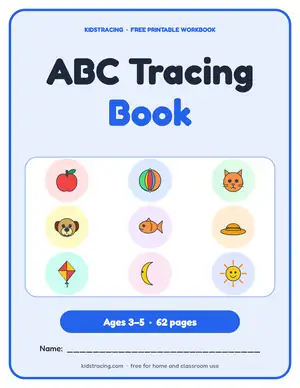
ABC Tracing Book
Every letter A to Z with numbered stroke arrows, a picture to color and a word to trace.
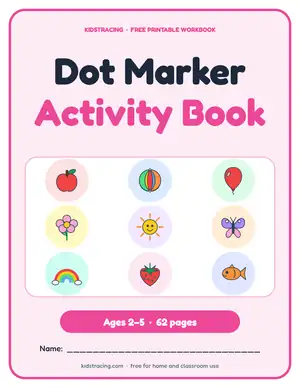
Dot Marker Activity Book
Big letters, numbers, shapes and pictures filled with circles for dot markers, stickers or fingertips.
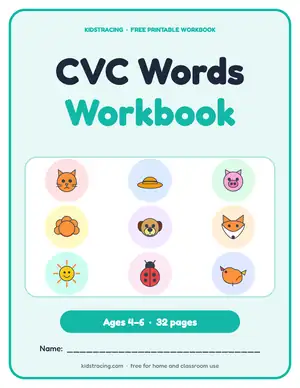
CVC Words Workbook
Read, build, trace and write short a, e, i, o and u words with pictures, sound boxes and sentences.
Related worksheet tools
Explore more: Handwriting and Tracing Worksheets for Kids · Preschool Worksheets · Kindergarten Worksheets · All free worksheet tools
Guides for parents and teachers: Letter Formation Order: Which Letters to Teach First · How to Teach a Child to Write Their Name · How to Teach Cursive Handwriting to Kids · Cursive Letters A to Z: A Simple Guide for Kids